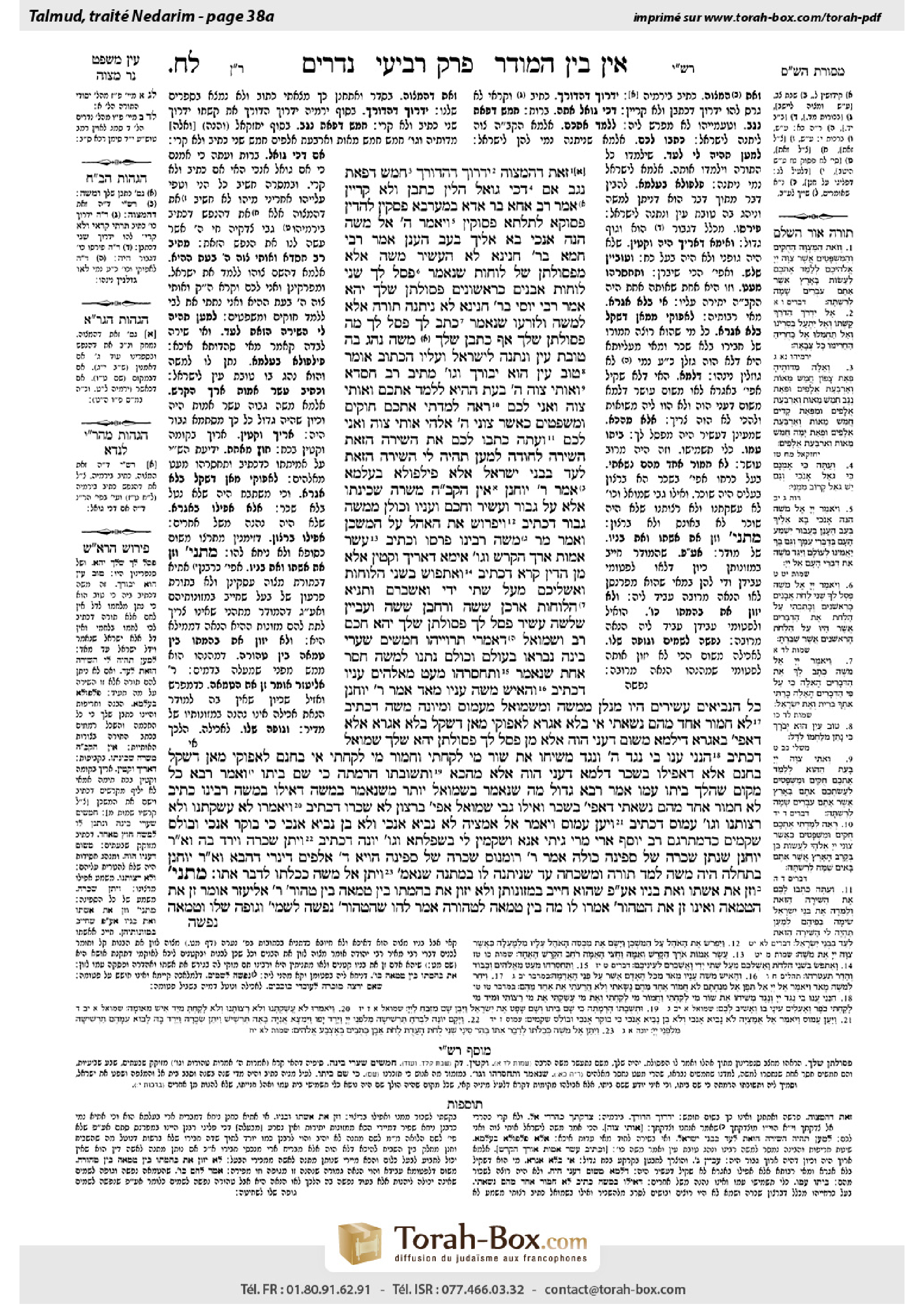
Nedarim 38a: Talmud study for Daf Yomi
Daf Yomi is the daily study of one Talmud folio. Explore 37 tractates with scans, Hebrew text, Sefaria English and AI-generated French translations where annotated.
Passage selection and English or AI-generated French translation are available where the scan has annotations. Daf Study is independent of Torah-Box and Sefaria.
Browse Nedarim · נדרים · All tractatesNedarim 38a text and translations
This page of Nedarim includes the Aramaic text, an English translation and an AI-generated French translation, alongside the scan above.
נדרים ל״ח א · Aramaic and Hebrew text
״זֹאת״ ״דְּ״הַמִּצְוָה״, ״יִדְרֹךְ״ דְּ״הַדֹּרֵךְ״, ״חֲמֵשׁ״ דִּ״פְאַת נֶגֶב״, ״אִם״ דְּ״כִי גֹאֵל״ — הָלֵין כְּתִבָן וְלָא קַרְיָין.
אָמַר רַב אַחָא בַּר אַדָּא: בְּמַעְרְבָא פָּסְקִין לְהָדֵין פְּסוּקָא לִתְלָתָא פְּסוּקִין: ״וַיֹּאמֶר ה׳ אֶל מֹשֶׁה הִנֵּה אָנֹכִי בָּא אֵלֶיךָ בְּעַב הֶעָנָן״.
אָמַר רַבִּי חָמָא בְּרַבִּי חֲנִינָא: לֹא הֶעֱשִׁיר מֹשֶׁה אֶלָּא מִפְּסוֹלְתָּן שֶׁל לוּחוֹת, שֶׁנֶּאֱמַר: ״פְּסׇל לְךָ שְׁנֵי לֻחֹת אֲבָנִים כָּרִאשֹׁנִים״ — פְּסוֹלְתָּן שֶׁלְּךָ יְהֵא.
אָמַר רַבִּי יוֹסֵי בְּרַבִּי חֲנִינָא: לֹא נִיתְּנָה תּוֹרָה אֶלָּא לְמֹשֶׁה וּלְזַרְעוֹ, שֶׁנֶּאֱמַר: ״כְּתׇב לְךָ״, ״פְּסׇל לְךָ״: מָה פְּסוֹלְתָּן שֶׁלְּךָ — אַף כְּתָבָן שֶׁלְּךָ. מֹשֶׁה נָהַג בָּהּ טוֹבַת עַיִן וּנְתָנָהּ לְיִשְׂרָאֵל, וְעָלָיו הַכָּתוּב אוֹמֵר: ״טוֹב עַיִן הוּא יְבֹרָךְ וְגוֹ׳״.
מֵתִיב רַב חִסְדָּא: ״וְאֹתִי צִוָּה ה׳ בָּעֵת הַהִיא לְלַמֵּד אֶתְכֶם״ — וְאוֹתִי צִוָּה, וַאֲנִי לָכֶם. ״רְאֵה לִמַּדְתִּי אֶתְכֶם חֻקִּים וּמִשְׁפָּטִים כַּאֲשֶׁר צִוַּנִי ה׳ אֱלֹהָי״ — אוֹתִי צִוָּה, וַאֲנִי לָכֶם.
״וְעַתָּה כִּתְבוּ לָכֶם אֶת הַשִּׁירָה הַזֹּאת״, הַשִּׁירָה לְחוּדַּהּ. ״לְמַעַן תִּהְיֶה לִּי הַשִּׁירָה הַזֹּאת לְעֵד בִּבְנֵי יִשְׂרָאֵל״! אֶלָּא, פִּילְפּוּלָא בְּעָלְמָא.
אָמַר רַבִּי יוֹחָנָן: אֵין הַקָּדוֹשׁ בָּרוּךְ הוּא מַשְׁרֶה שְׁכִינָתוֹ אֶלָּא עַל גִּבּוֹר וְעָשִׁיר וְחָכָם וְעָנָיו, וְכוּלָּן מִמֹּשֶׁה. גִּבּוֹר, דִּכְתִיב: ״וַיִּפְרֹשׂ אֶת הָאֹהֶל עַל הַמִּשְׁכָּן״, וְאָמַר מָר: מֹשֶׁה רַבֵּינוּ פְּרָסוֹ, וּכְתִיב: ״עֶשֶׂר אַמּוֹת אֹרֶךְ הַקָּרֶשׁ וְגוֹ׳״. אֵימָא דַּאֲרִיךְ וְקַטִּין!
אֶלָּא מִן הָדֵין קְרָא, דִּכְתִיב: ״וָאֶתְפֹּשׂ בִּשְׁנֵי הַלֻּחֹת וָאַשְׁלִכֵם מֵעַל שְׁתֵּי יָדָי וָאֲשַׁבְּרֵם״, וְתַנְיָא: הַלּוּחוֹת אׇרְכָּן שִׁשָּׁה וְרׇחְבָּן שִׁשָּׁה וְעׇבְיָין שְׁלֹשָׁה.
עָשִׁיר — ״פְּסׇל לָךְ״, פְּסוֹלְתָּן שֶׁלְּךָ יְהֵא. חָכָם — רַב וּשְׁמוּאֵל דְּאָמְרִי תַּרְוַיְיהוּ: חֲמִשִּׁים שַׁעֲרֵי בִינָה נִבְרְאוּ בָּעוֹלָם, וְכוּלָּם נִתְּנוּ לְמֹשֶׁה חָסֵר אַחַת, שֶׁנֶּאֱמַר: ״וַתְּחַסְּרֵהוּ מְעַט מֵאֱלֹהִים״. עָנָיו — דִּכְתִיב: ״וְהָאִישׁ מֹשֶׁה עָנָו מְאֹד״.
אָמַר רַבִּי יוֹחָנָן: כׇּל הַנְּבִיאִים עֲשִׁירִים הָיוּ, מְנָלַן — מִמֹּשֶׁה וּמִשְּׁמוּאֵל מֵעָמוֹס וּמִיּוֹנָה.
מֹשֶׁה — דִּכְתִיב: ״לֹא חֲמוֹר אֶחָד מֵהֶם נָשָׂאתִי״. אִי בְּלָא אַגְרָא, לְאַפּוֹקֵי מַאן דְּשָׁקֵל בְּלָא אַגְרָא? אֶלָּא דַּאֲפִילּוּ בְּאַגְרָא. דִּילְמָא מִשּׁוּם דְּעָנִי הֲוָה. אֶלָּא מִן ״פְּסׇל לָךְ״ — פְּסוֹלְתָּן יְהֵא שֶׁלְּךָ.
שְׁמוּאֵל, דִּכְתִיב: ״הִנְנִי עֲנוּ בִי נֶגֶד ה׳ וְנֶגֶד מְשִׁיחוֹ אֶת שׁוֹר מִי לָקַחְתִּי וַחֲמוֹר מִי לָקַחְתִּי״. אִי בְּחִנָּם, לְאַפּוֹקֵי מַאן דְּשָׁקֵל בְּחִנָּם?! אֶלָּא, דַּאֲפִילּוּ בְּשָׂכָר. דִּלְמָא דְּעָנִי הֲוָה, אֶלָּא מֵהָכָא: ״וּתְשֻׁבָתוֹ הָרָמָתָה כִּי שָׁם בֵּיתוֹ״, וְאָמַר רָבָא: כׇּל מָקוֹם שֶׁהָלַךְ — בֵּיתוֹ עִמּוֹ.
אָמַר רָבָא: גָּדוֹל מַה שֶּׁנֶּאֱמַר בִּשְׁמוּאֵל יוֹתֵר מִשֶּׁנֶּאֱמַר בְּמֹשֶׁה, דְּאִילּוּ בְּמֹשֶׁה רַבֵּינוּ כְּתִיב ״לֹא חֲמוֹר אֶחָד מֵהֶם נָשָׂאתִי״, דַּאֲפִילּוּ בְּשָׂכָר, וְאִילּוּ גַּבֵּי שְׁמוּאֵל אֲפִילּוּ בְּרָצוֹן לֹא שְׂכָרוֹ, דִּכְתִיב: ״וַיֹּאמְרוּ לֹא עֲשַׁקְתָּנוּ וְלֹא רַצּוֹתָנוּ וְגוֹ׳״.
עָמוֹס, דִּכְתִיב: ״וַיַּעַן עָמוֹס וַיֹּאמֶר אֶל אֲמַצְיָה לֹא נָבִיא אָנֹכִי וְלֹא בֶן נָבִיא אָנֹכִי כִּי בוֹקֵר אָנֹכִי וּבוֹלֵס שִׁקְמִים״, כְּדִמְתַרְגֵּם רַב יוֹסֵף: אֲרִי מָרֵי גִיתֵּי אֲנָא וְשִׁקְמִין לִי בְּשָׁפֵלְתָּא וְגוֹ׳.
יוֹנָה, דִּכְתִיב: ״וַיִּתֵּן שְׂכָרָהּ וַיֵּרֶד בָּהּ״, וְאָמַר רַבִּי יוֹחָנָן: שֶׁנָּתַן שְׂכָרָהּ שֶׁל סְפִינָה כּוּלָּהּ. אָמַר רַבִּי רוֹמָנוּס: שְׂכָרָהּ שֶׁל סְפִינָה הָוְיָא אַרְבַּעַת אֲלָפִים דִּינָרֵי דַהֲבָא.
וְאָמַר רַבִּי יוֹחָנָן: בַּתְּחִלָּה הָיָה מֹשֶׁה לָמֵד תּוֹרָה וּמְשַׁכְּחָה, עַד שֶׁנִּיתְּנָה לוֹ בְּמַתָּנָה, שֶׁנֶּאֱמַר: ״וַיִּתֵּן אֶל מֹשֶׁה כְּכַלֹּתוֹ לְדַבֵּר אִתּוֹ״.
מַתְנִי׳ וְזָן אֶת אִשְׁתּוֹ וְאֶת בָּנָיו, אַף עַל פִּי שֶׁהוּא חַיָּיב בִּמְזוֹנוֹתָן. וְלֹא יָזוּן אֶת בְּהֶמְתּוֹ, בֵּין טְמֵאָה בֵּין טְהוֹרָה. רַבִּי אֱלִיעֶזֶר אוֹמֵר: זָן אֶת הַטְּמֵאָה, וְאֵינוֹ זָן אֶת הַטְּהוֹרָה. אָמְרוּ לוֹ: מָה בֵּין טְמֵאָה לִטְהוֹרָה? אָמַר לְהוּ: שֶׁהַטְּהוֹרָה נַפְשָׁהּ לַשָּׁמַיִם וְגוּפָהּ שֶׁלּוֹ, וּטְמֵאָה
Nedarim 38a · English translation
The same is true for “this” that is in the verse “and this is the mitzva” (Deuteronomy 6:1); and for “bend” that is in the verse “let the archer bend his bow” (Jeremiah 51:3); and for “five” that is in the verse “and the south side four thousand and five hundred” (Ezekiel 48:16); and for “if” that is in the verse “that if I am a near kinsman” (Ruth 3:12). All these are written but not read.
Rav Aḥa bar Adda said: In the West, Eretz Yisrael, they divide this verse into three verses: “And the Lord said to Moses, behold I come to you in a thick cloud, that the people may hear as I speak with you, and may also believe in you forever; and Moses told the words of the people unto the Lord” (Exodus 19:9).
§ Rabbi Ḥama, son of Rabbi Ḥanina, said: Moses became wealthy only from the waste remaining from hewing the Tablets of the Covenant, as it is stated: “Hew for you two tablets of stone like the first” (Exodus 34:1). “Hew for you” means that their waste shall be yours. As the tablets were crafted from valuable gems, their remnants were similarly valuable.
Rabbi Yosei, son of Rabbi Ḥanina, said: The Torah was given initially only to Moses and his descendants, as it is stated: “Write for you” (Exodus 34:27), and it is also stated: “Hew for you” (Exodus 34:1), meaning: Just as their waste is yours, so too their writing is yours. However, Moses treated the Torah with generosity and gave it to the Jewish people. And about him, the verse says: “He that has a bountiful eye shall be blessed, as he gives of his bread to the poor” (Proverbs 22:9).
Rav Ḥisda raised an objection from the verse that states: “And the Lord commanded me at that time to teach you statutes and laws” (Deuteronomy 4:14). This indicates that Moses was commanded to teach Torah to the Jewish people from the outset. The Gemara answers: The verse means: And the Lord commanded the Torah to me, Moses, and I, on my own initiative, decided to teach you its statutes and laws. The Gemara cites an additional verse proving that God commanded to teach the Jewish people from the outset: “Behold, I have taught you statutes and laws, as the Lord my God commanded me” (Deuteronomy 4:5). The Gemara answers: The Lord commanded the Torah to me, Moses, and I decided to teach you statutes and laws.
The Gemara cites an additional verse: “Now therefore write this song for you, and teach it the children of Israel” (Deuteronomy 31:19). Apparently, Moses was commanded to teach the Torah to the Jewish people. The Gemara answers: The verse is referring to the song of Ha’azinu (Deuteronomy 31) alone and not to the rest of the Torah. The Gemara asks: But the continuation of that cited verse: “That this song may be a witness for Me among the children of Israel” (Deuteronomy 31:19), indicates that the reference is to the entire Torah, in which the mitzvot are written. Rather, the Torah was given from the outset to all of the Jewish people, and when Rabbi Yosei, son of Rabbi Ḥanina, said that the Torah was given exclusively to Moses, he was referring merely to the profound analysis of the Torah. Moses opted to teach it to the people on his own initiative.
Rabbi Yoḥanan said: The Holy One, Blessed be He, rests His Divine Presence only upon one who is mighty, and wealthy, and wise, and humble. And all of these qualities are derived from Moses. He was mighty, as it is written: “And he spread the tent over the Tabernacle” (Exodus 40:19), and the Master said: Moses, our teacher, spread it himself. And it is written: “Ten cubits shall be the length of a board, and a cubit and a half the breadth of each board” (Exodus 26:16). Moses was tall and strong enough to spread the tent over the boards alone. The Gemara asks: Say that he was tall and thin, and the fact that he was mighty cannot be derived.
Rather, the fact that Moses was mighty is derived from this verse, as it is written: “And I took hold of the two tablets, and cast them out of my two hands, and broke them before your eyes” (Deuteronomy 9:17), and it is taught in a baraita: The tablets, their length was six handbreadths, and their width was six handbreadths, and their thickness was three handbreadths. If Moses was capable of lifting and casting a burden that heavy, apparently he was mighty.
Moses was wealthy, as it is written: “Hew for you” (Exodus 34:1), from which it was derived: The waste of the Tablets of the Covenant shall be yours, and that waste consisted of precious stones. That Moses was wise is derived from the statement of Rav and Shmuel, who both say: Fifty measures of understanding were created in the world, and all were given to Moses except one, as it is stated: “Yet you have deprived him of little, of God” (Psalms 8:6). He lacked only complete knowledge of God. Moses was humble, as it is written: “Now the man Moses was very humble” (Numbers 12:3).
§ Rabbi Yoḥanan said: All the prophets were wealthy. From where do we derive this? It is derived from Moses, and from Samuel, and from Amos, and from Jonah, who were all wealthy.
Moses was wealthy, as it is written: “I have not taken one donkey from them” (Numbers 16:15). The Gemara analyzes the statement of Moses. If he said that he did not take a donkey without payment, was his intent to exclude himself from the category of one who takes items that belong to others without paying? That is obvious, as one who does so is a thief. Rather, he said that even with payment he did not take a donkey. Apparently, he was wealthy and did not need to purchase anything. The Gemara rejects this proof. Perhaps, on the contrary, he did not purchase a donkey because he was poor and could not afford it. Rather, it is derived from the verse written with regard to the Tablets of the Covenant: “Hew for you” (Exodus 34:1), which indicates that their waste shall be yours.
Samuel was wealthy, as it is written: “Here I am; witness against me before the Lord, and before His anointed: Whose ox have I taken, or whose donkey have I taken?” (I Samuel 12:3). If he is saying that he did not take an ox or a donkey for free, was his intent to exclude himself from the category of one who takes items that belong to others for free? Rather, he is saying that even with payment he did not take a donkey or an ox. Apparently, he was wealthy. The Gemara rejects this proof. Perhaps, on the contrary, the reason he did not purchase the donkeys is due to the fact that he was poor. Rather, the fact that Samuel was wealthy is derived from here, as it is written: “And his return was to Ramah, for there was his house” (I Samuel 7:17). And Rava said: Everywhere he went, his home was with him. He was so wealthy that he could afford to hire servants and pack animals to take all his belongings from place to place.
Rava said: That which is stated with regard to Samuel is greater than that which is stated with regard to Moses, as with regard to Moses our teacher it is written: “I have not taken one donkey from them” (Numbers 16:15), meaning that he did not take an item from another against his will even with payment. Whereas with regard to Samuel, even with the consent of the owner, he would not rent an item from him, as it is written: “And they said: You have not defrauded us, nor oppressed us [ratzotanu], neither have you taken anything from any man’s hand” (I Samuel 12:4), even with his consent [ratzon].
Amos was wealthy, as it is written: “Then answered Amos, and said to Amaziah: I am neither a prophet, nor son of a prophet, but I am a herdsman, and a dresser of sycamore-trees” (Amos 7:14). Amos is saying, as Rav Yosef translates: Because I am the owner of flocks and I have sycamores in the lowland, and I do not come to prophesy for financial gain. Apparently, Amos was wealthy.
Jonah was wealthy, as it is written: “And he went down to Jaffa, and found a ship going to Tarshish, so he paid its cost and went down into it” (Jonah 1:3), and Rabbi Yoḥanan said: He paid the cost of the entire ship. Rabbi Romanus said: The cost for the entire ship was four thousand gold dinars.
And Rabbi Yoḥanan said: Initially, Moses would study Torah and forget it, until it was given to him as a gift, as it is stated: “And He gave it to Moses when he concluded speaking with him” (Exodus 31:18). Once the Torah was given him as a gift, it became his and he was able to remember it.
MISHNA: And with regard to one for whom benefit from another is forbidden by vow, that other person may feed his wife and children, although the one who is bound by the vow is obligated in their support and benefits when another supports them. And he may not feed his animal, whether it is a kosher animal or whether it is a non-kosher animal. Rabbi Eliezer says: He may feed the non-kosher animal, and he may not feed the kosher animal. The Rabbis said to him: What is the difference between kosher and non-kosher animals in this respect? Rabbi Eliezer said to them: The kosher animal’s being belongs to Heaven, and the animal’s body is the property of its owner, as he can eat it. Therefore, the owner benefits directly when another feeds his animal. And a non-kosher animal,
Nedarim 38a · Traduction française (IA)
Il en va de même pour « ceci », dans le verset « et voici la mitsva » (Deutéronome 6:1) ; pour « courber », dans le verset « que l’archer courbe son arc » (Jérémie 51:3) ; pour « cinq », dans le verset « et du côté sud, quatre mille cinq cents » (Ézéchiel 48:16) ; et pour « si », dans le verset « que si je suis un proche parent » (Ruth 3:12). Tous ces mots sont écrits, mais ne se lisent pas.
Rav Aḥa bar Adda dit : En Occident, c’est-à-dire en terre d’Israël, on divise ce verset en trois versets : « Et le Seigneur dit à Moïse : Voici, je viens à toi dans une épaisse nuée, afin que le peuple entende quand je parlerai avec toi et qu’il ait aussi toujours foi en toi ; et Moïse rapporta au Seigneur les paroles du peuple » (Exode 19:9).
§ Rabbi Ḥama, fils de Rabbi Ḥanina, dit : Moïse ne devint riche que grâce aux résidus provenant de la taille des Tables de l’Alliance, comme il est dit : « Taille pour toi deux tables de pierre semblables aux premières » (Exode 34:1). « Taille pour toi » signifie : leurs résidus seront à toi. Puisque les tables étaient faites de pierres précieuses, leurs fragments avaient eux aussi de la valeur.
Rabbi Yosei, fils de Rabbi Ḥanina, dit : Au départ, la Torah ne fut donnée qu’à Moïse et à ses descendants, comme il est dit : « Écris pour toi » (Exode 34:27), et aussi : « Taille pour toi » (Exode 34:1), ce qui signifie : de même que leurs résidus sont à toi, leur écriture est également à toi. Cependant, Moïse traita la Torah avec générosité et la donna au peuple juif. À son sujet, le verset dit : « Celui qui a le regard généreux sera béni, car il donne de son pain au pauvre » (Proverbes 22:9).
Rav Ḥisda soulève une objection à partir du verset qui dit : « Et le Seigneur m’ordonna alors de vous enseigner des lois et des règles » (Deutéronome 4:14). Cela indique que Moïse reçut dès le départ l’ordre d’enseigner la Torah au peuple juif. La Guemara répond : Le verset signifie : Le Seigneur m’ordonna, à moi, Moïse, de recevoir la Torah, et moi, de ma propre initiative, décidai de vous enseigner ses lois et ses règles. La Guemara cite un autre verset qui semble prouver que Dieu ordonna dès le départ d’enseigner au peuple juif : « Voici, je vous ai enseigné des lois et des règles, comme le Seigneur mon Dieu me l’a ordonné » (Deutéronome 4:5). La Guemara répond : Le Seigneur m’ordonna, à moi, Moïse, de recevoir la Torah, et je décidai de vous enseigner des lois et des règles.
La Guemara cite un autre verset : « Maintenant donc, écrivez pour vous ce cantique et enseignez-le aux enfants d’Israël » (Deutéronome 31:19). Apparemment, Moïse reçut l’ordre d’enseigner la Torah au peuple juif. La Guemara répond : Le verset se rapporte uniquement au cantique de Ha’azinu (Deutéronome 31), et non au reste de la Torah. La Guemara demande : Mais la suite du verset cité — « afin que ce cantique soit un témoignage contre Moi parmi les enfants d’Israël » (Deutéronome 31:19) — indique que la référence est à toute la Torah, où sont écrites les mitsvot. En réalité, la Torah fut donnée dès le départ à tout le peuple juif, et lorsque Rabbi Yosei, fils de Rabbi Ḥanina, dit que la Torah fut donnée exclusivement à Moïse, il faisait seulement référence à son analyse approfondie. Moïse choisit de l’enseigner au peuple de sa propre initiative.
Rabbi Yoḥanan dit : Le Saint, béni soit-Il, ne fait reposer Sa Présence divine que sur celui qui est puissant, riche, sage et humble. Toutes ces qualités se déduisent de Moïse. Il était puissant, comme il est écrit : « Il déploya la tente sur le Tabernacle » (Exode 40:19), et le maître a dit : Moïse, notre maître, la déploya lui-même. Il est également écrit : « La longueur de chaque planche sera de dix coudées, et sa largeur d’une coudée et demie » (Exode 26:16). Moïse était assez grand et assez fort pour déployer seul la tente sur les planches. La Guemara demande : On pourrait dire qu’il était grand et mince ; on ne peut donc pas en déduire qu’il était puissant.
En réalité, le fait que Moïse était puissant se déduit de ce verset, comme il est écrit : « Je pris les deux tables, les jetai de mes deux mains et les brisai sous vos yeux » (Deutéronome 9:17). Or, une baraïta enseigne : Les tables mesuraient chacune six palmes de long, six palmes de large et trois palmes d’épaisseur. Si Moïse était capable de soulever et de lancer une charge aussi lourde, c’est qu’il était puissant.
Moïse était riche, comme il est écrit : « Taille pour toi » (Exode 34:1), d’où l’on déduit que les résidus des Tables de l’Alliance seraient à lui, et ces résidus étaient constitués de pierres précieuses. On déduit que Moïse était sage de la déclaration de Rav et de Shmuel, qui disent tous deux : Cinquante mesures d’intelligence furent créées dans le monde, et toutes furent données à Moïse sauf une, comme il est dit : « Tu l’as fait manquer de peu par rapport à Dieu » (Psaumes 8:6). Il lui manquait seulement la connaissance complète de Dieu. Moïse était humble, comme il est écrit : « Or Moïse était un homme très humble » (Nombres 12:3).
§ Rabbi Yoḥanan dit : Tous les prophètes étaient riches. D’où le déduisons-nous ? Nous le déduisons de Moïse, de Samuel, d’Amos et de Jonas, qui étaient tous riches.
Moïse était riche, comme il est écrit : « Je ne leur ai pas pris un seul âne » (Nombres 16:15). La Guemara analyse la déclaration de Moïse. S’il voulait dire qu’il n’avait pris aucun âne sans payer, entendait-il ainsi se distinguer de ceux qui prennent gratuitement des biens appartenant à autrui ? Cela va de soi, car celui qui agit ainsi est un voleur. Il voulait donc dire qu’il n’avait pris aucun âne, même en payant. Apparemment, il était riche et n’avait besoin d’acheter quoi que ce soit. La Guemara rejette cette preuve. Peut-être, au contraire, n’acheta-t-il pas d’âne parce qu’il était pauvre et n’en avait pas les moyens. On le déduit plutôt du verset concernant les Tables de l’Alliance : « Taille pour toi » (Exode 34:1), qui indique que leurs résidus seront à toi.
Samuel était riche, comme il est écrit : « Me voici ; témoignez contre moi devant le Seigneur et devant son oint : De qui ai-je pris le bœuf, ou de qui ai-je pris l’âne ? » (I Samuel 12:3). S’il dit qu’il n’a pris gratuitement ni bœuf ni âne, entend-il ainsi se distinguer de ceux qui prennent gratuitement les biens d’autrui ? Il veut plutôt dire qu’il n’a pris ni âne ni bœuf, même en payant. Apparemment, il était riche. La Guemara rejette cette preuve. Peut-être, au contraire, n’acheta-t-il pas d’ânes parce qu’il était pauvre. On déduit plutôt que Samuel était riche de ce verset, comme il est écrit : « Et il retournait à Rama, car c’est là qu’était sa maison » (I Samuel 7:17). Et Rava dit : Partout où il allait, sa maison l’accompagnait. Il était si riche qu’il pouvait payer des serviteurs et des bêtes de somme pour transporter tous ses biens d’un endroit à l’autre.
Rava dit : Ce qui est dit au sujet de Samuel est plus remarquable que ce qui est dit au sujet de Moïse. En effet, au sujet de Moïse notre maître, il est écrit : « Je ne leur ai pas pris un seul âne » (Nombres 16:15), ce qui signifie qu’il ne prenait à autrui aucun bien contre sa volonté, même en payant. En revanche, Samuel, même avec le consentement du propriétaire, ne lui louait aucun bien, comme il est écrit : « Ils dirent : Tu ne nous as ni lésés [ratzotanu], ni opprimés, et tu n’as rien pris de la main de personne » (I Samuel 12:4), même avec son consentement [ratzon].
Amos était riche, comme il est écrit : « Amos répondit à Amatsia : Je ne suis ni prophète ni fils de prophète, mais je suis éleveur de troupeaux et cultivateur de sycomores » (Amos 7:14). Amos veut dire, selon la traduction de Rav Yosef : Parce que je suis propriétaire de troupeaux et que j’ai des sycomores dans la plaine, je ne viens pas prophétiser pour un gain financier. Apparemment, Amos était riche.
Jonas était riche, comme il est écrit : « Il descendit à Jaffa et trouva un navire en partance pour Tarsis ; il en paya le prix et y descendit » (Jonas 1:3). Rabbi Yoḥanan dit qu’il paya le prix du navire tout entier. Rabbi Romanus dit que le prix du navire entier était de quatre mille dinars d’or.
Et Rabbi Yoḥanan dit : Au début, Moïse étudiait la Torah puis l’oubliait, jusqu’à ce qu’elle lui soit donnée en cadeau, comme il est dit : « Il la donna à Moïse lorsqu’Il eut achevé de parler avec lui » (Exode 31:18). Une fois que la Torah lui eut été donnée en cadeau, elle lui appartint et il put s’en souvenir.
MICHNA : Quant à celui à qui un vœu interdit de tirer bénéfice d’autrui, cet autre peut nourrir sa femme et ses enfants, bien que celui qui est lié par le vœu soit tenu de pourvoir à leur entretien et tire bénéfice du fait qu’un autre les entretienne. Il ne peut pas nourrir son animal, qu’il soit pur ou impur. Rabbi Eliezer dit : Il peut nourrir l’animal impur, mais pas l’animal pur. Les Sages lui dirent : En quoi les animaux purs et impurs diffèrent-ils à cet égard ? Rabbi Eliezer leur répondit : L’être de l’animal pur appartient au Ciel, tandis que son corps est la propriété de son maître, puisqu’il peut le manger. Par conséquent, son maître tire directement bénéfice du fait qu’un autre nourrit son animal. Quant à l’animal impur,
Traduction française générée par IA à partir de l’édition anglaise de Sefaria. Vérifie toujours un passage avec le texte source.
Text from Sefaria: William Davidson Edition - Vocalized Aramaic (CC BY NC); William Davidson Edition - English (CC BY NC).