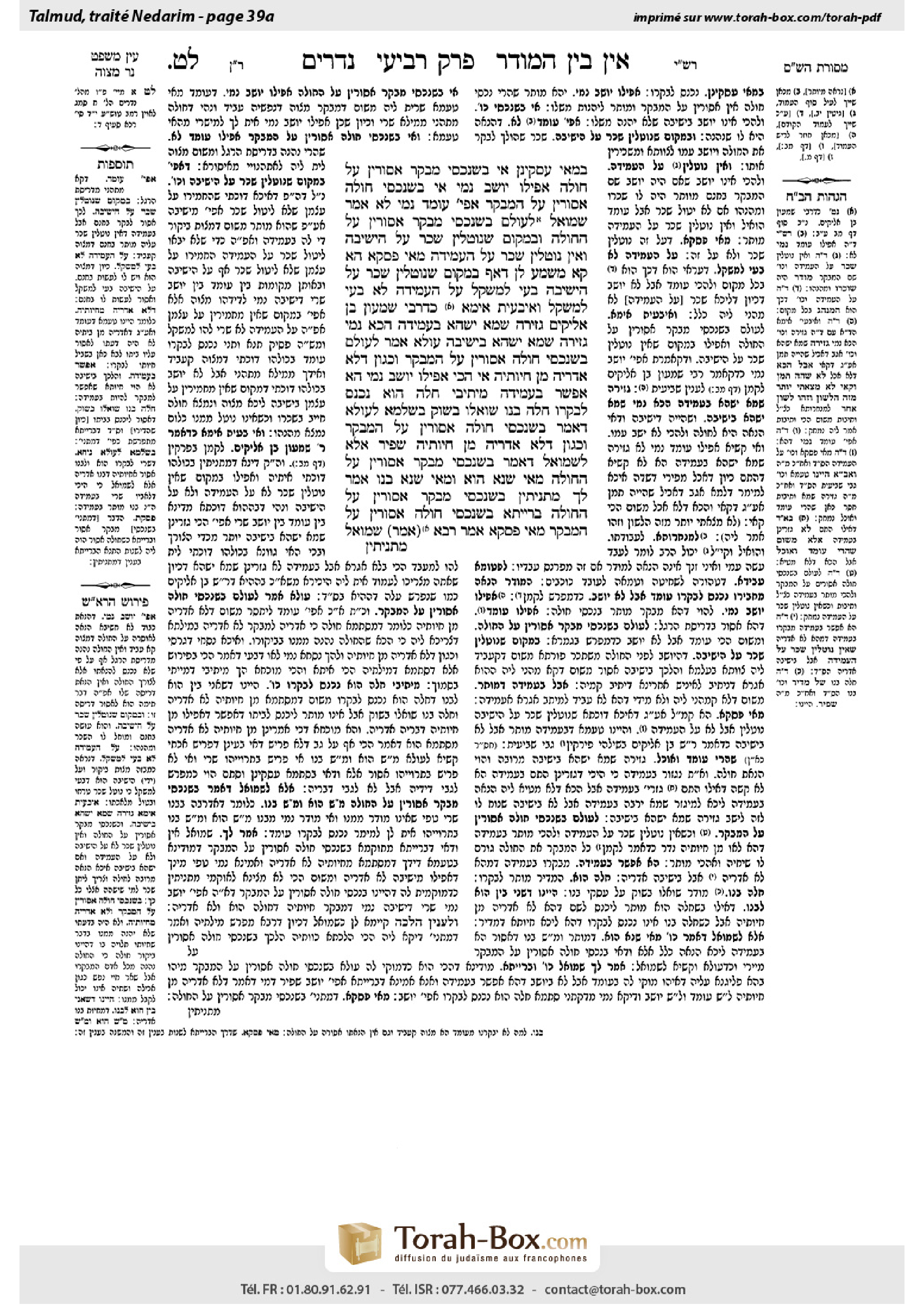
Nedarim 39a: Talmud study for Daf Yomi
Daf Yomi is the daily study of one Talmud folio. Explore 37 tractates with scans, Hebrew text, Sefaria English and AI-generated French translations where annotated.
Passage selection and English or AI-generated French translation are available where the scan has annotations. Daf Study is independent of Torah-Box and Sefaria.
Browse Nedarim · נדרים · All tractatesNedarim 39a text and translations
This page of Nedarim includes the Aramaic text, an English translation and an AI-generated French translation, alongside the scan above.
נדרים ל״ט א · Aramaic and Hebrew text
גְּמָ׳ בְּמַאי עָסְקִינַן? אִי בְּשֶׁנִּכְסֵי מְבַקֵּר אֲסוּרִין עַל חוֹלֶה — אֲפִילּוּ יוֹשֵׁב נָמֵי? אִי בְּשֶׁנִּכְסֵי חוֹלֶה אֲסוּרִין עַל הַמְבַקֵּר — אֲפִילּוּ עוֹמֵד נָמֵי לָא! אָמַר שְׁמוּאֵל: לְעוֹלָם בְּשֶׁנִּכְסֵי מְבַקֵּר אֲסוּרִין עַל הַחוֹלֶה, וּבִמְקוֹם שֶׁנּוֹטְלִין שָׂכָר עַל הַיְּשִׁיבָה, וְאֵין נוֹטְלִין שָׂכָר עַל הָעֲמִידָה.
מַאי פַּסְקָא? הָא קָא מַשְׁמַע לַן דְּאַף בִּמְקוֹם שֶׁנּוֹטְלִין שָׂכָר, עַל הַיְּשִׁיבָה — בָּעֵי לְמִשְׁקַל, עַל הָעֲמִידָה — לָא בָּעֵי לְמִשְׁקַל. וְאִיבָּעֵית אֵימָא: כִּדְרַבִּי שִׁמְעוֹן בֶּן אֶלְיָקִים, גְּזֵירָה שֶׁמָּא יִשְׁהֶא בַּעֲמִידָה. הָכָא נָמֵי גְּזֵירָה שֶׁמָּא יִשְׁהֶא בִּישִׁיבָה.
עוּלָּא אָמַר: לְעוֹלָם בְּשֶׁנִּכְסֵי חוֹלֶה אֲסוּרִין עַל הַמְבַקֵּר, וּכְגוֹן דְּלָא אַדְּרֵיהּ מִן חַיּוּתֵיהּ. אִי הָכִי, אֲפִילּוּ יוֹשֵׁב נָמֵי! הָא אֶפְשָׁר בַּעֲמִידָה.
מֵיתִיבִי: חָלָה הוּא — נִכְנָס לְבַקְּרוֹ, חָלָה בְּנוֹ — שׁוֹאֲלוֹ בַּשּׁוּק. בִּשְׁלָמָא לְעוּלָּא דְּאָמַר בְּשֶׁנִּכְסֵי חוֹלֶה אֲסוּרִין עַל הַמְבַקֵּר, וּכְגוֹן דְּלָא אַדְּרֵיהּ מִן חַיּוּתֵיהּ — שַׁפִּיר.
אֶלָּא לִשְׁמוּאֵל דְּאָמַר בְּשֶׁנִּכְסֵי מְבַקֵּר אֲסוּרִין עַל הַחוֹלֶה, מַאי שְׁנָא הוּא וּמַאי שְׁנָא בְּנוֹ? אָמַר לָךְ: מַתְנִיתִין בְּשֶׁנִּכְסֵי מְבַקֵּר אֲסוּרִין עַל הַחוֹלֶה, בָּרַיְיתָא בְּשֶׁנִּכְסֵי חוֹלֶה אֲסוּרִין עַל הַמְבַקֵּר.
מַאי פַּסְקָא? אָמַר רָבָא: (אָמַר) שְׁמוּאֵל
Nedarim 39a · English translation
GEMARA: With what are we dealing? If it is a case where the property of the visitor is forbidden to the ill person, even if he is sitting, this should also be permitted. If it is a case where the property of the ill person is forbidden to the visitor, even if he is standing, it should also not be permitted, as one derives benefit from entering the house. Shmuel said: Actually, it is a case where the property of the visitor is forbidden to the ill person, and it is in a place where one takes payment for visiting and sitting with an ill person and one does not take payment for visiting and standing with an ill person. Therefore, by sitting with the ill person the visitor provides him forbidden benefit by sparing him the expense of hiring another person to sit with him.
Why was this distinction stated without qualification? There is no apparent fundamental difference between sitting and standing when visiting the ill. The Gemara answers: It teaches us this: Even in a place where one takes payment for visiting the ill, for sitting, one ought to take payment, but for standing, one ought not to take payment. And if you wish, say instead that the distinction can be explained in accordance with the statement that Rabbi Shimon ben Elyakim said elsewhere (42a), that one who is prohibited to derive benefit from another due to a rabbinic decree may not enter a field that is owned by the latter, lest he remain standing there longer than permitted. Here too, sitting is prohibited due to a rabbinic decree, lest he remain sitting there longer than is necessary to perform the mitzva of visiting the ill.
Ulla said: Actually, it is a case where the property of the ill person is forbidden to the visitor, and where the ill person did not vow that his property would be forbidden in cases where its use enables the visitor to meet needs pertaining to his continued existence. The Gemara asks: If so, then even sitting should be permitted as well, since the vow did not prohibit use pertaining to his existential needs. The Gemara answers: Isn’t it possible to meet those needs and visit the ill while standing? Therefore, sitting is not an existential need.
The Gemara raises an objection from a baraita: If he became ill, he enters to visit him; if his son became ill, he inquires about his son’s health in the marketplace but may not enter the house to visit him. Granted, according to Ulla, who said: It is a case where the property of the ill person is forbidden to the visitor and where the ill person did not vow that the property be forbidden in cases pertaining to his continued existence, this works out well, as he excluded his own existential needs from the vow, not his son’s existential needs.
However, according to Shmuel, who said: It is a case where the property of the visitor is forbidden to the ill person, what is different about him and what is different about his son? Why is it prohibited for him to visit when the son is ill? The Gemara answers: Shmuel could have said to you: The mishna is referring to a case where the property of the visitor is forbidden to the ill person; the baraita is referring to a case where the property of the ill person is forbidden to the visitor.
The Gemara asks: Why was this distinction between the mishna and the baraita stated without qualification? Rava said: With regard to Shmuel,
Nedarim 39a · Traduction française (IA)
GUEMARA : De quoi s’agit-il ? Si les biens du visiteur sont interdits au malade, alors même si le visiteur est assis, cela devrait aussi être permis. Si les biens du malade sont interdits au visiteur, alors même s’il est debout, cela ne devrait pas être permis non plus, car il tire profit du fait d’entrer dans la maison. Chemouel dit : En réalité, il s’agit d’un cas où les biens du visiteur sont interdits au malade, dans un endroit où l’on fait payer les visites et le fait de rester assis auprès d’un malade, mais où l’on ne fait pas payer les visites où l’on reste debout auprès de lui. Par conséquent, en restant assis auprès du malade, le visiteur lui procure un avantage interdit, puisqu’il lui épargne la dépense nécessaire pour engager quelqu’un d’autre afin de rester assis auprès de lui.
Pourquoi cette distinction a-t-elle été énoncée sans autre précision ? Il n’existe apparemment aucune différence fondamentale entre rester assis et rester debout lorsqu’on rend visite à un malade. La Guemara répond : Cela nous enseigne ceci : même dans un endroit où l’on fait payer les visites aux malades, on doit faire payer le fait de rester assis, mais pas celui de rester debout. Et si tu préfères, dis plutôt que cette distinction s’explique conformément à ce que Rabbi Chimon ben Elyakim a dit ailleurs (42a) : celui à qui il est interdit de tirer profit d’autrui en vertu d’un décret rabbinique ne peut entrer dans un champ appartenant à celui-ci, de crainte d’y rester debout plus longtemps que permis. Ici aussi, rester assis est interdit en vertu d’un décret rabbinique, de crainte qu’il ne reste assis plus longtemps que nécessaire pour accomplir la mitsva de rendre visite à un malade.
Oulla dit : En réalité, il s’agit d’un cas où les biens du malade sont interdits au visiteur, mais où le malade n’a pas fait vœu d’interdire ses biens lorsque leur usage permet au visiteur de satisfaire des besoins liés à sa subsistance. La Guemara demande : Dans ce cas, même rester assis devrait être permis, puisque le vœu n’interdit pas l’usage répondant à ses besoins de subsistance. La Guemara répond : N’est-il pas possible de satisfaire ces besoins et de rendre visite au malade tout en restant debout ? Par conséquent, rester assis ne répond pas à un besoin de subsistance.
La Guemara soulève une objection à partir d’une baraïta : s’il tombe malade, il entre lui rendre visite ; si son fils tombe malade, il s’enquiert de la santé de son fils sur la place du marché, mais ne peut pas entrer dans la maison pour lui rendre visite. Cela s’explique bien selon Oulla, qui a dit qu’il s’agit d’un cas où les biens du malade sont interdits au visiteur et où le malade n’a pas fait vœu d’interdire ses biens lorsque leur usage répond à des besoins liés à sa subsistance : il a exclu de son vœu ses propres besoins de subsistance, mais pas ceux de son fils.
Cependant, selon Chemouel, qui a dit qu’il s’agit d’un cas où les biens du visiteur sont interdits au malade, en quoi le malade diffère-t-il de son fils ? Pourquoi est-il interdit au visiteur de rendre visite au malade lorsque c’est son fils qui est malade ? La Guemara répond : Chemouel aurait pu te dire : la Michna parle d’un cas où les biens du visiteur sont interdits au malade ; la baraïta parle d’un cas où les biens du malade sont interdits au visiteur.
La Guemara demande : Pourquoi cette distinction entre la Michna et la baraïta a-t-elle été énoncée sans autre précision ? Rava dit : À propos de Chemouel,
Traduction française générée par IA à partir de l’édition anglaise de Sefaria. Vérifie toujours un passage avec le texte source.
Text from Sefaria: William Davidson Edition - Vocalized Aramaic (CC BY NC); William Davidson Edition - English (CC BY NC).