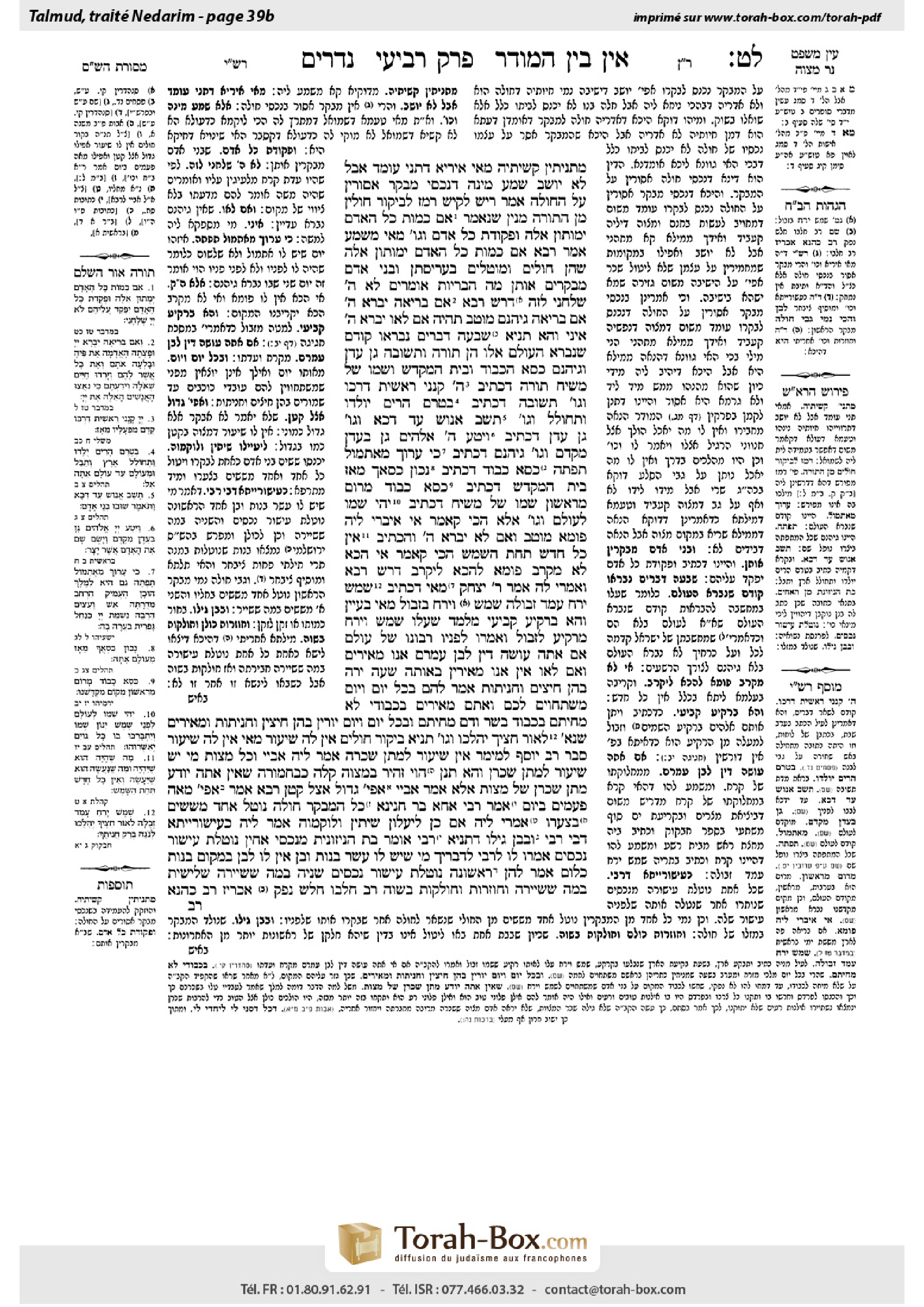
Nedarim 39b: Talmud study for Daf Yomi
Daf Yomi is the daily study of one Talmud folio. Explore 37 tractates with scans, Hebrew text, Sefaria English and AI-generated French translations where annotated.
Passage selection and English or AI-generated French translation are available where the scan has annotations. Daf Study is independent of Torah-Box and Sefaria.
Browse Nedarim · נדרים · All tractatesNedarim 39b text and translations
This page of Nedarim includes the Aramaic text, an English translation and an AI-generated French translation, alongside the scan above.
נדרים ל״ט ב · Aramaic and Hebrew text
מַתְנִיתִין קְשִׁיתֵיהּ; מַאי אִירְיָא דְּתָנֵי עוֹמֵד אֲבָל לֹא יוֹשֵׁב? שְׁמַע מִינַּהּ דְּנִכְסֵי מְבַקֵּר אֲסוּרִין עַל הַחוֹלֶה.
אָמַר רֵישׁ לָקִישׁ: רֶמֶז לְבִיקּוּר חוֹלִין מִן הַתּוֹרָה מִנַּיִן? שֶׁנֶּאֱמַר: ״אִם כְּמוֹת כׇּל הָאָדָם יְמֻתוּן אֵלֶּה וּפְקֻדַּת כׇּל הָאָדָם וְגוֹ׳״. מַאי מַשְׁמַע? אָמַר רָבָא: אִם כְּמוֹת כׇּל הָאָדָם יְמוּתוּן אֵלֶּה, שֶׁהֵן חוֹלִים וּמוּטָלִים בַּעֲרִיסָתָן, וּבְנֵי אָדָם מְבַקְּרִים אוֹתָן, מָה הַבְּרִיּוֹת אוֹמְרִים — ״לֹא ה׳ שְׁלָחַנִי לָזֶה״.
דָּרֵשׁ רָבָא: ״אִם בְּרִיאָה יִבְרָא ה׳״, ״אִם בְּרִיאָה״ גֵּיהִנָּם — מוּטָב תִּהְיֶה, אִם לָאו — ״יִבְרָא ה׳״.
אִינִי? וְהָא תַּנְיָא: שִׁבְעָה דְּבָרִים נִבְרְאוּ קוֹדֶם שֶׁנִּבְרָא הָעוֹלָם, אֵלּוּ הֵן: תּוֹרָה, וּתְשׁוּבָה, גַּן עֵדֶן, וְגֵיהִנָּם, כִּסֵּא הַכָּבוֹד, וּבֵית הַמִּקְדָּשׁ, וּשְׁמוֹ שֶׁל מָשִׁיחַ.
תּוֹרָה, דִּכְתִיב ה׳: ״קָנָנִי רֵאשִׁית דַּרְכּוֹ וְגוֹ׳״.
תְּשׁוּבָה, דִּכְתִיב: ״בְּטֶרֶם הָרִים יֻלָּדוּ וַתְּחוֹלֵל וְגוֹ׳ תָּשֵׁב אֱנוֹשׁ עַד דַּכָּא וְגוֹ׳״.
גַּן עֵדֶן, דִּכְתִיב: ״וַיִּטַּע ה׳ אֱלֹהִים גַּן בְּעֵדֶן מִקֶּדֶם וְגוֹ׳״.
גֵּיהִנָּם, דִּכְתִיב: ״כִּי עָרוּךְ מֵאֶתְמוּל תׇּפְתֶּה״.
כִּסֵּא כָּבוֹד, דִּכְתִיב: ״נָכוֹן כִּסְאֲךָ מֵאָז״.
בֵּית הַמִּקְדָּשׁ, דִּכְתִיב: ״כִּסֵּא כָבוֹד מָרוֹם מֵרִאשׁוֹן״.
שְׁמוֹ שֶׁל מָשִׁיחַ, דִּכְתִיב: ״יְהִי שְׁמוֹ לְעוֹלָם וְגוֹ׳״.
אֶלָּא הָכִי קָאָמַר: אִי אִיבְּרִי לֵיהּ פּוּמָּא — מוּטָב, וְאִם לָא — ״יִבְרָא ה׳״. וְהָכְתִיב: ״אֵין כׇּל חָדָשׁ תַּחַת הַשָּׁמֶשׁ״! הָכִי קָאָמַר: אִי הָכָא לָא מְקָרַב פּוּמָּא — לְהָכָא לִיקְרַב.
דָּרֵשׁ רָבָא, וְאָמְרִי לַהּ אָמַר רַבִּי יִצְחָק: מַאי דִּכְתִיב ״שֶׁמֶשׁ יָרֵחַ עָמַד זְבֻלָה״. שֶׁמֶשׁ וְיָרֵחַ בִּזְבוּל מַאי בָּעֲיָין? וְהָא בְּרָקִיעַ קְבִיעִי! מְלַמֵּד שֶׁעָלוּ שֶׁמֶשׁ וְיָרֵחַ מֵרָקִיעַ לִזְבוּל, וְאָמְרוּ לְפָנָיו: רִבּוֹנוֹ שֶׁל עוֹלָם, אִם אַתָּה עוֹשֶׂה דִּין לְבֶן עַמְרָם — אָנוּ מְאִירִים, וְאִם לָאו — אֵין אָנוּ מְאִירִין.
בְּאוֹתָהּ שָׁעָה יָרָה בָּהֶן חִיצִּים וַחֲנִיתוֹת, אָמַר לָהֶם: בְּכׇל יוֹם וָיוֹם מִשְׁתַּחֲוִים לָכֶם וְאַתֶּם מְאִירִים. בִּכְבוֹדִי לֹא מְחִיתֶם, בִּכְבוֹד בָּשָׂר וָדָם מְחִיתֶם! וּבְכׇל יוֹם וָיוֹם יוֹרִין בָּהֶן חִיצִּין וַחֲנִיתוֹת וּמְאִירִים, שֶׁנֶּאֱמַר: ״לְאוֹר חִצֶּיךָ יְהַלֵּכוּ וְגוֹ׳״.
תַּנְיָא: בִּיקּוּר חוֹלִים אֵין לָהּ שִׁיעוּר. מַאי ״אֵין לָהּ שִׁיעוּר״? סָבַר רַב יוֹסֵף לְמֵימַר אֵין שִׁיעוּר לְמַתַּן שְׂכָרָהּ. אֲמַר לֵיהּ אַבָּיֵי: וְכׇל מִצְוֹת מִי יֵשׁ שִׁיעוּר לְמַתַּן שְׂכָרָן? וְהָא תְּנַן: הֱוֵי זָהִיר בְּמִצְוָה קַלָּה כְּבַחֲמוּרָה, שֶׁאֵין אַתָּה יוֹדֵעַ מַתַּן שְׂכָרָן שֶׁל מִצְוֹת! אֶלָּא אָמַר אַבָּיֵי: אֲפִילּוּ גָּדוֹל אֵצֶל קָטָן. רָבָא אָמַר: אֲפִילּוּ מֵאָה פְּעָמִים בְּיוֹם.
אָמַר רַבִּי אַחָא בַּר חֲנִינָא: כׇּל הַמְבַקֵּר חוֹלֶה, נוֹטֵל אֶחָד מִשִּׁשִּׁים בְּצַעֲרוֹ. אָמְרִי לֵיהּ: אִם כֵּן לִיעַלּוּן שִׁיתִּין וְלוֹקְמוּהּ! אֲמַר לֵיהּ: כְּעִישּׂוּרְיָיתָא דְּבֵי רַבִּי, וּבְבֶן גִּילוֹ.
דְּתַנְיָא רַבִּי אוֹמֵר: בַּת הַנִּיזוֹנֶית מִנִּכְסֵי אַחִין — נוֹטֶלֶת עִישּׂוּר נְכָסִים. אָמְרוּ לוֹ לְרַבִּי: לִדְבָרֶיךָ מִי שֶׁיֵּשׁ לוֹ עֶשֶׂר בָּנוֹת וּבֵן, אֵין לוֹ לַבֵּן בִּמְקוֹם בָּנוֹת כְּלוּם! אָמַר לָהֶן: רִאשׁוֹנָה נוֹטֶלֶת עִישּׂוּר נְכָסִים, שְׁנִיָּה בַּמֶּה שֶׁשִּׁיְּירָה, שְׁלִישִׁית בַּמֶּה שֶׁשִּׁיְּירָה, וְחוֹזְרוֹת וְחוֹלְקוֹת בְּשָׁוֶה.
רַב חֶלְבּוֹ חֲלַשׁ, נְפַק אַכְרֵיז רַב כָּהֲנָא:
Nedarim 39b · English translation
the mishna was difficult for him: Why does the tanna specifically teach: He stands in his house but may not sit? Conclude from it that the property of the visitor is forbidden to the ill person.
§ Apropos the halakhot of visiting the ill, the Gemara cites related statements. Reish Lakish said: From where is there an allusion from the Torah to visiting the ill? It is as it is stated: “If these men die the common death of all men, and be visited after the visitation of all men, then the Lord has not sent me” (Numbers 16:29). The Gemara asks: From where in this verse may visiting the ill be inferred? Rava said that this is what Moses is saying: If these men, the congregation of Korah, die the common death of all men, who become ill, and are confined to their beds, and people come to visit them; if that happens to them, what do the people say? They say: The Lord has not sent me for this task.
Apropos Korah and his congregation, Rava interpreted the repetitive formulation in this verse homiletically: “But if the Lord will create a creation [beria yivra], and the ground opens its mouth, and swallows them, and all that is theirs, and they will descend alive into the pit, then you shall understand that these men have despised God” (Numbers 16:30). Here, Moses is saying: If Gehenna is already a creation [beria] and exists, that is optimal; if not, God should create [yivra] it now.
The Gemara asks: Is that so? Was there uncertainty at that point as to whether Gehenna had already been created? But isn’t it taught in a baraita: Seven phenomena were created before the world was created, and they are: Torah, and repentance, the Garden of Eden, and Gehenna, the Throne of Glory, and the Temple, and the name of the Messiah.
The Gemara provides sources for each of these phenomena. Torah was created before the world was created, as it is written: “The Lord made me as the beginning of His way, the first of His works of old” (Proverbs 8:22). Based on the subsequent verses, this is referring to the Torah.
Repentance was created before the world was created, as it is written: “Before the mountains were brought forth, or ever You had formed the earth and the world, even from everlasting to everlasting, You are God” (Psalms 90:2), and it is written immediately afterward: “You return man to contrition; and You say: Repent, children of man” (Psalms 90:3).
The Garden of Eden was created before the world was created, as it is written: “And the Lord God planted a garden in Eden eastward [mikedem]” (Genesis 2:8). “Eastward [mikedem]” is interpreted in the sense of before [mikodem], i.e., before the world was created.
Gehenna was created before the world was created, as it is written: “For its hearth is ordained of old” (Isaiah 30:33). The hearth, i.e., Gehenna, was created before the world was created.
The Throne of Glory was created before the world was created, as it is written: “Your throne is established of old, You are from everlasting” (Psalms 93:2).
The Temple was created before the world was created, as it is written: “Your Throne of Glory on high from the beginning, in the place of our Temple” (Jeremiah 17:12).
The name of the Messiah was created before the world was created, as it is written about him: “May his name endure forever; his name existed before the sun” (Psalms 72:17). The name of the Messiah predated the creation of the sun and the rest of the world. Apparently, Rava’s explanation that Moses was uncertain whether Gehenna had been created yet is contradicted by this baraita.
Rather, the interpretation of the repetitive formulation of the verse is that this is what Moses is saying: If the opening was created for Gehenna, that is optimal, and if not, the Lord should create it now. The Gemara asks: But isn’t it written: “And there is nothing new under the sun” (Ecclesiastes 1:9)? How, then, could Moses request that God create the mouth of Gehenna now? The Gemara answers: This is what Moses said: If the mouth of Gehenna is not close to here, let God bring it closer.
Apropos the conflict between Moses and Korah, the Gemara cites an additional verse that Rava interpreted homiletically, and some say that it was Rabbi Yitzḥak who said: What is the meaning of that which is written: “The sun and moon stood still in their habitation [zevula], at the light of Your arrows as they go, at the shining of Your glittering spear” (Habakkuk 3:11)? What do the sun and moon seek in zevul, which is the fourth heaven; aren’t they fixed in rakia, the second heaven? Rather, this teaches that the sun and moon ascended from rakia to zevul and said before Him: Master of the Universe! If You do justice for the son of Amram, i.e., Moses, in his dispute with Korah, we will continue to illuminate the world, and if not, we will not illuminate the world.
At that moment, the Holy One, Blessed be He, shot arrows, and threw spears at them, and said to them: Each and every day idolaters bow to you and you continue to illuminate the world and do not protest. In My honor, you did not protest, but in honor of flesh and blood, you protested? And ever since, each and every day the heavenly hosts shoot arrows and throw spears at the sun and the moon, and only then do they emerge and illuminate the world, as it is stated: “At the light of Your arrows as they go, at the shining of Your glittering spear” (Habakkuk 3:11).
§ Returning to the topic of visiting the ill, the Gemara states: It is taught in a baraita: The mitzva of visiting the ill has no fixed measure. The Gemara asks: What is the meaning of: Has no fixed measure? Rav Yosef thought to say: There is no fixed measure for the granting of its reward. Abaye said to him: And do all other mitzvot have a fixed measure for the granting of their reward? But didn’t we learn in a mishna (Avot 2:1): Be as meticulous in the observance of a minor mitzva as a major one, as you do not know the granting of reward for mitzvot. Rather, Abaye said: There is no fixed measure for the disparity between the ill person and his visitor, as even a prominent person pays a visit to a lowly person and should not say that doing so is beneath a person of his standing. Rava said: There is no fixed measure for the number of times that one should visit the ill, as even one hundred times a day is appropriate.
Rav Aḥa bar Ḥanina said: Anyone who visits an ill person takes from him one-sixtieth of his suffering. The Sages said to him: If so, let sixty people enter to visit him, and stand him up, and restore him to health. Rav Aḥa bar Ḥanina said to them: It is like the tenths of the school of Rabbi Yehuda HaNasi, who said that each of one’s daughters inherits one-tenth of his possessions. His intent was that each daughter would receive one-tenth of the remainder after the previous daughter took her portion. Here too, each visitor takes from the ill person one-sixtieth of the suffering that remains, and consequently a degree of suffering will always remain with the ill person. Furthermore, visiting is effective in easing the suffering of the ill person only when the visitor is one born under the same constellation as the ill person.
The Gemara elaborates on the tenths of the school of Rabbi Yehuda HaNasi, as it is taught in a baraita that Rabbi Yehuda HaNasi says: A daughter who is supported from the property of her brothers after the death of their father receives one-tenth of the estate as her dowry. The Sages said to Rabbi Yehuda HaNasi: According to your statement, in the case of one who has ten daughters and a son, no property at all remains for the son in a place where there are daughters, as they receive the entire inheritance. Rabbi Yehuda HaNasi said to them: The first daughter takes one-tenth of the estate, the second takes one-tenth of that which the first left of the inheritance, the third takes one-tenth of that which the second left of the inheritance, and so on. After each succeeding daughter takes her share, they pool their resources and then divide the property equally. Therefore, the son is left with a share of the inheritance.
The Gemara relates: Rav Ḥelbo fell ill. Rav Kahana went out and announced:
Nedarim 39b · Traduction française (IA)
La Michna lui posait une difficulté : pourquoi le tanna enseigne-t-il précisément : « Il se tient dans sa maison, mais ne peut pas s’asseoir » ? Il faut en conclure que les biens du visiteur sont interdits au malade.
§ À propos des halakhot relatives à la visite des malades, la Guemara cite des déclarations connexes. Reish Lakish a dit : d’où trouve-t-on dans la Torah une allusion à la visite des malades ? C’est ce qui est dit : « Si ces hommes meurent de la mort commune à tous les hommes et subissent le sort commun à tous les hommes, alors l’Éternel ne m’a pas envoyé » (Nombres 16,29). La Guemara demande : où peut-on déduire de ce verset la visite des malades ? Rava a dit que voici ce que Moché dit : si ces hommes, l’assemblée de Korah, meurent de la mort commune à tous les hommes, qui tombent malades, restent alités et reçoivent la visite de gens, si cela leur arrive, que diront les gens ? Ils diront : « L’Éternel ne m’a pas envoyé pour cette mission. »
À propos de Korah et de son assemblée, Rava a interprété de manière homilétique la formulation redondante de ce verset : « Mais si l’Éternel crée une création [beria yivra], si la terre ouvre sa bouche et les engloutit, eux et tout ce qui leur appartient, et qu’ils descendent vivants dans le gouffre, alors vous saurez que ces hommes ont méprisé Dieu » (Nombres 16,30). Moché dit ici : si la Géhenne est déjà une création [beria] et existe, tant mieux ; sinon, que Dieu la crée [yivra] maintenant.
La Guemara demande : en est-il ainsi ? À ce moment-là, on ne savait donc pas si la Géhenne avait déjà été créée ? Pourtant, n’est-il pas enseigné dans une baraïta que sept phénomènes ont été créés avant le monde : la Torah, le repentir, le Jardin d’Éden, la Géhenne, le Trône de Gloire, le Temple et le nom du Messie ?
La Guemara apporte des sources pour chacun de ces phénomènes. La Torah a été créée avant le monde, comme il est écrit : « L’Éternel m’a créée au commencement de sa voie, avant ses œuvres les plus anciennes » (Proverbes 8,22). Les versets qui suivent montrent qu’il s’agit de la Torah.
Le repentir a été créé avant le monde, comme il est écrit : « Avant que les montagnes fussent nées, avant que tu eusses créé la terre et le monde, d’éternité en éternité, tu es Dieu » (Psaumes 90,2), et il est écrit immédiatement après : « Tu ramènes l’homme à la contrition, et tu dis : Repentez-vous, fils de l’homme » (Psaumes 90,3).
Le Jardin d’Éden a été créé avant le monde, comme il est écrit : « L’Éternel Dieu planta un jardin en Éden, vers l’est [mikedem] » (Genèse 2,8). « Vers l’est [mikedem] » est interprété au sens de « auparavant » [mikodem], c’est-à-dire avant la création du monde.
La Géhenne a été créée avant le monde, comme il est écrit : « Car son foyer est préparé depuis longtemps » (Isaïe 30,33). Le foyer, c’est-à-dire la Géhenne, a été créé avant le monde.
Le Trône de Gloire a été créé avant le monde, comme il est écrit : « Ton trône est établi depuis longtemps, tu es depuis l’éternité » (Psaumes 93,2).
Le Temple a été créé avant le monde, comme il est écrit : « Ton Trône de Gloire, élevé dès le commencement, au lieu de notre Temple » (Jérémie 17,12).
Le nom du Messie a été créé avant le monde, comme il est écrit à son sujet : « Que son nom subsiste à jamais ; son nom existait avant le soleil » (Psaumes 72,17). Le nom du Messie existait avant la création du soleil et du reste du monde. Il semble donc que l’explication de Rava, selon laquelle Moché ne savait pas si la Géhenne avait déjà été créée, soit contredite par cette baraïta.
Il faut plutôt interpréter la formulation redondante du verset ainsi : voici ce que Moché dit : si l’ouverture destinée à la Géhenne a été créée, tant mieux ; sinon, que l’Éternel la crée maintenant. La Guemara demande : pourtant, n’est-il pas écrit : « Il n’y a rien de nouveau sous le soleil » (Ecclésiaste 1,9) ? Comment Moché aurait-il donc pu demander à Dieu de créer maintenant l’ouverture de la Géhenne ? La Guemara répond : voici ce que Moché a dit : si l’ouverture de la Géhenne n’est pas proche d’ici, que Dieu la rapproche.
À propos du conflit entre Moché et Korah, la Guemara cite un autre verset que Rava a interprété de manière homilétique ; selon certains, c’est Rabbi Yitzḥak qui l’a dit : que signifie ce qui est écrit : « Le soleil et la lune se tinrent dans leur demeure [zevula], à la lumière de tes flèches qui partent, à l’éclat de ta lance étincelante » (Habacuc 3,11) ? Que cherchent le soleil et la lune dans le zevul, qui est le quatrième ciel ? Ne sont-ils pas fixés dans le rakia, le deuxième ciel ? Cela enseigne plutôt que le soleil et la lune sont montés du rakia au zevul et se sont présentés devant Lui en disant : « Maître de l’Univers ! Si tu rends justice au fils d’Amram, c’est-à-dire à Moché, dans son différend avec Korah, nous continuerons à éclairer le monde ; sinon, nous ne l’éclairerons pas. »
À ce moment-là, le Saint, béni soit-Il, leur décocha des flèches et leur lança des lances, en leur disant : « Chaque jour, les idolâtres se prosternent devant vous et vous continuez à éclairer le monde sans protester. Pour mon honneur, vous n’avez pas protesté, mais pour l’honneur d’un être de chair et de sang, vous protestez ? » Depuis lors, chaque jour, les armées célestes décochent des flèches et lancent des lances contre le soleil et la lune ; ce n’est qu’alors qu’ils apparaissent et éclairent le monde, comme il est dit : « À la lumière de tes flèches qui partent, à l’éclat de ta lance étincelante » (Habacuc 3,11).
§ Revenant au sujet de la visite des malades, la Guemara dit qu’il est enseigné dans une baraïta que la mitsva de rendre visite aux malades n’a pas de mesure fixe. La Guemara demande : que signifie « n’a pas de mesure fixe » ? Rav Yosef a pensé répondre : il n’y a pas de mesure fixe pour la récompense qu’elle procure. Abaye lui a dit : les autres mitsvot ont-elles donc une mesure fixe pour la récompense qu’elles procurent ? N’avons-nous pas appris dans une Michna (Avot 2,1) : « Sois aussi scrupuleux dans l’accomplissement d’une petite mitsva que d’une grande, car tu ne connais pas la récompense des mitsvot » ? Abaye a plutôt dit : il n’y a pas de mesure fixe quant à la différence de rang entre le malade et son visiteur ; même une personne importante rend visite à une personne modeste et ne doit pas dire que cela est indigne de son statut. Rava a dit : il n’y a pas de limite au nombre de visites que l’on peut rendre à un malade ; même cent fois par jour, cela convient.
Rav Aḥa bar Ḥanina a dit : quiconque rend visite à un malade lui enlève un soixantième de sa souffrance. Les Sages lui dirent : dans ce cas, que soixante personnes entrent lui rendre visite, le remettent sur pied et le rétablissent ! Rav Aḥa bar Ḥanina leur répondit : cela ressemble aux dixièmes de l’école de Rabbi Yehuda HaNasi, qui disait que chacune des filles hérite d’un dixième de ses biens. Il voulait dire que chaque fille recevrait un dixième du reste, après que la précédente eut pris sa part. De même, chaque visiteur enlève au malade un soixantième de la souffrance qui demeure, de sorte qu’il restera toujours une certaine souffrance chez le malade. En outre, la visite n’apaise effectivement la souffrance du malade que si le visiteur est né sous la même constellation que lui.
La Guemara développe la question des dixièmes de l’école de Rabbi Yehuda HaNasi, car il est enseigné dans une baraïta que Rabbi Yehuda HaNasi dit : une fille qui est entretenue par les biens de ses frères après la mort de leur père reçoit un dixième de la succession à titre de dot. Les Sages dirent à Rabbi Yehuda HaNasi : selon tes propos, dans le cas d’un homme qui a dix filles et un fils, il ne restera aucun bien au fils dans un endroit où il y a des filles, puisqu’elles recevront toute la succession. Rabbi Yehuda HaNasi leur dit : la première fille prend un dixième de la succession ; la deuxième prend un dixième de ce que la première a laissé ; la troisième prend un dixième de ce que la deuxième a laissé, et ainsi de suite. Une fois que chacune des filles suivantes a pris sa part, elles mettent leurs ressources en commun, puis partagent les biens à parts égales. Le fils conserve donc une part de la succession.
La Guemara rapporte que Rav Ḥelbo tomba malade. Rav Kahana sortit et annonça :
Traduction française générée par IA à partir de l’édition anglaise de Sefaria. Vérifie toujours un passage avec le texte source.
Text from Sefaria: William Davidson Edition - Vocalized Aramaic (CC BY NC); William Davidson Edition - English (CC BY NC).