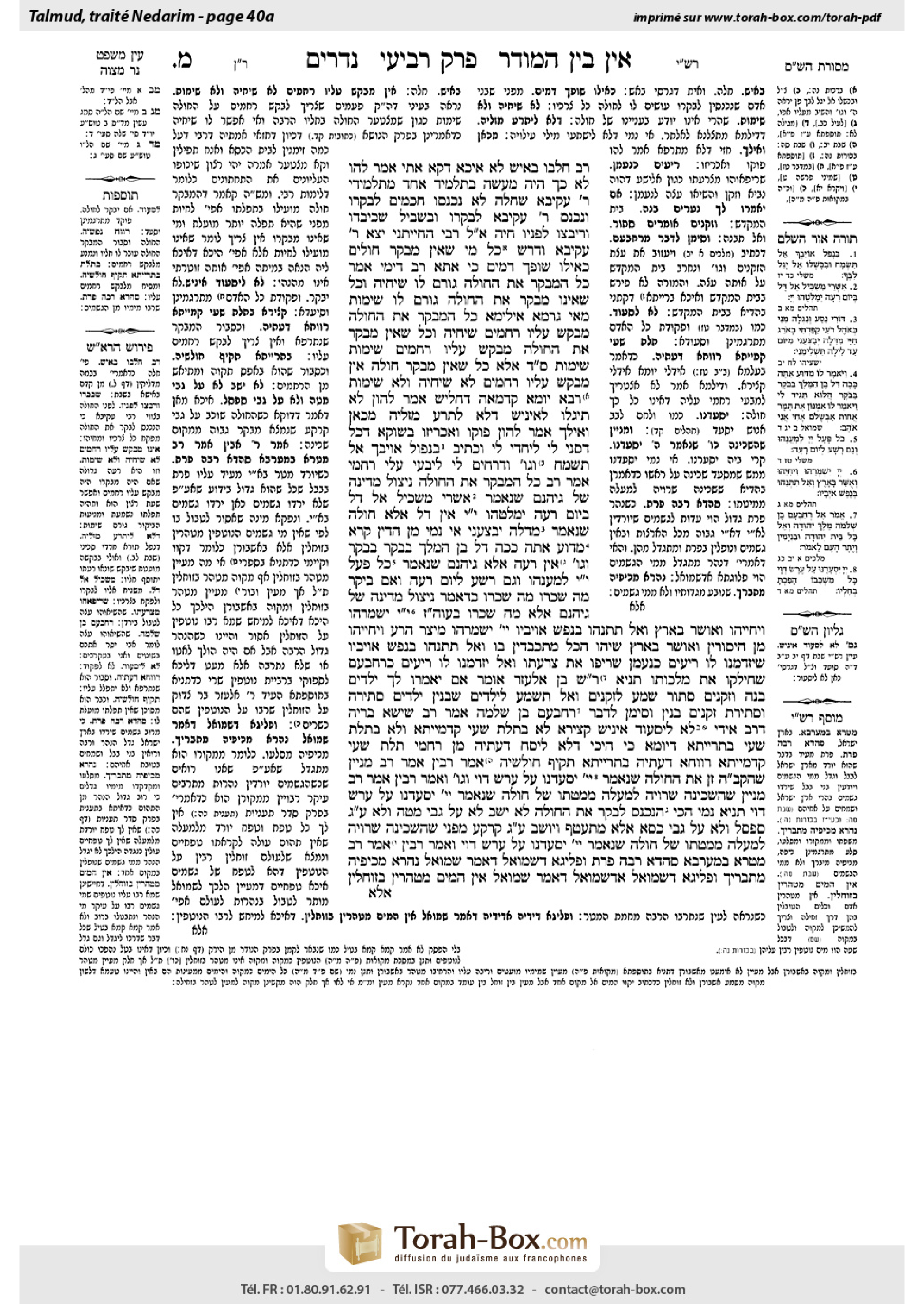
Nedarim 40a: Talmud study for Daf Yomi
Daf Yomi is the daily study of one Talmud folio. Explore 37 tractates with scans, Hebrew text, Sefaria English and AI-generated French translations where annotated.
Passage selection and English or AI-generated French translation are available where the scan has annotations. Daf Study is independent of Torah-Box and Sefaria.
Browse Nedarim · נדרים · All tractatesNedarim 40a text and translations
This page of Nedarim includes the Aramaic text, an English translation and an AI-generated French translation, alongside the scan above.
נדרים מ׳ א · Aramaic and Hebrew text
רַב חֶלְבּוֹ בְּאֵישׁ. לָא אִיכָּא דְּקָא אָתֵי. אָמַר לְהוּ: לֹא כָּךְ הָיָה מַעֲשֶׂה בְּתַלְמִיד אֶחָד מִתַּלְמִידֵי רַבִּי עֲקִיבָא שֶׁחָלָה. לֹא נִכְנְסוּ חֲכָמִים לְבַקְּרוֹ, וְנִכְנָס רַבִּי עֲקִיבָא לְבַקְּרוֹ, וּבִשְׁבִיל שֶׁכִּיבְּדוּ וְרִיבְּצוּ לְפָנָיו, חָיָה. אָמַר לוֹ: רַבִּי, הֶחֱיִיתַנִי. יָצָא רַבִּי עֲקִיבָא וְדָרַשׁ: כׇּל מִי שֶׁאֵין מְבַקֵּר חוֹלִים כְּאִילּוּ שׁוֹפֵךְ דָּמִים.
כִּי אֲתָא רַב דִּימִי, אָמַר: כׇּל הַמְבַקֵּר אֶת הַחוֹלֶה גּוֹרֵם לוֹ שֶׁיִּחְיֶה, וְכֹל שֶׁאֵינוֹ מְבַקֵּר אֶת הַחוֹלֶה גּוֹרֵם לוֹ שֶׁיָּמוּת. מַאי גְּרָמָא? אִילֵּימָא כׇּל הַמְבַקֵּר אֶת הַחוֹלֶה מְבַקֵּשׁ עָלָיו רַחֲמִים שֶׁיִּחְיֶה, וְכֹל שֶׁאֵין מְבַקֵּר אֶת הַחוֹלֶה מְבַקֵּשׁ עָלָיו רַחֲמִים שֶׁיָּמוּת. שֶׁיָּמוּת סָלְקָא דַּעְתָּךְ?! אֶלָּא: כֹּל שֶׁאֵין מְבַקֵּר חוֹלֶה, אֵין מְבַקֵּשׁ עָלָיו רַחֲמִים, לֹא שֶׁיִּחְיֶה וְלֹא שֶׁיָּמוּת.
רָבָא, יוֹמָא קַדְמָאָה דְּחָלֵישׁ אָמַר לְהוֹן: לָא תִּיגַלּוֹ לְאִינִישׁ, דְּלָא לִתְּרַע מַזָּלֵיהּ. מִכָּאן וְאֵילָךְ אָמַר לְהוֹן: פּוּקוּ וְאַכְרִיזוּ בְּשׁוּקָא, דְּכׇל דְּסָנֵי לִי לִיחְדֵּי לִי, וּכְתִיב: ״בִּנְפֹל אוֹיִבְךָ אַל תִּשְׂמָח וְגוֹ׳״, וּדְרָחֵים לִי לִיבְעֵי עֲלַי רַחֲמֵי.
אָמַר רַב: כׇּל הַמְבַקֵּר אֶת הַחוֹלֶה נִיצּוֹל מִדִּינָהּ שֶׁל גֵּיהִנָּם, שֶׁנֶּאֱמַר: ״אַשְׁרֵי מַשְׂכִּיל אֶל דָּל בְּיוֹם רָעָה יְמַלְּטֵהוּ ה׳״, אֵין דַּל אֶלָּא חוֹלֶה, שֶׁנֶּאֱמַר: ״מִדַּלָּה יְבַצְּעֵנִי״, אִי נָמֵי מִן הָדֵין קְרָא: ״מַדּוּעַ אַתָּה כָּכָה דַּל בֶּן הַמֶּלֶךְ בַּבֹּקֶר בַּבֹּקֶר וְגוֹ׳״. אֵין רָעָה אֶלָּא גֵּיהִנָּם, שֶׁנֶּאֱמַר: ״כֹּל פָּעַל ה׳ לַמַּעֲנֵהוּ וְגַם רָשָׁע לְיוֹם רָעָה״.
וְאִם בִּיקֵּר מָה שְׂכָרוֹ? מָה שְׂכָרוֹ?! כִּדְאָמַר: נִיצּוֹל מִדִּינָהּ שֶׁל גֵּיהִנָּם! אֶלָּא: מָה שְׂכָרוֹ בָּעוֹלָם הַזֶּה —
״ה׳ יִשְׁמְרֵהוּ וִיחַיֵּהוּ וְאֻשַּׁר בָּאָרֶץ וְאַל תִּתְּנֵהוּ בְּנֶפֶשׁ אֹיְבָיו״. ״ה׳ יִשְׁמְרֵהוּ״ — מִיֵּצֶר הָרָע, ״וִיחַיֵּהוּ״ — מִן הַיִּסּוּרִין, ״וְאֻשַּׁר בָּאָרֶץ״ — שֶׁיְּהוּ הַכֹּל מִתְכַּבְּדִין בּוֹ, ״וְאַל תִּתְּנֵהוּ בְּנֶפֶשׁ אֹיְבָיו״ — שֶׁיִּזְדַּמְּנוּ לוֹ רֵיעִים כְּנַעֲמָן שֶׁרִיפּוּ אֶת צָרַעְתּוֹ, וְאַל יִזְדַּמְּנוּ לוֹ רֵיעִים כִּרְחַבְעָם שֶׁחִילְּקוּ אֶת מַלְכוּתוֹ.
תַּנְיָא, רַבִּי שִׁמְעוֹן בֶּן אֶלְעָזָר אוֹמֵר: אִם יֹאמְרוּ לָךְ יְלָדִים ״בְּנֵה״ וּזְקֵנִים ״סְתוֹר״ — שְׁמַע לַזְּקֵנִים וְאַל תִּשְׁמַע לַיְּלָדִים. שֶׁבִּנְיַן יְלָדִים סְתִירָה, וּסְתִירַת זְקֵנִים בִּנְיָן. וְסִימָן לַדָּבָר: רְחַבְעָם בֶּן שְׁלֹמֹה.
אָמַר רַב שִׁישָׁא בְּרֵיהּ דְּרַב אִידִי: לָא לִיסְעוֹד אִינִישׁ קְצִירָא לָא בִּתְלָת שָׁעֵי קַדְמָיָיתָא, וְלָא בִּתְלָת שָׁעֵי בָּתְרָיָיתָא דְּיוֹמָא, כִּי הֵיכִי דְּלָא לַיסַּח דַּעְתֵּיהּ מִן רַחֲמֵי. תְּלָת שָׁעֵי קַדְמָיָיתָא — רָוְוחָא דַּעְתֵּיהּ. בָּתְרָיָיתָא — תָּקֵיף חוּלְשֵׁיהּ.
אָמַר רָבִין אָמַר רַב: מִנַּיִין שֶׁהַקָּדוֹשׁ בָּרוּךְ הוּא זָן אֶת הַחוֹלֶה, שֶׁנֶּאֱמַר: ״ה׳ יִסְעָדֶנּוּ עַל עֶרֶשׂ דְּוָי וְגוֹ׳״. וְאָמַר רָבִין אָמַר רַב: מִנַּיִין שֶׁהַשְּׁכִינָה שְׁרוּיָה לְמַעְלָה מִמִּטָּתוֹ שֶׁל הַחוֹלֶה, שֶׁנֶּאֱמַר: ״ה׳ יִסְעָדֶנּוּ עַל עֶרֶשׂ דְּוָי״.
תַּנְיָא נָמֵי הָכִי: הַנִּכְנָס לְבַקֵּר אֶת הַחוֹלֶה, לֹא יֵשֵׁב לֹא עַל גַּבֵּי מִטָּה וְלֹא עַל גַּבֵּי סַפְסָל וְלֹא עַל גַּבֵּי כִּסֵּא, אֶלָּא מִתְעַטֵּף וְיוֹשֵׁב עַל גַּבֵּי קַרְקַע, מִפְּנֵי שֶׁהַשְּׁכִינָה שְׁרוּיָה לְמַעְלָה מִמִּטָּתוֹ שֶׁל חוֹלֶה, שֶׁנֶּאֱמַר: ״ה׳ יִסְעָדֶנּוּ עַל עֶרֶשׂ דְּוָי״.
וְאָמַר רָבִין אָמַר רַב: מִטְרָא בְּמַעְרְבָא — סָהֲדָא רַבָּה פְּרָת. וּפְלִיגָא דִּשְׁמוּאֵל, דְּאָמַר שְׁמוּאֵל: נַהְרָא מִכֵּיפֵיהּ מִתְבָּרֵיךְ. וּפְלִיגָא דִּשְׁמוּאֵל אַדִּשְׁמוּאֵל, דְּאָמַר שְׁמוּאֵל: אֵין הַמַּיִם מְטַהֲרִין בְּזוֹחֲלִין
Nedarim 40a · English translation
Rav Ḥelbo fell ill. There was no one who came to visit him. Rav Kahana said to the Sages: Didn’t the incident involving one of the students of Rabbi Akiva who became sick transpire in that manner? In that case, the Sages did not enter to visit him, and Rabbi Akiva entered to visit him and instructed his students to care for him. And since they swept and sprinkled water on the dirt floor before the sick student, he recovered. The student said to Rabbi Akiva: My teacher, you revived me. Rabbi Akiva went out and taught: With regard to anyone who does not visit the ill, it is as though he is spilling blood, as it could be that the sick person has no one to care for him. If there are no visitors, no one will know his situation and therefore no one will come to his aid.
When Rav Dimi came from Eretz Yisrael to Babylonia he said: Anyone who visits the ill causes that he will live, and anyone who does not visit the ill causes that he will die. The Gemara asks: In what way are his actions the cause of that result? If we say that anyone who visits the ill pleads for mercy from God that he will live, and anyone who does not visit the ill pleads for mercy that he will die, does it enter your mind that he would pray that the sick person will die? Rather, anyone who does not visit the ill does not plead for mercy for him, neither that he will live nor that he will die. Since he might have saved the sick person with prayers had he visited, his failure to visit is tantamount to causing his death.
The Gemara relates with regard to Rava: On the first day that he was ill, he would say to his family: Do not reveal to any person that I am ill, so that his luck not suffer. From this point forward, when his situation deteriorated he would say to them: Go and proclaim in the marketplace that I am ill, as thereby let all who hate me rejoice over my distress, and it is written: “Rejoice not when your enemy falls, and let not your heart be glad when he stumbles; lest the Lord see it, and it displease Him, and He turn away His wrath from him” (Proverbs 24:17–18). And let all who love me pray that God have mercy upon me.
Rav said: Anyone who visits the ill is spared from the judgment of Gehenna, as it is stated: “Happy is he that considers the poor; the Lord will deliver him in the day of evil” (Psalms 41:2). In this verse, the term poor [dal] means nothing other than ill, as it is stated in the prayer of Hezekiah when he was ill: “He will cut me off from the illness [middalla]” (Isaiah 38:12). Alternatively, it may be derived from this verse in which Jonadab asked his sick friend Amnon, son of King David: “Why, son of the king, are you so sick [dal] from morning to morning?” (II Samuel 13:4). And the term evil means nothing other than Gehenna, as it is stated: “The Lord made everything for His own purpose, and even the wicked for the day of evil” (Proverbs 16:4), and the ultimate punishment of the evildoer is Gehenna.
And if one visited the ill, what is his reward? The Gemara wonders at that question: What is his reward? It is as Rav said: He is spared from the judgment of Gehenna. Rather, the question is: What is his reward in this world?
Rav continues: His reward is as it is written: “The Lord will preserve him, and keep him alive, let him be called happy in the land; and deliver not You him unto the greed of his enemies” (Psalms 41:3). He elaborates: “The Lord will preserve him” from the evil inclination; “and keep him alive” and spare him from suffering; “let him be called happy in the land” means that everyone will be honored from their association with him; “and deliver not You him unto the greed of his enemies,” so that companions like those who counseled Naaman to seek a cure for his leprosy from Elisha (II Kings 5:3) will happen to associate with him, and companions like those who counseled Rehoboam with advice that resulted in the schism in his kingdom (I Kings 12:6–19) will not happen to associate with him.
On a similar note, it is taught in a baraita that Rabbi Shimon ben Elazar says: If youths would say to you: Construct, and Elders would say to you: Demolish, heed the Elders and do not heed the youths, as the construction of youths is demolition, and the demolition of Elders is construction. And a mnemonic device for this matter is “Rehoboam, son of Solomon” (I Kings 12:21). Had he heeded the advice of the Elders and yielded at that time, there would have been no schism.
Rav Sheisha, son of Rav Idi, said: Let one not visit a sick person, neither during the first three hours of the day, nor in the last three hours of the day, so that he will not be diverted from praying for mercy. Rav Sheisha elaborates: During the first three hours the sick person is relieved, as after a night’s sleep his suffering is somewhat alleviated and the visitor will conclude that there is no need for prayer. In the last three hours of the day his weakness is exacerbated, and the visitor will despair of ameliorating his suffering and will conclude that prayer is futile.
§ Ravin said that Rav said: From where is it derived that the Holy One, Blessed be He Himself sustains the sick person? It is as it is stated: “The Lord will support him upon the bed of suffering” (Psalms 41:4). Support in this context is understood to mean that He will feed him. And Ravin said that Rav said: From where is it derived that the Divine Presence is resting above the bed of the sick person? It is also as it is stated: “The Lord will support him upon the bed of suffering,” which indicates that God is actually over his bed.
The Gemara notes that this is also taught in a baraita: One who enters to visit a sick person may neither sit on the bed nor sit on a bench or on a chair that is higher than the bed upon which the sick person is lying. Rather, he deferentially wraps himself in his garment and sits on the ground, because the Divine Presence is resting above the bed of the sick person, as it is stated: “The Lord will support him upon the bed of suffering,” and it is inappropriate for one to sit above the place where the Divine Presence rests.
And apropos statements of Rav cited by Ravin, the Gemara cites an additional statement that Ravin said that Rav said: When there is rain in the West, Eretz Yisrael, a great witness to that rainfall is the Euphrates River, as ultimately that rainwater increases the water flow in the Euphrates River. And this statement of Rav disagrees with a statement of Shmuel, as Shmuel said: A river is blessed from its banks, i.e., the increase in its water flow is attributable to its tributaries and not to rain. The Gemara comments: And this statement of Shmuel disagrees with another statement of Shmuel, as Shmuel said: The water purifies when flowing
Nedarim 40a · Traduction française (IA)
Rav Ḥelbo tomba malade. Personne ne vint lui rendre visite. Rav Kahana dit aux Sages : « L’incident concernant l’un des élèves de Rabbi Akiva, qui tomba malade, ne s’est-il pas déroulé de la même manière ? Dans ce cas, les Sages n’entrèrent pas lui rendre visite, tandis que Rabbi Akiva vint le voir et ordonna à ses élèves de prendre soin de lui. Comme ils balayèrent le sol en terre battue et l’aspergèrent d’eau devant l’élève malade, celui-ci se rétablit. L’élève dit à Rabbi Akiva : “Mon maître, vous m’avez rendu la vie.” Rabbi Akiva sortit et enseigna : Quiconque ne rend pas visite à un malade, c’est comme s’il versait le sang, car il se peut que le malade n’ait personne pour prendre soin de lui. S’il ne reçoit aucune visite, personne ne connaîtra sa situation et personne ne viendra donc à son secours. »
Lorsque Rav Dimi vint d’Eretz Israël en Babylonie, il dit : « Quiconque rend visite à un malade contribue à ce qu’il vive, et quiconque ne lui rend pas visite contribue à ce qu’il meure. » La Guemara demande : En quoi ses actes sont-ils la cause de ce résultat ? Si l’on dit que quiconque rend visite à un malade implore Dieu pour qu’il vive, et que quiconque ne lui rend pas visite implore Dieu pour qu’il meure, peut-on imaginer qu’il prierait pour que le malade meure ? Il faut plutôt dire que celui qui ne rend pas visite au malade n’implore pas Dieu en sa faveur, ni pour qu’il vive ni pour qu’il meure. Puisqu’il aurait pu sauver le malade par ses prières s’il lui avait rendu visite, son absence équivaut à causer sa mort.
La Guemara rapporte au sujet de Rava : Le premier jour de sa maladie, il disait aux gens de sa maison : « Ne révélez à personne que je suis malade, de peur que sa chance n’en pâtisse. » Par la suite, lorsque son état s’aggrava, il leur disait : « Allez annoncer sur la place du marché que je suis malade, afin que tous ceux qui me haïssent se réjouissent de mon malheur. » Il est en effet écrit : « Ne te réjouis pas de la chute de ton ennemi, et que ton cœur ne soit pas dans l’allégresse quand il trébuche, de peur que le Seigneur ne le voie, que cela ne Lui déplaise et qu’Il ne détourne de lui Sa colère » (Proverbes 24:17–18). « Et que tous ceux qui m’aiment prient pour que Dieu ait pitié de moi. »
Rav dit : Quiconque rend visite à un malade est épargné du jugement de la Géhenne, comme il est dit : « Heureux celui qui se soucie du pauvre ; le Seigneur le délivrera au jour du malheur » (Psaumes 41:2). Dans ce verset, le terme « pauvre » [dal] désigne uniquement un malade, comme il est dit dans la prière de Hizkiya lorsqu’il était malade : « Il me retranchera de la maladie [middalla] » (Isaïe 38:12). On peut aussi le déduire du verset dans lequel Yonadav demanda à son ami malade Amnon, fils du roi David : « Pourquoi, fils du roi, es-tu si malade [dal] de jour en jour ? » (II Samuel 13:4). Et le terme « mal » désigne uniquement la Géhenne, comme il est dit : « Le Seigneur a tout fait pour son dessein, même le méchant pour le jour du mal » (Proverbes 16:4), et le châtiment ultime du méchant est la Géhenne.
Et si quelqu’un rend visite à un malade, quelle est sa récompense ? La Guemara s’étonne de cette question : « Quelle est sa récompense ? Rav a dit qu’il est épargné du jugement de la Géhenne. » La question est plutôt : quelle est sa récompense dans ce monde-ci ?
Rav poursuit : Sa récompense est celle-ci, comme il est écrit : « Le Seigneur le protégera et le gardera en vie ; qu’il soit déclaré heureux sur la terre, et ne le livre pas à la convoitise de ses ennemis » (Psaumes 41:3). Il explique : « Le Seigneur le protégera » du mauvais penchant ; « et le gardera en vie » en l’épargnant de la souffrance ; « qu’il soit déclaré heureux sur la terre » signifie que tous seront honorés du fait de leur association avec lui ; et « ne le livre pas à la convoitise de ses ennemis » signifie que des compagnons comme ceux qui conseillèrent à Naaman de chercher auprès d’Élisha un remède à sa lèpre (II Rois 5:3) s’associeront à lui, tandis que des compagnons comme ceux qui conseillèrent à Rehavam de prendre des décisions ayant entraîné la scission de son royaume (I Rois 12:6–19) ne s’associeront pas à lui.
Dans le même ordre d’idées, une baraïta enseigne que Rabbi Shimon ben Elazar dit : « Si des jeunes te disent : “Construis”, et que des anciens te disent : “Démolis”, écoute les anciens et non les jeunes, car la construction des jeunes est une démolition, et la démolition des anciens est une construction. » Un moyen mnémotechnique pour retenir cette idée est « Rehavam, fils de Salomon » (I Rois 12:21). S’il avait écouté les conseils des anciens et cédé à ce moment-là, il n’y aurait pas eu de scission.
Rav Sheisha, fils de Rav Idi, dit : « On ne doit pas rendre visite à un malade durant les trois premières heures du jour ni durant les trois dernières heures du jour, afin de ne pas être détourné de la prière pour obtenir la miséricorde divine. » Rav Sheisha explique : Durant les trois premières heures, le malade se sent mieux, car après une nuit de sommeil, sa souffrance s’est quelque peu atténuée, et le visiteur conclura qu’il n’est pas nécessaire de prier. Durant les trois dernières heures du jour, sa faiblesse s’accentue ; le visiteur désespérera de pouvoir atténuer sa souffrance et conclura qu’il est inutile de prier.
§ Ravin dit au nom de Rav : D’où apprend-on que le Saint, béni soit-Il, soutient Lui-même le malade ? Du verset : « Le Seigneur le soutiendra sur son lit de souffrance » (Psaumes 41:4). Dans ce contexte, « soutenir » s’entend au sens de le nourrir. Et Ravin dit au nom de Rav : D’où apprend-on que la Présence divine repose au-dessus du lit du malade ? Du même verset : « Le Seigneur le soutiendra sur son lit de souffrance », qui indique que Dieu se trouve effectivement au-dessus de son lit.
La Guemara relève que cela est également enseigné dans une baraïta : Celui qui entre pour rendre visite à un malade ne peut ni s’asseoir sur le lit ni s’asseoir sur un banc ou une chaise plus élevés que le lit sur lequel le malade est couché. Il s’enveloppe plutôt respectueusement dans son vêtement et s’assied à même le sol, car la Présence divine repose au-dessus du lit du malade, comme il est dit : « Le Seigneur le soutiendra sur son lit de souffrance. » Il ne convient pas de s’asseoir au-dessus de l’endroit où repose la Présence divine.
À propos des propos de Rav cités par Ravin, la Guemara rapporte une autre déclaration que Ravin transmit au nom de Rav : Lorsqu’il pleut à l’ouest, en Eretz Israël, le fleuve Euphrate en témoigne de façon éclatante, car ces eaux de pluie finissent par accroître son débit. Cette déclaration de Rav est en désaccord avec une déclaration de Shmuel, car Shmuel dit : « Un fleuve est alimenté par ses rives », c’est-à-dire que l’accroissement de son débit est dû à ses affluents et non à la pluie. La Guemara fait remarquer que cette déclaration de Shmuel est en désaccord avec une autre déclaration de Shmuel, car Shmuel dit : « L’eau purifie lorsqu’elle coule »
Traduction française générée par IA à partir de l’édition anglaise de Sefaria. Vérifie toujours un passage avec le texte source.
Text from Sefaria: William Davidson Edition - Vocalized Aramaic (CC BY NC); William Davidson Edition - English (CC BY NC).