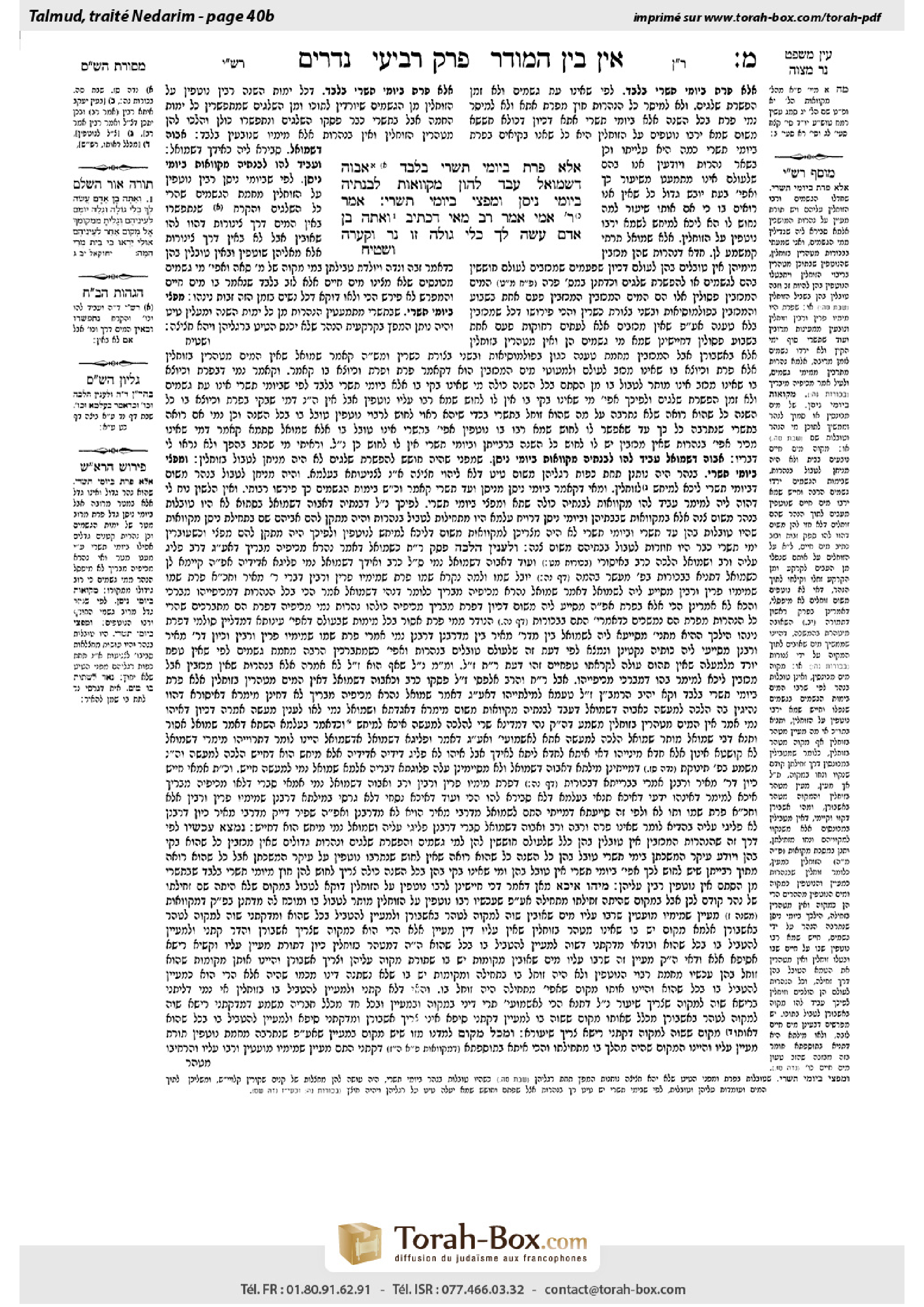
Nedarim 40b: Talmud study for Daf Yomi
Daf Yomi is the daily study of one Talmud folio. Explore 37 tractates with scans, Hebrew text, Sefaria English and AI-generated French translations where annotated.
Passage selection and English or AI-generated French translation are available where the scan has annotations. Daf Study is independent of Torah-Box and Sefaria.
Browse Nedarim · נדרים · All tractatesNedarim 40b text and translations
This page of Nedarim includes the Aramaic text, an English translation and an AI-generated French translation, alongside the scan above.
נדרים מ׳ ב · Aramaic and Hebrew text
אֶלָּא פְּרָת בְּיוֹמֵי תִשְׁרֵי בִּלְבַד.
אֲבוּהּ דִּשְׁמוּאֵל עֲבַד לְהוֹן מִקְווֹאוֹת לִבְנָתֵיהּ בְּיוֹמֵי נִיסָן, וּמַפָּצֵי בְּיוֹמֵי תִשְׁרֵי.
אָמַר רַבִּי אַמֵּי אָמַר רַב: מַאי דִּכְתִיב ״וְאַתָּה בֶן אָדָם עֲשֵׂה לְךָ כְּלֵי גוֹלָה״ — זוֹ נֵר וּקְעָרָה
Nedarim 40b · English translation
in the Euphrates River only during the days of Tishrei alone, as after the summer, when no rain falls, it is clear that the water in the river flows from the source of the river. During the rest of the year, rain and snow are mingled with the river water, and water from rain and snow purify one who immerses in them only when the water is standing.
The Gemara relates: Shmuel’s father fashioned ritual baths for his daughters during the days of Nisan and placed mats in the Euphrates River during the days of Tishrei. He fashioned ritual baths during Nisan due to the concern that the rainwater and snow water that accumulated in the river exceeded the amount of water that originated in the river’s sources. Since immersion in the flowing water would be ineffective, he fashioned ritual baths of standing water elsewhere for them. He placed mats during the days of Tishrei, when they immersed in the river itself, to prevent the mud on the riverbed from acting as an interposition that would invalidate the immersion.
Rabbi Ami said that Rav said: What is the meaning of that which is written: “And you, son of man, make for yourself implements of exile” (Ezekiel 12:3)? That is referring to a lamp, and a bowl,
Nedarim 40b · Traduction française (IA)
dans le fleuve Euphrate uniquement pendant les jours de Tichri, car après l’été, lorsqu’il ne tombe pas de pluie, il est clair que l’eau du fleuve provient de sa source. Pendant le reste de l’année, la pluie et la neige se mêlent à l’eau du fleuve, et l’eau de pluie et de neige ne purifie celui qui s’y immerge que lorsqu’elle est stagnante.
La Guemara rapporte : le père de Chmouel aménageait des bains rituels pour ses filles pendant les jours de Nissan et plaçait des nattes dans le fleuve Euphrate pendant les jours de Tichri. Il aménageait des bains rituels pendant Nissan, par crainte que l’eau de pluie et de neige accumulée dans le fleuve ne dépasse la quantité d’eau provenant des sources du fleuve. Puisque l’immersion dans l’eau courante aurait été inefficace, il leur aménageait ailleurs des bains rituels d’eau stagnante. Il plaçait des nattes pendant les jours de Tichri, où elles s’immergeaient dans le fleuve lui-même, afin que la boue du lit du fleuve ne fasse pas obstacle et n’invalide pas l’immersion.
Rabbi Ami a dit au nom de Rav : Quel est le sens de ce qui est écrit : « Et toi, fils de l’homme, prépare pour toi des objets d’exil » (Ézéchiel 12:3) ? Cela désigne une lampe et un bol,
Traduction française générée par IA à partir de l’édition anglaise de Sefaria. Vérifie toujours un passage avec le texte source.
Text from Sefaria: William Davidson Edition - Vocalized Aramaic (CC BY NC); William Davidson Edition - English (CC BY NC).