Nedarim 41a: Talmud study for Daf Yomi
Daf Yomi is the daily study of one Talmud folio. Explore 37 tractates with scans, Hebrew text, Sefaria English and AI-generated French translations where annotated.
Passage selection and English or AI-generated French translation are available where the scan has annotations. Daf Study is independent of Torah-Box and Sefaria.
Browse Nedarim · נדרים · All tractatesNedarim 41a text and translations
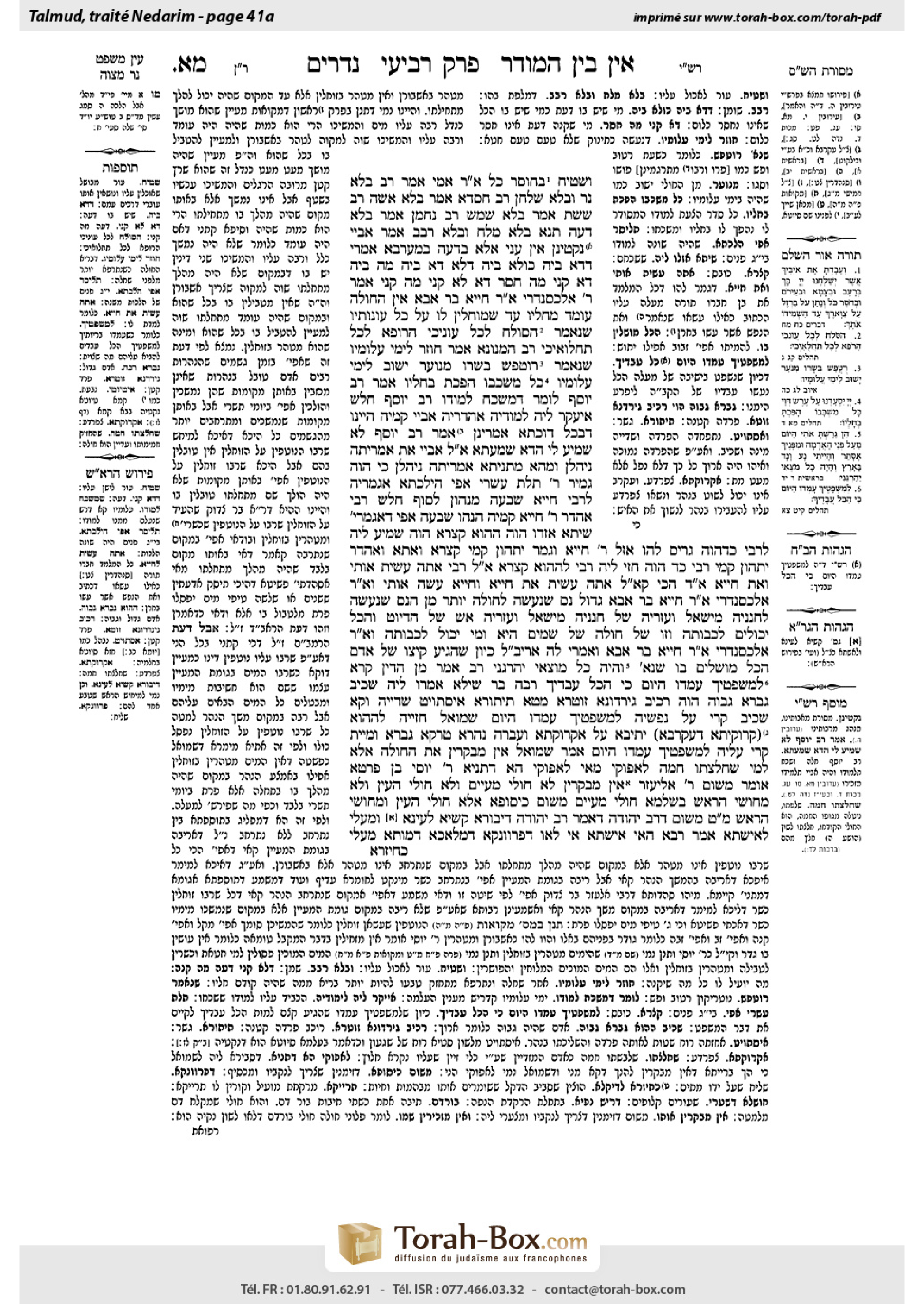
This page of Nedarim includes the Aramaic text, an English translation and an AI-generated French translation, alongside the scan above.
נדרים מ״א א · Aramaic and Hebrew text
וְשָׁטִיחַ. ״בְּחֹסֶר כֹּל״, אָמַר רַבִּי אַמֵּי אָמַר רַב: בְּלֹא נֵר וּבְלֹא שֻׁלְחָן. רַב חִסְדָּא אָמַר: בְּלֹא אִשָּׁה. רַב שֵׁשֶׁת אָמַר: בְּלֹא שַׁמָּשׁ. רַב נַחְמָן אָמַר: בְּלֹא דֵּעָה. תָּנָא: בְּלֹא מֶלַח וּבְלֹא רְבָב.
אָמַר אַבָּיֵי: נָקְטִינַן — אֵין עָנִי אֶלָּא בְּדֵעָה. בְּמַעְרְבָא אָמְרִי: דְּדָא בֵּיהּ — כּוּלָּא בֵּיהּ, דְּלָא דָּא בֵּיהּ — מָה בֵּיהּ. דָּא קָנֵי — מָה חָסַר, דָּא לָא קָנֵי — מָה קָנֵי.
אָמַר רַבִּי אֲלֶכְּסַנְדְּרִי אָמַר רַבִּי חִיָּיא בַּר אַבָּא: אֵין הַחוֹלֶה עוֹמֵד מֵחׇלְיוֹ עַד שֶׁמּוֹחֲלִין לוֹ עַל כֹּל עֲוֹנוֹתָיו, שֶׁנֶּאֱמַר: ״הַסֹּלֵחַ לְכׇל עֲוֹנֵכִי הָרֹפֵא לְכׇל תַּחֲלוּאָיְכִי״. רַב הַמְנוּנָא אָמַר: חוֹזֵר לִימֵי עֲלוּמָיו, שֶׁנֶּאֱמַר: ״רֻטְפַשׁ בְּשָׂרוֹ מִנֹּעַר יָשׁוּב לִימֵי עֲלוּמָיו״. ״כׇּל מִשְׁכָּבוֹ הָפַכְתָּ בְחׇלְיוֹ״, אָמַר רַב יוֹסֵף: לוֹמַר דִּמְשַׁכֵּחַ תַּלְמוּדוֹ.
רַב יוֹסֵף חֲלַשׁ, אִיעַקַּר לֵיהּ תַּלְמוּדֵיהּ, אַהְדְּרֵיהּ אַבָּיֵי קַמֵּיהּ. הַיְינוּ דִּבְכָל דּוּכְתָּא אָמְרִינַן, אָמַר רַב יוֹסֵף: לָא שְׁמִיעַ לִי הָדָא שְׁמַעְתָּא, אֲמַר לֵיהּ אַבָּיֵי: אַתְּ אַמְרִיתַהּ נִיהֲלַן, וּמַהָא מַתְנִיתָא אַמְרִיתַהּ נִיהֲלַן.
כִּי הֲוָה גְּמִיר רַבִּי תְּלָת עֶשְׂרֵי אַפֵּי הִילְכָתָא, אַגְמְרֵיהּ לְרַבִּי חִיָּיא שִׁבְעָה מִנְּהוֹן. לְסוֹף חֲלַשׁ רַבִּי, אַהְדַּר רַבִּי חִיָּיא קַמֵּיהּ הָנְהוּ שִׁבְעָה אַפֵּי דְּאַגְמְרֵיהּ, שִׁיתָּא אַזְּדּוּ. הֲוָה הָהוּא קַצָּרָא, הֲוָה שְׁמִיעַ לֵיהּ לְרַבִּי כְּדַהֲוָה גָּרֵיס לְהוּ. אֲזַל רַבִּי חִיָּיא וּגְמַר יָתְהוֹן קַמֵּי קַצָּרָא וַאֲתָא וְאַהְדַּר יָתְהוֹן קַמֵּי רַבִּי. כַּד הֲוָה חָזֵי לֵיהּ רַבִּי לְהָהוּא קַצָּרָא אֲמַר לֵיהּ רַבִּי: אַתָּה עָשִׂיתָ אוֹתִי וְאֶת חִיָּיא. אִיכָּא דְאָמְרִי, הָכִי קָאָמַר לֵיהּ: אַתָּה עָשִׂיתָ אֶת חִיָּיא, וְחִיָּיא עָשָׂה אוֹתִי.
וְאָמַר רַבִּי אֲלֶכְּסַנְדְּרִי אָמַר רַבִּי חִיָּיא בַּר אַבָּא: גָּדוֹל נֵס שֶׁנַּעֲשֶׂה לַחוֹלֶה יוֹתֵר מִן הַנֵּס שֶׁנַּעֲשָׂה לַחֲנַנְיָה מִישָׁאֵל וַעֲזַרְיָה. שֶׁל חֲנַנְיָה מִישָׁאֵל וַעֲזַרְיָה אֵשׁ שֶׁל הֶדְיוֹט, וְהַכֹּל יְכוֹלִים לְכַבּוֹתָהּ. וְזוֹ שֶׁל חוֹלֶה — שֶׁל שָׁמַיִם הִיא, וּמִי יָכוֹל לְכַבּוֹתָהּ?
וְאָמַר רַבִּי אֲלֶכְּסַנְדְּרִי אָמַר רַבִּי חִיָּיא בַּר אַבָּא וְאָמְרִי לַהּ אָמַר רַבִּי יְהוֹשֻׁעַ בֶּן לֵוִי: כֵּיוָן שֶׁהִגִּיעַ קִיצּוֹ שֶׁל אָדָם הַכֹּל מוֹשְׁלִים בּוֹ, שֶׁנֶּאֱמַר: ״וְהָיָה כׇל מֹצְאִי יַהַרְגֵנִי״. רַב אָמַר מִן הָדֵין קְרָא: ״לְמִשְׁפָּטֶיךָ עָמְדוּ הַיּוֹם כִּי הַכֹּל עֲבָדֶיךָ״.
רַבָּה בַּר שֵׁילָא אֲמַרוּ לֵיהּ: שְׁכֵיב גַּבְרָא. גָּבוֹהַּ הֲוָה, רְכִיב גִּירְדּוֹנָא זוּטְרָא, מְטָא תִּיתּוּרָא אִיסְתְּוִיט, שַׁדְיֵיהּ וְקָא שָׁכֵיב. קָרֵי עַל נַפְשֵׁיהּ: ״לְמִשְׁפָּטֶיךָ עָמְדוּ הַיּוֹם״.
שְׁמוּאֵל חַזְיַיהּ לְהָהוּא קְרוּקִיתָא דְעַקְרַבָּא יְתִיבָא עַל אַקְרוּקְתָּא וְעָבְרָה נַהֲרָא טָרְקָא גַּבְרָא וּמָיֵית. קָרֵי עֲלֵיהּ ״לְמִשְׁפָּטֶיךָ עָמְדוּ הַיּוֹם״.
אָמַר שְׁמוּאֵל: אֵין מְבַקְּרִין אֶת הַחוֹלֶה אֶלָּא לְמִי שֶׁחֲלָצַתּוּ חַמָּה. לְאַפּוֹקֵי מַאי? לְאַפּוֹקֵי הָא דְּתַנְיָא, רַבִּי יוֹסֵי בֶּן פְּרָטָא אוֹמֵר מִשּׁוּם רַבִּי אֱלִיעֶזֶר: אֵין מְבַקְּרִין לֹא חוֹלֵי מֵעַיִים וְלֹא חוֹלֵי הָעַיִן וְלֹא מְחוּשֵׁי הָרֹאשׁ. בִּשְׁלָמָא חוֹלֵי מֵעַיִים — מִשּׁוּם כִּיסּוּפָא. אֶלָּא חוֹלֵי הָעַיִן וּמְחוּשֵׁי הָרֹאשׁ מַאי טַעְמָא?
מִשּׁוּם דְּרַב יְהוּדָה, דְּאָמַר רַב יְהוּדָה: דִּיבּוּרָא קַשְׁיָא לְעֵינָא וּמְעַלֵּי לְאִישָּׁתָא. אָמַר רָבָא: הַאי אִישָּׁתָא, אִי לָאו דְּפַרְווֹנְקָא דְּמַלְאֲכָא דְמוֹתָא, מְעַלֵּי
Nedarim 41a · English translation
and a rug, as an exile needs those items and they are portable. The Sages interpreted the following verse describing the exile experience: “Therefore shall you serve your enemy whom the Lord shall send against you, in hunger, and in thirst, and in nakedness, and in want of all things; and he shall put a yoke of iron upon your neck, until he has destroyed you” (Deuteronomy 28:48). Rabbi Ami said that Rav said: “In want of all things” means without a lamp and without a table to eat upon. Rav Ḥisda said: Without a wife. Rav Sheshet said: Without an attendant to aid him. Rav Naḥman said: Without intelligence. One of the Sages teaches in a baraita: Without salt and without fat [revav] in which to dip his bread.
Abaye said that we have a tradition: A poor person is only one lacking in intelligence, in agreement with the opinion of Rav Naḥman. In the West, Eretz Yisrael, they say: One who has this attribute, intelligence, in him has everything in him. One who does not have this attribute in him, what is in him? If he acquired this, what else is lacking? If he has not acquired this, what has he acquired?
§ Rabbi Alexandri said that Rabbi Ḥiyya bar Abba said: The sick person recovers from his illness only when the heavenly court forgives him for all his sins, as it is stated: “Who forgives all your iniquity; Who heals all your diseases” (Psalms 103:3). Rav Hamnuna said: When he recovers, he returns to the days of his youth, as it is stated in a verse with regard to one recovering from illness: “His flesh is tenderer than a child’s; he returns to the days of his youth” (Job 33:25). Interpreting the verse: “The Lord will support him upon the bed of suffering; You overturned all his lying down in his illness” (Psalms 41:4), Rav Yosef said: That is to say that the sick person forgets his studies, as everything that is organized is overturned.
The Gemara relates: Rav Yosef himself fell ill and his studies were forgotten. Abaye restored his studies by reviewing what he had learned from Rav Yosef before him. This is the background for that which we say everywhere throughout the Talmud, that Rav Yosef said: I did not learn this halakha, and Abaye said to him in response: You said this to us and it was from this baraita that you said it to us.
The Gemara relates: When Rabbi Yehuda HaNasi would learn thirteen aspects of a halakha on a certain issue, he taught Rabbi Ḥiyya seven of them. Ultimately, Rabbi Yehuda HaNasi fell ill and forgot all thirteen aspects. Rabbi Ḥiyya restored those seven aspects that Rabbi Yehuda HaNasi taught him by reviewing them before Rabbi Yehuda HaNasi. However, six were gone and forgotten, as Rabbi Yehuda HaNasi had not taught them to anyone. There was a certain launderer who would hear Rabbi Yehuda HaNasi when he was studying those halakhot. Rabbi Ḥiyya went and learned those halakhot from the launderer and he came and restored them by reviewing them before Rabbi Yehuda HaNasi. When Rabbi Yehuda HaNasi saw that launderer, Rabbi Yehuda HaNasi said to him: You made me and Ḥiyya, as we were able to learn these halakhot that otherwise would have been forgotten. Some say that this is what he said to the launderer: You made Ḥiyya, and Ḥiyya made me.
And Rabbi Alexandri said that Rabbi Ḥiyya bar Abba said: Greater is the miracle performed for the sick person than the miracle that was performed for Hananiah, Mishael, and Azariah, who were rescued from the fiery furnace (see Daniel, chapter 3), as in the miracle of Hananiah, Mishael, and Azariah, they were rescued from the fire of a layman, and anyone is capable of extinguishing it. And that fire afflicting a sick person with a fever is the fire of Heaven, and who can extinguish it?
And Rabbi Alexandri said that Rabbi Ḥiyya bar Abba said, and some say Rabbi Yehoshua ben Levi said: Once the end of the time allotted for the life of a person arrived, everything has dominion over him, as it is stated that Cain said: “Whosoever finds me will slay me” (Genesis 4:14). Cain feared that since God sentenced him to death he would be susceptible to all threats and vulnerable to anyone seeking to murder him. Rav said that it is derived from this verse: “They stand this day according to Your judgments; for all are Your servants” (Psalms 119:91). When the decree emerges from Heaven that the time has arrived for a person to die, everyone is a servant of God, an agent to kill him.
The Gemara relates that people said to Rabba bar Sheila: A man died. This person was tall and was riding on a small mule [giredona]. When he reached a bridge [tittora], the mule was frightened [istavveit] and cast off the rider, and although the rider was tall and the mule was short and the rider did not fall far, he died. Rabba bar Sheila read the verse and applied it to the rider: “They stand this day according to Your judgments.”
Shmuel saw a certain frog [kerokita], and also noticed that a scorpion was sitting upon the frog and the frog crossed the river. The scorpion stung a man on the other side of the river and the man died. Shmuel read and applied the verse to the dead man: “They stand this day according to Your judgments.” Even the frog and scorpion are servants and agents of God. The only way the scorpion could reach the man and kill him was by means of the frog taking it across the river.
§ Shmuel said: One visits a sick person only if that person is one whom fever overcame. The Gemara asks: What illnesses does this statement come to exclude? The Gemara answers: It comes to exclude that which is taught in a baraita: Rabbi Yosei ben Perata says in the name of Rabbi Eliezer: One visits neither those with intestinal illness, nor those with eye illness, nor those suffering from headaches. The Gemara asks: Granted, one does not visit those with intestinal sickness, due to the sick person’s embarrassment, as he would need to frequently relieve himself and it would be awkward for him in the presence of the visitor. However, what is the reason that one does not visit those with eye illnesses and headaches?
The Gemara answers: It is due to that which Rav Yehuda said, as Rav Yehuda said: Speech is injurious for the eye and beneficial for curing a fever. Therefore, if one suffers from pain in his eye or his head it is better for him not to talk. If he has visitors, he will need to speak to them, which will cause him harm. Rava said: With regard to this fever [ishta], were it not the agent [parvanka] of the Angel of Death, i.e., the cause of serious, potentially deadly illnesses, it could be deemed beneficial,
Nedarim 41a · Traduction française (IA)
et un tapis, car un exilé a besoin de ces objets, qui sont transportables. Les Sages ont interprété le verset suivant, qui décrit l’expérience de l’exil : « C’est pourquoi tu serviras tes ennemis que l’Éternel enverra contre toi, dans la faim, dans la soif, dans la nudité et dans le manque de toute chose ; ils mettront un joug de fer sur ton cou, jusqu’à ce qu’ils t’aient détruit » (Deutéronome 28,48). Rabbi Ami a dit au nom de Rav : « Dans le manque de toute chose » signifie sans lampe et sans table pour prendre son repas. Rav Ḥisda a dit : sans épouse. Rav Sheshet a dit : sans serviteur pour l’aider. Rav Naḥman a dit : sans intelligence. Un des Sages enseigne dans une baraïta : sans sel et sans graisse [revav] dans laquelle tremper son pain.
Abaye a dit que nous avons une tradition : un pauvre n’est qu’une personne qui manque d’intelligence, conformément à l’avis de Rav Naḥman. En Occident, en Eretz Israël, on dit : celui qui possède cette qualité, l’intelligence, possède tout. Celui qui ne la possède pas, que possède-t-il ? S’il l’a acquise, que lui manque-t-il encore ? S’il ne l’a pas acquise, qu’a-t-il acquis ?
§ Rabbi Alexandri a dit au nom de Rabbi Ḥiyya bar Abba : le malade ne guérit de sa maladie que lorsque le tribunal céleste lui a pardonné tous ses péchés, comme il est dit : « Lui qui pardonne toutes tes fautes, qui guérit toutes tes maladies » (Psaumes 103,3). Rav Hamnuna a dit : lorsqu’il guérit, il retrouve les jours de sa jeunesse, comme il est dit au sujet de celui qui se remet d’une maladie : « Sa chair est plus tendre que celle d’un enfant ; il revient aux jours de sa jeunesse » (Job 33,25). À propos du verset : « L’Éternel le soutiendra sur son lit de souffrance ; tu as bouleversé toute sa couche dans sa maladie » (Psaumes 41,4), Rav Yosef a dit : cela signifie que le malade oublie son étude, car tout ce qui était ordonné est bouleversé.
La Guemara rapporte : Rav Yosef lui-même tomba malade et oublia ses études. Abaye les lui restitua en révisant avec lui ce qu’il avait appris auparavant de Rav Yosef. C’est le contexte de ce que nous disons partout dans le Talmud : Rav Yosef dit : « Je n’ai pas appris cette halakha », et Abaye lui répond : « Tu nous l’as enseignée, et c’est de cette baraïta que tu nous l’as enseignée. »
La Guemara rapporte : lorsque Rabbi Yehuda HaNasi étudiait treize aspects d’une halakha sur un sujet donné, il en enseignait sept à Rabbi Ḥiyya. Finalement, Rabbi Yehuda HaNasi tomba malade et oublia les treize aspects. Rabbi Ḥiyya lui restitua les sept aspects que Rabbi Yehuda HaNasi lui avait enseignés, en les révisant devant lui. Mais six avaient disparu et étaient oubliés, car Rabbi Yehuda HaNasi ne les avait enseignés à personne. Un blanchisseur entendait Rabbi Yehuda HaNasi étudier ces halakhot. Rabbi Ḥiyya alla apprendre ces halakhot auprès du blanchisseur, puis vint les restituer en les révisant devant Rabbi Yehuda HaNasi. Lorsque Rabbi Yehuda HaNasi vit ce blanchisseur, il lui dit : « Tu nous as faits, Rabbi Ḥiyya et moi », car nous avons pu apprendre ces halakhot qui, autrement, auraient été oubliées. Certains disent qu’il dit au blanchisseur : « Tu as fait Rabbi Ḥiyya, et Rabbi Ḥiyya m’a fait. »
Et Rabbi Alexandri a dit au nom de Rabbi Ḥiyya bar Abba : le miracle accompli pour le malade est plus grand que celui qui fut accompli pour Hananiah, Mishael et Azariah, sauvés de la fournaise ardente (voir Daniel, chapitre 3). En effet, Hananiah, Mishael et Azariah furent sauvés du feu d’un homme, que n’importe qui peut éteindre. Mais le feu qui accable le malade de fièvre est un feu céleste : qui peut l’éteindre ?
Et Rabbi Alexandri a dit au nom de Rabbi Ḥiyya bar Abba — certains disent que c’est Rabbi Yehoshua ben Levi qui l’a dit : dès que le terme fixé pour la vie d’une personne est arrivé, tout a pouvoir sur elle, comme il est dit que Caïn déclara : « Quiconque me trouvera me tuera » (Genèse 4,14). Caïn craignait que, puisque Dieu l’avait condamné à mort, il fût désormais exposé à toutes les menaces et vulnérable à quiconque voudrait le tuer. Rav a dit que cela se déduit du verset : « Ils subsistent aujourd’hui selon tes jugements, car tous sont tes serviteurs » (Psaumes 119,91). Lorsque le décret émane du Ciel, signifiant que le terme est arrivé pour qu’une personne meure, tous sont les serviteurs de Dieu, chargés de la tuer.
La Guemara rapporte que des gens dirent à Rabba bar Sheila : un homme est mort. Cet homme était grand et montait une petite mule [giredona]. Lorsqu’il arriva à un pont [tittora], la mule prit peur [istavveit] et le jeta à terre ; bien que le cavalier fût grand, que la mule fût petite et qu’il ne fût pas tombé de haut, il mourut. Rabba bar Sheila lut le verset et l’appliqua au cavalier : « Ils subsistent aujourd’hui selon tes jugements. »
Shmuel vit une grenouille [kerokita] et remarqua aussi qu’un scorpion était assis sur elle ; la grenouille traversa le fleuve. Le scorpion piqua un homme sur l’autre rive, et l’homme mourut. Shmuel lut le verset et l’appliqua au défunt : « Ils subsistent aujourd’hui selon tes jugements. » Même la grenouille et le scorpion sont des serviteurs et des agents de Dieu. Le scorpion ne pouvait atteindre l’homme et le tuer qu’en étant transporté de l’autre côté du fleuve par la grenouille.
§ Shmuel a dit : on ne rend visite à un malade que si celui-ci a été terrassé par la fièvre. La Guemara demande : quelles maladies cette déclaration entend-elle exclure ? La Guemara répond : elle exclut ce qui est enseigné dans une baraïta : Rabbi Yosei ben Perata dit au nom de Rabbi Eliezer : on ne rend visite ni à ceux qui souffrent d’une affection intestinale, ni à ceux qui ont une maladie des yeux, ni à ceux qui souffrent de maux de tête. La Guemara demande : il est compréhensible qu’on ne rende pas visite à ceux qui souffrent d’une affection intestinale, par égard pour leur gêne, car ils devraient se soulager fréquemment, ce qui serait embarrassant en présence du visiteur. Mais pourquoi ne rend-on pas visite à ceux qui ont une maladie des yeux ou des maux de tête ?
La Guemara répond : c’est en raison de ce qu’a dit Rav Yehuda, car Rav Yehuda a dit : la parole nuit aux yeux et aide à guérir la fièvre. Par conséquent, si quelqu’un souffre des yeux ou de la tête, il vaut mieux qu’il ne parle pas. S’il reçoit des visiteurs, il devra leur parler, ce qui lui nuira. Rava a dit : quant à cette fièvre [ishta], si elle n’était pas l’agent [parvanka] de l’Ange de la Mort, c’est-à-dire la cause de maladies graves susceptibles d’être mortelles, on pourrait la considérer comme bénéfique,
Traduction française générée par IA à partir de l’édition anglaise de Sefaria. Vérifie toujours un passage avec le texte source.
Text from Sefaria: William Davidson Edition - Vocalized Aramaic (CC BY NC); William Davidson Edition - English (CC BY NC).