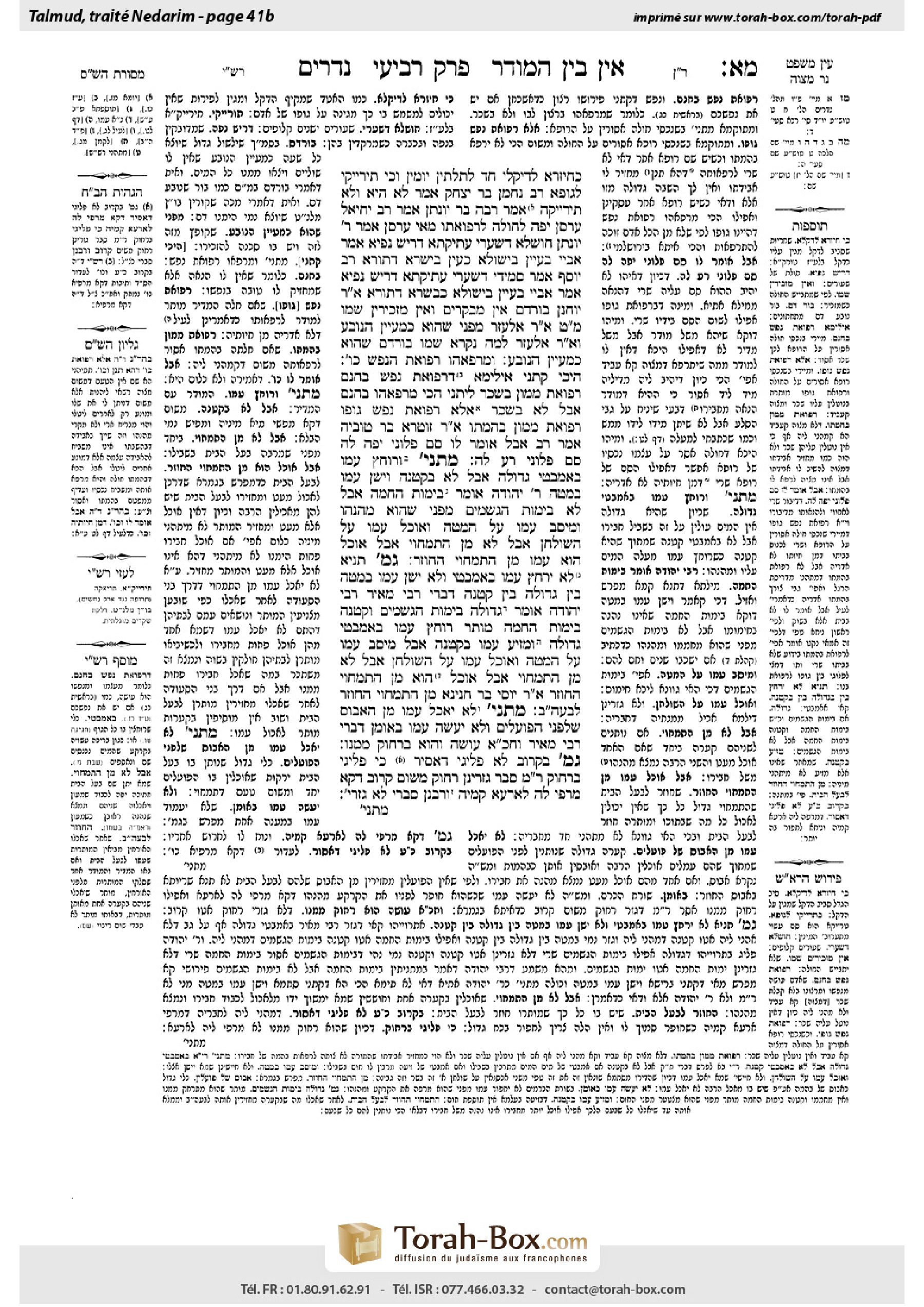
Nedarim 41b: Talmud study for Daf Yomi
Daf Yomi is the daily study of one Talmud folio. Explore 37 tractates with scans, Hebrew text, Sefaria English and AI-generated French translations where annotated.
Passage selection and English or AI-generated French translation are available where the scan has annotations. Daf Study is independent of Torah-Box and Sefaria.
Browse Nedarim · נדרים · All tractatesNedarim 41b text and translations
This page of Nedarim includes the Aramaic text, an English translation and an AI-generated French translation, alongside the scan above.
נדרים מ״א ב · Aramaic and Hebrew text
כְּחִיזְרָא לְדִיקְלֵי, חַד לִתְלָתִין יוֹמִין, וְכִי תִּירְיָיקִי לְגוּפָא. רַב נַחְמָן בַּר יִצְחָק אָמַר: לָא הִיא וְלָא תִּירְיָיקָה.
אָמַר רַבָּה בַּר יוֹנָתָן אָמַר רַב יְחִיאֵל: עַרְסָן יָפֶה לַחוֹלֶה לִרְפוּאָתוֹ. מַאי עַרְסָן? אָמַר רַבִּי יוֹנָתָן: חוּשְׁלָא דִּשְׂעָרֵי עַתִּיקָתָא דְּרֵישׁ נָפְיָא, אָמַר אַבָּיֵי: בָּעֲיָין בִּישּׁוּלָא כְּעֵין בִּישְׂרָא דְתוֹרָא. רַב יוֹסֵף אָמַר: סְמִידֵי דִּשְׂעָרֵי עַתִּיקָתָא דְּרֵישׁ נָפְיָא, אָמַר אַבָּיֵי: בָּעֲיָין בִּישּׁוּלָא כְּבִשְׂרָא דְתוֹרָא.
אָמַר רַבִּי יוֹחָנָן: בּוֹרְדָם, אֵין מְבַקְּרִים וְאֵין מַזְכִּירִין שְׁמוֹ. מַאי טַעְמָא? אָמַר רַבִּי אֶלְעָזָר: מִפְּנֵי שֶׁהוּא כְּמַעְיָין הַנּוֹבֵעַ. וְאָמַר רַבִּי אֶלְעָזָר: לָמָּה נִקְרָא שְׁמוֹ ״בּוֹרְדָם״ — שֶׁהוּא כְּמַעְיָין הַנּוֹבֵעַ.
וּמְרַפְּאֵהוּ רְפוּאַת הַנֶּפֶשׁ כּוּ׳. הֵיכִי קָתָנֵי? אִילֵּימָא דִּרְפוּאַת נֶפֶשׁ בְּחִנָּם, רְפוּאַת מָמוֹן בְּשָׂכָר, לִיתְנֵי הָכִי: מְרַפְּאֵהוּ בְּחִנָּם, אֲבָל לֹא בְּשָׂכָר! אֶלָּא: רְפוּאַת נֶפֶשׁ — גּוּפוֹ, רְפוּאַת מָמוֹן — בְּהֶמְתּוֹ. אָמַר רַבִּי זוּטְרָא בַּר טוֹבִיָּה אָמַר רַב: אֲבָל אוֹמֵר לוֹ ״סַם פְּלוֹנִי יָפֶה לָהּ, סַם פְּלוֹנִי רַע לָהּ״.
מַתְנִי׳ וְרוֹחֵץ עִמּוֹ בְּאַמְבָּטִי גְּדוֹלָה, אֲבָל לֹא בִּקְטַנָּה. וְיָשֵׁן עִמּוֹ בַּמִּטָּה.
רַבִּי יְהוּדָה אוֹמֵר: בִּימוֹת הַחַמָּה, אֲבָל לֹא בִּימוֹת הַגְּשָׁמִים, מִפְּנֵי שֶׁהוּא מַהֲנֵהוּ. וּמֵיסֵב עִמּוֹ עַל הַמִּטָּה. וְאוֹכֵל עִמּוֹ עַל הַשּׁוּלְחָן, אֲבָל לֹא מִן הַתַּמְחוּי. אֲבָל אוֹכֵל הוּא עִמּוֹ מִן הַתַּמְחוּי הַחוֹזֵר.
גְּמָ׳ תַּנְיָא: לֹא יִרְחַץ עִמּוֹ בְּאַמְבָּטִי, וְלֹא יִשַׁן עִמּוֹ בַּמִּטָּה, בֵּין גְּדוֹלָה בֵּין קְטַנָּה, דִּבְרֵי רַבִּי מֵאִיר. רַבִּי יְהוּדָה אוֹמֵר: גְּדוֹלָה בִּימוֹת הַגְּשָׁמִים, וּקְטַנָּה בִּימוֹת הַחַמָּה — מוּתָּר. רוֹחֵץ עִמּוֹ בְּאַמְבָּטִי גְּדוֹלָה, וּמַזִּיעַ עִמּוֹ בִּקְטַנָּה. אֲבָל מֵיסֵב עִמּוֹ עַל הַמִּטָּה וְאוֹכֵל עִמּוֹ עַל הַשּׁוּלְחָן, אֲבָל לֹא מִן הַתַּמְחוּי. אֲבָל אוֹכֵל הוּא מִן הַתַּמְחוּי הַחוֹזֵר. אָמַר רַבִּי יוֹסֵי בַּר חֲנִינָא: מִן הַתַּמְחוּי הַחוֹזֵר לְבַעַל הַבַּיִת.
מַתְנִי׳ לֹא יֹאכַל עִמּוֹ מִן הָאֵבוּס שֶׁלִּפְנֵי הַפּוֹעֲלִים, וְלֹא יַעֲשֶׂה עִמּוֹ בָּאוּמָן, דִּבְרֵי רַבִּי מֵאִיר. וַחֲכָמִים אוֹמְרִים: עוֹשֶׂה וְהוּא בָּרָחוֹק מִמֶּנּוּ.
גְּמָ׳ בְּקָרוֹב לָא פְּלִיגִי דַּאֲסִיר. כִּי פְּלִיגִי בְּרִחוּק, רַבִּי מֵאִיר סָבַר: גָּזְרִינַן רָחוֹק מִשּׁוּם קָרוֹב, דְּקָא מְרַפֵּי לֵהּ לְאַרְעָא קַמֵּיהּ. וְרַבָּנַן סָבְרִי: לָא גָּזְרִינַן.
Nedarim 41b · English translation
like thorns for palm trees, as the thorns prevent people and animals from touching and ruining the dates. The fever is advantageous if its incidence is once in thirty days, and it is like an antidote [tiraiki] for poison in the body. Rav Naḥman bar Yitzḥak said: It is preferable for one to have neither fever nor the benefits of its capacity to serve as an antidote.
Rabba bar Yonatan said that Rav Yeḥiel said: Arsan is beneficial for the sick person for his cure. The Gemara asks: What is arsan? Rabbi Yonatan said: It is old hulled barley from the beginning of the sifting process. Abaye said: And that barley requires extensive cooking like the meat of a bull. Rav Yosef said: Arsan is fine flour [semida] ground from old barley from the beginning of the sifting process. Abaye said: And that flour requires extensive cooking like the meat of a bull.
Rabbi Yoḥanan said: One does not visit a person suffering from buredam, an intestinal illness, nor is the name of that illness mentioned, because it is embarrassing for the one suffering from the illness. The Gemara asks: What is the reason that one does not visit him? Rabbi Elazar said: It is due to the fact that he is like a flowing spring, as the symptom of the illness is severe diarrhea. And Rabbi Elazar said: Why is the illness called buredam? It is due to the fact that the one suffering from the illness is like a flowing spring, a bottomless pit [bor] of blood [dam].
§ We learned in the mishna that if one is prohibited by a vow from deriving benefit from another, that other person heals him with a cure of the nefesh but not a cure of property [mamon]. The Gemara asks: How is the mishna taught? If we say that cure of the nefesh means that he cures him for free and cure of mamon means that he cures him for a fee, then let the mishna teach this: He cures him for free but not for a fee. Rather, cure of the nefesh means that he cures his body, and cure of mamon means that he cures his animal. Rabbi Zutra bar Toviya said that Rav said: It is prohibited to cure the animal. However, he says to him: Such and such medicine is beneficial for the animal, and such and such medicine is harmful for the animal. Advice, as opposed to treatment, is not considered benefit.
MISHNA: And with regard to another person who is prohibited from deriving benefit from him, one may bathe with him in a large bath [ambati], in which his presence does not affect the other person. However, he may not bathe with him in a small bath, as his presence moderates the temperature of water if it is too hot or too cold, thereby benefiting the other person. And he may sleep with him in one bed.
Rabbi Yehuda says: That is permitted during the days of summer, but he may not sleep with him in one bed during the rainy season, i.e., the winter, because he benefits him by warming the bed. And he may recline with him on a divan even during the rainy season, as no benefit is involved. And he may eat with him at the same table, but not from a common platter from which several people eat, as if one leaves food on the platter, the other derives benefit from him. However, he may eat with him from a platter that returns to the host, as everyone takes a small portion and leaves food on the platter. No benefit is derived. Since there is enough food for everyone, none of the diners receives part of another’s portion.
GEMARA: It is taught in a baraita: One may neither bathe with him in a bath nor sleep with him in a bed, and there is no difference whether it is a large bed or whether it is a small bed; this is the statement of Rabbi Meir. Rabbi Yehuda says: It is permitted for him to sleep with him in a large bed during the rainy season and a small bed during the days of summer, as no benefit is derived. He may bathe with him in a large bath and sweat with him in a small one, as his presence provides no benefit for the other. However, he may recline with him on a divan, and he may eat with him at the same table but not from a common platter. However, he may eat with him from a platter that returns. Rabbi Yosei bar Ḥanina said: That means a platter that returns to the host.
MISHNA: One may neither eat with him from the large vessel of food placed before the laborers, nor may he work with him in the same row in a vineyard; this is the statement of Rabbi Meir. And the Rabbis say: He may work in the same row with him provided that he is at a distance from him. If he is close, the other would derive forbidden benefit from him.
GEMARA: In a case where one is proximate to the other, the tanna’im do not disagree that it is prohibited for them to work together. When they disagree, it is in a case where one is distant from the other. Rabbi Meir holds: We issue a decree prohibiting their working together when one is distant from the other, due to the prohibition against their working together when one is proximate to the other, as he loosens for him the earth before him. And the Rabbis hold: We do not issue a decree.
Nedarim 41b · Traduction française (IA)
comme les épines pour les palmiers, car elles empêchent les hommes et les animaux de toucher aux dattes et de les abîmer. La fièvre est bénéfique lorsqu’elle survient une fois tous les trente jours : elle est comme un antidote [tiraiki] contre le poison présent dans le corps. Rav Naḥman bar Yitzḥak dit : Mieux vaut ne souffrir ni de fièvre ni bénéficier de sa capacité à servir d’antidote.
Rabba bar Yonatan dit au nom de Rav Yeḥiel : L’arsan est bénéfique au malade pour le guérir. La Guemara demande : Qu’est-ce que l’arsan ? Rabbi Yonatan dit : C’est de l’orge ancienne mondée, provenant du début du processus de tamisage. Abaye dit : Cette orge nécessite une longue cuisson, comme la viande d’un taureau. Rav Yosef dit : L’arsan est une farine fine [semida], moulue à partir d’orge ancienne provenant du début du processus de tamisage. Abaye dit : Cette farine nécessite une longue cuisson, comme la viande d’un taureau.
Rabbi Yoḥanan dit : On ne rend pas visite à une personne souffrant de buredam, une maladie intestinale, et on ne mentionne pas non plus le nom de cette maladie, car cela embarrasse la personne qui en souffre. La Guemara demande : Pourquoi ne lui rend-on pas visite ? Rabbi Elazar dit : Parce qu’il est comme une source jaillissante, le symptôme de cette maladie étant une diarrhée sévère. Et Rabbi Elazar dit : Pourquoi cette maladie s’appelle-t-elle buredam ? Parce que celui qui en souffre est comme une source jaillissante, une fosse [bor] sans fond de sang [dam].
§ Nous avons appris dans la Michna que si une personne a fait vœu de ne tirer aucun profit d’une autre, cette dernière peut la soigner par un traitement de l’âme [nefesh], mais pas par un traitement du patrimoine [mamon]. La Guemara demande : Comment faut-il comprendre la formulation de la Michna ? Si le traitement de l’âme signifie qu’il la soigne gratuitement et que le traitement du mamon signifie qu’il la soigne contre rémunération, alors la Michna aurait dû enseigner : « Il la soigne gratuitement, mais pas contre rémunération. » Il faut plutôt comprendre que le traitement de l’âme signifie qu’il soigne son corps, et que le traitement du mamon signifie qu’il soigne son animal. Rabbi Zutra bar Toviya dit au nom de Rav : Il est interdit de soigner l’animal. Cependant, il peut lui dire : « Tel médicament est bénéfique pour l’animal, et tel autre lui est nuisible. » Un conseil, contrairement à un traitement, n’est pas considéré comme un profit.
MICHNA : Quant à une autre personne qui n’a pas le droit de tirer profit de lui, il peut se baigner avec elle dans un grand bain [ambati], où sa présence n’a pas d’incidence sur l’autre. Cependant, il ne peut pas se baigner avec elle dans un petit bain, car sa présence modère la température de l’eau lorsqu’elle est trop chaude ou trop froide, procurant ainsi un avantage à l’autre. Et il peut dormir avec elle dans le même lit.
Rabbi Yehuda dit : Cela est permis pendant les jours d’été, mais il ne peut pas dormir avec lui dans le même lit pendant la saison des pluies, c’est-à-dire en hiver, car il lui procure un avantage en réchauffant le lit. Il peut s’allonger avec lui sur un divan même pendant la saison des pluies, car cela n’implique aucun avantage. Il peut manger avec lui à la même table, mais pas dans un plat commun dont plusieurs personnes se servent, car si l’un laisse de la nourriture dans le plat, l’autre en tire profit. Cependant, il peut manger avec lui dans un plat qui revient à l’hôte, car chacun en prend une petite portion et laisse de la nourriture dans le plat. Il n’en résulte aucun profit. Puisqu’il y a assez de nourriture pour tous, aucun des convives ne reçoit une partie de la portion d’un autre.
GUEMARA : Il est enseigné dans une baraïta : On ne peut ni se baigner avec lui dans un bain ni dormir avec lui dans un lit, qu’il s’agisse d’un grand lit ou d’un petit lit. Telle est l’opinion de Rabbi Meir. Rabbi Yehuda dit : Il peut dormir avec lui dans un grand lit pendant la saison des pluies et dans un petit lit pendant les jours d’été, car il n’en tire aucun profit. Il peut se baigner avec lui dans un grand bain et transpirer avec lui dans un petit bain, car sa présence ne procure aucun avantage à l’autre. Il peut aussi s’allonger avec lui sur un divan et manger avec lui à la même table, mais pas dans un plat commun. Cependant, il peut manger avec lui dans un plat qui revient à l’hôte. Rabbi Yosei bar Ḥanina dit : Cela désigne un plat qui revient à l’hôte.
MICHNA : Il ne peut ni manger avec lui dans le grand récipient de nourriture placé devant les ouvriers, ni travailler avec lui sur le même rang dans une vigne. Telle est l’opinion de Rabbi Meir. Les Sages disent : Il peut travailler avec lui sur le même rang, à condition de se tenir à distance de lui. S’il est proche, l’autre tirerait de lui un profit interdit.
Dans le cas où l’un est proche de l’autre, les tannaïm ne sont pas en désaccord : il leur est interdit de travailler ensemble. Leur désaccord porte sur le cas où l’un est éloigné de l’autre. Rabbi Meir considère que l’on édicte un décret interdisant de travailler ensemble lorsque l’un est éloigné de l’autre, en raison de l’interdiction de travailler ensemble lorsque l’un est proche de l’autre, puisqu’il ameublit la terre devant lui. Les Sages considèrent que l’on n’édicte pas de décret.
Traduction française générée par IA à partir de l’édition anglaise de Sefaria. Vérifie toujours un passage avec le texte source.
Text from Sefaria: William Davidson Edition - Vocalized Aramaic (CC BY NC); William Davidson Edition - English (CC BY NC).