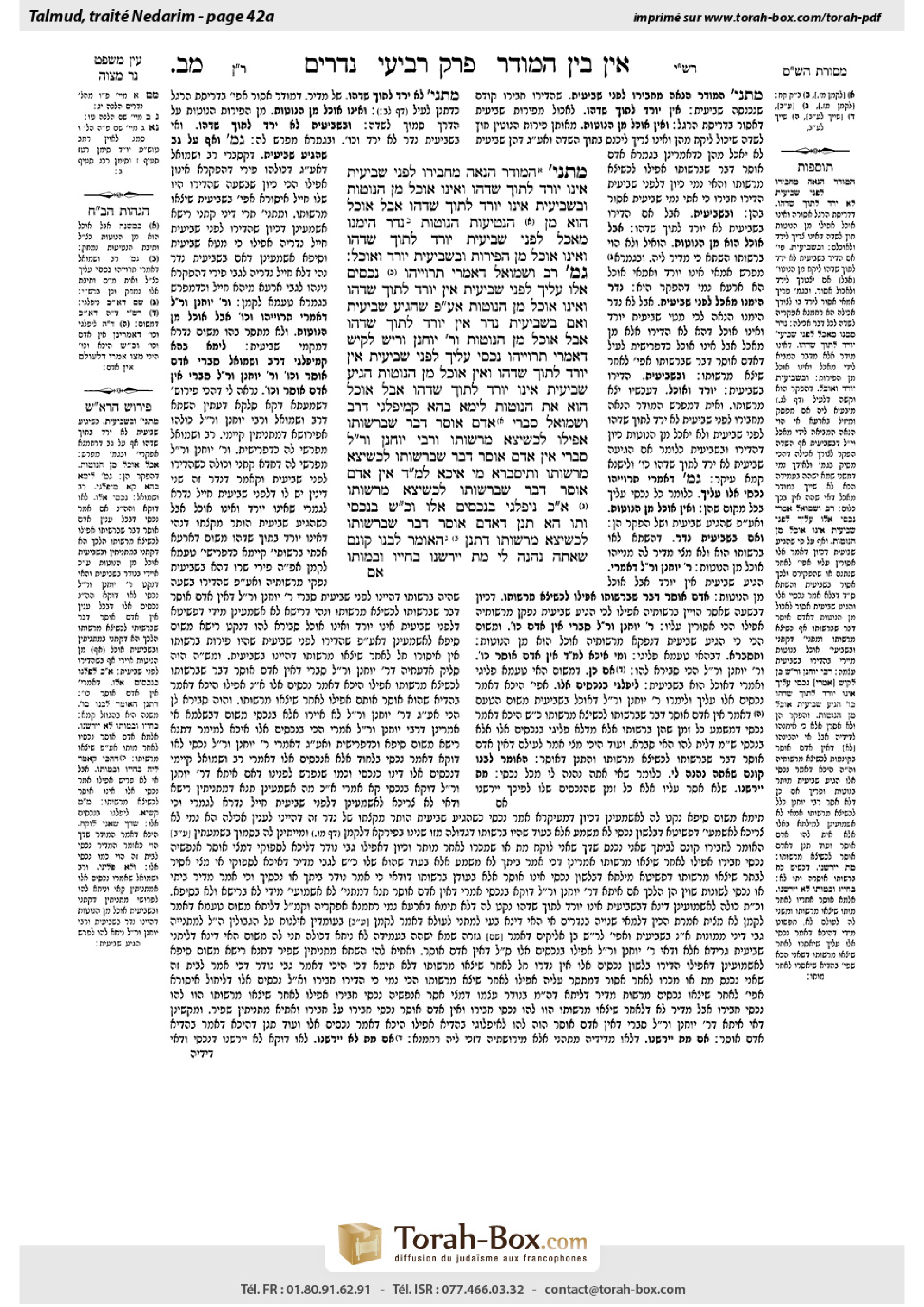
Nedarim 42a: Talmud study for Daf Yomi
Daf Yomi is the daily study of one Talmud folio. Explore 37 tractates with scans, Hebrew text, Sefaria English and AI-generated French translations where annotated.
Passage selection and English or AI-generated French translation are available where the scan has annotations. Daf Study is independent of Torah-Box and Sefaria.
Browse Nedarim · נדרים · All tractatesNedarim 42a text and translations
This page of Nedarim includes the Aramaic text, an English translation and an AI-generated French translation, alongside the scan above.
נדרים מ״ב א · Aramaic and Hebrew text
מַתְנִי׳ הַמּוּדָּר הֲנָאָה מֵחֲבֵירוֹ לִפְנֵי שְׁבִיעִית — אֵינוֹ יוֹרֵד לְתוֹךְ שָׂדֵהוּ, וְאֵינוֹ אוֹכֵל מִן הַנּוֹטוֹת. וּבַשְּׁבִיעִית — אֵינוֹ יוֹרֵד לְתוֹךְ שָׂדֵהוּ, אֲבָל אוֹכֵל הוּא מִן הַנְּטִיעוֹת הַנּוֹטוֹת. נָדַר הֵימֶנּוּ מַאֲכָל, לִפְנֵי שְׁבִיעִית — יוֹרֵד לְתוֹךְ שָׂדֵהוּ, וְאֵינוֹ אוֹכֵל מִן הַפֵּירוֹת, וּבַשְּׁבִיעִית — יוֹרֵד וְאוֹכֵל.
גְּמָ׳ רַב וּשְׁמוּאֵל דְּאָמְרִי תַּרְוַיְיהוּ: ״נְכָסִים אֵלּוּ עָלֶיךָ״ — לִפְנֵי שְׁבִיעִית אֵין יוֹרֵד לְתוֹךְ שָׂדֵהוּ, וְאֵינוֹ אוֹכֵל מִן הַנּוֹטוֹת, אַף עַל פִּי שֶׁהִגִּיעַ שְׁבִיעִית. וְאִם בַּשְּׁבִיעִית נָדַר — אֵין יוֹרֵד לְתוֹךְ שָׂדֵהוּ, אֲבָל אוֹכֵל מִן הַנּוֹטוֹת.
וְרַבִּי יוֹחָנָן וְרֵישׁ לָקִישׁ דְּאָמְרִי תַּרְוַיְיהוּ: ״נְכָסַי עָלֶיךָ״ — לִפְנֵי שְׁבִיעִית אֵין יוֹרֵד לְתוֹךְ שָׂדֵהוּ וְאֵין אוֹכֵל מִן הַנּוֹטוֹת, הִגִּיעַ שְׁבִיעִית — אֵינוֹ יוֹרֵד לְתוֹךְ שָׂדֵהוּ, אֲבָל אוֹכֵל הוּא אֶת הַנּוֹטוֹת.
לֵימָא בְּהָא קָמִיפַּלְגִי, דְּרַב וּשְׁמוּאֵל סָבְרִי: אָדָם אוֹסֵר דָּבָר שֶׁבִּרְשׁוּתוֹ אֲפִילּוּ לִכְשֶׁיֵּצֵא מֵרְשׁוּתוֹ. וְרַבִּי יוֹחָנָן וְרֵישׁ לָקִישׁ סָבְרִי: אֵין אָדָם אוֹסֵר דָּבָר שֶׁבִּרְשׁוּתוֹ לִכְשֶׁיֵּצֵא מֵרְשׁוּתוֹ.
וְתִסְבְּרָא? מִי אִיכָּא לְמַאן דְּאָמַר אֵין אָדָם אוֹסֵר דָּבָר שֶׁבִּרְשׁוּתוֹ לִכְשֶׁיֵּצֵא מֵרָשׁוּתוֹ? אִם כֵּן, נִיפְלְגֵי בִּ״נְכָסִים אֵלּוּ״, וְכׇל שֶׁכֵּן בִּ״נְכָסַי״!
וְתוּ, הָא תְּנַן דְּאָדָם אוֹסֵר דָּבָר שֶׁבִּרְשׁוּתוֹ לִכְשֶׁיֵּצֵא מֵרְשׁוּתוֹ, דִּתְנַן: הָאוֹמֵר לִבְנוֹ ״קֻוֽנָּם שֶׁאַתָּה נֶהֱנֶה לִי״, מֵת — יִירָשֶׁנּוּ. ״בְּחַיָּיו וּבְמוֹתוֹ״,
Nedarim 42a · English translation
MISHNA: In the case of one for whom benefit from another is forbidden, before, i.e., a year other than the Sabbatical Year, he may neither enter the field of that other person, nor eat from the produce that leans out of the field, even if he does not enter the field. And during the Sabbatical Year, when the produce of the trees is ownerless, he may not enter his field; however, he may eat from the growths that lean out of the field, as the produce does not belong to the other person. If one vowed before the Sabbatical Year that benefit from another’s food is forbidden for him, he may enter his field; however, he may not eat of the produce. And during the Sabbatical Year, he may enter the field and may eat the produce.
GEMARA: It is Rav and Shmuel who both say that if one vowed before the Sabbatical Year: Benefit from this property is forbidden to you, the other may neither enter his field, nor eat from the produce that leans out of the field, even though the Sabbatical Year arrived in the interim, because the prohibition of the produce took effect before the Sabbatical Year and remained in effect after the Sabbatical Year began. And if he vowed during the Sabbatical Year, he may not enter a field that is included in that property; however, he may eat from the produce that leans out of the field, because the produce was ownerless when he vowed.
And it is Rabbi Yoḥanan and Reish Lakish who both say that if one vowed before the Sabbatical Year: Benefit from my property is forbidden to you, the other may neither enter his field nor eat from the produce that leans out of the field. When the Sabbatical Year arrives, he may not enter his field; however, he may eat from the produce that leans out of the field, because the produce is ownerless.
The Gemara suggests: Let us say that they disagree about this, that Rav and Shmuel hold: A person can render an item in his possession forbidden, and the prohibition remains in effect even when it leaves his possession. Since he rendered the produce forbidden before the Sabbatical Year, the prohibition remains in effect after the produce becomes ownerless during the Sabbatical Year. And Rabbi Yoḥanan and Reish Lakish hold: A person cannot render an item in his possession forbidden and have the prohibition remain in effect when it leaves his possession. Therefore, it is permitted to eat the produce during the Sabbatical Year.
The Gemara asks: And how can you understand it in that manner? Is there anyone who says that a person cannot render an item in his possession forbidden and have the prohibition remain in effect when it leaves his possession? If so, if Rabbi Yoḥanan and Reish Lakish hold that one cannot do so, let them disagree in the case of one who said: Benefit from this property is forbidden to you, and that would be true all the more so if he said: Benefit from my property is forbidden to you. In the latter case, it is clear that the prohibition remains in effect only as long as the item remains in his possession.
And furthermore, didn’t we learn in a mishna (Bava Kamma 108b) that a person can render an item in his possession forbidden and the prohibition remains in effect when it leaves his possession? This is as we learned in a mishna, that with regard to one who says to his son: Benefit from my property is konam for you, if the father dies, the son will inherit him. He is not deriving benefit from his father’s property, as after death it is no longer his. If the father vowed to render benefit from his property forbidden to his son during his lifetime and upon his death,
Nedarim 42a · Traduction française (IA)
MICHNA : Dans le cas d’une personne à qui il est interdit de tirer profit d’une autre, avant l’année de la Chemita, c’est-à-dire pendant une année autre que l’année de Chemita, elle ne peut ni entrer dans le champ de cette autre personne ni manger les produits qui dépassent du champ, même sans y entrer. Pendant l’année de Chemita, lorsque les produits des arbres sont sans propriétaire, elle ne peut pas entrer dans le champ de l’autre personne ; elle peut toutefois manger les produits qui dépassent du champ, puisqu’ils n’appartiennent pas à cette personne. Si quelqu’un a fait, avant l’année de Chemita, un vœu lui interdisant de tirer profit de la nourriture d’une autre personne, il peut entrer dans le champ, mais il ne peut pas manger les produits. Pendant l’année de Chemita, il peut entrer dans le champ et manger les produits.
GUEMARA : Rav et Chmouel disent tous deux que si quelqu’un a fait, avant l’année de Chemita, le vœu suivant : « Il t’est interdit de tirer profit de ces biens », l’autre ne peut ni entrer dans son champ ni manger les produits qui dépassent du champ, même si l’année de Chemita est survenue entre-temps, car l’interdiction portant sur les produits a pris effet avant l’année de Chemita et est restée en vigueur après le début de celle-ci. S’il a fait son vœu pendant l’année de Chemita, il ne peut pas entrer dans un champ compris dans ces biens ; il peut toutefois manger les produits qui dépassent du champ, car ils étaient sans propriétaire au moment où il a fait son vœu.
Rabbi Yoḥanan et Rech Lakich disent tous deux que si quelqu’un a fait, avant l’année de Chemita, le vœu suivant : « Il t’est interdit de tirer profit de mes biens », l’autre ne peut ni entrer dans son champ ni manger les produits qui dépassent du champ. Lorsque l’année de Chemita arrive, il ne peut pas entrer dans le champ ; il peut toutefois manger les produits qui dépassent du champ, car ils sont sans propriétaire.
La Guemara suggère : Disons qu’ils sont en désaccord sur ce point : Rav et Chmouel considèrent qu’une personne peut rendre interdit un objet qui lui appartient et que l’interdiction reste en vigueur même lorsque l’objet cesse de lui appartenir. Puisqu’il a rendu les produits interdits avant l’année de Chemita, l’interdiction reste en vigueur après qu’ils sont devenus sans propriétaire pendant l’année de Chemita. Rabbi Yoḥanan et Rech Lakich considèrent qu’une personne ne peut pas rendre interdit un objet qui lui appartient de telle sorte que l’interdiction reste en vigueur lorsque l’objet cesse de lui appartenir. Par conséquent, il est permis de manger les produits pendant l’année de Chemita.
La Guemara demande : Mais comment pouvez-vous comprendre les choses ainsi ? Existe-t-il quelqu’un qui affirme qu’une personne ne peut pas rendre interdit un objet qui lui appartient de telle sorte que l’interdiction reste en vigueur lorsque l’objet cesse de lui appartenir ? Si Rabbi Yoḥanan et Rech Lakich considèrent qu’on ne peut pas le faire, qu’ils soient en désaccord dans le cas de celui qui a dit : « Il t’est interdit de tirer profit de ces biens » ; à plus forte raison devraient-ils être en désaccord s’il avait dit : « Il t’est interdit de tirer profit de mes biens ». Dans ce dernier cas, il est clair que l’interdiction reste en vigueur uniquement tant que l’objet lui appartient.
Et en outre, n’avons-nous pas appris dans une Michna (Bava Kamma 108b) qu’une personne peut rendre interdit un objet qui lui appartient et que l’interdiction reste en vigueur lorsque l’objet cesse de lui appartenir ? C’est ce que nous avons appris dans une Michna : à propos de celui qui dit à son fils : « Mes biens te sont interdits comme konam », si le père meurt, le fils hérite de lui. Le fils ne tire pas profit des biens de son père, car après sa mort, ils ne lui appartiennent plus. Si le père a fait un vœu interdisant à son fils de tirer profit de ses biens pendant sa vie et après sa mort,
Traduction française générée par IA à partir de l’édition anglaise de Sefaria. Vérifie toujours un passage avec le texte source.
Text from Sefaria: William Davidson Edition - Vocalized Aramaic (CC BY NC); William Davidson Edition - English (CC BY NC).