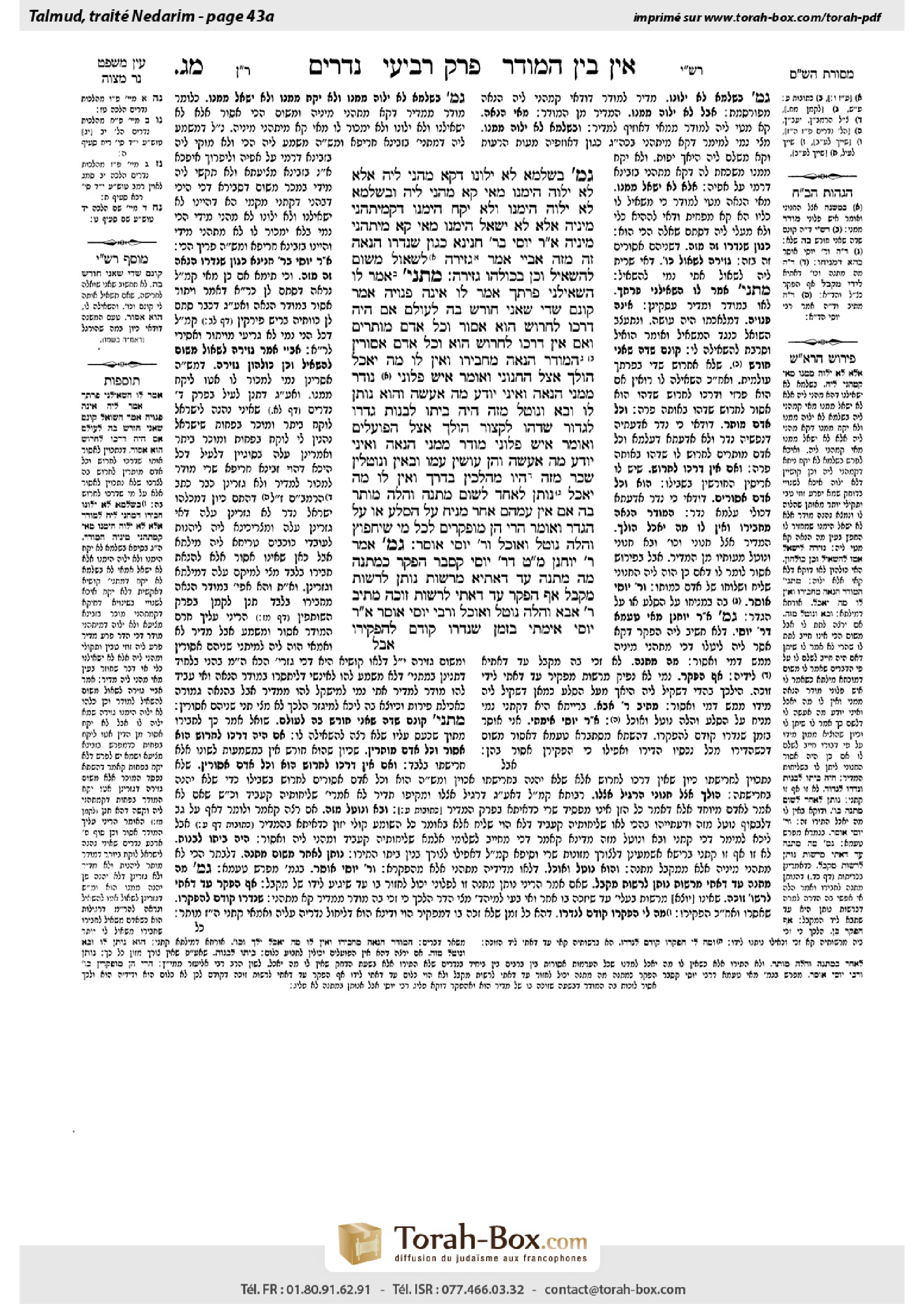
Nedarim 43a: Talmud study for Daf Yomi
Daf Yomi is the daily study of one Talmud folio. Explore 37 tractates with scans, Hebrew text, Sefaria English and AI-generated French translations where annotated.
Passage selection and English or AI-generated French translation are available where the scan has annotations. Daf Study is independent of Torah-Box and Sefaria.
Browse Nedarim · נדרים · All tractatesNedarim 43a text and translations
This page of Nedarim includes the Aramaic text, an English translation and an AI-generated French translation, alongside the scan above.
נדרים מ״ג א · Aramaic and Hebrew text
גְּמָ׳ בִּשְׁלָמָא לֹא יַלְוֶנּוּ — דְּקָא מַהֲנֵי לֵיהּ. אֶלָּא לָא יִלְוֶה הֵימֶנּוּ, מַאי קָא מַהֲנֵי לֵיהּ? וּבִשְׁלָמָא לֹא יִלְוֶה הֵימֶנּוּ וְלֹא יִקַּח הֵימֶנּוּ — דְּקָמִיתְהֲנֵי מִינֵּיהּ, אֶלָּא לֹא יִשְׁאַל הֵימֶנּוּ, מַאי קָא מִיתְהֲנֵי מִינֵּיהּ!
אָמַר רַבִּי יוֹסֵי בְּרַבִּי חֲנִינָא: כְּגוֹן שֶׁנָּדְרוּ הֲנָאָה זֶה מִזֶּה. אַבָּיֵי אָמַר: גְּזֵירָה לִשְׁאוֹל מִשּׁוּם לְהַשְׁאִיל, וְכֵן בְּכוּלְּהוּ גְּזֵירָה.
מַתְנִי׳ אָמַר לוֹ: ״הַשְׁאִילֵנִי פָּרָתְךָ״. אָמַר לוֹ: אֵינָהּ פְּנוּיָה. אָמַר: ״קֻוֽנָּם שָׂדִי שֶׁאֲנִי חוֹרֵשׁ בָּהּ לְעוֹלָם״. אִם הָיָה דַּרְכּוֹ לַחְרוֹשׁ — הוּא אָסוּר, וְכׇל אָדָם מוּתָּרִים. וְאִם אֵין דַּרְכּוֹ לַחְרוֹשׁ — הוּא וְכׇל אָדָם אֲסוּרִין.
הַמּוּדָּר הֲנָאָה מֵחֲבֵירוֹ וְאֵין לוֹ מַה יֹּאכַל, הוֹלֵךְ אֵצֶל הַחֶנְוָנִי וְאוֹמֵר: אִישׁ פְּלוֹנִי נוֹדֵר מִמֶּנִּי הֲנָאָה וְאֵינִי יוֹדֵעַ מַה אֶעֱשֶׂה. וְהוּא נוֹתֵן לוֹ, וּבָא וְנוֹטֵל מִזֶּה.
הָיָה בֵּיתוֹ לִבְנוֹת, גְּדֵרוֹ לִגְדּוֹר, שָׂדֵהוּ לִקְצוֹר, הוֹלֵךְ אֵצֶל הַפּוֹעֲלִים וְאוֹמֵר: אִישׁ פְּלוֹנִי מוּדָּר מִמֶּנִּי הֲנָאָה וְאֵינִי יוֹדֵעַ מַה אֶעֱשֶׂה. וְהֵן עוֹשִׂין עִמּוֹ, וּבָאִין וְנוֹטְלִין שָׂכָר מִזֶּה.
הָיוּ מְהַלְּכִין בַּדֶּרֶךְ וְאֵין לוֹ מַה יֹּאכַל, נוֹתֵן לְאֶחָד לְשׁוּם מַתָּנָה, וְהַלָּה מוּתָּר בָּהּ. אִם אֵין עִמָּהֶם אַחֵר — מַנִּיחַ עַל הַסֶּלַע אוֹ עַל הַגָּדֵר וְאוֹמֵר: הֲרֵי הֵן מוּפְקָרִים לְכׇל מִי שֶׁיַּחְפּוֹץ, וְהַלָּה נוֹטֵל וְאוֹכֵל. וְרַבִּי יוֹסֵי אוֹסֵר.
גְּמָ׳ אָמַר רַבִּי יוֹחָנָן: מַאי טַעְמָא דְּרַבִּי יוֹסֵי? קָסָבַר: הֶפְקֵר כְּמַתָּנָה. מָה מַתָּנָה — עַד דְּאָתְיָא מֵרְשׁוּת נוֹתֵן לִרְשׁוּת מְקַבֵּל, אַף הֶפְקֵר — עַד דְּאָתְיָא לִרְשׁוּת זוֹכֶה.
מֵתִיב רַבִּי אַבָּא: וְהַלָּה נוֹטֵל וְאוֹכֵל, וְרַבִּי יוֹסֵי אוֹסֵר. אָמַר רַבִּי יוֹסֵי: אֵימָתַי — בִּזְמַן שֶׁנִּדְרוֹ קוֹדֵם לְהֶפְקֵירוֹ.
Nedarim 43a · English translation
GEMARA: Granted that the person from whom benefit is forbidden may not lend money to the person for whom benefit is forbidden, as he thereby benefits him. However, with regard to the fact that the former may not borrow money from the latter, in what way does he benefit him by borrowing his money? And it could even be said, granted that he may neither borrow money from him nor purchase an item from him, as one benefits in lending money by preserving the value of that money in case the coins deteriorate, and in selling by ridding oneself an item that is difficult to sell. However, with regard to the fact that the person from whom benefit is forbidden may not borrow an item from the person for whom benefit is forbidden, in what way does the lender benefit from him? The borrower returns the same item to the lender.
Rabbi Yosei, son of Rabbi Ḥanina, said: The mishna is referring to a case where they both vowed that benefit from each other is forbidden. Clearly, then, neither of them may lend to the other or borrow from him. Abaye said: It is possible to explain the mishna as it is written, as referring to a case where only one vowed that benefit from the other is forbidden. However, the Sages issued a decree that it is also prohibited for one to borrow from a person for whom benefit from him is forbidden, due to the concern that he might come to lend to him, as reciprocity is common in these matters. And likewise, that is the explanation in all the cases in the mishna; it is prohibited to borrow money, borrow items, and to purchase items from him due to a rabbinic decree, lest he come to benefit him.
MISHNA: One said to another: Lend me your cow. The other person said to him: My cow is not available. The one seeking to borrow the cow responded angrily: Plowing my field with this cow is konam forever. If it was his typical manner to plow the field himself, then it is prohibited for him to plow his field with that cow but it is permitted for every other person. If it is not his typical manner to plow the field himself, and he has others plow for him, it is prohibited for him and for every other person to plow his field with that cow, because his intent was to render benefit from plowing with this cow forbidden.
In the case of one for whom benefit from another is forbidden by vow and who does not have anything to eat, the one from whom benefit is forbidden goes to the shopkeeper and says to him: So-and-so vowed that benefit from me is forbidden for him and I do not know what I will do. After grasping his intent, the shopkeeper gives food to the one for whom benefit is forbidden, and then the shopkeeper comes and takes payment for the food from that one who spoke to him.
Similarly, if the house of one for whom benefit is forbidden by a vow was to be built, his fence to be erected, or his field to be harvested, and laborers were required but he had no money to hire them, the one from whom benefit is forbidden goes to the laborers and says to them: Benefit from me is forbidden by vow to so-and-so and I do not know what I will do. And the laborers perform those tasks with him, and come and take payment for their labor from that person who approached them.
If the one who vowed to render benefit from him forbidden and the one for whom benefit is forbidden were traveling together along the road and the one for whom benefit is forbidden does not have anything to eat, the one who from whom benefit is forbidden gives food to one other person as a gift, and it is permitted for that person for whom benefit is forbidden to eat the food because it no longer belongs to the one from whom benefit is forbidden. If there is no other person with them, the one who vowed places the food on the nearest rock or on the nearest fence and says: These food items are hereby rendered ownerless and are available to anyone who wants them. Then that person for whom benefit is forbidden takes and eats the food. Rabbi Yosei prohibits doing so.
GEMARA: With regard to the dispute between the Rabbis and Rabbi Yosei whether one from whom benefit is forbidden to another can give the other person food by declaring the food ownerless, Rabbi Yoḥanan said: What is the reason for the opinion of Rabbi Yosei? He holds that the legal status of the process of rendering property ownerless is like that of the acquisition of a gift. Just as acquisition of a gift is not complete until the item comes from the possession of the one who gives the gift into the possession of the one who receives the gift, so too, the process of rendering property ownerless is not complete until the item comes into the possession of the one who acquires it. According to Rabbi Yosei, it is prohibited for the one for whom benefit is forbidden to take the food that was declared ownerless. Since it still belongs to the one from whom benefit is forbidden, by taking the food he derives forbidden benefit from him.
Rabbi Abba raises an objection from a baraita: And then that person takes and eats the food; and Rabbi Yosei prohibits doing so. Rabbi Yosei said: When is it prohibited to do so? When his vow predates his declaration that the food is ownerless. In that case, the vow took effect on all his possessions, including those that he later declared ownerless.
Nedarim 43a · Traduction française (IA)
GUEMARA : Il est admis que celui dont l’autre ne peut tirer profit ne peut pas lui prêter d’argent, puisqu’il lui procure ainsi un avantage. Cependant, en ce qui concerne l’interdiction faite à celui-ci d’emprunter de l’argent à l’autre, en quoi lui procure-t-il un avantage en lui empruntant son argent ? On pourrait même dire que, s’il est admis qu’il ne peut ni lui emprunter d’argent ni lui acheter un objet — car prêter de l’argent procure un avantage en préservant sa valeur au cas où les pièces se déprécieraient, et vendre en se débarrassant d’un objet difficile à vendre —, en revanche, concernant l’interdiction faite à celui dont l’autre ne peut tirer profit d’emprunter un objet à celui-ci, en quoi le prêteur en tire-t-il un avantage ? L’emprunteur rend au prêteur le même objet.
Rabbi Yossei, fils de Rabbi Ḥanina, dit : La Michna parle d’un cas où tous deux ont fait vœu de s’interdire mutuellement tout profit. Il est donc évident qu’aucun des deux ne peut prêter à l’autre ni lui emprunter. Abayé dit : On peut expliquer la Michna telle qu’elle est formulée, en disant qu’un seul a fait vœu de s’interdire tout profit de l’autre. Toutefois, les Sages ont décrété qu’il est également interdit d’emprunter à quelqu’un qui ne peut tirer profit de soi, de crainte qu’on en vienne à lui prêter, car les échanges de ce type sont fréquents. De même, il faut comprendre ainsi tous les cas de la Michna : emprunter de l’argent ou des objets, et acheter des objets auprès de lui, sont interdits par décret rabbinique, de peur qu’on en vienne à lui procurer un avantage.
MICHNA : Quelqu’un dit à un autre : « Prête-moi ta vache. » L’autre lui répond : « Ma vache n’est pas disponible. » Celui qui voulait emprunter la vache réplique avec colère : « Labourer mon champ avec cette vache m’est konam pour toujours. » Si labourer lui-même son champ est sa façon habituelle de faire, il lui est interdit de labourer son champ avec cette vache, mais cela est permis à toute autre personne. Si, au contraire, il n’a pas l’habitude de labourer lui-même son champ et fait labourer pour lui par d’autres, il est interdit à lui comme à toute autre personne de labourer son champ avec cette vache, car son intention était de s’interdire tout avantage tiré du labourage avec cette vache.
Dans le cas de quelqu’un à qui il est interdit par vœu de tirer profit d’un autre et qui n’a rien à manger, celui dont il ne peut tirer profit va trouver le boutiquier et lui dit : « Untel a fait vœu de s’interdire tout profit de ma part, et je ne sais pas quoi faire. » Ayant compris son intention, le boutiquier donne de la nourriture à celui à qui il est interdit de tirer profit, puis va demander le paiement de cette nourriture à celui qui lui a parlé.
De même, si la maison de quelqu’un à qui il est interdit par vœu de tirer profit d’un autre doit être construite, si sa clôture doit être érigée ou si son champ doit être moissonné, et que des ouvriers sont nécessaires mais qu’il n’a pas d’argent pour les engager, celui dont il ne peut tirer profit va trouver les ouvriers et leur dit : « Untel a fait vœu de s’interdire tout profit de ma part, et je ne sais pas quoi faire. » Les ouvriers accomplissent alors ces travaux pour lui, puis viennent réclamer le paiement de leur travail à celui qui les a abordés.
Si celui qui a fait vœu de s’interdire tout profit de l’autre et celui à qui il est interdit de tirer profit de lui voyageaient ensemble sur la route, et que ce dernier n’avait rien à manger, celui dont il ne peut tirer profit donne de la nourriture en cadeau à une autre personne. Celui à qui il est interdit de tirer profit peut alors manger cette nourriture, car elle n’appartient plus à celui dont il ne peut tirer profit. S’il n’y a personne d’autre avec eux, celui qui a fait vœu dépose la nourriture sur le rocher le plus proche ou sur la clôture la plus proche et dit : « Ces aliments sont désormais sans propriétaire et accessibles à quiconque les désire. » Celui à qui il est interdit de tirer profit prend alors la nourriture et la mange. Rabbi Yossei l’interdit.
GUEMARA : À propos du désaccord entre les Rabbins et Rabbi Yossei sur la question de savoir si celui dont une autre personne ne peut tirer profit peut lui donner de la nourriture en la déclarant sans propriétaire, Rabbi Yoḥanan dit : Quelle est la raison de l’opinion de Rabbi Yossei ? Il considère que le statut juridique de l’abandon d’un bien est comparable à celui de l’acquisition d’un cadeau. De même que l’acquisition d’un cadeau n’est achevée que lorsque l’objet passe de la possession du donateur à celle du bénéficiaire, de même, l’abandon d’un bien n’est achevé que lorsque l’objet passe en la possession de celui qui l’acquiert. Selon Rabbi Yossei, il est interdit à celui à qui il est interdit de tirer profit de prendre la nourriture déclarée sans propriétaire. Puisqu’elle appartient encore à celui dont l’autre ne peut tirer profit, en prenant cette nourriture, il tire de lui un profit interdit.
Rabbi Abba soulève une objection à partir d’une baraïta : « Celui-ci prend alors la nourriture et la mange ; Rabbi Yossei l’interdit. » Rabbi Yossei a dit : « Dans quel cas cela est-il interdit ? Lorsque son vœu précède sa déclaration selon laquelle la nourriture est sans propriétaire. » Dans ce cas, le vœu a pris effet sur tous ses biens, y compris ceux qu’il a déclarés sans propriétaire par la suite.
Traduction française générée par IA à partir de l’édition anglaise de Sefaria. Vérifie toujours un passage avec le texte source.
Text from Sefaria: William Davidson Edition - Vocalized Aramaic (CC BY NC); William Davidson Edition - English (CC BY NC).