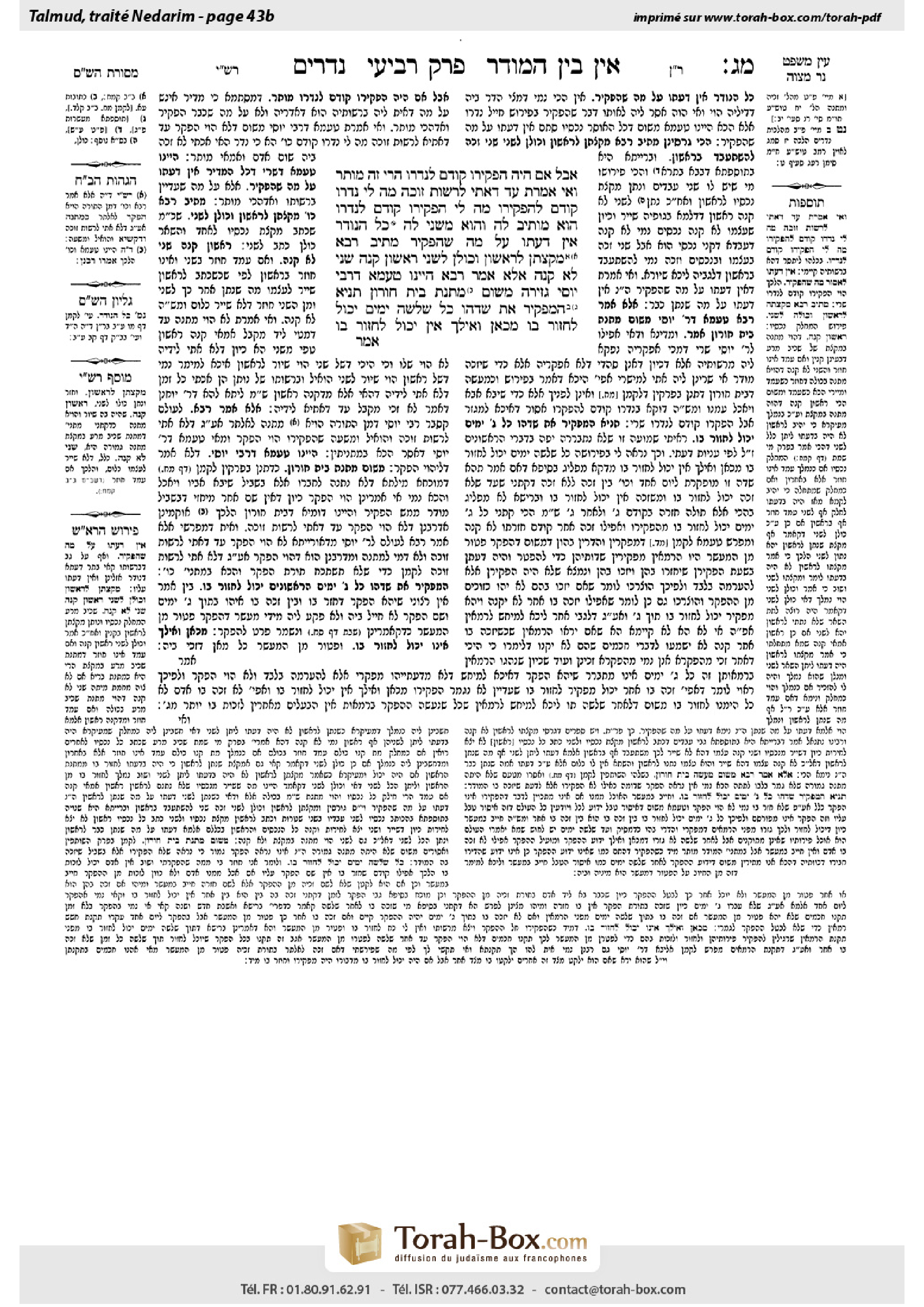
Nedarim 43b: Talmud study for Daf Yomi
Daf Yomi is the daily study of one Talmud folio. Explore 37 tractates with scans, Hebrew text, Sefaria English and AI-generated French translations where annotated.
Passage selection and English or AI-generated French translation are available where the scan has annotations. Daf Study is independent of Torah-Box and Sefaria.
Browse Nedarim · נדרים · All tractatesNedarim 43b text and translations
This page of Nedarim includes the Aramaic text, an English translation and an AI-generated French translation, alongside the scan above.
נדרים מ״ג ב · Aramaic and Hebrew text
אֲבָל אִם הָיָה הֶפְקֵירוֹ קוֹדֵם לְנִדְרוֹ — הֲרֵי זֶה מוּתָּר. וְאִי אָמְרַתְּ עַד דְּאָתֵי לִרְשׁוּת זוֹכֶה, מָה לִי נִדְרוֹ קוֹדֵם לְהֶפְקֵירוֹ, מָה לִי הֶפְקֵירוֹ קוֹדֵם לְנִדְרוֹ?
הוּא מוֹתֵיב לַהּ וְהוּא מְשַׁנֵּי לַהּ: כׇּל הַנּוֹדֵר אֵין דַּעְתּוֹ עַל מַה שֶּׁהִפְקִיר.
מֵתִיב רָבָא: מִקְצָתָן לָרִאשׁוֹן וְכוּלָּן לַשֵּׁנִי — רִאשׁוֹן קָנָה,
שֵׁנִי לֹא קָנָה!
אֶלָּא אָמַר רָבָא, הַיְינוּ טַעְמָא דְּרַבִּי יוֹסֵי: גְּזֵירָה מִשּׁוּם מַתְּנַת בֵּית חוֹרוֹן.
תַּנְיָא: הַמַּפְקִיר אֶת שָׂדֵהוּ, כׇּל שְׁלֹשָׁה יָמִים — יָכוֹל לַחֲזוֹר בּוֹ, מִכָּאן וְאֵילָךְ — אֵין יָכוֹל לַחֲזוֹר בּוֹ.
Nedarim 43b · English translation
However, if his declaration that the food is ownerless predates his vow, it is permitted for the other person to eat the food. And if you say that the reason for the opinion of Rabbi Yosei is because the food remains in the possession of the owner until it comes into the possession of the one who acquires it, what is different for me if his vow predates his declaration that the food is ownerless, and what is different for me if his declaration that the food is ownerless predates his vow? In any event, the item remains in the possession of its owner and the one for whom benefit is forbidden benefits from it.
The Gemara answers: Rabbi Abba raised the objection and he answered that objection. The difference between the cases does not relate to the halakhot of ownerless property; rather, it relates to the nature of vows. The intent of anyone who vows is that the vow not apply to an item that he rendered ownerless. Therefore, when he declares the food ownerless and then vows, he does not intend to include the ownerless food in his vow, and the prohibition does not take effect upon it.
Rava raised an objection: With regard to a person on his deathbed who ordered his executor to distribute all his property, if he recovers, he may retract the gift. However, if he ordered him to distribute only a portion of his property and kept the rest, he cannot retract the gift. If he ordered him to distribute his property to two people and said: A portion of the property is given to the first person and all of the remaining property is given to the second person, then if he recovered, the first person acquired the property that was given him, as it was a partial gift.
And the second person did not acquire the property that was given him, as it was a gift of all his remaining property, which can be retracted. Although the first person did not yet acquire the property, as the person on his deathbed did not die, the property is no longer considered to be in the possession of the one who owned it. This is clear from the fact that if it were still in his possession, the gift to the second person would not be a gift of all his remaining property. This contradicts the opinion of Rabbi Yoḥanan, who said in explanation of the opinion of Rabbi Yosei: Acquisition of a gift is not complete until the item comes from the possession of the one who gives the gift into the possession of the one who receives the gift.
Rather, Rava said that this is the reason for the opinion of Rabbi Yosei: It is prohibited by rabbinic decree for the one for whom benefit is forbidden to take food that was declared ownerless, due to the gift of Beit Ḥoron. An incident occurred in Beit Ḥoron involving a person who employed artifice and gave a gift to another to circumvent a vow. The Sages ruled that artifice of that sort is forbidden. Here too, when he renounced ownership he merely employed artifice to circumvent the vow.
It is taught in a baraita: In the case of one who declares his field ownerless, for the entire three days after that declaration he is able to retract it. From this point forward, he is unable to retract the declaration.
Nedarim 43b · Traduction française (IA)
Cependant, si sa déclaration d’abandon de la nourriture précède son vœu, l’autre personne peut la manger. Et si tu dis que, selon Rabbi Yossi, la raison est que la nourriture reste en possession de son propriétaire jusqu’à ce qu’elle passe en possession de celui qui l’acquiert, quelle différence cela fait-il que son vœu précède sa déclaration d’abandon ou que sa déclaration d’abandon précède son vœu ? Dans tous les cas, l’objet reste en possession de son propriétaire, et celui à qui il est interdit d’en tirer profit en tire profit.
La Guemara répond : Rabbi Abba a soulevé l’objection et y a répondu. La différence entre les cas ne concerne pas les règles relatives aux biens sans propriétaire ; elle porte plutôt sur la nature des vœux. Celui qui prononce un vœu entend que celui-ci ne s’applique pas à un objet qu’il a déclaré sans propriétaire. Par conséquent, lorsqu’il déclare la nourriture sans propriétaire, puis prononce un vœu, il n’entend pas inclure cette nourriture dans son vœu, et l’interdiction ne s’applique pas à celle-ci.
Rava a soulevé une objection : un homme à l’agonie qui a ordonné à son exécuteur testamentaire de distribuer tous ses biens peut, s’il guérit, revenir sur la donation. En revanche, s’il lui a ordonné de ne distribuer qu’une partie de ses biens et en a gardé le reste, il ne peut pas revenir sur la donation. S’il lui a ordonné de distribuer ses biens à deux personnes en disant : « Une partie des biens est donnée à la première personne, et tout le reste est donné à la seconde », alors, s’il guérit, la première personne a acquis les biens qui lui ont été donnés, puisqu’il s’agissait d’une donation partielle.
La seconde personne, quant à elle, n’a pas acquis les biens qui lui ont été donnés, puisqu’il s’agissait d’une donation de tous les biens qui restaient au donateur, sur laquelle il est possible de revenir. Bien que la première personne n’ait pas encore acquis les biens, car l’homme à l’agonie n’est pas mort, ces biens ne sont plus considérés comme étant en possession de leur propriétaire initial. Cela ressort clairement du fait que, s’ils étaient encore en sa possession, la donation à la seconde personne ne constituerait pas une donation de tous les biens qui lui restaient. Cela contredit l’opinion de Rabbi Yoḥanan, qui a dit, en expliquant celle de Rabbi Yossi : l’acquisition d’une donation n’est achevée que lorsque l’objet passe de la possession du donateur à celle du bénéficiaire.
Rava a plutôt dit que voici la raison de l’opinion de Rabbi Yossi : un décret rabbinique interdit à celui à qui il est interdit de tirer profit de prendre de la nourriture déclarée sans propriétaire, en raison de l’affaire du don de Beit Ḥoron. Un incident s’est produit à Beit Ḥoron : un homme avait usé d’un artifice et fait un don à quelqu’un d’autre pour contourner un vœu. Les Sages ont statué qu’un tel artifice est interdit. Ici aussi, en renonçant à la propriété, il n’a fait qu’user d’un artifice pour contourner le vœu.
Il est enseigné dans une baraïta : celui qui déclare son champ sans propriétaire peut revenir sur sa déclaration pendant les trois jours qui suivent. Passé ce délai, il ne peut plus revenir sur sa déclaration.
Traduction française générée par IA à partir de l’édition anglaise de Sefaria. Vérifie toujours un passage avec le texte source.
Text from Sefaria: William Davidson Edition - Vocalized Aramaic (CC BY NC); William Davidson Edition - English (CC BY NC).