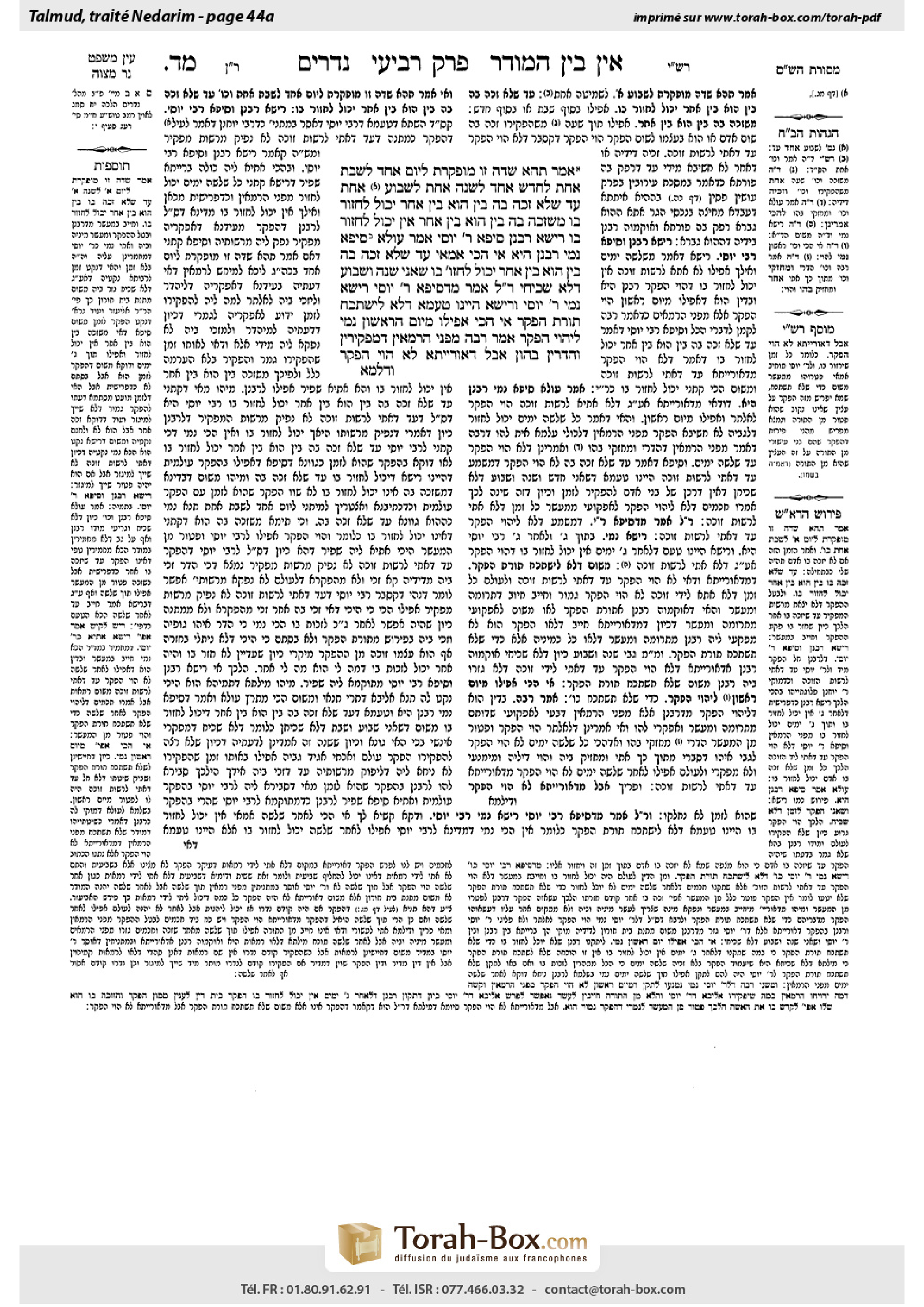
Nedarim 44a: Talmud study for Daf Yomi
Daf Yomi is the daily study of one Talmud folio. Explore 37 tractates with scans, Hebrew text, Sefaria English and AI-generated French translations where annotated.
Passage selection and English or AI-generated French translation are available where the scan has annotations. Daf Study is independent of Torah-Box and Sefaria.
Browse Nedarim · נדרים · All tractatesNedarim 44a text and translations
This page of Nedarim includes the Aramaic text, an English translation and an AI-generated French translation, alongside the scan above.
נדרים מ״ד א · Aramaic and Hebrew text
אָמַר ״תְּהֵא שָׂדֶה זוֹ מוּפְקֶרֶת לְיוֹם אֶחָד״, ״לְשַׁבָּת אַחַת״, ״לְחֹדֶשׁ אֶחָד״, ״לְשָׁנָה אַחַת״, ״לְשָׁבוּעַ אֶחָת״ — עַד שֶׁלֹּא זָכָה בָּהּ, בֵּין הוּא בֵּין אַחֵר יָכוֹל לַחֲזוֹר בּוֹ. מִשֶּׁזָּכָה בָּהּ — בֵּין הוּא בֵּין אַחֵר, אֵין יָכוֹל לַחֲזוֹר בּוֹ. רֵישָׁא רַבָּנַן, סֵיפָא רַבִּי יוֹסֵי!
אָמַר עוּלָּא: סֵיפָא נָמֵי רַבָּנַן הִיא. אִי הָכִי, אַמַּאי עַד שֶׁלֹּא זָכָה בָּהּ בֵּין הוּא בֵּין אַחֵר, יָכוֹל לַחֲזוֹר בּוֹ? שָׁאנֵי שָׁנָה וְשָׁבוּעַ דְּלָא שְׁכִיחִי.
רֵישׁ לָקִישׁ אָמַר: מִדְּסֵיפָא רַבִּי יוֹסֵי, רֵישָׁא נָמֵי רַבִּי יוֹסֵי. וְרֵישָׁא, הַיְינוּ טַעְמָא — דְּלָא לִישְׁתַּכַּח תּוֹרַת הֶפְקֵר.
אִי הָכִי, אֲפִילּוּ מִיּוֹם הָרִאשׁוֹן נָמֵי לֶיהֱוֵי הֶפְקֵר! אָמַר רַבָּה: מִפְּנֵי הָרַמָּאִין, דְּמַפְקִירִין וְהָדְרִין בְּהוֹן.
אֲבָל דְּאוֹרָיְיתָא לָא הָוֵי הֶפְקֵר?
Nedarim 44a · English translation
If one said: This field will be ownerless for one day, for one week, for one month, for one year, or for one seven-year Sabbatical cycle, as long as no one took possession of the field, neither the one who declared it ownerless nor another person, he is able to retract his declaration. Once one took possession of the field, whether it is he or whether it is another person, he is unable to retract his declaration. This baraita is difficult, as the first clause is apparently in accordance with the opinion of the Rabbis, who hold that rendering property ownerless is unilateral and not contingent upon whether one took possession of it, and the latter clause is in accordance with the opinion of Rabbi Yosei, who holds that rendering property ownerless is complete only when one takes possession of that property.
Ulla said: The latter clause is also in accordance with the opinion of the Rabbis. The Gemara asks: If so, why is the ruling in the baraita: As long as one did not take possession of the field, neither the one who declared it ownerless nor another person, he is able to retract his declaration; according to the Rabbis, once he declared the property ownerless, although he can take possession of it, he is unable to retract the declaration. The Gemara answers: It is different when one declares an item ownerless for a year or a seven-year period, as doing so is uncommon. Since from the outset he limited the duration of ownerless status, clearly he reserved for himself certain rights; therefore, he can retract his declaration.
Reish Lakish said: From the fact that the latter clause is in accordance with the opinion of Rabbi Yosei, the first clause is also in accordance with the opinion of Rabbi Yosei. And in the first clause, this is the reason that one cannot retract his declaration once three days have passed: It is an ordinance instituted by the Sages to ensure that the halakhic status of ownerlessness would not be forgotten. If one could retract his declaration of ownerless status after three days, people would not distinguish between a case where another took possession, where, according to Rabbi Yosei, one is unable to retract the declaration, and a case where another did not take possession, where, according to Rabbi Yosei, one is able to retract the declaration. The result would be that people would mistakenly conclude that ownerless status can always be reversed, even after it was claimed by another. Therefore, the Sages instituted a limit of three days, after which one may not retract his declaration.
The Gemara asks: If so, then let the Sages institute that the item is considered ownerless even from the first day as well and that he cannot retract his declaration at all. Rabba said: The reason that the Sages did not render the item ownerless from the first day is due to the swindlers, who declare the field ownerless in order to render the produce of the field exempt from the requirement of tithing, and then retract that declaration and immediately reclaim the field. Therefore, the Sages instituted that ownerless status takes effect only after three days.
The Gemara asks: The Sages instituted that one cannot retract his declaration of ownerless status once three days have passed. However, by Torah law, isn’t the item ownerless according to Rabbi Yosei, regardless of when he retracted his declaration as long as no other person acquired it?
Nedarim 44a · Traduction française (IA)
Si quelqu’un dit : « Ce champ sera sans propriétaire pendant un jour, une semaine, un mois, un an ou un cycle de sept ans », il peut revenir sur sa déclaration tant que personne n’a pris possession du champ, ni celui qui l’a déclaré sans propriétaire ni quelqu’un d’autre. Dès que quelqu’un en a pris possession, que ce soit lui-même ou quelqu’un d’autre, il ne peut plus revenir sur sa déclaration. Cette baraïta pose difficulté, car sa première partie semble conforme à l’opinion des Rabbins, selon lesquels déclarer un bien sans propriétaire est un acte unilatéral, qui ne dépend pas de la prise de possession du bien, tandis que sa dernière partie semble conforme à l’opinion de Rabbi Yossei, selon lequel la déclaration ne prend effet que lorsque quelqu’un prend possession du bien.
Oulla dit : La dernière partie est elle aussi conforme à l’opinion des Rabbins. La Guemara demande : Si tel est le cas, pourquoi la baraïta statue-t-elle qu’il peut revenir sur sa déclaration tant que personne n’a pris possession du champ, ni celui qui l’a déclaré sans propriétaire ni quelqu’un d’autre ? Selon les Rabbins, une fois qu’il a déclaré le bien sans propriétaire, il ne peut plus revenir sur sa déclaration, même s’il peut en prendre possession. La Guemara répond : Le cas où quelqu’un déclare un bien sans propriétaire pour un an ou pour une période de sept ans est différent, car une telle déclaration est inhabituelle. Puisqu’il en a limité d’emblée la durée, il est clair qu’il s’est réservé certains droits ; il peut donc revenir sur sa déclaration.
Reish Lakish dit : Puisque la dernière partie est conforme à l’opinion de Rabbi Yossei, la première partie l’est elle aussi. Dans la première partie, voici pourquoi on ne peut pas revenir sur sa déclaration après trois jours : les Sages ont institué cette règle afin que le statut halakhique de bien sans propriétaire ne tombe pas dans l’oubli. Si l’on pouvait revenir sur sa déclaration après trois jours, les gens ne feraient pas la distinction entre le cas où quelqu’un d’autre a pris possession du bien, dans lequel, selon Rabbi Yossei, on ne peut pas revenir sur la déclaration, et celui où personne d’autre n’en a pris possession, dans lequel, selon Rabbi Yossei, on peut revenir sur la déclaration. Les gens pourraient alors conclure à tort qu’on peut toujours annuler le statut de bien sans propriétaire, même après qu’une autre personne en a pris possession. Les Sages ont donc fixé une limite de trois jours, après laquelle on ne peut plus revenir sur sa déclaration.
La Guemara demande : Si tel est le cas, que les Sages instituent aussi que le bien soit considéré comme sans propriétaire dès le premier jour et qu’il ne puisse en aucun cas revenir sur sa déclaration. Rabba dit : Si les Sages n’ont pas rendu le bien sans propriétaire dès le premier jour, c’est à cause des fraudeurs, qui déclarent le champ sans propriétaire afin d’exempter ses produits de l’obligation de prélever les dîmes, puis reviennent sur leur déclaration et reprennent aussitôt possession du champ. Les Sages ont donc institué que le statut de bien sans propriétaire ne prenne effet qu’après trois jours.
La Guemara demande : Les Sages ont institué qu’on ne puisse plus revenir sur sa déclaration après trois jours. Cependant, selon la Torah, le bien n’est-il pas sans propriétaire, selon Rabbi Yossei, quel que soit le moment où il revient sur sa déclaration, tant qu’aucune autre personne ne l’a acquis ?
Traduction française générée par IA à partir de l’édition anglaise de Sefaria. Vérifie toujours un passage avec le texte source.
Text from Sefaria: William Davidson Edition - Vocalized Aramaic (CC BY NC); William Davidson Edition - English (CC BY NC).