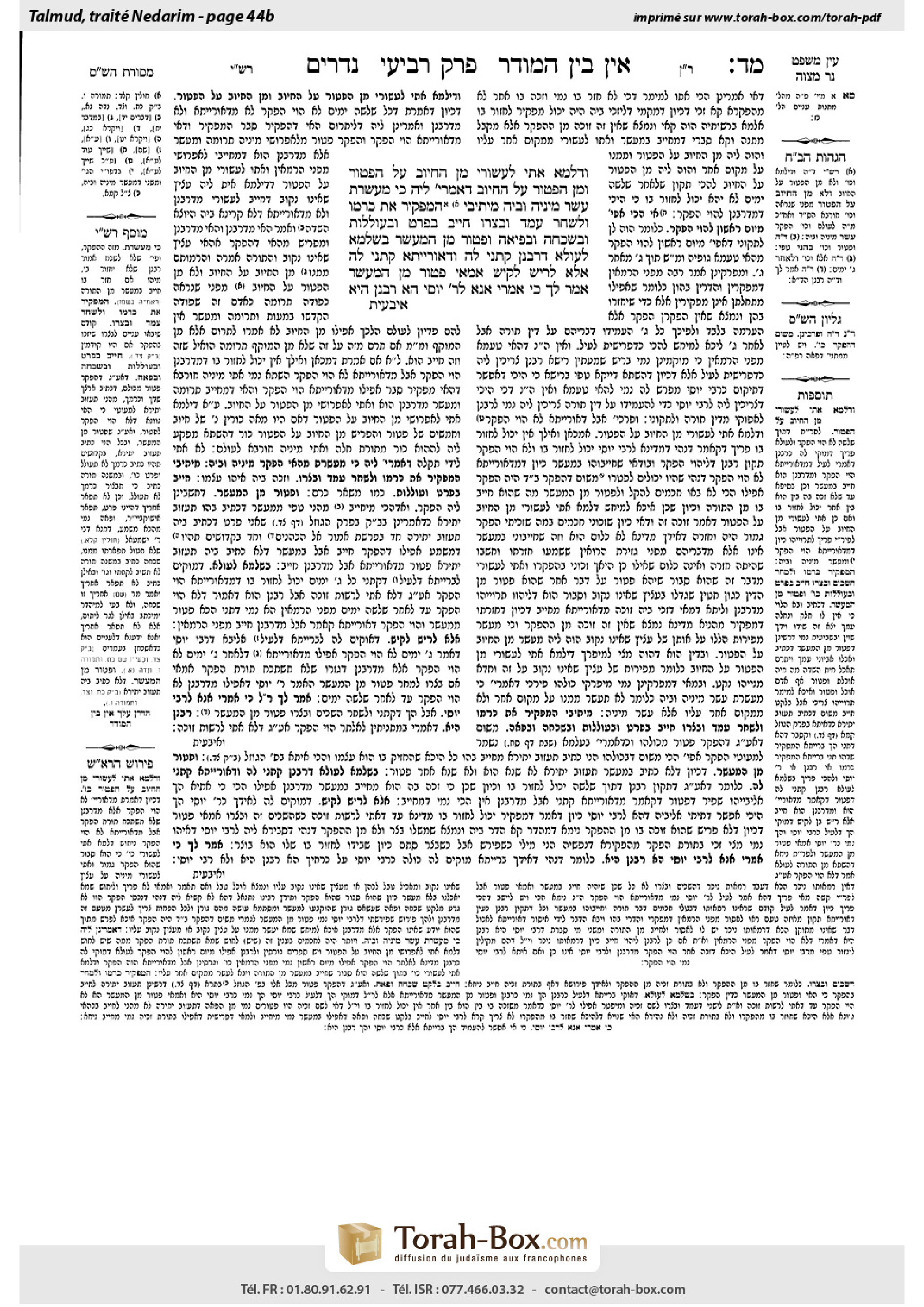
Nedarim 44b: Talmud study for Daf Yomi
Daf Yomi is the daily study of one Talmud folio. Explore 37 tractates with scans, Hebrew text, Sefaria English and AI-generated French translations where annotated.
Passage selection and English or AI-generated French translation are available where the scan has annotations. Daf Study is independent of Torah-Box and Sefaria.
Browse Nedarim · נדרים · All tractatesNedarim 44b text and translations
This page of Nedarim includes the Aramaic text, an English translation and an AI-generated French translation, alongside the scan above.
נדרים מ״ד ב · Aramaic and Hebrew text
וְדִלְמָא אָתֵי לְעַשּׂוֹרֵי מִן הַחִיּוּב עַל הַפְּטוּר וּמִן הַפְּטוּר עַל הַחִיּוּב.
דְּאָמְרִינַן לֵיהּ: כִּי מְעַשְּׂרַתְּ — עַשַּׂר מִינֵּיהּ וּבֵיהּ.
מֵיתִיבִי: הַמַּפְקִיר אֶת כַּרְמוֹ, וְלַשַּׁחַר עָמַד וּבְצָרוֹ — חַיָּיב בְּפֶרֶט וּבְעוֹלֵלוֹת וּבְשִׁכְחָה וּבְפֵיאָה. וּפָטוּר מִן הַמַּעֲשֵׂר.
בִּשְׁלָמָא לְעוּלָּא, דְּרַבָּנַן קָתָנֵי לַהּ וּדְאוֹרָיְיתָא קָתָנֵי לַהּ. אֶלָּא לְרֵישׁ לָקִישׁ, אַמַּאי פָּטוּר מִן הַמַּעֲשֵׂר?
אָמַר לְךָ: כִּי אֲמַרִי אֲנָא — לְרַבִּי יוֹסֵי, הָא — רַבָּנַן הִיא.
Nedarim 44b · English translation
And that ordinance could lead to a problem, as perhaps he will come to tithe from produce that requires tithing by Torah law for produce exempt from tithing by Torah law and from produce exempt from tithing by Torah law for produce that requires tithing by Torah law. By Torah law, the produce is not ownerless and requires tithing. However, due to the ordinance, people might relate to it as ownerless produce and assume that one is exempt from tithing it. Alternatively, they will erroneously conclude that the obligation to tithe from that produce is by rabbinic law and will tithe produce from it that one is exempt from tithing by Torah law, or they will tithe that produce from produce that one is exempt from tithing by Torah law. The result will be produce that is not properly tithed, as one may tithe produce that one is obligated to tithe by Torah law only from other produce that one is obligated to tithe by Torah law.
The Gemara answers: That problem will not arise, because if the declaration of ownerless status is retracted after three days, we say to the person who ultimately takes possession of the produce: When you tithe, tithe from that produce itself. In that way, the above problem does not arise.
The Gemara raises an objection from a baraita: One who declares his vineyard ownerless, and at dawn he arose and picked grapes from the vineyard, is obligated in the mitzva of leaving individual fallen grapes left for the poor [peret], and in the mitzva of leaving incompletely formed clusters of grapes for the poor [olelot], and in the mitzva of leaving forgotten sheaves, and in the mitzva of pe’a, produce from the corner of the field or vineyard, as the obligation to separate those gifts from the poor is incumbent upon the one who harvests the field (see Leviticus 19:9–10). And he is exempt from the obligation to separate the tithe from the grapes. Because the vineyard is ownerless, there is no obligation to tithe the produce.
The Gemara asks: Granted, this is so according to Ulla, who explained that the Rabbis taught the previous baraita and explains that although the Sages instituted that the ownerless status does not take effect completely until three days have passed, by Torah law it takes effect immediately, and that this baraita is taught in accordance with Torah law. That is the reason that one is exempt from tithing the grapes. However, according to Reish Lakish, why is he exempt from separating the tithe? Until three days after the declaration, neither by Torah law nor by rabbinic law does ownerless status take effect.
The Gemara answers that Reish Lakish could have said to you: Although when I explained the first clause and the latter clause of that baraita I said that both are in accordance with the opinion of Rabbi Yosei, who said that an ownerless item leaves the possession of the owner only when it enters the possession of another, this baraita is in accordance with the opinion of the Rabbis, who hold that it leaves the possession of the owner immediately upon the declaration of ownerless status.
Nedarim 44b · Traduction française (IA)
Cette ordonnance pouvait entraîner un problème : peut-être viendrait-il à prélever la dîme sur des produits assujettis à la dîme selon la Torah pour des produits qui en sont exemptés selon la Torah, et inversement. Selon la Torah, ces produits ne sont pas sans propriétaire et sont assujettis à la dîme. Toutefois, en raison de l’ordonnance, les gens pourraient les considérer comme des produits sans propriétaire et supposer qu’ils sont exemptés de la dîme. Ou bien ils en concluraient à tort que l’obligation de prélever la dîme sur ces produits relève de la loi rabbinique et prélèveraient la dîme sur eux pour des produits qui en sont exemptés selon la Torah, ou prélèveraient la dîme sur eux à partir de produits qui en sont exemptés selon la Torah. Il en résulterait des produits dont la dîme n’aurait pas été correctement prélevée, car on ne peut prélever la dîme sur des produits assujettis à cette obligation selon la Torah qu’à partir d’autres produits qui y sont eux aussi assujettis selon la Torah.
La Guemara répond : ce problème ne se posera pas, car si la déclaration de mise en hefker est révoquée après trois jours, nous disons à celui qui finit par prendre possession des produits : « Lorsque tu prélèveras la dîme, prélève-la sur ces produits eux-mêmes. » Ainsi, le problème mentionné ne se pose pas.
La Guemara soulève une objection à partir d’une baraïta : celui qui déclare son vignoble hefker, puis se lève à l’aube et cueille des raisins dans le vignoble, est tenu d’accomplir la mitsva de laisser aux pauvres les grains tombés un à un [peret], celle de leur laisser les grappes incomplètement formées [olelot], celle de laisser les gerbes oubliées, ainsi que celle de laisser la pe’a, les produits du coin du champ ou du vignoble, car l’obligation de réserver ces dons aux pauvres incombe à celui qui récolte le champ (voir Lévitique 19,9-10). Il est exempté de l’obligation de prélever la dîme sur les raisins. Puisque le vignoble est hefker, il n’y a pas d’obligation de prélever la dîme sur ses produits.
La Guemara demande : cela se comprend selon Oula, qui a expliqué que les Rabbins ont enseigné la baraïta précédente et précise que, bien que les Sages aient institué que la mise en hefker ne prenne pleinement effet qu’après trois jours, elle prend effet immédiatement selon la Torah, et que cette baraïta est enseignée conformément à la Torah. C’est pourquoi on est exempté de prélever la dîme sur les raisins. Mais selon Rech Lakich, pourquoi est-il exempté de prélever la dîme ? Jusqu’à trois jours après la déclaration, la mise en hefker ne prend effet ni selon la Torah ni selon la loi rabbinique.
La Guemara répond que Rech Lakich aurait pu te dire : bien que, lorsque j’ai expliqué la première clause et la dernière clause de cette baraïta, j’aie dit que toutes deux suivent l’opinion de Rabbi Yossi, selon laquelle un bien déclaré hefker ne sort de la possession de son propriétaire que lorsqu’il entre en possession d’une autre personne, cette baraïta suit l’opinion des Rabbins, qui soutiennent qu’il sort de la possession de son propriétaire dès la déclaration de mise en hefker.
Traduction française générée par IA à partir de l’édition anglaise de Sefaria. Vérifie toujours un passage avec le texte source.
Text from Sefaria: William Davidson Edition - Vocalized Aramaic (CC BY NC); William Davidson Edition - English (CC BY NC).