Nedarim 45a: Talmud study for Daf Yomi
Daf Yomi is the daily study of one Talmud folio. Explore 37 tractates with scans, Hebrew text, Sefaria English and AI-generated French translations where annotated.
Passage selection and English or AI-generated French translation are available where the scan has annotations. Daf Study is independent of Torah-Box and Sefaria.
Browse Nedarim · נדרים · All tractatesNedarim 45a text and translations
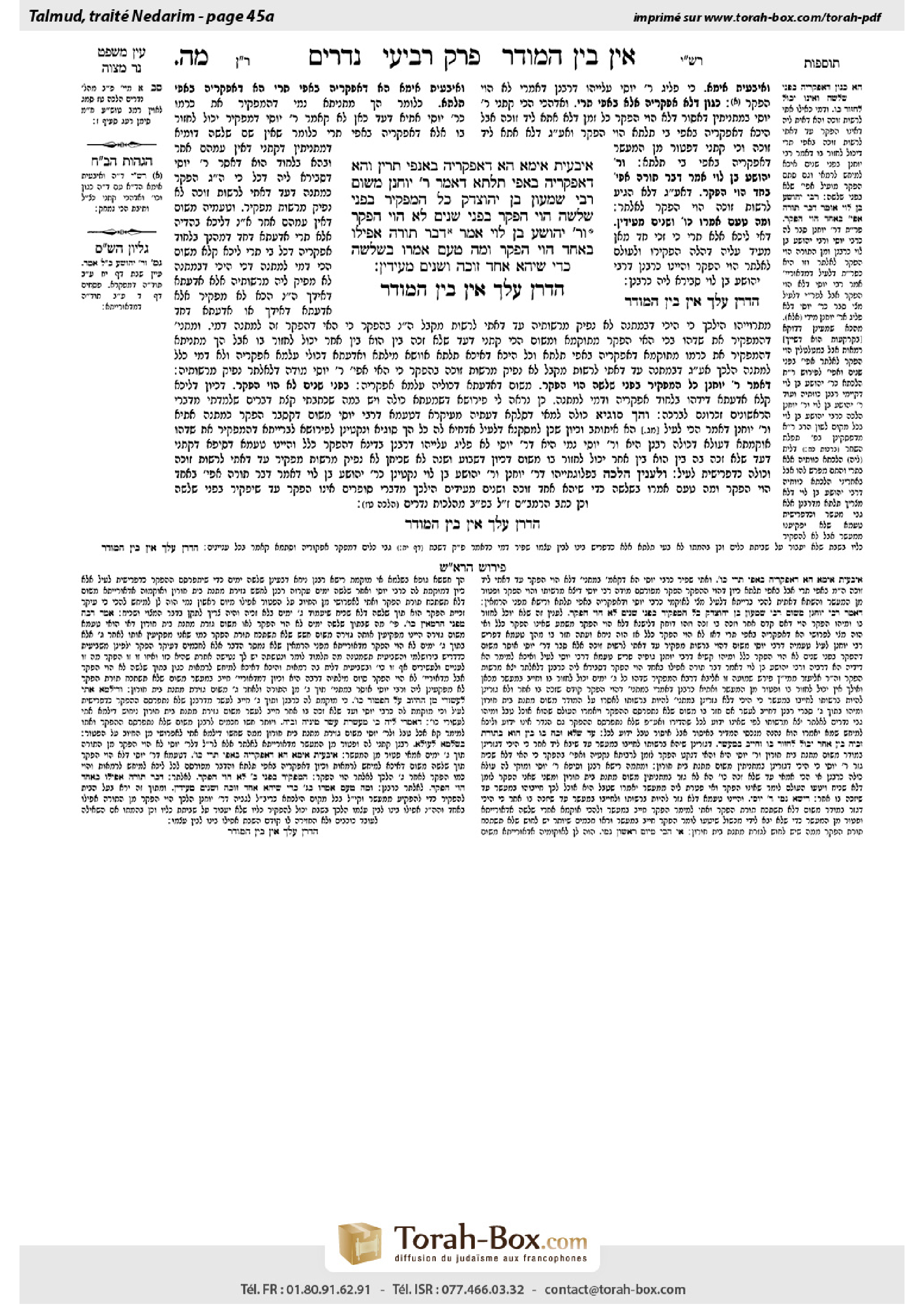
This page of Nedarim includes the Aramaic text, an English translation and an AI-generated French translation, alongside the scan above.
נדרים מ״ה א · Aramaic and Hebrew text
אִיבָּעֵית אֵימָא: הָא דְּאַפְקְרֵיהּ בְּאַנְפֵּי תְרֵין, וְהָא דְּאַפְקְרֵיהּ בְּאַפֵּי תְלָתָא. דְּאָמַר רַבִּי יוֹחָנָן מִשּׁוּם רַבִּי שִׁמְעוֹן בֶּן יְהוֹצָדָק: כׇּל הַמַּפְקִיר בִּפְנֵי שְׁלֹשָׁה — הָוֵי הֶפְקֵר, בִּפְנֵי שְׁנַיִם — לָא הָוֵי הֶפְקֵר.
וְרַבִּי יְהוֹשֻׁעַ בֶּן לֵוִי אָמַר: דְּבַר תּוֹרָה אֲפִילּוּ בְּאֶחָד — הָוֵי הֶפְקֵר, וּמַה טַּעַם אָמְרוּ בִּשְׁלֹשָׁה, כְּדֵי שֶׁיְּהֵא אֶחָד זוֹכֶה וּשְׁנַיִם מְעִידִין.
הַדְרָן עֲלָךְ אֵין בֵּין הַמּוּדָּר
Nedarim 45a · English translation
If you wish, say instead: That baraita, in which it is taught that the item does not leave the possession of the owner until it enters the possession of another, is referring to a case where one declared it ownerless before two people; and this baraita, in which it is taught that the item is ownerless when it is declared ownerless, is referring to a case where one declared it ownerless before three people. As Rabbi Yoḥanan said in the name of Rabbi Shimon ben Yehotzadak: With regard to anyone who declares an item ownerless before three people, that item is ownerless; if he does so before two people, it is not ownerless.
And Rabbi Yehoshua ben Levi said: By Torah law, even with one person, the item is ownerless, and what is the reason that the Sages said that ownerless status must be declared with three people? It is so that one will take possession of the item and two will testify that the item was declared ownerless and that it was acquired by that person. It is not a requirement fundamental to the declaration of ownerless status.
Nedarim 45a · Traduction française (IA)
Si tu le souhaites, dis plutôt : Cette baraïta, qui enseigne que l’objet ne sort pas de la possession de son propriétaire tant qu’il n’entre pas en la possession d’un autre, concerne le cas où quelqu’un l’a déclaré sans propriétaire devant deux personnes ; et cette baraïta, qui enseigne que l’objet est sans propriétaire dès qu’il est déclaré comme tel, concerne le cas où quelqu’un l’a déclaré sans propriétaire devant trois personnes. Car Rabbi Yoḥanan a dit au nom de Rabbi Shimon ben Yehotzadak : quiconque déclare un objet sans propriétaire devant trois personnes rend cet objet sans propriétaire ; s’il le fait devant deux personnes, l’objet ne devient pas sans propriétaire.
Et Rabbi Yehoshua ben Levi a dit : selon la Torah, l’objet devient sans propriétaire même si la déclaration est faite devant une seule personne. Pourquoi les Sages ont-ils donc dit que la déclaration devait se faire devant trois personnes ? Pour qu’une personne prenne possession de l’objet et que deux autres témoignent que l’objet a été déclaré sans propriétaire et que cette personne l’a acquis. Ce n’est pas une condition essentielle à la déclaration selon laquelle l’objet est sans propriétaire.
Traduction française générée par IA à partir de l’édition anglaise de Sefaria. Vérifie toujours un passage avec le texte source.
Text from Sefaria: William Davidson Edition - Vocalized Aramaic (CC BY NC); William Davidson Edition - English (CC BY NC).