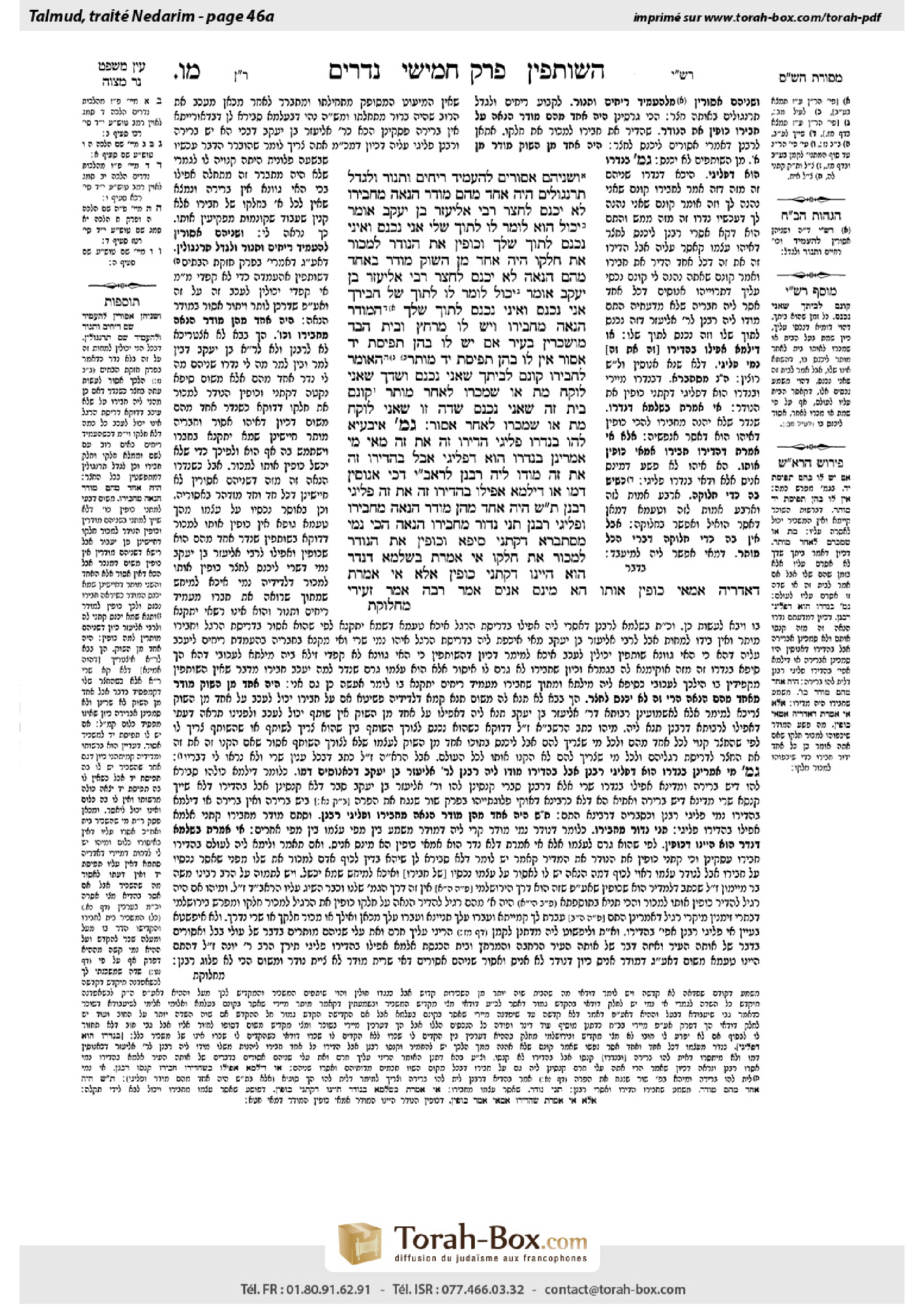
Nedarim 46a: Talmud study for Daf Yomi
Daf Yomi is the daily study of one Talmud folio. Explore 37 tractates with scans, Hebrew text, Sefaria English and AI-generated French translations where annotated.
Passage selection and English or AI-generated French translation are available where the scan has annotations. Daf Study is independent of Torah-Box and Sefaria.
Browse Nedarim · נדרים · All tractatesNedarim 46a text and translations
This page of Nedarim includes the Aramaic text, an English translation and an AI-generated French translation, alongside the scan above.
נדרים מ״ו א · Aramaic and Hebrew text
וּשְׁנֵיהֶם אֲסוּרִים לְהַעֲמִיד רֵיחַיִם וְתַנּוּר וּלְגַדֵּל תַּרְנְגוֹלִים.
הָיָה אֶחָד מֵהֶם מוּדָּר הֲנָאָה מֵחֲבֵירוֹ — לֹא יִכָּנֵס לֶחָצֵר. רַבִּי אֱלִיעֶזֶר בֶּן יַעֲקֹב אוֹמֵר, יָכוֹל הוּא לוֹמַר לוֹ: לְתוֹךְ שֶׁלִּי אֲנִי נִכְנָס, וְאֵינִי נִכְנָס לְתוֹךְ שֶׁלְּךָ. וְכוֹפִין אֶת הַנּוֹדֵר לִמְכּוֹר אֶת חֶלְקוֹ.
הָיָה אֶחָד מִן הַשּׁוּק מוּדָּר בְּאֶחָד מֵהֶם הֲנָאָה — לֹא יִכָּנֵס לֶחָצֵר. רַבִּי אֱלִיעֶזֶר בֶּן יַעֲקֹב אוֹמֵר, יָכוֹל לוֹמַר לוֹ: לְתוֹךְ שֶׁל חֲבֵירְךָ אֲנִי נִכְנָס, וְאֵינִי נִכְנָס לְתוֹךְ שֶׁלְּךָ.
הַמּוּדָּר הֲנָאָה מֵחֲבֵירוֹ וְיֵשׁ לוֹ מֶרְחָץ וּבֵית הַבַּד מוּשְׂכָּרִין בָּעִיר, אִם יֵשׁ לוֹ בָּהֶן תְּפִיסַת יָד — אָסוּר, אֵין לוֹ בָּהֶן תְּפִיסַת יָד — מוּתָּר.
הָאוֹמֵר לַחֲבֵירוֹ: ״קֻוֽנָּם לְבֵיתְךָ שֶׁאֲנִי נִכְנָס, וְשָׂדְךָ שֶׁאֲנִי לוֹקֵחַ״, מֵת אוֹ שֶׁמְּכָרוֹ לְאַחֵר — מוּתָּר. ״קֻוֽנָּם בַּיִת זֶה שֶׁאֲנִי נִכְנָס״, ״שָׂדֶה זוֹ שֶׁאֲנִי לוֹקֵחַ״, מֵת אוֹ שֶׁמְּכָרוֹ לְאַחֵר — אָסוּר.
גְּמָ׳ אִיבַּעְיָא לְהוּ: בְּנָדְרוּ פְּלִיגִי, הִדִּירוּ זֶה אֶת זֶה מַאי? מִי אָמְרִינַן: בְּנָדְרוּ הוּא דִּפְלִיגִי, אֲבָל בְּהִדִּירוּ זֶה אֶת זֶה — מוֹדוּ לֵיהּ רַבָּנַן לְרַבִּי אֱלִיעֶזֶר בֶּן יַעֲקֹב דְּכִי אֲנוּסִין דָּמוּ. אוֹ דִילְמָא: אֲפִילּוּ בְּהִדִּירוּ זֶה אֶת זֶה פְּלִיגִי רַבָּנַן?
תָּא שְׁמַע: הָיָה אֶחָד מֵהֶן מוּדָּר הֲנָאָה מֵחֲבֵירוֹ, וּפְלִיגִי רַבָּנַן! תָּנֵי: נָדוּר מֵחֲבֵירוֹ הֲנָאָה.
הָכִי נָמֵי מִסְתַּבְּרָא, דְּקָתָנֵי סֵיפָא: וְכוֹפִין אֶת הַנּוֹדֵר לִמְכּוֹר אֶת חֶלְקוֹ. אִי אָמְרַתְּ בִּשְׁלָמָא דִּנְדַר הוּא, הַיְינוּ דְּקָתָנֵי כּוֹפִין. אֶלָּא אִי אָמְרַתְּ דְּאַדְּרֵיהּ, אַמַּאי כּוֹפִין אוֹתוֹ? הָא מֵינָס אֲנִיס?
אָמַר רַבָּה אָמַר זְעֵירִי:
Nedarim 46a · English translation
And all agree that they are both prohibited from setting up a mill or an oven in the jointly owned courtyard, or to raise chickens in it.
If only one of the partners was prohibited by a vow from deriving benefit from the other, he may not enter the courtyard. Rabbi Eliezer ben Ya’akov says: He can say to the partner: I am entering into my own portion and I am not entering into your portion. And the court forces the one who took such a vow to sell his portion so that he does not cause the other to transgress.
If someone from the marketplace is prohibited by a vow from deriving benefit from one of the partners, he may not enter a courtyard of the partners, since it belongs partly to the one from whom he may not benefit. Rabbi Eliezer ben Ya’akov says: He can say to him: I am entering into the portion of another resident of the courtyard and I am not entering your own portion since it does not belong entirely to you.
With regard to one prohibited by a vow from deriving benefit from another and he has a bathhouse or an olive press in the city that is leased out and available for public use, if the one who took the vow has a right to profits from usage in the property, i.e., he retains some rights in the property and has not leased them out completely, it is forbidden for the one who took the vow to use it. If he has no right of usage in the property, it is permitted.
With regard to one who says to another: Entering your house is konam for me, or: Purchasing your field is konam for me, then if he, i.e., the owner of the house or field, dies or sells the house to another, it is permitted for the one who took the vow to enter the house or purchase the field, as it is no longer in the possession of the prior owner. But if he said: Entering this house is konam for me, or: Purchasing this field is konam for me, then even if the owner dies or sells it to another, it is forbidden.
GEMARA: A dilemma was raised before the Sages: In the mishna, the Rabbis and Rabbi Eliezer ben Ya’akov disagree with regard to the permissibility of entering a jointly owned courtyard where the partners vowed not to derive benefit from one another. However, if they instead vowed to prohibit one another from deriving benefit from them and their property, what is the halakha? Do we say that they disagree where the partners each vowed not to benefit from the other, but where they each vowed to prohibit one another from deriving benefit from them, the Rabbis concede to Rabbi Eliezer ben Ya’akov, as they are each considered to be forbidden due to circumstances beyond their control? Or perhaps the Rabbis disagree even in a case where each vowed to prohibit one another from deriving benefit?
Come and hear a proof from the mishna: If only one of the partners was prohibited by a vow from deriving benefit from the other, he may not enter the shared courtyard. Here, the prohibitive vow was stated by the other party, and still the Rabbis disagree and forbid the use of the courtyard. Evidently, the dispute in the mishna applies equally to cases beyond the control of the one forbidden by the vow. The Gemara responds: Teach an emended version of the mishna: If one had vowed to prohibit himself from deriving benefit from another. According to this emended version, the mishna may be addressing only the one who brought the prohibition upon himself.
So too, it is reasonable to assume that the mishna is referring to one who imposes the prohibition upon himself, as it was taught in the latter clause with regard to the same case: And the court forces the one who took such a vow to sell his portion. Granted, if you say that the mishna is speaking of a case where he himself vowed not to benefit from the other, this is consistent with that which teaches that the court forces him to sell his portion; since he created the problem, he is forced to resolve it. But if you say that it is referring to a case where the other prohibited him with a vow, why does the court force him to sell his property? He is put in a situation beyond his control. This clause offers no proof, and the Rabbis may still concede in a case where one is forbidden due to another’s vow.
Rabba said that Ze’eiri said:
Nedarim 46a · Traduction française (IA)
Tous s’accordent à dire qu’il leur est interdit à tous deux d’installer un moulin ou un four dans la cour qu’ils possèdent en commun, ou d’y élever des poules.
Si un vœu interdit à l’un des associés de tirer profit de l’autre, il ne peut pas entrer dans la cour. Rabbi Eliezer ben Ya’akov dit : « Il peut dire à son associé : “J’entre dans ma propre part et je n’entre pas dans la tienne.” » Le tribunal contraint celui qui a prononcé un tel vœu à vendre sa part, afin qu’il ne fasse pas transgresser l’autre.
Si une personne venue du marché est frappée par un vœu qui lui interdit de tirer profit de l’un des associés, elle ne peut pas entrer dans la cour commune, puisqu’une partie de celle-ci appartient à celui dont elle ne peut tirer profit. Rabbi Eliezer ben Ya’akov dit : « Elle peut lui dire : “J’entre dans la part d’un autre habitant de la cour et non dans ta propre part, puisqu’elle ne t’appartient pas entièrement.” »
Lorsqu’un vœu interdit à une personne de tirer profit d’une autre, et que cette dernière possède dans la ville un établissement de bains ou un pressoir à olives qu’elle a donné en location et qui est à la disposition du public, si celui qui a prononcé le vœu a droit aux revenus tirés de l’utilisation du bien, c’est-à-dire s’il conserve certains droits sur celui-ci et ne les a pas entièrement cédés en location, il lui est interdit de l’utiliser. S’il ne conserve aucun droit d’utilisation sur le bien, cela lui est permis.
Si quelqu’un dit à un autre : « Entrer dans ta maison est pour moi konam », ou : « Acheter ton champ est pour moi konam », alors, si l’autre, c’est-à-dire le propriétaire de la maison ou du champ, meurt ou vend la maison à quelqu’un d’autre, celui qui a prononcé le vœu peut entrer dans la maison ou acheter le champ, car ceux-ci ne sont plus en possession de leur ancien propriétaire. Mais s’il a dit : « Entrer dans cette maison est pour moi konam », ou : « Acheter ce champ est pour moi konam », alors, même si le propriétaire meurt ou vend le bien à quelqu’un d’autre, cela reste interdit.
GUEMARA : Une question fut posée aux Sages : dans la Michna, les Rabbins et Rabbi Eliezer ben Ya’akov sont en désaccord sur la possibilité d’entrer dans une cour commune lorsque les associés ont fait vœu de ne pas tirer profit l’un de l’autre. Mais s’ils ont plutôt fait vœu de s’interdire mutuellement de tirer profit d’eux-mêmes et de leurs biens, quelle est la halakha ? Devons-nous dire qu’ils sont en désaccord lorsque les associés ont chacun fait vœu de ne pas tirer profit de l’autre, mais que, lorsque chacun a fait vœu d’interdire à l’autre de tirer profit de lui, les Rabbins reconnaissent l’avis de Rabbi Eliezer ben Ya’akov, car chacun est alors considéré comme empêché par des circonstances indépendantes de sa volonté ? Ou peut-être les Rabbins sont-ils en désaccord même dans un cas où chacun a fait vœu d’interdire à l’autre de tirer profit de lui ?
Viens et entends une preuve tirée de la Michna : si un vœu interdit à l’un des associés de tirer profit de l’autre, il ne peut pas entrer dans la cour commune. Ici, le vœu d’interdiction a été prononcé par l’autre partie, et pourtant les Rabbins sont en désaccord avec Rabbi Eliezer ben Ya’akov et interdisent l’usage de la cour. Il apparaît donc que le désaccord dans la Michna s’applique également aux cas où celui que le vœu frappe est empêché par des circonstances indépendantes de sa volonté. La Guemara répond : enseigne une version corrigée de la Michna : « Si quelqu’un avait fait vœu de s’interdire de tirer profit d’un autre. » Selon cette version corrigée, la Michna peut ne traiter que du cas de celui qui s’est imposé l’interdiction.
De même, il est raisonnable de supposer que la Michna parle de celui qui s’impose l’interdiction, car la dernière clause enseigne, à propos du même cas : « Et le tribunal contraint celui qui a prononcé un tel vœu à vendre sa part. » En effet, si l’on dit que la Michna parle d’un cas où il a lui-même fait vœu de ne pas tirer profit de l’autre, il est cohérent qu’elle enseigne que le tribunal le contraint à vendre sa part : puisqu’il a créé le problème, il est contraint de le résoudre. Mais si l’on dit qu’elle parle d’un cas où l’autre lui a interdit quelque chose par un vœu, pourquoi le tribunal le contraindrait-il à vendre son bien ? Il se trouve dans une situation indépendante de sa volonté. Cette clause n’apporte aucune preuve, et les Rabbins peuvent encore reconnaître l’avis de Rabbi Eliezer ben Ya’akov dans le cas où une personne est frappée par l’interdiction résultant du vœu d’un autre.
Rabba dit au nom de Ze’eiri :
Traduction française générée par IA à partir de l’édition anglaise de Sefaria. Vérifie toujours un passage avec le texte source.
Text from Sefaria: William Davidson Edition - Vocalized Aramaic (CC BY NC); William Davidson Edition - English (CC BY NC).