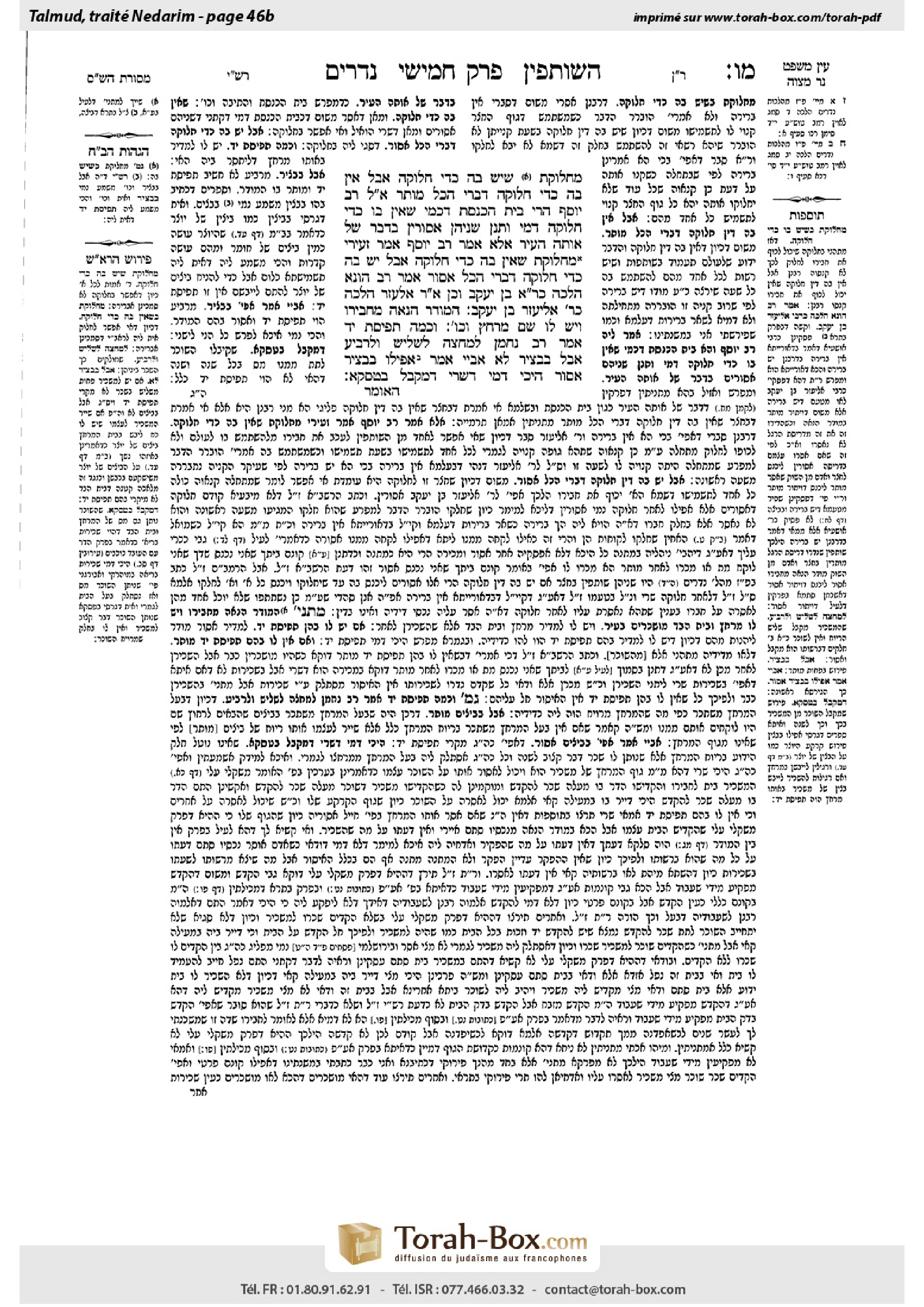
Nedarim 46b: Talmud study for Daf Yomi
Daf Yomi is the daily study of one Talmud folio. Explore 37 tractates with scans, Hebrew text, Sefaria English and AI-generated French translations where annotated.
Passage selection and English or AI-generated French translation are available where the scan has annotations. Daf Study is independent of Torah-Box and Sefaria.
Browse Nedarim · נדרים · All tractatesNedarim 46b text and translations
This page of Nedarim includes the Aramaic text, an English translation and an AI-generated French translation, alongside the scan above.
נדרים מ״ו ב · Aramaic and Hebrew text
מַחְלוֹקֶת שֶׁיֵּשׁ בָּהּ כְּדֵי חֲלוּקָּה. אֲבָל אֵין בָּהּ כְּדֵי חֲלוּקָּה — דִּבְרֵי הַכֹּל מוּתָּר.
אֲמַר לֵיהּ רַב יוֹסֵף: הֲרֵי בֵּית הַכְּנֶסֶת, דִּכְמִי שֶׁאֵין בּוֹ כְּדֵי חֲלוּקָּה דָּמֵי, וּתְנַן: שְׁנֵיהֶן אֲסוּרִין בְּדָבָר שֶׁל אוֹתָהּ הָעִיר!
אֶלָּא, אָמַר רַב יוֹסֵף, אָמַר זְעֵירִי: מַחְלוֹקֶת שֶׁאֵין בָּהּ כְּדֵי חֲלוּקָּה, אֲבָל יֵשׁ בָּהּ כְּדֵי חֲלוּקָּה — דִּבְרֵי הַכֹּל אָסוּר.
אָמַר רַב הוּנָא: הֲלָכָה כְּרַבִּי אֱלִיעֶזֶר בֶּן יַעֲקֹב. וְכֵן אָמַר רַבִּי אֶלְעָזָר: הֲלָכָה כְּרַבִּי אֱלִיעֶזֶר בֶּן יַעֲקֹב.
הַמּוּדָּר הֲנָאָה מֵחֲבֵירוֹ וְיֵשׁ לוֹ שָׁם מֶרְחָץ וְכוּ׳. וְכַמָּה תְּפִיסַת יָד? אָמַר רַב נַחְמָן: לְמֶחֱצָה לִשְׁלִישׁ וְלִרְבִיעַ. אֲבָל בִּבְצִיר — לָא. אַבָּיֵי אָמַר: אֲפִילּוּ בִּבְצִיר — אָסוּר. הֵיכִי דָּמֵי דִּשְׁרֵי — דִּמְקַבֵּל בְּטַסְקָא.
Nedarim 46b · English translation
The dispute between Rabbi Eliezer ben Ya’akov and the Rabbis is with regard to a courtyard where there is sufficient area in the courtyard for it to be divided into four square cubits for each partner, so each can be said to have a real portion that can be forbidden to the other. But if there is not sufficient area in it to be divided, everyone agrees that it is permitted to benefit from it, since the entire courtyard is viewed as belonging to both of them and each one can say that he is entering his own portion.
Rav Yosef said to Rabba: A synagogue belongs to the entire public and is therefore considered like a courtyard in which there is not sufficient area in it to be divided, and we learned in a mishna later in the chapter (48a) that with regard to two people who vow not to derive benefit from each other, both are prohibited from deriving benefit from an entity belonging to that city such as a synagogue. Evidently, the Rabbis prohibit deriving benefit even from such entities.
Rather, Rav Yosef said: Ze’eiri must have said: The dispute holds where there is not sufficient area in the courtyard for it to be divided, but if there is sufficient area in it for it to be divided, everyone agrees that it is forbidden, since if either enters it he may be entering the other’s portion.
Rav Huna said: The halakha is in accordance with the opinion of Rabbi Eliezer ben Ya’akov. And so too, Rabbi Elazar said: The halakha is in accordance with the opinion of Rabbi Eliezer ben Ya’akov.
§ The mishna teaches: With regard to one prohibited by a vow from deriving benefit from another and he has a bathhouse or an olive press in the city that is leased out and available for public use, the forbidden party may use it only if the owner has forfeited his own right to profits from usage. The Gemara asks: And how much is this right to profits from usage that prohibits the subject of the vow from entering the bathhouse? Rav Naḥman said: In cases where he receives one half, one-third, or one-quarter of the profits of the bathhouse. But in a case where he receives less, it is not forbidden. Abaye said: Even in a case where he receives less, it is forbidden. If so, what are the circumstances in which it is permitted and he is not considered to have a right to profits from usage? Where he completely forfeits all profits and receives only an annual rental fee [taska] from a tenant.
Nedarim 46b · Traduction française (IA)
La controverse entre Rabbi Eliezer ben Ya’akov et les Sages porte sur une cour dont la superficie est suffisante pour être divisée en parts de quatre coudées carrées pour chaque associé, de sorte que chacun peut être considéré comme ayant une véritable part qu’il peut interdire à l’autre. Mais si sa superficie n’est pas suffisante pour la diviser, tous reconnaissent qu’il est permis d’en tirer profit, puisque la cour entière est considérée comme appartenant aux deux et que chacun peut dire qu’il entre dans sa propre part.
Rav Yossef dit à Rabba : Une synagogue appartient à l’ensemble du public et est donc considérée comme une cour dont la superficie n’est pas suffisante pour être divisée. Or, nous avons appris dans une Michna plus loin dans le chapitre (48a) qu’en ce qui concerne deux personnes qui ont fait le vœu de ne pas tirer profit l’une de l’autre, toutes deux ont l’interdiction de tirer profit d’un bien appartenant à leur ville, tel qu’une synagogue. Il ressort de là que les Sages interdisent de tirer profit même de tels biens.
Rav Yossef dit plutôt : Ze’eiri a dû dire que la controverse porte sur le cas où la superficie de la cour n’est pas suffisante pour être divisée ; mais si elle est suffisante pour l’être, tous reconnaissent que cela est interdit, car si l’un d’eux y entre, il peut pénétrer dans la part de l’autre.
Rav Houna dit : La halakha est conforme à l’opinion de Rabbi Eliezer ben Ya’akov. De même, Rabbi Elazar dit : La halakha est conforme à l’opinion de Rabbi Eliezer ben Ya’akov.
§ La Michna enseigne : Lorsqu’une personne a l’interdiction, en vertu d’un vœu, de tirer profit d’une autre, et que cette dernière possède dans la ville un bain public ou un pressoir à olives qu’elle loue et qui est à la disposition du public, la personne visée par l’interdiction ne peut s’en servir que si le propriétaire a renoncé à son droit aux revenus de leur utilisation. La Guemara demande : Quel montant de revenus tirés de l’utilisation constitue un droit qui interdit à la personne visée par le vœu d’entrer dans le bain public ? Rav Naḥman dit : Il est interdit lorsqu’il reçoit la moitié, le tiers ou le quart des revenus du bain public. Mais s’il en reçoit moins, cela n’est pas interdit. Abaye dit : Même s’il en reçoit moins, cela est interdit. Dans ce cas, quand l’utilisation est-elle permise, de sorte qu’on ne considère pas qu’il a un droit aux revenus tirés de l’utilisation ? Lorsqu’il renonce entièrement à tous les revenus et ne reçoit de son locataire qu’un loyer annuel [taska].
Traduction française générée par IA à partir de l’édition anglaise de Sefaria. Vérifie toujours un passage avec le texte source.
Text from Sefaria: William Davidson Edition - Vocalized Aramaic (CC BY NC); William Davidson Edition - English (CC BY NC).