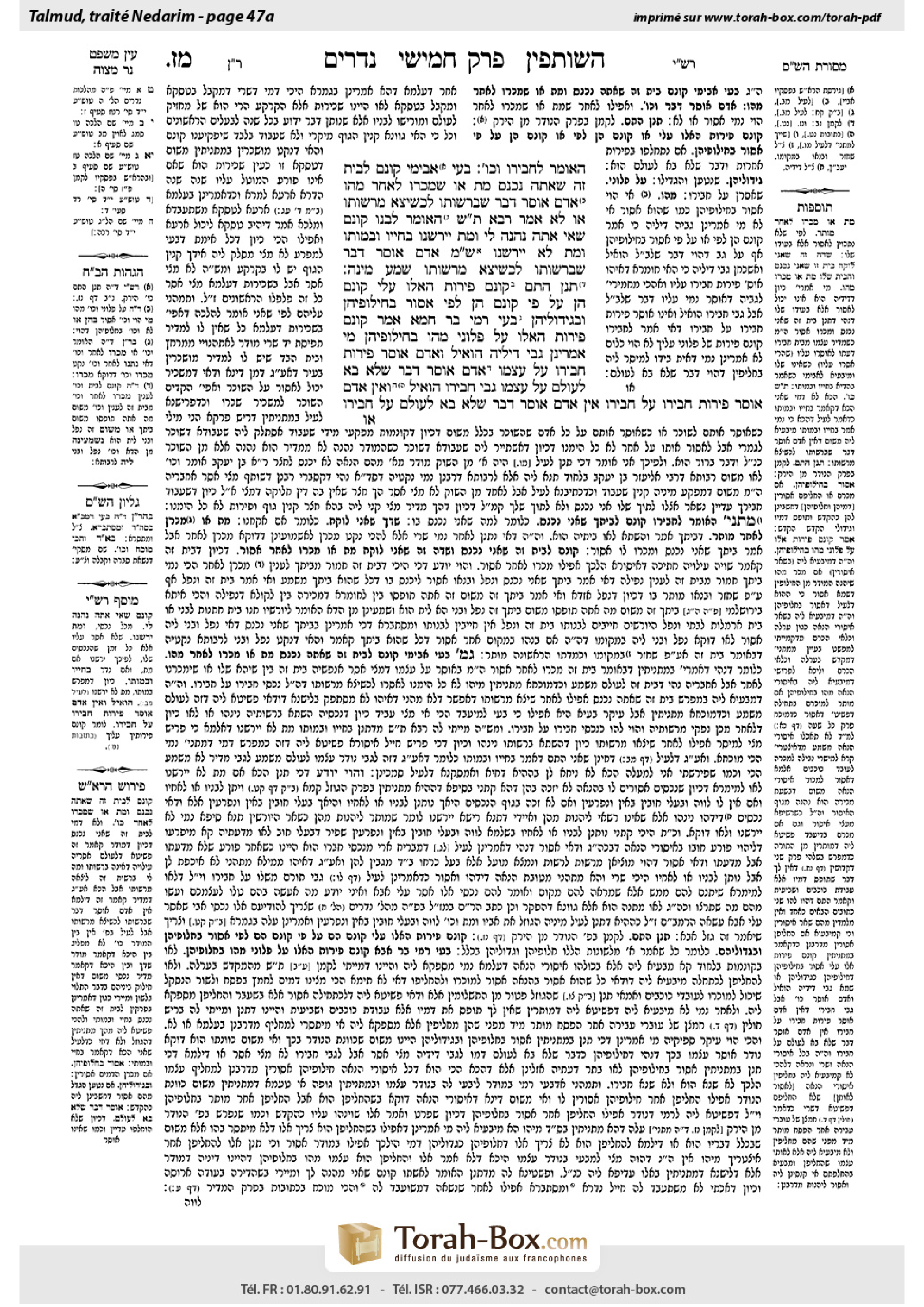
Nedarim 47a: Talmud study for Daf Yomi
Daf Yomi is the daily study of one Talmud folio. Explore 37 tractates with scans, Hebrew text, Sefaria English and AI-generated French translations where annotated.
Passage selection and English or AI-generated French translation are available where the scan has annotations. Daf Study is independent of Torah-Box and Sefaria.
Browse Nedarim · נדרים · All tractatesNedarim 47a text and translations
This page of Nedarim includes the Aramaic text, an English translation and an AI-generated French translation, alongside the scan above.
נדרים מ״ז א · Aramaic and Hebrew text
הָאוֹמֵר לַחֲבֵירוֹ וְכוּ׳. בָּעֵי אֲבִימִי: ״קֻוֽנָּם לְבַיִת זֶה שֶׁאַתָּה נִכְנָס״, מֵת אוֹ שֶׁמְּכָרוֹ לְאַחֵר, מַהוּ? אָדָם אוֹסֵר דָּבָר שֶׁבִּרְשׁוּתוֹ לִכְשֶׁיֵּצֵא מֵרְשׁוּתוֹ, אוֹ לָא?
אָמַר רָבָא, תָּא שְׁמַע: הָאוֹמֵר לִבְנוֹ ״קֻוֽנָּם שֶׁאִי אַתָּה נֶהֱנֶה לִי״, וּמֵת — יִירָשֶׁנּוּ. ״בְּחַיָּיו וּבְמוֹתוֹ״, וּמֵת — לֹא יִירָשֶׁנּוּ. שְׁמַע מִינַּהּ אָדָם אוֹסֵר דָּבָר שֶׁבִּרְשׁוּתוֹ לִכְשֶׁיֵּצֵא מֵרְשׁוּתוֹ. שְׁמַע מִינַּהּ.
תְּנַן הָתָם: ״קֻוֽנָּם פֵּירוֹת הָאֵלּוּ עָלַי״, ״קֻוֽנָּם הֵן עַל פִּי״, ״קֻוֽנָּם הֵן לְפִי״ — אָסוּר בְּחִילּוּפֵיהֶן וּבְגִידּוּלֵיהֶן.
בָּעֵי רָמֵי בַּר חָמָא: אָמַר ״קֻוֽנָּם פֵּירוֹת הָאֵלּוּ עַל פְּלוֹנִי״, מַהוּ בְּחִילּוּפֵיהֶן? מִי אָמְרִינַן גַּבֵּי דִילֵיהּ, הוֹאִיל וְאָדָם אוֹסֵר פֵּירוֹת חֲבֵירוֹ עַל עַצְמוֹ, אָדָם אוֹסֵר דָּבָר שֶׁלֹּא בָא לְעוֹלָם עַל עַצְמוֹ. גַּבֵּי חֲבֵירוֹ, הוֹאִיל וְאֵין אָדָם אוֹסֵר פֵּירוֹת חֲבֵירוֹ עַל חֲבֵירוֹ, אֵין אָדָם אוֹסֵר דָּבָר שֶׁלֹּא בָא לְעוֹלָם עַל חֲבֵירוֹ.
Nedarim 47a · English translation
§ The mishna teaches: With regard to one who says to another: Entering your house is konam for me, and the owner dies or sells the house, the prohibition is lifted. But if he said: Entering this house is konam for me, he remains prohibited from entering the house even after the owner dies or sells the house. Avimi raises a dilemma: If the owner of a house said: Entering this house is konam for you, and then he died or sold it to another, what is the halakha? Do we say that a person can render an item in his possession forbidden even for a time after it will leave his possession, or not?
Rava said: Come and hear a proof from a mishna (Bava Kamma 108b–109a): If one says to his son: Benefiting from me is konam for you, and dies, the son still inherits from him. If, however, the father explicitly states that benefit is forbidden both in his lifetime and after his death, and dies, the son does not inherit from him. Rava suggests: Conclude from the mishna that a person can render an item in his possession forbidden even for a time after it will leave his possession. The Gemara notes: Conclude from the mishna that this is so.
§ We learned in a mishna there (57a): If one says: This produce is konam upon me, or: It is konam upon my mouth, or: It is konam for my mouth, he is prohibited from eating even its replacements, should they be traded or exchanged, and anything that grows from it if it is replanted.
Rami bar Ḥama raises a dilemma: If one said: This produce is konam for so-and-so, what is the halakha with regard to their replacements? Do we say: With regard to himself, since a person can render another’s produce forbidden for himself, though it is not presently in his possession, so too, a person can render an entity that has not yet come into the world forbidden to himself? Is this why the replacement produce and anything that grows from it is forbidden to him, even if it did not yet exist when he took the vow? If so, with regard to another, since a person cannot render another’s produce forbidden to another, i.e., to that owner himself, similarly one cannot render an entity that has not yet come into the world forbidden to another. The produce’s replacements would therefore be permitted to him.
Nedarim 47a · Traduction française (IA)
§ La Michna enseigne : Celui qui dit à un autre : « Entrer dans ta maison m’est konam », voit l’interdit levé si le propriétaire meurt ou vend la maison. Mais s’il dit : « Entrer dans cette maison m’est konam », il lui demeure interdit d’y entrer, même après la mort du propriétaire ou la vente de la maison. Avimi soulève une question : Si le propriétaire d’une maison dit à quelqu’un : « Entrer dans cette maison t’est konam », puis meurt ou la vend à quelqu’un d’autre, quelle est la halakha ? Doit-on dire qu’une personne peut rendre interdit un bien qui lui appartient même pour une période postérieure au moment où il ne sera plus en sa possession, ou non ?
Rava dit : « Viens et écoute une preuve tirée d’une Michna (Bava Kama 108b–109a) : Si quelqu’un dit à son fils : “Tirer profit de moi t’est konam”, puis meurt, son fils hérite néanmoins de lui. En revanche, si le père précise que tout profit lui est interdit aussi bien de son vivant qu’après sa mort, et qu’il meurt, son fils n’hérite pas de lui. » Rava propose d’en conclure qu’une personne peut rendre interdit un bien qui lui appartient même pour une période postérieure au moment où il ne sera plus en sa possession. La Guemara relève : « Conclus de cette Michna que c’est bien le cas. »
§ Nous avons appris dans une Michna, là-bas (57a) : Si quelqu’un dit : « Ces fruits me sont konam », ou : « Ils sont konam pour ma bouche », ou : « Ils sont konam à ma bouche », il lui est interdit de manger même leurs produits de remplacement, s’ils sont échangés ou troqués, ainsi que tout ce qui en pousse lorsqu’ils sont replantés.
Rami bar Ḥama soulève une question : Si quelqu’un dit : « Ces fruits sont konam pour untel », quelle est la halakha concernant leurs produits de remplacement ? Doit-on dire que, s’agissant de lui-même, puisqu’une personne peut s’interdire le produit d’autrui, bien que celui-ci ne soit pas actuellement en sa possession, elle peut également s’interdire une entité qui n’est pas encore venue au monde ? Est-ce pour cette raison que les produits de remplacement et tout ce qui pousse à partir du produit initial lui sont interdits, même s’ils n’existaient pas encore au moment où il a prononcé le vœu ? Si tel est le cas, s’agissant d’autrui, puisqu’une personne ne peut pas interdire à autrui le produit de celui-ci, c’est-à-dire à son propre propriétaire, de même, elle ne peut pas interdire à autrui une entité qui n’est pas encore venue au monde. Les produits de remplacement lui seraient donc permis.
Traduction française générée par IA à partir de l’édition anglaise de Sefaria. Vérifie toujours un passage avec le texte source.
Text from Sefaria: William Davidson Edition - Vocalized Aramaic (CC BY NC); William Davidson Edition - English (CC BY NC).