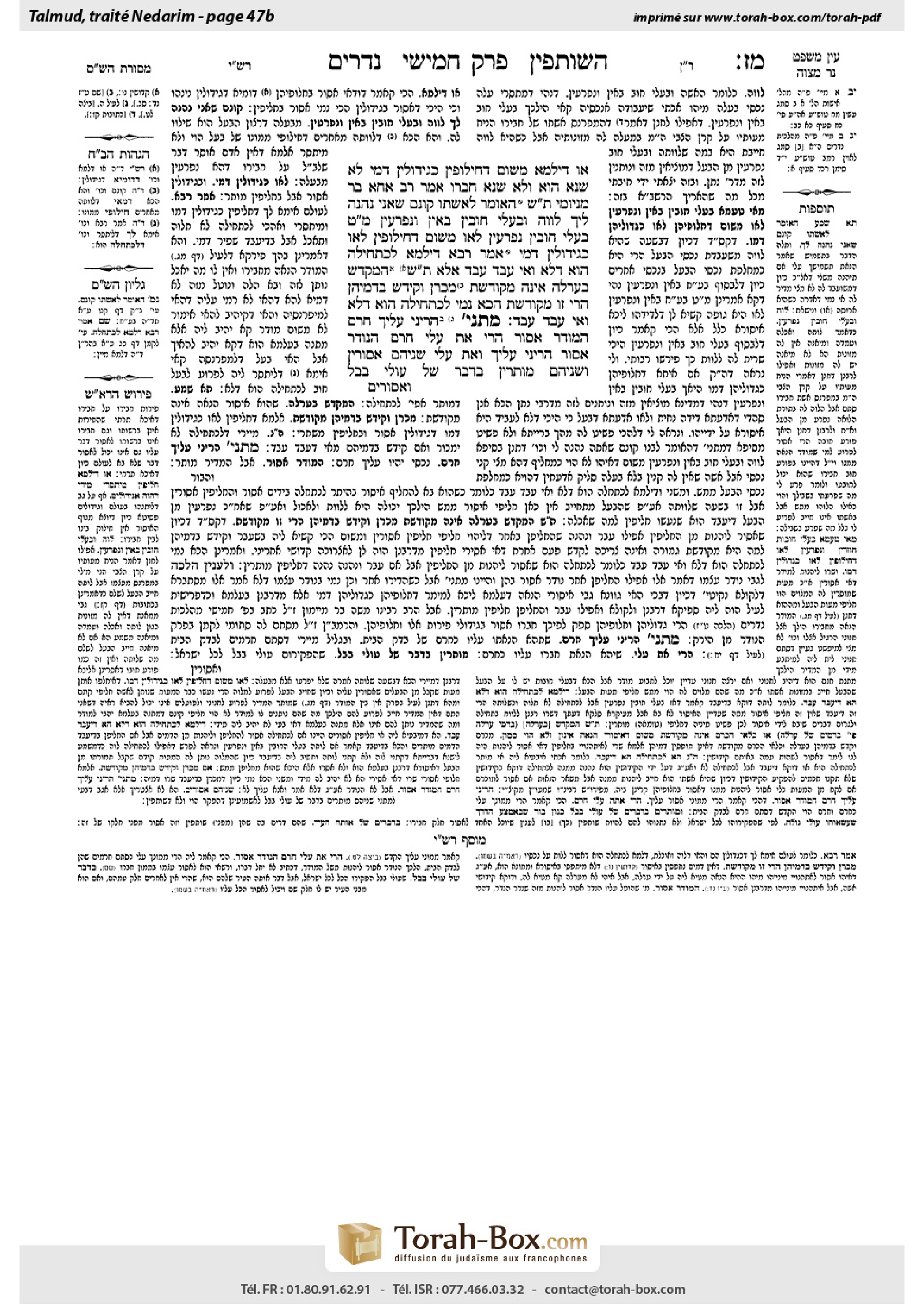
Nedarim 47b: Talmud study for Daf Yomi
Daf Yomi is the daily study of one Talmud folio. Explore 37 tractates with scans, Hebrew text, Sefaria English and AI-generated French translations where annotated.
Passage selection and English or AI-generated French translation are available where the scan has annotations. Daf Study is independent of Torah-Box and Sefaria.
Browse Nedarim · נדרים · All tractatesNedarim 47b text and translations
This page of Nedarim includes the Aramaic text, an English translation and an AI-generated French translation, alongside the scan above.
נדרים מ״ז ב · Aramaic and Hebrew text
אוֹ דִילְמָא מִשּׁוּם דְּחִילּוּפִין כְּגִידּוּלִין דָּמֵי, לָא שְׁנָא הוּא וְלָא שְׁנָא חֲבֵרוֹ.
אָמַר רַב אַחָא בַּר מִנְיוֹמֵי, תָּא שְׁמַע: הָאוֹמֵר לְאִשְׁתּוֹ ״קֻוֽנָּם שֶׁאֲנִי נֶהֱנֶה לִיךְ״, לוֹוָה וּבַעְלֵי חוֹבִין בָּאִין וְנִפְרָעִין. מַאי טַעְמָא בַּעְלֵי חוֹבִין נִפְרָעִין — לָאו מִשּׁוּם דְּחִילּוּפִין לָאו כְּגִידּוּלִין דָּמֵי?
אָמַר רָבָא: דִּילְמָא לְכַתְּחִילָּה הוּא דְּלָא, וְאִי עֲבַד — עֲבַד.
אֶלָּא, תָּא שְׁמַע: הַמְקַדֵּשׁ בְּעׇרְלָה — אֵינָהּ מְקוּדֶּשֶׁת. מְכָרָן וְקִידֵּשׁ בִּדְמֵיהֶן — הֲרֵי זוֹ מְקוּדֶּשֶׁת. הָכָא נָמֵי: לְכַתְּחִילָּה הוּא דְּלָא, וְאִי עֲבַד — עֲבַד.
מַתְנִי׳ ״הֲרֵינִי עָלֶיךָ חֵרֶם״ — הַמּוּדָּר אָסוּר. ״הֲרֵי אַתְּ עָלַי חֵרֶם״ — הַנּוֹדֵר אָסוּר. ״הֲרֵינִי עָלֶיךָ וְאַתְּ עָלַי״ — שְׁנֵיהֶם אֲסוּרִין, וּשְׁנֵיהֶם מוּתָּרִין בְּדָבָר שֶׁל עוֹלֵי בָּבֶל,
Nedarim 47b · English translation
Or perhaps the prohibition on replacement produce in the mishna is due to the fact that replacements of the produce are viewed as being like that which grows from them? They are both forbidden because they derive from the forbidden produce. If this is the case, it is no different for him and it is no different for another. Neither may derive benefit from the replacements.
Rav Aḥa bar Minyumi said: Come and hear a proof from a baraita: With regard to one who says to his wife: Benefiting from me is konam for you, she may nevertheless borrow money to sustain herself, and the creditors can come and collect her debts from her husband. What is the reason that the creditors can collect from the husband? Is it not because she benefits only indirectly, and it must be that replacements, i.e., the creditors’ money, are not like that which grows from the original item?
Rava said: This is not proof: Perhaps it is the case that one should not benefit from replacements ab initio, but if one did it, it is done after the fact. Since the wife lacks any other means to support herself, the case is considered to be after the fact, and it is permitted for her to benefit indirectly. Still, replacements of an item are considered to be like that which grows from it ab initio.
Rather, come and hear a proof from another mishna (Kiddushin 56b): With regard to one who betroths a woman with fruit of orla, i.e., fruit of the first three years of a tree’s growth, from which it is forbidden to benefit, she is not betrothed because the fruits have no value. Betrothal can be performed only with an object worth at least one peruta. But if he sold them and betrothed her with the money he received, she is betrothed. Evidently, replacements of a forbidden item are permitted. The Gemara responds: Here also, one should not benefit from the replacement items given in exchange for the orla ab initio, but if one did it, it is done after the fact. Replacements of an item may still be considered to be like that which grows from it ab initio.
MISHNA: If someone says to another: I am hereby forbidden to you like an item dedicated to the Temple, then the one prohibited by the vow is prohibited from benefiting from the possessions of the one who took the vow. If someone says: You are hereby forbidden to me like an item dedicated to the Temple, then the one who took the vow is prohibited from benefiting from the possessions of the other. If he says: I am hereby forbidden to you and you are hereby forbidden to me like an item dedicated to the Temple, both are prohibited from benefiting from the possessions of the other. But it is permitted for both of them to benefit from the objects belonging to those who ascended from Babylonia, i.e., common property of the nation as a whole, which is not considered to be the property of any individual.
Nedarim 47b · Traduction française (IA)
Ou peut-être l’interdiction des produits de remplacement dans la Michna tient-elle au fait que ceux-ci sont considérés comme ce qui pousse à partir du produit initial ? Les deux sont interdits, car ils proviennent du produit interdit. Si tel est le cas, il n’y a aucune différence entre lui et autrui : ni l’un ni l’autre ne peut tirer profit des produits de remplacement.
Rav Aḥa bar Minyumi dit : Viens et écoute une preuve tirée d’une baraïta : celui qui dit à sa femme : « Tirer profit de moi t’est interdit comme konam », celle-ci peut néanmoins emprunter de l’argent pour subvenir à ses besoins, et les créanciers peuvent venir recouvrer leurs créances auprès de son mari. Pourquoi les créanciers peuvent-ils recouvrer leurs créances auprès du mari ? N’est-ce pas parce qu’elle ne tire profit que de manière indirecte, ce qui implique que les produits de remplacement — c’est-à-dire l’argent des créanciers — ne sont pas considérés comme ce qui pousse à partir de l’objet initial ?
Rava dit : Ce n’est pas une preuve. Peut-être est-il interdit, a priori, de tirer profit des produits de remplacement, mais que, si on l’a fait, cela soit valable a posteriori. Puisque l’épouse ne dispose d’aucun autre moyen de subvenir à ses besoins, le cas est considéré comme une situation a posteriori, et elle est autorisée à en tirer profit indirectement. Néanmoins, a priori, les produits de remplacement d’un objet sont considérés comme ce qui pousse à partir de celui-ci.
Au contraire, viens et écoute une preuve tirée d’une autre Michna (Kiddouchin 56b) : celui qui épouse une femme au moyen de fruits d’orla, c’est-à-dire les fruits produits au cours des trois premières années de croissance d’un arbre, dont il est interdit de tirer profit, ne l’a pas épousée, car ces fruits n’ont aucune valeur. Pour conclure un mariage, il faut un objet valant au moins une perouta. Mais s’il les a vendus et l’a épousée avec l’argent reçu, elle est épousée. Il ressort de là que les produits de remplacement d’un objet interdit sont permis. La Guemara répond : ici aussi, il est interdit, a priori, de tirer profit des objets obtenus en échange des fruits d’orla, mais, si on l’a fait, cela est valable a posteriori. Les produits de remplacement d’un objet peuvent néanmoins être considérés, a priori, comme ce qui pousse à partir de celui-ci.
MICHNA : Si quelqu’un dit à un autre : « Je te suis désormais interdit comme un objet consacré au Temple », la personne à qui le vœu impose cette interdiction ne peut pas tirer profit des biens de celui qui a prononcé le vœu. Si quelqu’un dit : « Tu m’es désormais interdit comme un objet consacré au Temple », celui qui a prononcé le vœu ne peut pas tirer profit des biens de l’autre. S’il dit : « Je te suis désormais interdit et tu m’es désormais interdit comme un objet consacré au Temple », aucun des deux ne peut tirer profit des biens de l’autre. Cependant, tous deux peuvent tirer profit des biens appartenant à ceux qui sont montés de Babylone, c’est-à-dire des biens communs à l’ensemble de la nation, qui ne sont considérés comme la propriété d’aucun individu.
Traduction française générée par IA à partir de l’édition anglaise de Sefaria. Vérifie toujours un passage avec le texte source.
Text from Sefaria: William Davidson Edition - Vocalized Aramaic (CC BY NC); William Davidson Edition - English (CC BY NC).