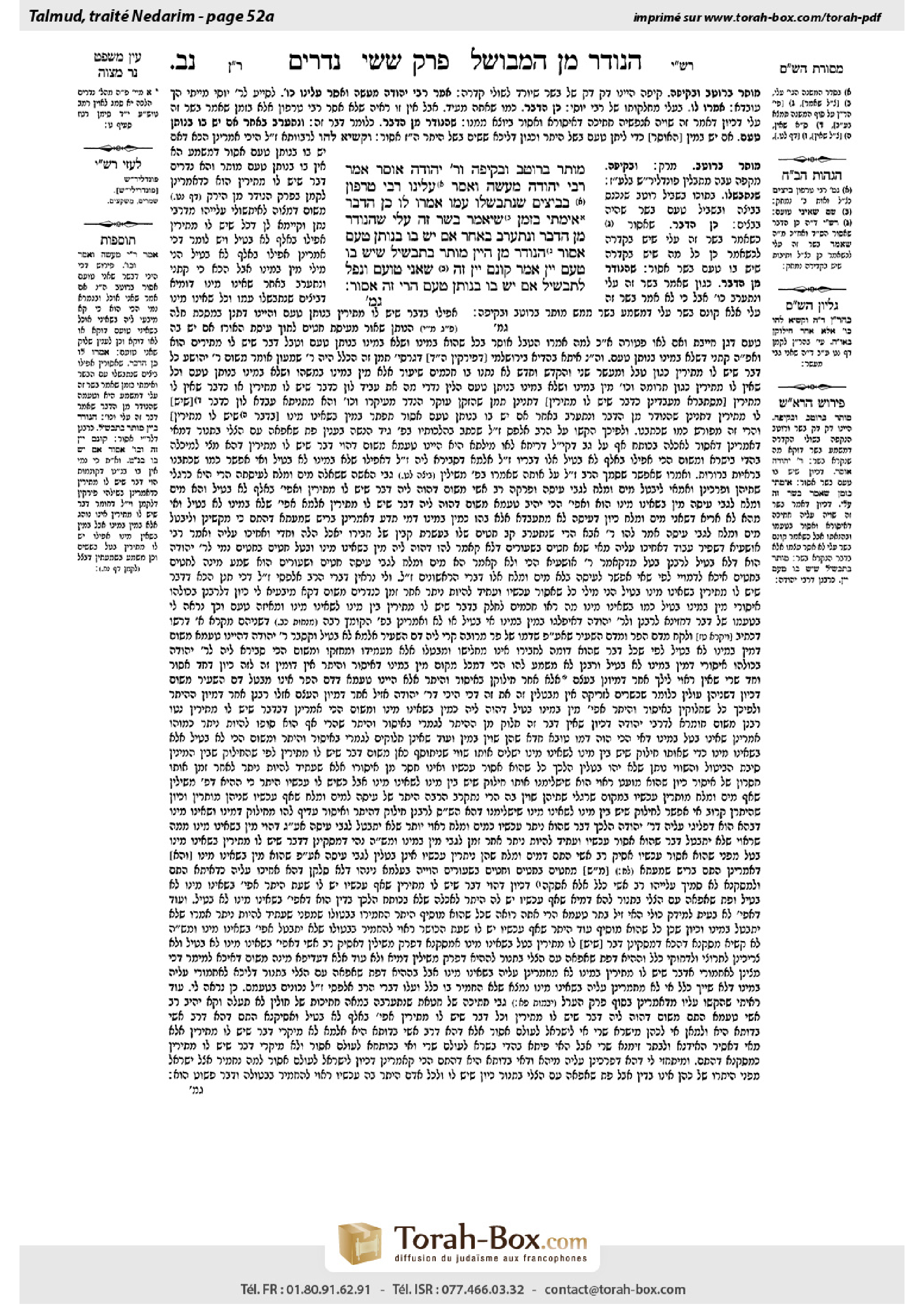
Nedarim 52a: Talmud study for Daf Yomi
Daf Yomi is the daily study of one Talmud folio. Explore 37 tractates with scans, Hebrew text, Sefaria English and AI-generated French translations where annotated.
Passage selection and English or AI-generated French translation are available where the scan has annotations. Daf Study is independent of Torah-Box and Sefaria.
Browse Nedarim · נדרים · All tractatesNedarim 52a text and translations
This page of Nedarim includes the Aramaic text, an English translation and an AI-generated French translation, alongside the scan above.
נדרים נ״ב א · Aramaic and Hebrew text
מוּתָּר בָּרוֹטֶב וּבַקֵּיפֶה, וְרַבִּי יְהוּדָה אוֹסֵר.
אָמַר רַבִּי יְהוּדָה: מַעֲשֶׂה וְאָסַר עָלֵינוּ רַבִּי טַרְפוֹן בְּבֵיצִים שֶׁנִּתְבַּשְּׁלוּ עִמּוֹ. אָמְרוּ לוֹ: כֵּן הַדָּבָר, אֵימָתַי — בִּזְמַן שֶׁיֹּאמַר: ״בָּשָׂר זֶה עָלַי״, שֶׁהַנּוֹדֵר מִן הַדָּבָר וְנִתְעָרֵב בְּאַחֵר, אִם יֵשׁ בּוֹ בְּנוֹתֵן טַעַם — אָסוּר.
הַנּוֹדֵר מִן הַיַּיִן — מוּתָּר בְּתַבְשִׁיל שֶׁיֵּשׁ בּוֹ טַעַם יַיִן. אָמַר: ״קֻוֽנָּם יַיִן זֶה שֶׁאֲנִי טוֹעֵם״ וְנָפַל לְתַבְשִׁיל, אִם יֵשׁ בּוֹ בְּנוֹתֵן טַעַם — הֲרֵי זֶה אָסוּר.
Nedarim 52a · English translation
is permitted to eat gravy and sediments of boiled meat [kifa]. But Rabbi Yehuda maintains that he is prohibited from eating them.
Rabbi Yehuda said: There was an incident where one took such a vow and Rabbi Tarfon prohibited us from even eggs that were cooked with meat. The Rabbis said to him: Indeed so, but when is this the halakha? When he says: This meat is forbidden to me, referring to a specific piece of meat. This is because in the case of one who vows that an item is forbidden to him, and it becomes mixed into another item, if the latter contains an amount of the forbidden food that gives it flavor, i.e., the forbidden food can be tasted in the permitted food, the mixture is forbidden. However, if one vows that meat in general is forbidden to him, without specifying a particular piece, only the meat itself is forbidden, not the gravy, sediments, or eggs cooked with that meat.
Likewise, one who vows that wine is forbidden to him is permitted to eat a cooked dish that has the flavor of wine. However, if he said: This wine is konam for me, and for that reason I will not taste it, and the wine fell into a cooked dish, if the dish contains an amount of the wine that gives it flavor, it is forbidden.
Nedarim 52a · Traduction française (IA)
il est permis de manger le jus et les résidus de viande bouillie [kifa]. Mais Rabbi Yehuda soutient qu’il lui est interdit d’en manger.
Rabbi Yehuda dit : Il arriva qu’un homme prononça un tel vœu, et Rabbi Tarfon nous interdit même les œufs cuits avec de la viande. Les Sages lui dirent : C’est exact, mais dans quel cas cette halakha s’applique-t-elle ? Lorsqu’il dit : « Cette viande m’est interdite », en faisant référence à un morceau de viande précis. En effet, lorsqu’une personne voue un aliment à l’interdit et que celui-ci se mélange à un autre aliment, si ce dernier contient une quantité suffisante de l’aliment interdit pour lui donner du goût, c’est-à-dire si l’on peut sentir l’aliment interdit dans l’aliment permis, le mélange est interdit. Toutefois, si une personne fait le vœu que la viande, de manière générale, lui soit interdite, sans désigner un morceau particulier, seule la viande elle-même lui est interdite, et non le jus, les résidus ou les œufs cuits avec cette viande.
De même, celui qui fait le vœu que le vin lui soit interdit peut manger un plat cuisiné ayant le goût du vin. Toutefois, s’il dit : « Ce vin m’est konam, et pour cette raison je n’y goûterai pas », puis que le vin tombe dans un plat cuisiné, si celui-ci contient une quantité de vin suffisante pour lui donner du goût, le plat est interdit.
Traduction française générée par IA à partir de l’édition anglaise de Sefaria. Vérifie toujours un passage avec le texte source.
Text from Sefaria: William Davidson Edition - Vocalized Aramaic (CC BY NC); William Davidson Edition - English (CC BY NC).