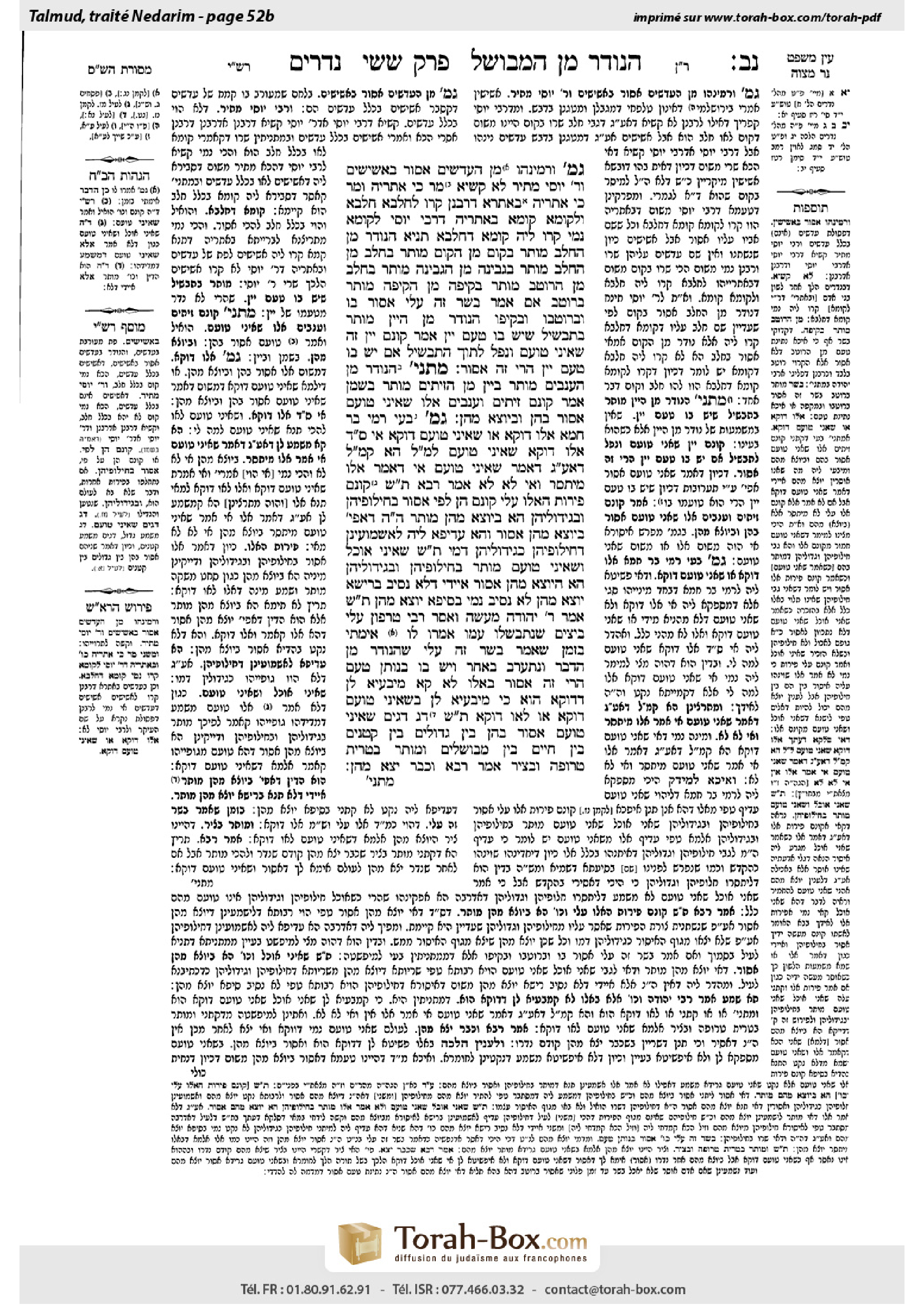
Nedarim 52b: Talmud study for Daf Yomi
Daf Yomi is the daily study of one Talmud folio. Explore 37 tractates with scans, Hebrew text, Sefaria English and AI-generated French translations where annotated.
Passage selection and English or AI-generated French translation are available where the scan has annotations. Daf Study is independent of Torah-Box and Sefaria.
Browse Nedarim · נדרים · All tractatesNedarim 52b text and translations
This page of Nedarim includes the Aramaic text, an English translation and an AI-generated French translation, alongside the scan above.
נדרים נ״ב ב · Aramaic and Hebrew text
גְּמָ׳ וּרְמִינְהוּ: ״מִן״ הָעֲדָשִׁים״ — אָסוּר בַּאֲשִׁישִׁים, וְרַבִּי יוֹסֵי מַתִּיר.
לָא קַשְׁיָא: מָר כִּי אַתְרֵיהּ וּמָר כִּי אַתְרֵיהּ. בְּאַתְרָא דְרַבָּנַן קָרוּ לַחֲלָבָא חֲלָבָא וּלְקוֹמָא קוֹמָא, בְּאַתְרֵיהּ דְּרַבִּי יוֹסֵי לְקוֹמָא נָמֵי קָרוּ לֵיהּ ״קוֹמָא דַחֲלָבָא״.
תַּנְיָא: הַנּוֹדֵר מִן הֶחָלָב — מוּתָּר בַּקּוֹם, מִן הַקּוֹם — מוּתָּר בְּחָלָב. מִן הֶחָלָב — מוּתָּר בִּגְבִינָה, מִן הַגְּבִינָה — מוּתָּר בְּחָלָב. מִן הָרוֹטֶב — מוּתָּר בְּקֵיפֶה, מִן הַקֵּיפֶה — מוּתָּר בְּרוֹטֶב. אִם אָמַר ״בָּשָׂר זֶה עָלַי״ — אָסוּר בּוֹ וּבְרוֹטְבּוֹ וּבְקֵיפוֹ.
הַנּוֹדֵר מִן הַיַּיִן — מוּתָּר בְּתַבְשִׁיל שֶׁיֵּשׁ בּוֹ טַעַם יַיִן. אָמַר: ״קֻוֽנָּם יַיִן זֶה שֶׁאֵינִי טוֹעֵם״ וְנָפַל לְתוֹךְ הַתַּבְשִׁיל, אִם יֵשׁ בּוֹ טַעַם יַיִן — הֲרֵי זֶה אָסוּר.
מַתְנִי׳ הַנּוֹדֵר מִן הָעֲנָבִים — מוּתָּר בְּיַיִן. מִן הַזֵּיתִים — מוּתָּר בְּשֶׁמֶן. אָמַר ״קֻוֽנָּם זֵיתִים וַעֲנָבִים אֵלּוּ שֶׁאֵינִי טוֹעֵם״ — אָסוּר בָּהֶן וּבְיוֹצֵא מֵהֶן.
גְּמָ׳ בָּעֵי רָמֵי בַּר חָמָא: ״אֵלּוּ״ דַּוְקָא, אוֹ ״שֶׁאֵינִי טוֹעֵם״ דַּוְקָא?
אִי סָלְקָא דַעְתָּךְ ״אֵלּוּ״ דַּוְקָא, ״שֶׁאֵינִי טוֹעֵם״ לְמָה לִי? הָא קָא מַשְׁמַע לַן, דְּאַף עַל גַּב דְּאָמַר ״שֶׁאֵינִי טוֹעֵם״, אִי דְּאָמַר ״אֵלּוּ״ — מִיתְּסַר, וְאִי לָא — לָא.
אָמַר רָבָא, תָּא שְׁמַע: ״קֻוֽנָּם פֵּירוֹת הָאֵלּוּ עָלַי״, ״קֻוֽנָּם הֵן לְפִי״ — אָסוּר בְּחִילּוּפֵיהֶן וּבְגִידּוּלֵיהֶן, הָא בַּיּוֹצֵא מֵהֶן מוּתָּר!
הוּא הַדִּין דַּאֲפִילּוּ בְּיוֹצֵא מֵהֶן אָסוּר. וְהָא עֲדִיפָא לֵיהּ לְאַשְׁמוֹעִינַן דְּחִילּוּפֵיהֶן כְּגִידּוּלֵיהֶן דָּמֵי.
תָּא שְׁמַע: ״שֶׁאֵינִי אוֹכֵל״, וְ״שֶׁאֵינִי טוֹעֵם״ — מוּתָּר בְּחִילּוּפֵיהֶן וּבְגִידּוּלֵיהֶן. הָא הַיּוֹצֵא מֵהֶן — אָסוּר! אַיְּידֵי דְּלָא נָסֵיב בְּרֵישָׁא ״יוֹצֵא מֵהֶן״, לָא נָסֵיב נָמֵי בְּסֵיפָא ״יוֹצֵא מֵהֶן״.
תָּא שְׁמַע, אָמַר רַבִּי יְהוּדָה: מַעֲשֶׂה וְאָסַר רַבִּי טַרְפוֹן עָלַי בֵּיצִים שֶׁנִּתְבַּשְּׁלוּ עִמּוֹ. אָמְרוּ לוֹ: אֵימָתַי, בִּזְמַן שֶׁאָמַר ״בָּשָׂר זֶה עָלַי״, שֶׁהַנּוֹדֵר מִן הַדָּבָר וְנִתְעָרֵב בְּאַחֵר, וְיֵשׁ בּוֹ בְּנוֹתֵן טַעַם — הֲרֵי זֶה אָסוּר.
בְּ״אֵלּוּ״ — לָא קָא מִיבַּעְיָא לַן דְּדַוְקָא הוּא. כִּי מִיבַּעְיָא לַן בְּ״שֶׁאֵינִי טוֹעֵם״ — דַּוְקָא, אוֹ לָאו דַּוְקָא?
תָּא שְׁמַע: ״דָּג דָּגִים שֶׁאֵינִי טוֹעֵם״ — אָסוּר בָּהֶן, בֵּין גְּדוֹלִים בֵּין קְטַנִּים, בֵּין חַיִּים בֵּין מְבוּשָּׁלִים, וּמוּתָּר בְּטָרִית טְרוּפָה וּבְצִיר.
אָמַר רָבָא: וּכְבָר יָצָא מֵהֶן.
Nedarim 52b · English translation
GEMARA: The mishna cited a dispute between Rabbi Yosei and the Rabbis, in which Rabbi Yosei ruled that one who vows that milk is forbidden to him is prohibited from eating whey as well. And the Gemara raises a contradiction between this ruling and Rabbi Yosei’s opinion in a later mishna (53b): One who vows that lentils are forbidden to him is prohibited from eating ashishim, a dish made from lentils. But Rabbi Yosei permits it. Apparently, Rabbi Yosei holds that if the forbidden food changes in form, it is permitted, contrary to his opinion with regard to whey.
The Gemara answers: This is not difficult. The opinion of this Sage is in accordance with the custom of his locale, and the opinion of that Sage in accordance with the custom of his locale. In the Rabbis’ locale they call milk, milk and whey, whey, whereas in Rabbi Yosei’s locale they also call whey, milk whey. In the latter location, the word milk is used in reference to whey, and therefore one who vows there that milk is forbidden to him is prohibited from eating whey as well.
It is taught in a baraita: One who vows that milk is forbidden to him is permitted to partake of whey. One who vows that whey is forbidden to him is permitted to partake of milk. One who vows that milk is forbidden to him is permitted to eat cheese. One who vows that cheese is forbidden to him is permitted to partake of milk. One who vows that gravy is forbidden to him is permitted to eat sediments of boiled meat. One who vows that sediments of boiled meat are forbidden to him is permitted to eat gravy. If one said: This piece of meat is hereby forbidden to me, he is prohibited from eating it, and from its gravy, and from its sediments.
One who vows: Wine is forbidden to me, is permitted to eat a cooked dish that has the flavor of wine. However, if he said: This wine is konam for me, and for that reason I will not taste it, and the wine fell into a cooked dish, if the dish contains an amount of the wine that gives it flavor, it is forbidden.
MISHNA: One who vows that grapes are forbidden to him is permitted to partake of wine. One who vows that olives are forbidden to him is permitted to partake of oil. However, if one said: Olives and grapes are konam for me, and for that reason I will not taste these items, he is prohibited from tasting them and the wine and oil that emerge from them.
GEMARA: With regard to the last ruling in the mishna, that one who vows: Olives and grapes are konam for me, and for that reason I will not taste these items, he is prohibited from tasting them and the wine and oil that emerge from them, Rami bar Ḥama raises a dilemma: Is it specifically because he said these, i.e., he referred to specific olives or grapes, or is it specifically because he said: For that reason I will not taste, i.e., he referred not to eating but to tasting?
The Gemara asks: If it enters your mind that it is specifically because he said these, why do I need the phrase: That I will not taste? The Gemara answers: This teaches us that even if he said: That I will not taste, only if he said the word these is he prohibited from tasting oil or wine, but if he did not say the word these, he is not prohibited from doing so. The dilemma therefore cannot be resolved by inference from the phrasing of the vow in the mishna.
Rava said: Come and hear a resolution to this dilemma from the mishna below (57a): If one says: This produce is konam upon me, or: It is konam to my mouth, he is prohibited from eating their replacements and anything that grows from them. It may be inferred that liquids that emerge from them are permitted. Evidently, referring to specific produce is not sufficient to render their juice forbidden. Rather, the prohibition in the mishna is apparently due to the phrase: And for that reason I will not taste.
The Gemara refutes this proof: The same ruling as in the mishna above is true with regard to liquids that emerge from the produce; they too are forbidden. And the reason this ruling isn’t mentioned there is that it is preferable for that mishna to teach us that their replacements are forbidden just like what grows from them is forbidden, although they contain no substance of the forbidden item.
Come and hear a resolution from the continuation of that same mishna: If one says: This produce is konam upon me, and for that reason I will not eat them, or: This produce is konam upon me, and for that reason I will not taste them, he is permitted to eat their replacements and anything that grows from them. It may be inferred that liquids that emerge from them are forbidden. The Gemara rejects this argument: Since that mishna did not cite liquids that emerge from them in the first clause, it did not cite liquids that emerge from them in the latter clause either. Therefore, it cannot be inferred that liquids that come from the produce are forbidden.
Come and hear a resolution from the previous mishna (52a): Rabbi Yehuda said: There was an incident where Rabbi Tarfon prohibited me from eating even eggs that were cooked with meat. The Rabbis said to him: Indeed so, but when is this the halakha? When the one who took the vow said: This meat is forbidden to me, referring to a specific piece of meat. This is because in the case of one who vows that something is forbidden to him and it gets mixed into another food, and the latter food contains an amount of the forbidden food that gives it flavor, i.e., the prohibited food can be tasted in the permitted food, the mixture is forbidden. Evidently, referring to a specific food causes what emerges from it to be forbidden as well.
The Gemara reinterprets the dilemma: We do not raise the dilemma with regard to the word these, as using specifically this word is certainly sufficient to render the liquids that come from the produce forbidden. When we raise a dilemma, it is with regard to the phrase: That I will not taste it. Is this phrase mentioned by the mishna specifically to teach that using it in a vow is sufficient to render the juice forbidden, or is it not mentioned specifically for that purpose?
Come and hear a resolution from the mishna above (51b): If one vows: Fish or fishes are konam for me, and for that reason I will not taste them, he is prohibited with regard to all of them, whether large fish or small, and whether raw or cooked. But he is permitted to taste minced sardines and to taste fish brine. The phrase: I will not taste, clearly does not render fish brine forbidden, although it contains that which emerged from fish.
Rava said: But there is no evidence from here, as the fish brine that is permitted by the mishna may be referring to brine that already emerged from them before the vow was taken, and was therefore not included in the fish that were rendered forbidden by the vow. The dilemma therefore remains unresolved.
Nedarim 52b · Traduction française (IA)
GUEMARA : La Michna citait une controverse entre Rabbi Yossei et les Sages : Rabbi Yossei statuait que celui qui fait vœu de s’interdire le lait n’a pas non plus le droit de manger du petit-lait. La Guemara soulève une contradiction entre cette décision et l’opinion de Rabbi Yossei dans une Michna ultérieure (53b) : celui qui fait vœu de s’interdire les lentilles n’a pas le droit de manger des ashishim, un plat à base de lentilles. Or, Rabbi Yossei le permet. Il semble donc que, selon Rabbi Yossei, si l’aliment interdit change de forme, il devient permis, contrairement à son opinion concernant le petit-lait.
La Guemara répond : Il n’y a pas de difficulté. L’opinion de ce Sage correspond à l’usage de sa région, et celle de cet autre Sage à l’usage de la sienne. Dans la région des Sages, on appelle le lait « lait » et le petit-lait « petit-lait », tandis que dans la région de Rabbi Yossei, on appelle aussi le petit-lait « petit-lait de lait ». Dans cette dernière région, le mot « lait » désigne donc également le petit-lait ; par conséquent, celui qui y fait vœu de s’interdire le lait n’a pas non plus le droit de manger du petit-lait.
Il est enseigné dans une baraïta : Celui qui fait vœu de s’interdire le lait peut consommer du petit-lait. Celui qui fait vœu de s’interdire le petit-lait peut consommer du lait. Celui qui fait vœu de s’interdire le lait peut manger du fromage. Celui qui fait vœu de s’interdire le fromage peut consommer du lait. Celui qui fait vœu de s’interdire la sauce de viande peut manger les résidus de viande bouillie. Celui qui fait vœu de s’interdire les résidus de viande bouillie peut consommer la sauce. Si quelqu’un dit : « Que ce morceau de viande me soit interdit », il lui est interdit de le manger, ainsi que sa sauce et ses résidus.
Celui qui fait vœu en disant : « Le vin m’est interdit » peut manger un plat cuisiné qui a le goût du vin. En revanche, s’il dit : « Que ce vin soit konam pour moi, et pour cette raison je n’y goûterai pas », et que le vin tombe dans un plat cuisiné, si le plat contient une quantité de vin qui lui donne du goût, il est interdit.
MICHNA : Celui qui fait vœu de s’interdire les raisins peut consommer du vin. Celui qui fait vœu de s’interdire les olives peut consommer de l’huile. Toutefois, si quelqu’un dit : « Que les olives et les raisins soient konam pour moi, et pour cette raison je ne goûterai pas ces aliments », il lui est interdit d’y goûter, ainsi qu’au vin et à l’huile qui en sont extraits.
Concernant la dernière décision de la Michna, selon laquelle celui qui fait vœu en disant : « Que les olives et les raisins soient konam pour moi, et pour cette raison je ne goûterai pas ces aliments » n’a pas le droit d’y goûter, ni de goûter le vin et l’huile qui en sont extraits, Rami bar Ḥama soulève une question : Est-ce précisément parce qu’il a dit « ces », c’est-à-dire qu’il a désigné des olives ou des raisins particuliers, ou est-ce précisément parce qu’il a dit : « Pour cette raison, je ne goûterai pas », autrement dit parce qu’il a parlé de goûter plutôt que de manger ?
La Guemara demande : Si tu penses que c’est précisément parce qu’il a dit « ces », pourquoi faut-il ajouter la formule « que je ne goûterai pas » ? La Guemara répond : Cela nous enseigne que, même s’il a dit « que je ne goûterai pas », il n’est interdit de goûter l’huile ou le vin que s’il a prononcé le mot « ces » ; s’il ne l’a pas prononcé, cela ne lui est pas interdit. On ne peut donc pas trancher la question par déduction à partir de la formulation du vœu dans la Michna.
Rava dit : Viens et entends une réponse à cette question dans la Michna ci-dessous (57a) : si quelqu’un dit : « Que ce produit soit konam pour moi » ou « Qu’il soit konam pour ma bouche », il lui est interdit de manger les produits de remplacement et tout ce qui pousse à partir de ce produit. On peut en déduire que les liquides qui en sont extraits sont permis. Il semble donc qu’il ne suffise pas de désigner un produit précis pour en interdire le jus. L’interdiction énoncée dans la Michna est donc apparemment due à la formule : « Et pour cette raison, je ne goûterai pas. »
La Guemara réfute cette preuve : la même décision que dans la Michna ci-dessus s’applique aux liquides qui se dégagent du produit ; eux aussi sont interdits. Si cette décision n’y est pas mentionnée, c’est parce que cette Michna préfère nous enseigner que les produits de remplacement sont interdits, tout comme ce qui pousse à partir du produit est interdit, bien qu’ils ne contiennent aucune substance de l’aliment interdit.
Viens et entends une réponse dans la suite de cette même Michna : si quelqu’un dit : « Que ce produit soit konam pour moi, et pour cette raison je ne le mangerai pas », ou : « Que ce produit soit konam pour moi, et pour cette raison je n’y goûterai pas », il lui est permis de manger les produits de remplacement et tout ce qui pousse à partir de ce produit. On peut en déduire que les liquides qui en sont extraits sont interdits. La Guemara rejette cet argument : puisque la Michna n’a pas mentionné les liquides qui en sont extraits dans la première clause, elle ne les a pas non plus mentionnés dans la dernière clause. On ne peut donc pas en déduire que les liquides provenant du produit sont interdits.
Viens et entends une réponse dans la Michna précédente (52a) : Rabbi Yehouda dit : « Il est arrivé que Rabbi Tarfon m’interdise même de manger des œufs cuits avec de la viande. » Les Sages lui ont dit : « C’est bien cela, mais dans quel cas est-ce la halakha ? Lorsque celui qui a fait le vœu a dit : “Que cette viande me soit interdite”, désignant un morceau de viande précis. » En effet, si quelqu’un fait vœu de s’interdire une chose et que celle-ci se mélange à un autre aliment, et que ce dernier contient une quantité de l’aliment interdit suffisante pour lui donner du goût, c’est-à-dire que l’on peut discerner le goût de l’aliment interdit dans l’aliment permis, le mélange est interdit. Il est donc évident que désigner un aliment précis rend également interdit ce qui en est extrait.
La Guemara reformule la question : nous ne soulevons pas de difficulté au sujet du mot « ces », car employer précisément ce mot suffit certainement à interdire les liquides provenant du produit. La question porte sur la formule : « Que je ne goûterai pas. » La Michna la mentionne-t-elle précisément pour enseigner que l’utiliser dans un vœu suffit à interdire le jus, ou ne la mentionne-t-elle pas précisément dans ce but ?
Viens et entends une réponse dans la Michna ci-dessus (51b) : si quelqu’un fait vœu en disant : « Que le poisson ou les poissons soient konam pour moi, et pour cette raison je ne les goûterai pas », il lui est interdit de consommer tout poisson, grand ou petit, cru ou cuit. Mais il lui est permis de goûter des sardines hachées et de la saumure de poisson. La formule « je ne goûterai pas » ne rend clairement pas la saumure de poisson interdite, bien qu’elle contienne une substance provenant du poisson.
Rava dit : Mais cela ne constitue pas une preuve, car la saumure de poisson que la Michna permet peut désigner une saumure qui s’était déjà dégagée des poissons avant que le vœu soit prononcé ; elle n’était donc pas incluse dans les poissons rendus interdits par le vœu. La question reste donc sans réponse.
Traduction française générée par IA à partir de l’édition anglaise de Sefaria. Vérifie toujours un passage avec le texte source.
Text from Sefaria: William Davidson Edition - Vocalized Aramaic (CC BY NC); William Davidson Edition - English (CC BY NC).