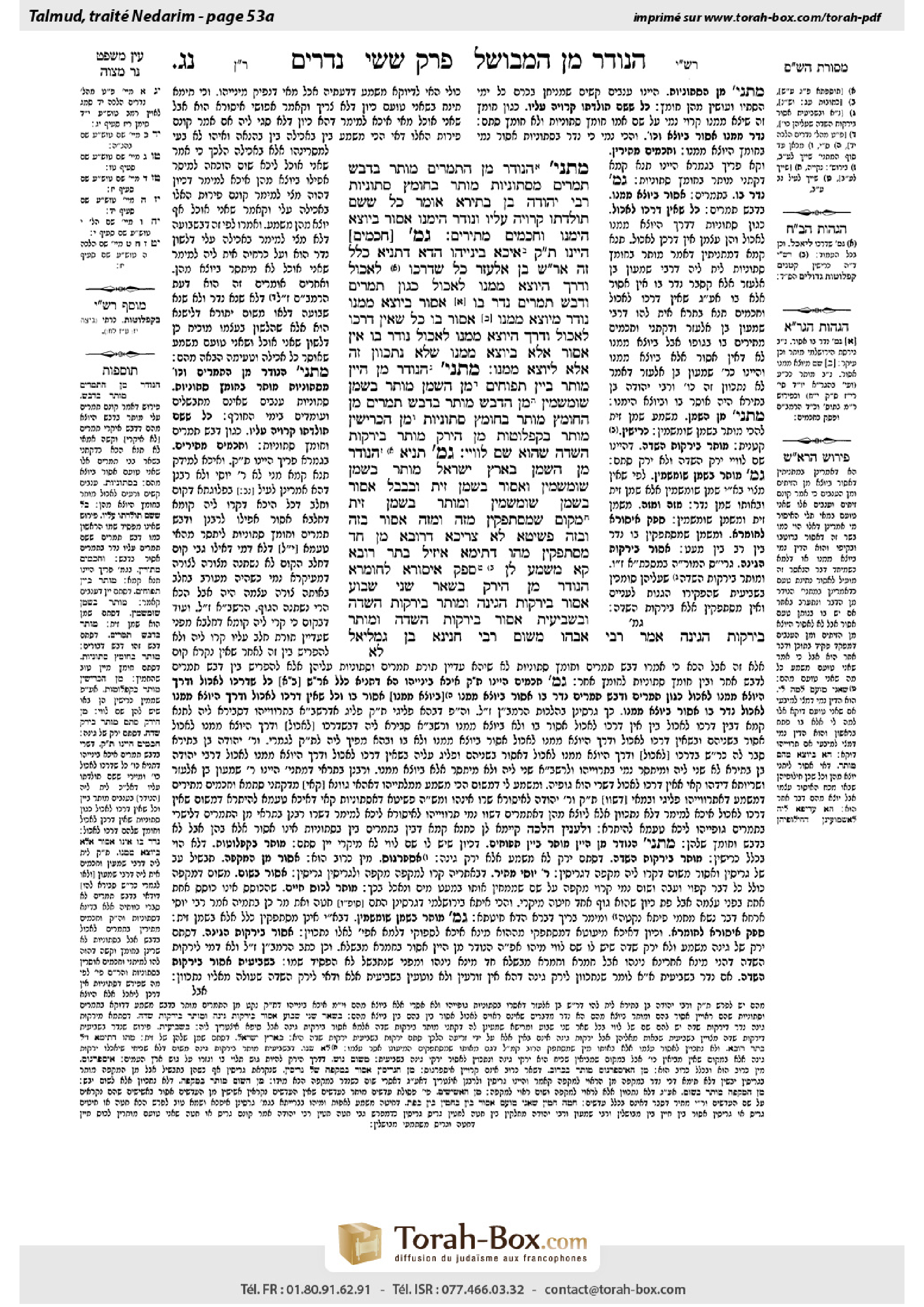
Nedarim 53a: Talmud study for Daf Yomi
Daf Yomi is the daily study of one Talmud folio. Explore 37 tractates with scans, Hebrew text, Sefaria English and AI-generated French translations where annotated.
Passage selection and English or AI-generated French translation are available where the scan has annotations. Daf Study is independent of Torah-Box and Sefaria.
Browse Nedarim · נדרים · All tractatesNedarim 53a text and translations
This page of Nedarim includes the Aramaic text, an English translation and an AI-generated French translation, alongside the scan above.
נדרים נ״ג א · Aramaic and Hebrew text
מַתְנִי׳ הַנּוֹדֵר מִן הַתְּמָרִים — מוּתָּר בִּדְבַשׁ תְּמָרִים. מִסִּתְוָנִיּוֹת — מוּתָּר בְּחוֹמֶץ סִתְוָנִיּוֹת. רַבִּי יְהוּדָה בֶּן בְּתֵירָא אוֹמֵר: כׇּל שֶׁשֵּׁם תּוֹלַדְתּוֹ קְרוּיָה עָלָיו, וְנוֹדֵר הֵימֶנּוּ — אָסוּר בַּיּוֹצֵא הֵימֶנּוּ, וַחֲכָמִים מַתִּירִים.
גְּמָ׳ [חֲכָמִים] הַיְינוּ תַּנָּא קַמָּא?
אִיכָּא בֵּינַיְיהוּ הָדָא דְּתַנְיָא: כְּלָל זֶה אָמַר רַבִּי שִׁמְעוֹן בֶּן אֶלְעָזָר: כֹּל שֶׁדַּרְכּוֹ לֶאֱכוֹל, וְדֶרֶךְ הַיּוֹצֵא מִמֶּנּוּ לֶאֱכוֹל. כְּגוֹן תְּמָרִים וּדְבַשׁ תְּמָרִים, נָדַר בּוֹ — אָסוּר בַּיּוֹצֵא מִמֶּנּוּ, נוֹדֵר מִיּוֹצֵא מִמֶּנּוּ — אָסוּר בּוֹ.
כֹּל שֶׁאֵין דַּרְכּוֹ לֶאֱכוֹל, וְדֶרֶךְ הַיּוֹצֵא מִמֶּנּוּ לֶאֱכוֹל, נוֹדֵר בּוֹ — אֵין אָסוּר אֶלָּא בַּיּוֹצֵא מִמֶּנּוּ, שֶׁלֹּא נִתְכַּוֵּון זֶה אֶלָּא לַיּוֹצֵא מִמֶּנּוּ.
מַתְנִי׳ הַנּוֹדֵר מִן הַיַּיִן — מוּתָּר בְּיֵין תַּפּוּחִים. מִן הַשֶּׁמֶן — מוּתָּר בְּשֶׁמֶן שׁוּמְשְׁמִין. מִן הַדְּבַשׁ — מוּתָּר בִּדְבַשׁ תְּמָרִים.
מִן הַחוֹמֶץ — מוּתָּר בְּחוֹמֶץ סִתְוָנִיּוֹת. מִן הַכְּרֵישִׁין — מוּתָּר בְּקַפְלוֹטוֹת. מִן הַיָּרָק — מוּתָּר בְּיַרְקוֹת הַשָּׂדֶה, שֶׁהוּא שֵׁם לָווּיי.
גְּמָ׳ תַּנְיָא: הַנּוֹדֵר מִן הַשֶּׁמֶן, בְּאֶרֶץ יִשְׂרָאֵל — מוּתָּר בְּשֶׁמֶן שׁוּמְשְׁמִין, וְאָסוּר בְּשֶׁמֶן זַיִת. וּבְבָבֶל — אָסוּר בְּשֶׁמֶן שׁוּמְשְׁמִין, וּמוּתָּר בְּשֶׁמֶן זַיִת. מָקוֹם שֶׁמִּסְתַּפְּקִין מִזֶּה וּמִזֶּה — אָסוּר בָּזֶה וּבָזֶה.
פְּשִׁיטָא! לָא צְרִיכָא, דְּרוּבָּא מִן חַד מִסְתַּפְּקִין. מַהוּ דְּתֵימָא: אֵיזִיל בָּתַר רוּבָּא, קָא מַשְׁמַע לַן סָפֵק אִיסּוּרָא לְחוּמְרָא.
הַנּוֹדֵר מִן הַיָּרָק, בִּשְׁאָר שְׁנֵי שָׁבוּעַ — אָסוּר בְּיַרְקוֹת הַגִּינָּה, וּמוּתָּר בְּיַרְקוֹת הַשָּׂדֶה. וּבַשְּׁבִיעִית — אָסוּר בְּיַרְקוֹת הַשָּׂדֶה, וּמוּתָּר בְּיַרְקוֹת הַגִּינָּה. אָמַר רַבִּי אֲבָהוּ מִשּׁוּם רַבִּי חֲנִינָא בֶּן גַּמְלִיאֵל:
Nedarim 53a · English translation
MISHNA: One who vows that dates are forbidden to him is permitted to eat date honey. One who vows that late grapes are forbidden to him is permitted to eat vinegar of late grapes. Rabbi Yehuda ben Beteira says: In the case of any food that the name of its derivative is called after its name, i.e., the liquid that emerges from it bears its name, e.g., date honey or vinegar of late grapes, and one vows that the item itself, e.g., the grape, is forbidden to him, he is also prohibited from consuming the liquid that emerges from it. But the Rabbis permit this.
GEMARA: The statement of the Rabbis is identical to the statement of the first tanna of the mishna, who rules that one who vows that dates are forbidden to him is permitted to eat date honey. What is the difference between them?
The Gemara answers: There is a difference between them with regard to that which is taught in a baraita: Rabbi Shimon ben Elazar said this principle: With regard to anything that is commonly eaten in its existing form, and it is also common to eat the liquid that emerges from it, for example, dates and date honey, if one vowed that it is forbidden to him, he is also prohibited from consuming the liquid that emerges from it. Similarly, if one vows that the liquid that emerges from it is forbidden to him, he is also prohibited from partaking of it.
The baraita continues: Conversely, with regard to anything that is not commonly eaten as it is, and it is common to eat the liquid that emerges from it, if one vowed that he will not eat from it, he is prohibited from consuming only the liquid that emerges from it, as this person intended to prohibit himself from eating only from the liquid that emerges from it. The first tanna does not distinguish between dates, which are commonly eaten in their original state, and late grapes, which are not. In both cases, he rules that the produce itself is forbidden and the derivative is permitted. By contrast, the Rabbis agree with Rabbi Shimon ben Elazar’s ruling with regard to produce that is not commonly eaten in its original state. They permit the produce itself and prohibit that which has emerged from it. Therefore, in the last case of the mishna, they permit eating the late grapes and prohibit eating their vinegar, whereas in the first case they prohibit both dates and date honey.
MISHNA: One who vows that wine is forbidden to him is permitted to partake of apple wine, i.e., cider, as the unspecified term wine refers only to grape wine. One who vows that oil is forbidden to him is permitted to partake of sesame oil, as the unspecified term oil refers only to olive oil. One who vows that honey is forbidden to him is permitted to eat date honey, as the unspecified term honey refers only to bee honey.
One who vows that vinegar is forbidden to him is permitted to partake of vinegar of late grapes, as vinegar is typically made from wine. One who vows that leeks are forbidden to him is permitted to eat kaflutot, a type of leek. One who vows that vegetables are forbidden to him is permitted to eat wild field vegetables, as this type of vegetable has a modifier and is not referred to by the unspecified term vegetable.
GEMARA: It is taught in a baraita: With regard to one who vows that oil is forbidden to him, if he is in Eretz Yisrael he is permitted to eat sesame oil and is prohibited from eating olive oil, as in Eretz Yisrael the unspecified term oil refers to olive oil. And if he took the vow in Babylonia, sesame oil is forbidden to him, as oil in Babylonia was generally made from sesame seeds, and it is permitted for him to eat olive oil, which was rarely used there. If he takes the vow in a locale where people use both this type of oil and that type, he is prohibited from eating both this type and that.
The Gemara asks with regard to the last statement: Isn’t it obvious that he is prohibited from eating both types of oil? The statement seems superfluous. The Gemara answers: No, it is not superfluous. It is necessary only to teach that this is the halakha even where most people use only one type of oil. Lest you say: I should follow the majority and permit the other kind of oil, the baraita teaches us that an uncertain Torah prohibition is treated stringently. Therefore, the other type is forbidden as well, as it is possibly included in the meaning of the vow, although it is used only by a minority of the residents.
The baraita continues: With regard to one who vows that vegetables are forbidden to him, if he takes the vow during the first six years of the seven-year Sabbatical cycle, he is prohibited from eating garden vegetables and permitted to eat field vegetables. But if he takes the vow during the Sabbatical Year, he is prohibited from eating field vegetables, which are commonly eaten in the Sabbatical Year, and he is permitted to eat garden vegetables, which are rarely consumed during that period, as it is prohibited to work the land. Rabbi Abbahu said in the name of Rabbi Ḥanina ben Gamliel:
Nedarim 53a · Traduction française (IA)
MICHNA : Celui qui fait vœu de s’interdire les dattes peut consommer du miel de dattes. Celui qui fait vœu de s’interdire les raisins tardifs peut consommer du vinaigre de raisins tardifs. Rabbi Yehouda ben Beteira dit : Pour tout aliment dont le dérivé porte le nom de l’aliment lui-même, c’est-à-dire dont le liquide qui en est extrait porte son nom, comme le miel de dattes ou le vinaigre de raisins tardifs, celui qui fait vœu de s’interdire l’aliment lui-même, par exemple le raisin, s’interdit également de consommer le liquide qui en est extrait. Mais les Sages l’autorisent.
GUEMARA : La position des Sages est identique à celle du premier tanna de la Michna, qui enseigne que celui qui fait vœu de s’interdire les dattes peut consommer du miel de dattes. Quelle est donc la différence entre eux ?
La Guemara répond : Ils divergent au sujet de ce qui est enseigné dans une baraïta : Rabbi Shimon ben Elazar a énoncé le principe suivant : Pour tout aliment que l’on consomme couramment sous sa forme initiale et dont on consomme également couramment le liquide qui en est extrait, par exemple les dattes et le miel de dattes, si l’on fait vœu de s’en interdire la consommation, on s’interdit également de consommer le liquide qui en est extrait. De même, si l’on fait vœu de s’interdire le liquide qui en est extrait, on s’interdit également de consommer l’aliment lui-même.
La baraïta poursuit : À l’inverse, pour tout aliment que l’on ne consomme pas couramment tel quel, mais dont on consomme couramment le liquide qui en est extrait, si l’on fait vœu de ne pas en manger, on s’interdit uniquement de consommer le liquide qui en est extrait, car cette personne entendait s’interdire seulement ce liquide. Le premier tanna ne distingue pas les dattes, que l’on consomme couramment à l’état naturel, des raisins tardifs, que l’on ne consomme pas couramment ainsi. Dans les deux cas, il enseigne que le produit lui-même est interdit et que son dérivé est permis. En revanche, les Sages s’accordent avec la décision de Rabbi Shimon ben Elazar concernant les produits que l’on ne consomme pas couramment à l’état naturel. Ils autorisent le produit lui-même et interdisent ce qui en est extrait. Ainsi, dans le dernier cas de la Michna, ils autorisent la consommation des raisins tardifs et interdisent celle de leur vinaigre, tandis que dans le premier cas, ils interdisent à la fois les dattes et le miel de dattes.
MICHNA : Celui qui fait vœu de s’interdire le vin peut consommer du vin de pomme, c’est-à-dire du cidre, car le terme « vin », sans précision, désigne uniquement le vin de raisin. Celui qui fait vœu de s’interdire l’huile peut consommer de l’huile de sésame, car le terme « huile », sans précision, désigne uniquement l’huile d’olive. Celui qui fait vœu de s’interdire le miel peut consommer du miel de dattes, car le terme « miel », sans précision, désigne uniquement le miel d’abeille.
Celui qui fait vœu de s’interdire le vinaigre peut consommer du vinaigre de raisins tardifs, car le vinaigre est généralement fabriqué à partir de vin. Celui qui fait vœu de s’interdire les poireaux peut manger des kaflutot, une sorte de poireau. Celui qui fait vœu de s’interdire les légumes peut consommer des légumes sauvages des champs, car cette catégorie de légumes est désignée par un qualificatif et n’est pas appelée simplement « légume ».
GUEMARA : Il est enseigné dans une baraïta : Celui qui fait vœu de s’interdire l’huile, s’il se trouve en Eretz Israël, peut consommer de l’huile de sésame, mais ne peut pas consommer d’huile d’olive, car en Eretz Israël le terme « huile », sans précision, désigne l’huile d’olive. S’il fait son vœu en Babylonie, l’huile de sésame lui est interdite, car en Babylonie l’huile était généralement fabriquée à partir de graines de sésame, et il peut consommer de l’huile d’olive, qui y était rarement utilisée. S’il fait son vœu dans un lieu où l’on utilise les deux types d’huile, il lui est interdit de consommer l’un comme l’autre.
Au sujet de cette dernière affirmation, la Guemara demande : N’est-il pas évident qu’il lui est interdit de consommer les deux types d’huile ? Cette affirmation semble superflue. La Guemara répond : Non, elle ne l’est pas. Elle est nécessaire uniquement pour enseigner que cette halakha s’applique même là où la plupart des gens n’utilisent qu’un seul type d’huile. De peur que l’on dise : « Je dois suivre la majorité et autoriser l’autre type d’huile », la baraïta nous enseigne qu’une interdiction toranique incertaine doit être traitée avec rigueur. L’autre type est donc également interdit, puisqu’il est possible qu’il soit compris dans le sens du vœu, même s’il n’est utilisé que par une minorité des habitants.
La baraïta poursuit : Celui qui fait vœu de s’interdire les légumes, s’il fait ce vœu pendant les six premières années du cycle sabbatique de sept ans, ne peut pas consommer de légumes du jardin, mais peut consommer des légumes des champs. En revanche, s’il fait ce vœu pendant l’année sabbatique, il ne peut pas consommer de légumes des champs, que l’on consomme couramment durant cette année, mais peut consommer des légumes du jardin, que l’on consomme rarement durant cette période puisqu’il est interdit de travailler la terre. Rabbi Abbahou a dit au nom de Rabbi Ḥanina ben Gamliel :
Traduction française générée par IA à partir de l’édition anglaise de Sefaria. Vérifie toujours un passage avec le texte source.
Text from Sefaria: William Davidson Edition - Vocalized Aramaic (CC BY NC); William Davidson Edition - English (CC BY NC).