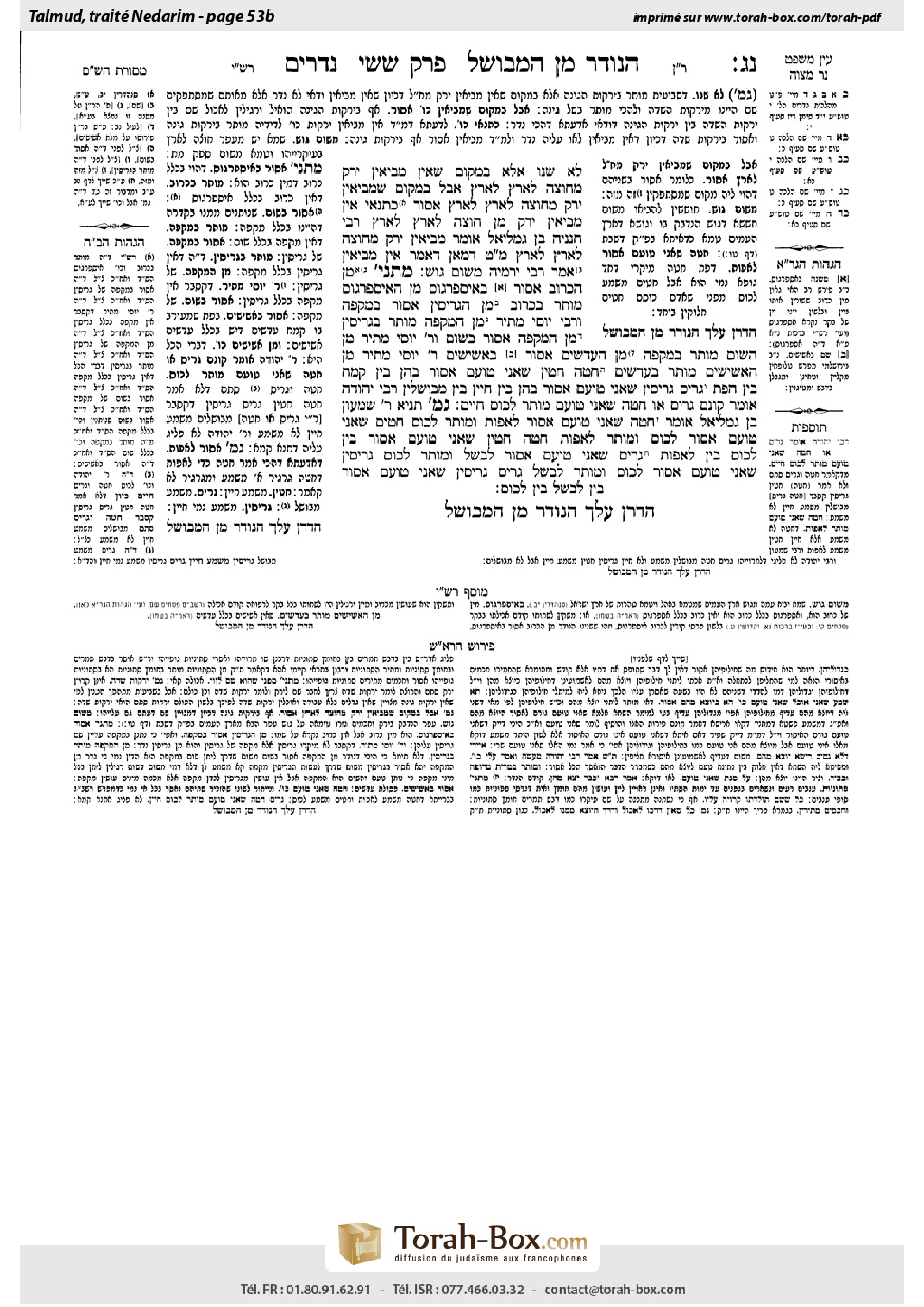
Nedarim 53b: Talmud study for Daf Yomi
Daf Yomi is the daily study of one Talmud folio. Explore 37 tractates with scans, Hebrew text, Sefaria English and AI-generated French translations where annotated.
Passage selection and English or AI-generated French translation are available where the scan has annotations. Daf Study is independent of Torah-Box and Sefaria.
Browse Nedarim · נדרים · All tractatesNedarim 53b text and translations
This page of Nedarim includes the Aramaic text, an English translation and an AI-generated French translation, alongside the scan above.
נדרים נ״ג ב · Aramaic and Hebrew text
לֹא שָׁנוּ אֶלָּא בִּמְקוֹם שֶׁאֵין מְבִיאִין יָרָק מֵחוּצָה לָאָרֶץ לָאָרֶץ. אֲבָל בְּמָקוֹם שֶׁמְּבִיאִין יָרָק מֵחוּצָה לָאָרֶץ לָאָרֶץ — אָסוּר.
כְּתַנָּאֵי: אֵין מְבִיאִין יָרָק מִן חוּצָה לָאָרֶץ לָאָרֶץ, רַבִּי חֲנַנְיָה בֶּן גַּמְלִיאֵל אוֹמֵר: מְבִיאִין יָרָק מֵחוּצָה לָאָרֶץ לָאָרֶץ. מַאי טַעְמֵיהּ דְּמַאן דְּאָמַר אֵין מְבִיאִין? אָמַר רַבִּי יִרְמְיָה: מִשּׁוּם גּוּשׁ.
מַתְנִי׳ מִן הַכְּרוּב — אָסוּר בְּאִיסְפַּרְגוֹס, מִן הָאִיסְפַּרְגוֹס — מוּתָּר בִּכְרוּב.
מִן הַגְּרִיסִין — אָסוּר בְּמִקְפָּה, וְרַבִּי יוֹסֵי מַתִּיר. מִן הַמִּקְפָּה — מוּתָּר בִּגְרִיסִין. מִן הַמִּקְפָּה — אָסוּר בִּשּׁוּם, וְרַבִּי יוֹסֵי מַתִּיר. מִן הַשּׁוּם — מוּתָּר בְּמִקְפָּה.
מִן הָעֲדָשִׁים — אָסוּר בַּאֲשִׁישִׁים, רַבִּי יוֹסֵי מַתִּיר. מִן הָאֲשִׁישִׁים — מוּתָּר בַּעֲדָשִׁים.
״חִטָּה חִטִּין שֶׁאֲנִי טוֹעֵם״ — אָסוּר בָּהֶן בֵּין קֶמַח בֵּין הַפַּת. ״גְּרִיס גְּרִיסִין שֶׁאֲנִי טוֹעֵם״ — אָסוּר בָּהֶן בֵּין חַיִּין בֵּין מְבוּשָּׁלִין. רַבִּי יְהוּדָה אוֹמֵר: ״קֻוֽנָּם גְּרִיס אוֹ חִטָּה שֶׁאֲנִי טוֹעֵם״ — מוּתָּר לָכוֹס חַיִּים.
גְּמָ׳ תַּנְיָא רַבִּי שִׁמְעוֹן בֶּן גַּמְלִיאֵל אוֹמֵר: ״חִטָּה שֶׁאֲנִי טוֹעֵם״ — אָסוּר לֶאֱפוֹת וּמוּתָּר לָכוֹס. ״חִטִּים שֶׁאֲנִי טוֹעֵם״ — אָסוּר לָכוֹס וּמוּתָּר לֶאֱפוֹת. ״חִטָּה חִטִּין שֶׁאֲנִי טוֹעֵם״ — אָסוּר בֵּין לָכוֹס בֵּין לֶאֱפוֹת.
״גְּרִיס שֶׁאֲנִי טוֹעֵם״ — אָסוּר לְבַשֵּׁל וּמוּתָּר לָכוֹס. ״גְּרִיסִין שֶׁאֲנִי טוֹעֵם״ — אָסוּר לָכוֹס וּמוּתָּר לְבַשֵּׁל. ״גְּרִיס גְּרִיסִין שֶׁאֲנִי טוֹעֵם״ — אָסוּר בֵּין לְבַשֵּׁל בֵּין לָכוֹס.
הֲדַרַן עֲלָךְ הַנּוֹדֵר מִן הַמְבוּשָּׁל
Nedarim 53b · English translation
They taught that if he takes the vow in the Sabbatical Year he is permitted to eat garden vegetables only if he is in a place where people do not bring vegetables from outside of Eretz Yisrael to Eretz Yisrael. However, in a place where people bring vegetables from outside of Eretz Yisrael, where the halakhot of the Sabbatical Year do not apply, to Eretz Yisrael, he is prohibited from eating garden vegetables as well, as they are widely available, and therefore included in the unspecified word vegetable.
The Gemara comments that this distinction is like a dispute between tanna’im cited in a baraita: One may not bring vegetables from outside of Eretz Yisrael to Eretz Yisrael. Rabbi Ḥananya ben Gamliel says: One may bring vegetables from outside of Eretz Yisrael to Eretz Yisrael. The Gemara asks: What is the reason of the one who said that one may not bring vegetables from outside of Eretz Yisrael? Rabbi Yirmeya said: It is because a clod of earth might be brought with the vegetables to Eretz Yisrael. Earth from outside of Eretz Yisrael is ritually impure, and bringing it to Eretz Yisrael would spread ritual impurity in the land.
MISHNA: One who vows that cabbage is forbidden to him is prohibited from eating ispargus, as that is a type of cabbage. However, one who vows that ispargus is forbidden to him is permitted to eat cabbage.
One who vows that pounded beans are forbidden to him is prohibited from eating pounded bean stew [mikpa]. However, Rabbi Yosei rules that he is permitted to eat it. One who vows that pounded bean stew is forbidden to him is permitted to eat pounded beans according to all opinions. One who vows that stew is forbidden to him is prohibited from eating the garlic of the stew. However, Rabbi Yosei rules that he is permitted to eat the garlic. One who vows that garlic is forbidden to him is permitted to eat stew.
One who vows that lentils are forbidden to him is prohibited from eating ashishim, a dish made from lentils. However, Rabbi Yosei permits it. It is agreed by all opinions that one who vows that ashishim is forbidden to him is permitted to eat lentils.
If one says: Ḥitta, wheat in singular form, or ḥittim, wheat in plural form, are konam for me, and for that reason I will not taste them, he is prohibited from eating wheat, whether as flour or bread. If one says: Pounded bean or pounded beans are konam for me, and for that reason I will not taste them, he is prohibited from eating them, whether raw or cooked. Rabbi Yehuda says that if one says: Pounded bean or ḥitta is konam for me, and for that reason I will not taste them, he is permitted to chew them raw, as that is not the normal way to eat them, and therefore was not included in the intention of the vow.
GEMARA: It is taught in a baraita that Rabbi Shimon ben Gamliel says that if one vows: Ḥitta is konam for me, and for that reason I will not taste it, he is prohibited from eating baked wheat, i.e., baked wheat bread, but he is permitted to chew wheat grains. If one says: Ḥittim are konam for me, and for that reason I will not taste them, he is prohibited from chewing wheat grains but is permitted to bake them, as this term is referring to grains of wheat. If one says: Ḥitta or ḥittin are konam for me, and for that reason I will not taste them ,he is prohibited both from chewing wheat grains and from baking wheat bread.
Similarly, if one says: Pounded bean is konam for me, and for that reason I will not taste it, he is prohibited from cooking pounded bean, i.e., from eating a dish of cooked pounded beans, as that is what the word pounded bean commonly means, but he is permitted to chew raw pounded beans. If one says: Pounded beans are konam for me, and for that reason I will not taste them, he is prohibited from chewing pounded beans but is permitted to cook them. If one says: Pounded bean or pounded beans are konam for me, and for that reason I will not taste them, he is prohibited from both cooking and chewing pounded beans.
Nedarim 53b · Traduction française (IA)
Ils enseignent que, s’il prononce le vœu pendant l’année de jachère, il lui est permis de manger des légumes du jardin uniquement s’il se trouve dans un endroit où l’on n’apporte pas de légumes de l’extérieur de la Terre d’Israël en Terre d’Israël. En revanche, dans un endroit où l’on apporte en Terre d’Israël des légumes provenant de l’extérieur de la Terre d’Israël, où les lois de l’année de jachère ne s’appliquent pas, il lui est également interdit de manger des légumes du jardin, car les légumes y sont largement disponibles et sont donc inclus dans le terme générique « légume ».
La Guemara fait remarquer que cette distinction correspond à une controverse entre des tannaïm rapportée dans une baraïta : on ne doit pas apporter de légumes de l’extérieur de la Terre d’Israël en Terre d’Israël. Rabbi Ḥananya ben Gamliel dit : on peut apporter des légumes de l’extérieur de la Terre d’Israël en Terre d’Israël. La Guemara demande : quelle est la raison de celui qui dit qu’on ne peut pas apporter de légumes de l’extérieur de la Terre d’Israël ? Rabbi Yirmeya répond : c’est parce qu’une motte de terre pourrait être apportée avec les légumes en Terre d’Israël. La terre provenant de l’extérieur de la Terre d’Israël est rituellement impure ; l’y apporter répandrait donc l’impureté rituelle dans le pays.
MICHNA : Celui qui fait vœu de s’interdire le chou ne peut pas manger d’ispargus, car c’est une sorte de chou. En revanche, celui qui fait vœu de s’interdire l’ispargus peut manger du chou.
Celui qui fait vœu de s’interdire les fèves pilées ne peut pas manger de ragoût de fèves pilées [mikpa]. Rabbi Yosei statue toutefois qu’il peut en manger. Celui qui fait vœu de s’interdire le ragoût de fèves pilées peut manger des fèves pilées, selon toutes les opinions. Celui qui fait vœu de s’interdire le ragoût ne peut pas manger l’ail qui s’y trouve. Rabbi Yosei statue toutefois qu’il peut manger l’ail. Celui qui fait vœu de s’interdire l’ail peut manger du ragoût.
Celui qui fait vœu de s’interdire les lentilles ne peut pas manger d’ashishim, un plat préparé à base de lentilles. Rabbi Yosei le permet toutefois. Tous s’accordent à dire que celui qui fait vœu de s’interdire les ashishim peut manger des lentilles.
Si quelqu’un dit : « Ḥitta », le blé au singulier, ou « ḥittim », le blé au pluriel, m’est interdit par konam et, pour cette raison, je n’y goûterai pas, il lui est interdit de manger du blé, que ce soit sous forme de farine ou de pain. Si quelqu’un dit : « fève pilée » ou « fèves pilées » me sont interdites par konam et, pour cette raison, je n’y goûterai pas, il lui est interdit d’en manger, qu’elles soient crues ou cuites. Rabbi Yehuda dit que si quelqu’un dit : « fève pilée » ou « ḥitta » m’est interdit par konam et, pour cette raison, je n’y goûterai pas, il lui est permis de les mâcher crues, car ce n’est pas la manière habituelle de les manger et elles n’étaient donc pas comprises dans l’intention du vœu.
GUEMARA : Une baraïta enseigne que Rabbi Shimon ben Gamliel dit que si quelqu’un fait vœu en disant : « Ḥitta m’est interdit par konam et, pour cette raison, je n’y goûterai pas », il lui est interdit de manger du blé cuit au four, c’est-à-dire du pain de blé cuit au four, mais il lui est permis de mâcher des grains de blé. Si quelqu’un dit : « Ḥittim me sont interdits par konam et, pour cette raison, je n’y goûterai pas », il lui est interdit de mâcher des grains de blé, mais il lui est permis de les cuire, car ce terme désigne les grains de blé. Si quelqu’un dit : « Ḥitta » ou « ḥittin » me sont interdits par konam et, pour cette raison, je n’y goûterai pas, il lui est interdit aussi bien de mâcher des grains de blé que de cuire du pain de blé.
De même, si quelqu’un dit : « Fève pilée m’est interdite par konam et, pour cette raison, je n’y goûterai pas », il lui est interdit de cuire des fèves pilées, c’est-à-dire de manger un plat de fèves pilées cuites, car c’est le sens habituel du terme « fève pilée », mais il lui est permis de mâcher des fèves pilées crues. Si quelqu’un dit : « Fèves pilées me sont interdites par konam et, pour cette raison, je n’y goûterai pas », il lui est interdit de mâcher des fèves pilées, mais il lui est permis de les cuire. Si quelqu’un dit : « Fève pilée » ou « fèves pilées » me sont interdites par konam et, pour cette raison, je n’y goûterai pas, il lui est interdit aussi bien de cuire que de mâcher des fèves pilées.
Traduction française générée par IA à partir de l’édition anglaise de Sefaria. Vérifie toujours un passage avec le texte source.
Text from Sefaria: William Davidson Edition - Vocalized Aramaic (CC BY NC); William Davidson Edition - English (CC BY NC).