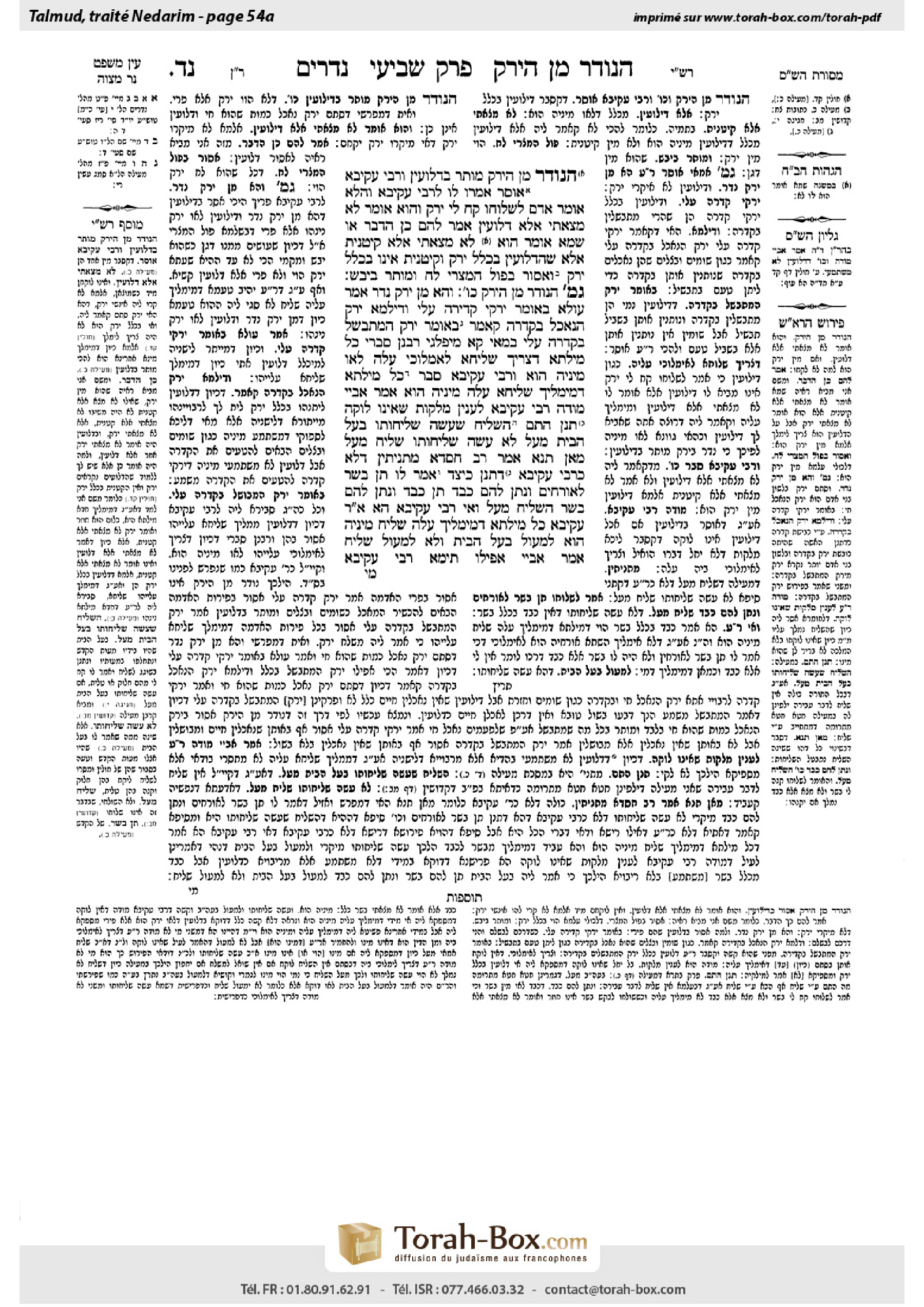
Nedarim 54a: Talmud study for Daf Yomi
Daf Yomi is the daily study of one Talmud folio. Explore 37 tractates with scans, Hebrew text, Sefaria English and AI-generated French translations where annotated.
Passage selection and English or AI-generated French translation are available where the scan has annotations. Daf Study is independent of Torah-Box and Sefaria.
Browse Nedarim · נדרים · All tractatesNedarim 54a text and translations
This page of Nedarim includes the Aramaic text, an English translation and an AI-generated French translation, alongside the scan above.
נדרים נ״ד א · Aramaic and Hebrew text
הַנּוֹדֵר מִן הַיָּרָק — מוּתָּר בַּדִּלּוּעִין, וְרַבִּי עֲקִיבָא אוֹסֵר. אָמְרוּ לוֹ לְרַבִּי עֲקִיבָא: וַהֲלֹא אוֹמֵר אָדָם לִשְׁלוּחוֹ ״קַח לִי יָרָק״, וְהוּא אוֹמֵר: ״לֹא מָצָאתִי אֶלָּא דִּלּוּעִין״.
אָמַר לָהֶם: כֵּן הַדָּבָר, אוֹ שֶׁמָּא אוֹמֵר הוּא ״לֹא מָצָאתִי אֶלָּא קִיטְנִית״? אֶלָּא, שֶׁהַדִּלּוּעִין בִּכְלַל יָרָק, וְקִיטְנִית אֵינוֹ בִּכְלַל יָרָק. וְאָסוּר בְּפוֹל הַמִּצְרִי לַח, וּמוּתָּר בַּיָּבֵשׁ.
גְּמָ׳ הַנּוֹדֵר מִן הַיָּרָק כּוּ׳. וְהָא מִן יָרָק נְדַר! אָמַר עוּלָּא: בְּאוֹמֵר ״יַרְקֵי קְדֵרָה עָלַי״, וְדִילְמָא יָרָק הַנֶּאֱכָל בִּקְדֵרָה קָאָמַר? בְּאוֹמֵר ״יָרָק הַמִּתְבַּשֵּׁל בִּקְדֵרָה עָלַי״.
בְּמַאי קָא מִיפַּלְגִי? רַבָּנַן סָבְרִי: כֹּל מִילְּתָא דִּצְרִיךְ שְׁלִיחָא לְאִמְּלוֹכֵי עֲלַהּ — לָאו מִינֵיהּ הוּא. וְרַבִּי עֲקִיבָא סָבַר: כֹּל מִילְּתָא דְּמִימְּלִיךְ שְׁלִיחָא עֲלַהּ — מִינֵיהּ הוּא. אָמַר אַבָּיֵי: מוֹדֶה רַבִּי עֲקִיבָא לְעִנְיַן מַלְקוֹת, שֶׁאֵינוֹ לוֹקֶה.
תְּנַן הָתָם: הַשָּׁלִיחַ שֶׁעָשָׂה שְׁלִיחוּתוֹ — בַּעַל הַבַּיִת מָעַל. לֹא עָשָׂה שְׁלִיחוּתוֹ — שָׁלִיחַ מָעַל.
מַאן תַּנָּא? אָמַר רַב חִסְדָּא: מַתְנִיתִין דְּלָא כְּרַבִּי עֲקִיבָא, דִּתְנַן: כֵּיצַד? אָמַר לוֹ: ״תֵּן בָּשָׂר לָאוֹרְחִים״ וְנָתַן לָהֶם כָּבֵד, ״תֵּן כָּבֵד״ וְנָתַן לָהֶם בָּשָׂר — הַשָּׁלִיחַ מָעַל. וְאִי רַבִּי עֲקִיבָא, הָא אָמַר רַבִּי עֲקִיבָא: כֹּל מִילְּתָא דְּמִימְּלִיךְ עֲלַהּ שָׁלִיחַ — מִינֵיהּ הוּא, לִמְעוֹל בַּעַל הַבַּיִת וְלָא לִמְעוֹל שָׁלִיחַ!
אָמַר אַבָּיֵי: אֲפִילּוּ תֵּימָא רַבִּי עֲקִיבָא,
Nedarim 54a · English translation
MISHNA: For one who vows that vegetables are forbidden to him, it is permitted for him to eat gourds, as people typically do not include gourds in the category of vegetables; and Rabbi Akiva prohibits him from eating gourds. The Rabbis said to Rabbi Akiva: But doesn’t a person say to his agent: Purchase vegetables for me, and the agent, after failing to find vegetables, returns with gourds and says: I found only gourds? This indicates that gourds are not considered vegetables.
Rabbi Akiva said to them: The matter is so, and that proves my opinion; or perhaps, does the agent return and say: I found only legumes? Rather, it is apparent that gourds are included in the category of vegetables, although they differ from other vegetables, and therefore, the agent purchases gourds and explains that he found only gourds. And legumes are not included in the category of vegetables, and that is why the agent dispatched to purchase vegetables would not purchase legumes at all. And for one who vows that vegetables are forbidden to him, it is prohibited to eat the fresh cowpea, which is considered a vegetable, and it is permitted to eat dry cowpea, which is not a vegetable.
GEMARA: We learned in the mishna: For one who vows that vegetables are forbidden to him, it is permitted to eat gourds, and Rabbi Akiva prohibits him from eating gourds. The Gemara questions Rabbi Akiva’s ruling: But how can his vow include gourds, which are fruits and not vegetables; didn’t he vow to refrain from eating vegetables? Ulla said: The mishna is referring to one who said: Vegetables cooked in a pot are forbidden to me. Gourds are included in the category of vegetables cooked in a pot. The Gemara asks: And if that is what he said, perhaps he is saying: A vegetable that is eaten in a pot, i.e., a vegetable that is added to flavor the food cooked in the pot, is forbidden to me? The Gemara answers: The mishna is referring to one who said: A vegetable that is cooked in a pot is forbidden to me, a statement that can include gourds.
The Gemara asks: With regard to what principle do Rabbi Akiva and the Rabbis disagree? The Gemara explains that the Rabbis maintain: Any item with regard to which an agent must consult the person who dispatched him before purchasing it, is not considered the same type. Since the agent must ask whether he can purchase gourds, apparently they are not a vegetable. And Rabbi Akiva maintains: Any item with regard to which an agent must consult is considered the same type. With regard to food of a different type, he does not consult. Abaye said: Rabbi Akiva concedes with regard to lashes that the one who vowed is not flogged if he ate gourds, as the issue of whether or not he violated his vow is not entirely clear.
We learned in a mishna there (Me’ila 20a): With regard to an agent who performed his mission properly, if he was tasked to use a particular item, and the one who dispatched him forgot that it was a consecrated item, the employer, who dispatched him, misused the consecrated item and is liable, as the agent acted on his behalf. However, if the agent did not perform his mission properly, and the agent misused the consecrated item, he is liable, as once the agent deviates from his mission, he ceases to be an agent and his actions are attributable to him.
The Gemara asks: Who is the tanna who taught this halakha in the mishna? Rav Ḥisda said: The mishna is not in accordance with the opinion of Rabbi Akiva as we learned in the mishna: How so? If the employer said to the agent: Give meat to the guests, and he gave them liver; or if he said: Give them liver, and he gave them meat, the agent has misused the consecrated item, as he deviated from his mission. And if this were in accordance with the opinion of Rabbi Akiva, didn’t Rabbi Akiva say: Any matter with regard to which an agent must consult is considered the same type? Since based on that criterion, liver is certainly considered meat, let the employer be liable for misuse of consecrated property and let the agent not be liable for misuse of consecrated property, as he fulfilled his mission.
Abaye said: Even if you say that the mishna is in accordance with the opinion of Rabbi Akiva,
Nedarim 54a · Traduction française (IA)
MICHNA : Pour celui qui fait vœu de s’interdire les légumes, il est permis de manger des courges, car, en général, les gens ne les incluent pas dans la catégorie des légumes ; Rabbi Akiva lui interdit toutefois d’en manger. Les Sages dirent à Rabbi Akiva : « Mais une personne ne dit-elle pas à son agent : “Achète-moi des légumes”, puis, faute d’en avoir trouvé, l’agent revient avec des courges et dit : “Je n’ai trouvé que des courges” ? » Cela indique que les courges ne sont pas considérées comme des légumes.
Rabbi Akiva leur dit : « C’est bien le cas, et cela prouve que j’ai raison ; ou bien l’agent revient-il peut-être en disant : “Je n’ai trouvé que des légumineuses” ? » Il apparaît plutôt que les courges sont incluses dans la catégorie des légumes, bien qu’elles diffèrent des autres légumes ; c’est pourquoi l’agent achète des courges et explique qu’il n’a trouvé que des courges. Les légumineuses, en revanche, ne sont pas incluses dans la catégorie des légumes ; c’est pourquoi l’agent envoyé acheter des légumes n’achèterait pas du tout de légumineuses. Pour celui qui fait vœu de s’interdire les légumes, il est interdit de manger du niébé frais, qui est considéré comme un légume, mais il est permis de manger du niébé sec, qui n’est pas un légume.
GUEMARA : Nous avons appris dans la Michna : Pour celui qui fait vœu de s’interdire les légumes, il est permis de manger des courges, mais Rabbi Akiva lui interdit d’en manger. La Guemara s’interroge sur la décision de Rabbi Akiva : comment son vœu pourrait-il inclure les courges, qui sont des fruits et non des légumes ? N’a-t-il pas fait vœu de s’abstenir de manger des légumes ? Oulla dit : La Michna parle de celui qui a dit : « Les légumes cuits dans une marmite me sont interdits. » Les courges sont incluses dans la catégorie des légumes cuits dans une marmite. La Guemara demande : Mais s’il a dit cela, ne veut-il peut-être pas dire : « Un légume que l’on mange dans une marmite me est interdit », c’est-à-dire un légume que l’on ajoute pour donner du goût aux aliments cuits dans la marmite ? La Guemara répond : La Michna parle de celui qui a dit : « Un légume qui est cuit dans une marmite m’est interdit », une formule qui peut inclure les courges.
Sur quel principe Rabbi Akiva et les Sages sont-ils en désaccord ? La Guemara explique que les Sages soutiennent que tout produit au sujet duquel un agent doit consulter la personne qui l’a envoyé avant de l’acheter n’est pas considéré comme appartenant à la même catégorie. Puisque l’agent doit demander s’il peut acheter des courges, il apparaît que celles-ci ne sont pas des légumes. Rabbi Akiva, lui, soutient que tout produit au sujet duquel l’agent doit consulter est considéré comme appartenant à la même catégorie. Pour un aliment d’une catégorie différente, il ne consulte pas. Abayé dit : Rabbi Akiva reconnaît qu’en matière de flagellation, celui qui a fait le vœu n’est pas flagellé s’il a mangé des courges, car il n’est pas tout à fait certain qu’il ait transgressé son vœu.
Nous avons appris dans une Michna, là-bas (Meïla 20a) : Lorsqu’un agent a correctement exécuté sa mission, s’il avait reçu pour tâche d’utiliser un objet précis et que celui qui l’a envoyé a oublié qu’il s’agissait d’un objet consacré, c’est le mandant qui a commis le détournement d’un bien consacré et en est responsable, car l’agent a agi pour son compte. En revanche, si l’agent n’a pas correctement exécuté sa mission et qu’il a commis le détournement d’un bien consacré, c’est lui qui en est responsable, car dès lors qu’il s’écarte de sa mission, il cesse d’être un agent et ses actes lui sont imputés.
La Guemara demande : Quel est le tanna qui a enseigné cette halakha dans la Michna ? Rav Ḥisda dit : La Michna n’est pas conforme à l’avis de Rabbi Akiva, comme nous l’avons appris dans la Michna : « Dans quel cas ? Si le mandant dit à l’agent : “Donne de la viande aux invités”, et que celui-ci leur donne du foie ; ou s’il lui dit : “Donne-leur du foie”, et qu’il leur donne de la viande, l’agent a commis le détournement du bien consacré, car il s’est écarté de sa mission. » Mais si cette Michna était conforme à l’avis de Rabbi Akiva, celui-ci n’a-t-il pas dit que tout ce au sujet de quoi l’agent doit consulter est considéré comme appartenant à la même catégorie ? Puisque, selon ce critère, le foie est certainement considéré comme de la viande, que le mandant soit tenu responsable du détournement du bien consacré et que l’agent ne le soit pas, puisqu’il a exécuté sa mission.
Abayé dit : Même si tu dis que la Michna est conforme à l’avis de Rabbi Akiva,
Traduction française générée par IA à partir de l’édition anglaise de Sefaria. Vérifie toujours un passage avec le texte source.
Text from Sefaria: William Davidson Edition - Vocalized Aramaic (CC BY NC); William Davidson Edition - English (CC BY NC).