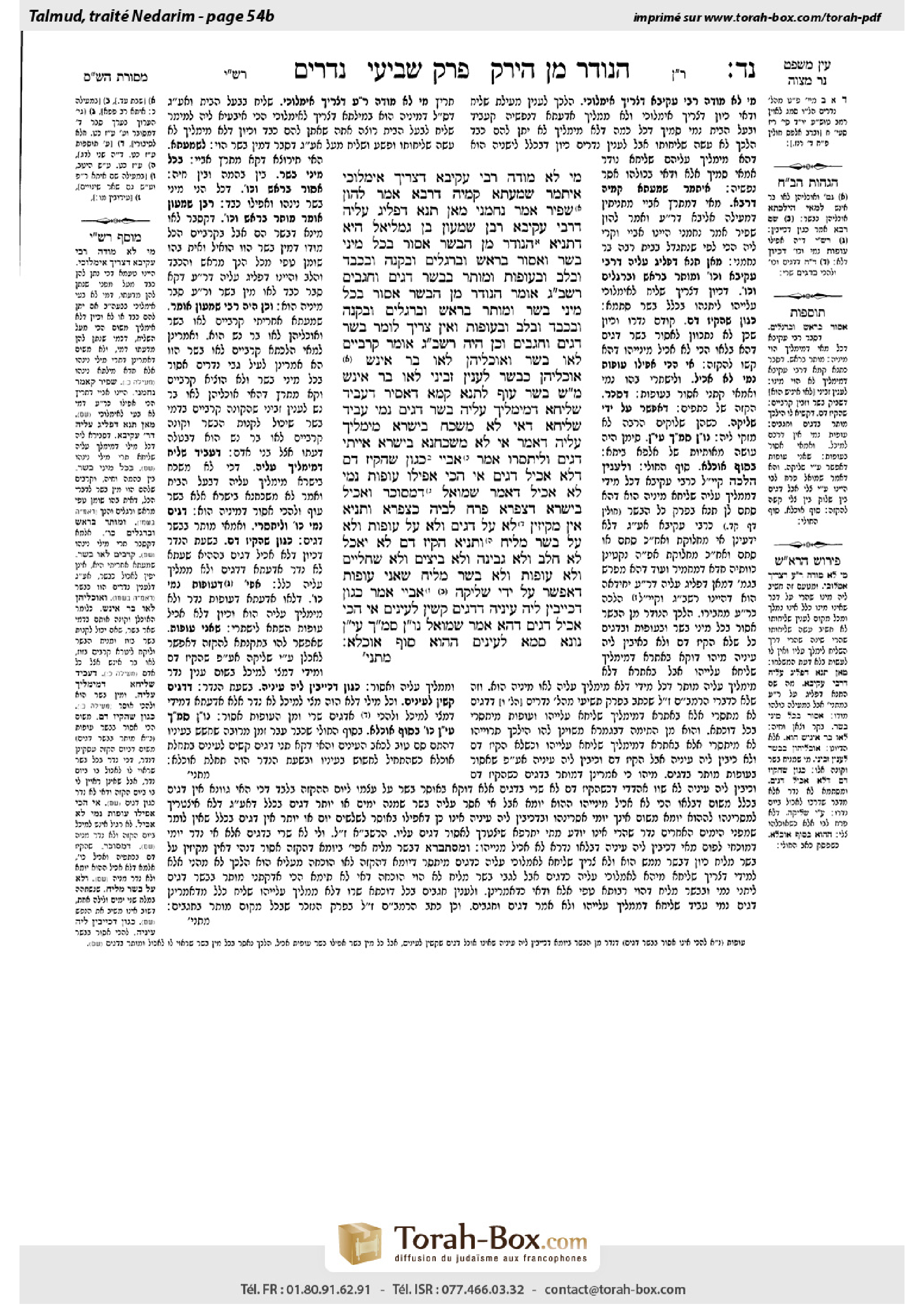
Nedarim 54b: Talmud study for Daf Yomi
Daf Yomi is the daily study of one Talmud folio. Explore 37 tractates with scans, Hebrew text, Sefaria English and AI-generated French translations where annotated.
Passage selection and English or AI-generated French translation are available where the scan has annotations. Daf Study is independent of Torah-Box and Sefaria.
Browse Nedarim · נדרים · All tractatesNedarim 54b text and translations
This page of Nedarim includes the Aramaic text, an English translation and an AI-generated French translation, alongside the scan above.
נדרים נ״ד ב · Aramaic and Hebrew text
מִי לָא מוֹדֶה רַבִּי עֲקִיבָא דִּצְרִיךְ אִימְּלוֹכֵי? אִיתְּמַר שְׁמַעְתָּא קַמֵּיהּ דְּרָבָא. אֲמַר לְהוֹן: שַׁפִּיר אָמַר נַחְמָנִי.
מַאן תַּנָּא דִּפְלִיג עֲלֵיהּ דְּרַבִּי עֲקִיבָא — רַבָּן שִׁמְעוֹן בֶּן גַּמְלִיאֵל הִיא. דְּתַנְיָא: הַנּוֹדֵר מִן הַבָּשָׂר — אָסוּר בְּכׇל מִינֵי בָשָׂר, וְאָסוּר בָּרֹאשׁ וּבָרַגְלַיִם וּבַקָּנֶה וּבַכָּבֵד וּבַלֵּב, וּבְעוֹפוֹת, וּמוּתָּר בִּבְשַׂר דָּגִים וַחֲגָבִים.
רַבָּן שִׁמְעוֹן בֶּן גַּמְלִיאֵל אוֹמֵר: הַנּוֹדֵר מִן הַבָּשָׂר — אָסוּר בְּכׇל מִינֵי בָשָׂר, וּמוּתָּר בָּרֹאשׁ וּבָרַגְלַיִם וּבַקָּנֶה וּבַכָּבֵד וּבַלֵּב וּבְעוֹפוֹת, וְאֵין צָרִיךְ לוֹמַר בְּשַׂר דָּגִים וַחֲגָבִים. וְכֵן הָיָה רַבָּן שִׁמְעוֹן בֶּן גַּמְלִיאֵל אוֹמֵר: קְרָבַיִים לָאו בָּשָׂר, וְאוֹכְלֵיהֶן לָאו בַּר אִינָשׁ. אוֹכְלֵיהֶן כְּבָשָׂר, לְעִנְיַן זְבִינֵי — לָאו בַּר אִינָשׁ.
מַאי שְׁנָא בְּשַׂר עוֹף לְתַנָּא קַמָּא דַּאֲסִיר — דַּעֲבִיד שְׁלִיחָא דְּמִימְּלִיךְ עֲלֵיהּ. בְּשַׂר דָּגִים נָמֵי עָבֵיד שְׁלִיחָא, דְּאִי לָא מַשְׁכַּח בִּישְׂרָא, מִימְּלִיךְ עֲלֵיהּ, דְּאָמַר: אִי לָא מַשְׁכַּחְנָא בִּישְׂרָא אַיְיתֵי דָּגִים, וְלִיתַּסְרוּ!
אָמַר אַבָּיֵי: כְּגוֹן שֶׁהִקִּיז דָּם, דְּלָא אָכֵיל דָּגִים. אִי הָכִי, אֲפִילּוּ עוֹפוֹת נָמֵי לָא אָכֵיל. דְּאָמַר שְׁמוּאֵל: דִּמְסוֹכַר וְאָכֵיל בִּישְׂרָא דְצִפְּרָא — פָּרַח לִבֵּיהּ כְּצִפְּרָא! וְתַנְיָא: אֵין מַקִּיזִין לֹא עַל דָּגִים, וְלֹא עַל עוֹפוֹת, וְלֹא עַל בָּשָׂר מָלִיחַ. וְתַנְיָא: הִקִּיז דָּם — לֹא יֹאכַל לֹא חָלָב, וְלֹא גְּבִינָה, וְלֹא בֵּיצִים, וְלֹא שַׁחֲלַיִים, וְלֹא עוֹפוֹת, וְלֹא בָּשָׂר מָלִיחַ! שָׁאנֵי עוֹפוֹת, דְּאֶפְשָׁר עַל יְדֵי שְׁלִיקָה.
אַבָּיֵי אָמַר: כְּגוֹן דְּכָיְיבִין לֵיהּ עֵינֵיהּ, דְּדָגִים קָשִׁין לָעֵינַיִם. אִי הָכִי אָכֵיל דָּגִים, דְּהָא אָמַר שְׁמוּאֵל: נוּן סָמֶךְ עַיִן — נוּנָא סַמָּא לְעֵינַיִם! הָהוּא סוֹף אוּכְלָא.
Nedarim 54b · English translation
doesn’t Rabbi Akiva concede that the agent must consult his employer? Because he failed to do so and acted on his own, he is not considered to have performed his mission. This halakha was stated before Rava. He said to those who stated the halakha before him: Naḥmani, i.e., Abaye, spoke well.
§ The Gemara asks: Who is the tanna who disagrees with the opinion of Rabbi Akiva in the mishna here? The Gemara answers: It is Rabban Shimon ben Gamliel, as it is taught in a dispute in the baraita: For one who vows that meat is forbidden to him, it is prohibited to eat all types of meat, and it is prohibited for him to eat meat of the head, and of the feet, and of the windpipe, and of the liver, and of the heart, although people do not typically eat meat from those parts of the body. And it is prohibited for him to eat meat of birds, as it too is popularly called meat. However, it is permitted for him to eat of the meat of fish and grasshoppers, as their flesh is not called meat.
Rabban Shimon ben Gamliel says: One who vows that meat is forbidden to him, is forbidden in all types of meat, and is permitted to eat meat of the head, and of the feet, and of the windpipe, and of the liver, and of the heart and of birds, and needless to say he may also partake of fish and grasshoppers. And Rabban Shimon ben Gamliel would likewise say: Innards are not considered meat, and one who eats them is not a person, meaning that the innards are not fit for human consumption. The Gemara elaborates: With regard to one who eats them, in terms of the halakhot related to their consumption, e.g., vows, they are considered as meat. However, with regard to purchase, one who purchases them is not a person. In any case, apparently, Rabban Shimon ben Gamliel disagrees with Rabbi Akiva, as he maintains that although if an agent fails to find meat he is required to consult his employer before replacing it with liver, it is not considered meat with regard to vows.
The Gemara asks: What is different about the meat of a bird according to the first tanna, that he prohibits it since it is considered meat, due to the fact that when the agent fails to find meat, he tends to consult his employer about it? The same should be true of the meat of fish too. If the agent does not find meat, he tends to consult his employer about it, as he says: If I do not find meat, should I bring fish? And therefore, let fish also be forbidden according to the first tanna.
Abaye said: This is referring to a case where he let his blood when he vowed, as a person in that condition does not eat fish. It was common knowledge then that eating fish after bloodletting is harmful. The Gemara asks: If so, he would not eat birds either, as Shmuel said: With regard to one who lets blood and eats the meat of a bird, his heart rate accelerates and flies like a bird. Clearly, bird meat too is deleterious for his health. And it is taught in a baraita: One neither lets blood before eating fish, nor before eating birds, nor before eating salted meat. And it is taught in another baraita: If one let blood, he may eat neither milk, nor cheese, nor eggs, nor cress, nor birds, nor salted meat. The Gemara answers: Meat of birds is different, as it is possible to eat it safely after bloodletting by means of thoroughly boiling it.
Abaye said: This is referring to a case where his eyes hurt him, as fish are harmful for eyes. Therefore, meat of birds is permitted, but not fish. The Gemara asks: If so, and he is suffering from eye pain, he should eat fish, as Shmuel said an acronym: Nun, samekh, ayin, which stands for: Nuna samma la’einayim, which means: Fish is a medicine for eyes. The Gemara answers: That statement of Shmuel is referring to the latter stages of the eye infection.
Nedarim 54b · Traduction française (IA)
Rabbi Akiva ne reconnaît-il pas que l’agent doit consulter son mandant ? Puisqu’il ne l’a pas fait et a agi de sa propre initiative, il n’est pas considéré comme ayant accompli sa mission. Cette halakha fut énoncée devant Rava. Il dit à ceux qui la lui rapportaient : « Naḥmani », c’est-à-dire Abaye, a bien parlé.
§ La Guemara demande : Quel est le tanna qui conteste l’opinion de Rabbi Akiva dans notre Michna ? La Guemara répond : C’est Rabban Shimon ben Gamliel, comme on l’enseigne dans une controverse de la baraïta : celui qui fait vœu de s’interdire la viande ne peut manger aucune sorte de viande ; il lui est également interdit de manger la viande de la tête, des pieds, de la trachée, du foie et du cœur, bien que les gens ne mangent généralement pas la viande de ces parties du corps. Il lui est aussi interdit de manger de la viande de volaille, car celle-ci est également couramment appelée « viande ». En revanche, il lui est permis de manger du poisson et des sauterelles, car leur chair n’est pas appelée « viande ».
Rabban Shimon ben Gamliel dit : Celui qui fait vœu de s’interdire la viande ne peut manger aucune sorte de viande, mais il lui est permis de manger la viande de la tête, des pieds, de la trachée, du foie et du cœur, ainsi que de la volaille ; à plus forte raison peut-il manger du poisson et des sauterelles. Rabban Shimon ben Gamliel disait également : Les abats ne sont pas considérés comme de la viande, et celui qui en mange n’est pas une personne, c’est-à-dire que les abats ne conviennent pas à la consommation humaine. La Guemara précise : Pour celui qui en mange, du point de vue des halakhot relatives à leur consommation, par exemple celles des vœux, ils sont considérés comme de la viande. En revanche, du point de vue de l’achat, celui qui en achète n’est pas une personne. Quoi qu’il en soit, il semble que Rabban Shimon ben Gamliel soit en désaccord avec Rabbi Akiva, puisqu’il estime que, même si l’agent qui ne trouve pas de viande doit consulter son mandant avant de la remplacer par du foie, le foie n’est pas considéré comme de la viande en matière de vœux.
La Guemara demande : Selon le premier tanna, en quoi la viande de volaille diffère-t-elle, pour qu’il l’interdise au motif qu’elle est considérée comme de la viande, puisque l’agent qui ne trouve pas de viande a tendance à consulter son mandant à ce sujet ? Il devrait en être de même pour le poisson. Si l’agent ne trouve pas de viande, il a tendance à consulter son mandant en lui demandant : « Si je ne trouve pas de viande, dois-je apporter du poisson ? » Le poisson devrait donc lui aussi être interdit selon le premier tanna.
Abaye dit : Il s’agit d’un cas où il s’était fait saigner au moment où il a fait vœu, car une personne dans cet état ne mange pas de poisson. À l’époque, on savait couramment que manger du poisson après une saignée est nocif. La Guemara demande : Si tel est le cas, il ne mangerait pas non plus de volaille, car Shmuel a dit : Celui qui se fait saigner et mange de la viande de volaille voit son cœur battre plus vite et s’envoler comme un oiseau. Il est donc clair que la viande de volaille aussi est nuisible à sa santé. Et l’on enseigne dans une baraïta : On ne se fait saigner ni avant de manger du poisson, ni avant de manger de la volaille, ni avant de manger de la viande salée. Une autre baraïta enseigne : Si quelqu’un s’est fait saigner, il ne peut manger ni lait, ni fromage, ni œufs, ni cresson, ni volaille, ni viande salée. La Guemara répond : Le cas de la viande de volaille est différent, car il est possible de la manger sans danger après une saignée en la faisant bouillir à fond.
Abaye dit : Il s’agit d’un cas où il souffrait des yeux, car le poisson est nocif pour les yeux. La viande de volaille lui est donc permise, mais pas le poisson. La Guemara demande : Si tel est le cas et qu’il souffre des yeux, il devrait manger du poisson, puisque Shmuel a donné l’acronyme noun, samekh, ayin, qui correspond à « Nuna samma la’einayim », c’est-à-dire : « Le poisson est un remède pour les yeux. » La Guemara répond : Cette déclaration de Shmuel concerne les derniers stades de l’infection oculaire.
Traduction française générée par IA à partir de l’édition anglaise de Sefaria. Vérifie toujours un passage avec le texte source.
Text from Sefaria: William Davidson Edition - Vocalized Aramaic (CC BY NC); William Davidson Edition - English (CC BY NC).