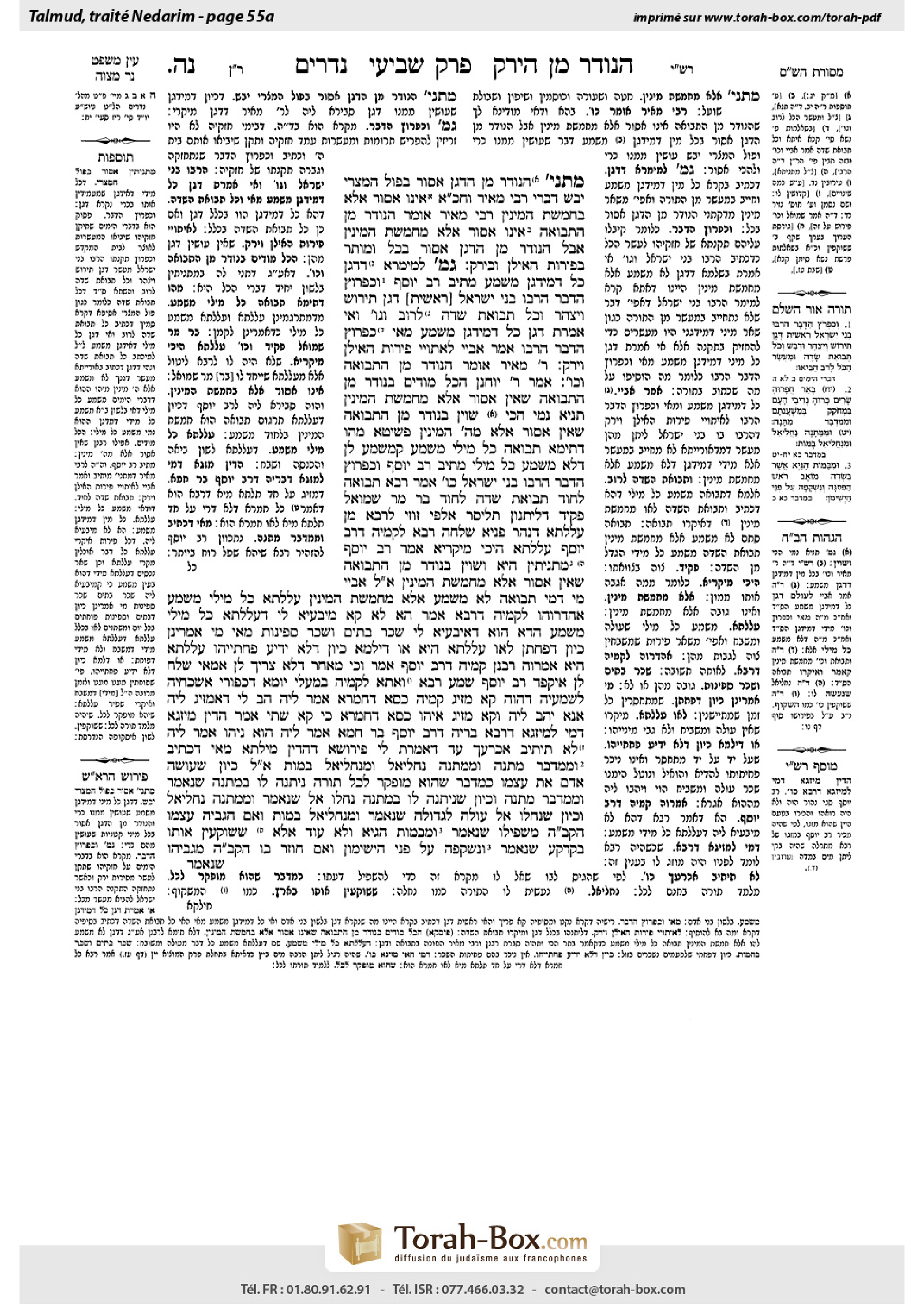
Nedarim 55a: Talmud study for Daf Yomi
Daf Yomi is the daily study of one Talmud folio. Explore 37 tractates with scans, Hebrew text, Sefaria English and AI-generated French translations where annotated.
Passage selection and English or AI-generated French translation are available where the scan has annotations. Daf Study is independent of Torah-Box and Sefaria.
Browse Nedarim · נדרים · All tractatesNedarim 55a text and translations
This page of Nedarim includes the Aramaic text, an English translation and an AI-generated French translation, alongside the scan above.
נדרים נ״ה א · Aramaic and Hebrew text
מַתְנִי׳ הַנּוֹדֵר מִן הַדָּגָן — אָסוּר בְּפוֹל הַמִּצְרִי יָבֵשׁ, דִּבְרֵי רַבִּי מֵאִיר. וַחֲכָמִים אוֹמְרִים: אֵינוֹ אָסוּר אֶלָּא בַּחֲמֵשֶׁת הַמִּינִין. רַבִּי מֵאִיר אוֹמֵר: הַנּוֹדֵר מִן הַתְּבוּאָה — אֵינוֹ אָסוּר אֶלָּא מֵחֲמֵשֶׁת הַמִּינִין. אֲבָל הַנּוֹדֵר מִן הַדָּגָן — אָסוּר בַּכֹּל, וּמוּתָּר בְּפֵירוֹת הָאִילָן וּבַיָּרָק.
גְּמָ׳ לְמֵימְרָא דְּ״דָגָן״ — כֹּל דְּמִידְּגַן מַשְׁמַע. מֵתִיב רַב יוֹסֵף: ״וְכִפְרֹץ הַדָּבָר הִרְבּוּ בְנֵי יִשְׂרָאֵל [רֵאשִׁית] דָּגָן תִּירוֹשׁ וְיִצְהָר וְכֹל תְּבוּאַת שָׂדֶה לָרֹב וְגוֹ׳״, וְאִי אָמְרַתְּ דָּגָן — כֹּל דְּמִידְּגַן מַשְׁמַע, מַאי ״כִּפְרֹץ הַדָּבָר הִרְבּוּ״? אָמַר אַבָּיֵי: לְאֵתוֹיֵי פֵּירוֹת הָאִילָן וְיָרָק.
רַבִּי מֵאִיר אוֹמֵר: הַנּוֹדֵר מִן הַתְּבוּאָה וְכוּ׳. אָמַר רַבִּי יוֹחָנָן: הַכֹּל מוֹדִים בְּנוֹדֵר מִן הַתְּבוּאָה שֶׁאֵין אָסוּר אֶלָּא מֵחֲמֵשֶׁת הַמִּינִין. תַּנְיָא נָמֵי הָכִי: שָׁוִין בַּנּוֹדֵר מִן הַתְּבוּאָה שֶׁאֵין אָסוּר אֶלָּא מֵחֲמֵשֶׁת הַמִּינִין. פְּשִׁיטָא! מַהוּ דְּתֵימָא: ״תְּבוּאָה״ — כׇּל מִלֵּי מַשְׁמַע, קָמַשְׁמַע לַן דְּלָא מַשְׁמַע כׇּל מִלִּי.
מֵתִיב רַב יוֹסֵף: ״וְכִפְרֹץ הַדָּבָר הִרְבּוּ בְנֵי יִשְׂרָאֵל כּוּ׳״, אָמַר רָבָא: ״תְּבוּאָה״ לְחוּד, ״תְּבוּאַת שָׂדֶה״ לְחוּד.
בַּר מָר שְׁמוּאֵל פַּקֵּיד דְּלִיתְּנוּן תְּלֵיסַר אַלְפֵי זוּזִי לְרָבָא מִן עֲלַלְתָּא דִּנְהַר פַּנְיָא. שַׁלְחַהּ רָבָא לְקַמֵּיהּ דְּרַב יוֹסֵף: ״עֲלַלְתָּא״ הֵיכִי מִיקַּרְיָא? אָמַר רַב יוֹסֵף, מַתְנִיתִין הִיא: וְשָׁוִין בַּנּוֹדֵר מִן הַתְּבוּאָה שֶׁאֵין אָסוּר אֶלָּא מֵחֲמֵשֶׁת הַמִּינִין. אֲמַר לֵיהּ אַבָּיֵי: מִי דָּמֵי? ״תְּבוּאָה״ — לָא מַשְׁמַע אֶלָּא מֵחֲמֵשֶׁת הַמִּינִין, ״עֲלַלְתָּא״ — כׇּל מִילֵּי מַשְׁמַע.
אַהְדְּרוּהוּ לְקַמֵּיהּ דְּרָבָא. אֲמַר: הָא לָא קָא מִיבַּעְיָא לִי דַּ״עֲלַלְתָּא״ כׇּל מִילֵּי מַשְׁמַע. הָדָא הוּא דְּאִיבַּעְיָא לִי: שְׂכַר בָּתִּים וּשְׂכַר סְפִינוֹת מַאי? מִי אָמְרִינַן: כֵּיוָן דְּפָחֲתָן, לָאו עֲלַלְתָּא הִיא. אוֹ דִילְמָא: כֵּיוָן דְּלָא יְדִיעַ פְּחָתַיְיהוּ — עֲלַלְתָּא הִיא. אַמְרוּהָ רַבָּנַן קַמֵּיהּ דְּרַב יוֹסֵף, אָמַר: וְכִי מֵאַחַר דְּלָא צְרִיךְ לַן, אַמַּאי שְׁלַח לַן? אִיקְּפַד רַב יוֹסֵף.
שְׁמַע רָבָא, וַאֲתָא לְקַמֵּיהּ בְּמַעֲלֵי יוֹמָא דְכִפּוּרֵי. אַשְׁכְּחֵיהּ לְשַׁמָּעֵיהּ דַּהֲוָה קָא מָזֵיג קַמֵּיהּ כָּסָא דְחַמְרָא. אֲמַר לֵיהּ: הַב לִי דְּאֶמְזִיג לֵיהּ אֲנָא. יְהַב לֵיהּ, וְקָא מָזֵיג אִיהוּ כָּסָא דְחַמְרָא. כִּי קָא שָׁתֵי אֲמַר: הָדֵין מִיזְגָּא דָּמֵי לְמִיזְגָּא דְּרָבָא בְּרֵיהּ דְּרַב יוֹסֵף בַּר חָמָא. אֲמַר לֵיהּ: הוּא נִיהוּ.
אֲמַר לֵיהּ: לָא תִּיתֵּיב אַכַּרְעָךְ עַד דְּאָמְרַתְּ לִי פֵּירוּשָׁא דְּהָדֵין מִילְּתָא: מַאי דִּכְתִיב: ״וּמִמִּדְבָּר מַתָּנָה וּמִמַּתָּנָה נַחֲלִיאֵל וּמִנַּחֲלִיאֵל בָּמוֹת״?
אֲמַר לֵיהּ: כֵּיוָן שֶׁעוֹשֶׂה אָדָם אֶת עַצְמוֹ כַּמִּדְבָּר, שֶׁהוּא מוּפְקָר לַכֹּל — תּוֹרָה נִיתְּנָה לוֹ בְּמַתָּנָה, שֶׁנֶּאֱמַר: ״וּמִמִּדְבָּר מַתָּנָה״. וְכֵיוָן שֶׁנִּיתְּנָה לוֹ בְּמַתָּנָה — נְחָלוֹ אֵל, שֶׁנֶּאֱמַר: ״וּמִמַּתָּנָה נַחֲלִיאֵל״. וְכֵיוָן שֶׁנְּחָלוֹ אֵל — עוֹלֶה לִגְדוּלָּה, שֶׁנֶּאֱמַר: ״וּמִנַּחֲלִיאֵל בָּמוֹת״. וְאִם הִגְבִּיהַּ עַצְמוֹ — הַקָּדוֹשׁ בָּרוּךְ הוּא מַשְׁפִּילוֹ, שֶׁנֶּאֱמַר: ״וּמִבָּמוֹת הַגַּיְא״, וְלֹא עוֹד אֶלָּא שֶׁשּׁוֹקְעִין אוֹתוֹ בַּקַּרְקַע, שֶׁנֶּאֱמַר: ״וְנִשְׁקָפָה עַל פְּנֵי הַיְשִׁימוֹן״. וְאִם חוֹזֵר בּוֹ — הַקָּדוֹשׁ בָּרוּךְ הוּא מַגְבִּיהוֹ
Nedarim 55a · English translation
MISHNA: For one who vows that grain [dagan] is forbidden to him, it is prohibited to eat the dry cowpea, because, like grain, its final stage of production involves being placed in a pile; this is the statement of Rabbi Meir. And the Rabbis say: It is prohibited for him to partake of only the five species of grain: Wheat, barley, oats, spelt, and rye, as that is the connotation of the term dagan in the Torah. Rabbi Meir says: For one who vows that grain is forbidden to him, and therefore he will refrain from eating grain [tevua], it is prohibited for him to eat from only the five species of grain. However, for one who vows that grain is forbidden to him, and therefore he will refrain from eating grain [dagan], it is prohibited to eat all produce whose final stage of production involves being placed in a pile, e.g., dry cowpea, and it is permitted for him to eat fruits of the tree and vegetables.
GEMARA: The Gemara asks: Is this to say that according to Rabbi Meir, the term dagan means any produce that is harvested at one time and placed in a pile [midgan]? Rav Yosef raised an objection: After King Hezekiah called upon the people to give teruma and tithes properly, the verse states: “And as soon as the matter was publicized, the children of Israel gave in abundance the first fruits of dagan, wine, and oil, and honey, and of all the tevua of the field; and the tithe of all that they brought in abundance” (II Chronicles 31:5). And if you say that dagan means any produce that is placed in a pile, what is the meaning of the words “As soon as the matter was publicized, the children of Israel gave in abundance the first fruits of dagan…and of all the tevua of the field”? There is no need to list both dagan and all tevua of the field. Abaye said: Tevua comes to include fruits of the tree and vegetables, which they tithed although they are not included in dagan, as they are not harvested at one time and placed in a pile.
§ We learned in the mishna that Rabbi Meir says: For one who vows that grain [tevua] is forbidden to him, it is prohibited for him to eat from only the five species of grain. Rabbi Yoḥanan said: Everyone concedes with regard to one who vows that tevua is forbidden to him that it is prohibited for him to eat from only the five species of grain. The Rabbis do not disagree with Rabbi Meir in that regard. That is also taught in a baraita: And they agree with regard to one who vows that tevua is forbidden to him that it is prohibited for him to eat from only the five species of grain. The Gemara asks: Isn’t that obvious, as it is only those species that are called tevua. The Gemara answers: It is necessary; lest you say that tevua means all items that grow from the ground, therefore, the tanna teaches us that this expression does not mean all items that grow from the ground.
Rav Yosef raised an objection: With regard to the verse “And as soon as the matter was publicized, the children of Israel gave in abundance…and of all the tevua of the field,” the phrase “and of all the tevua of the field” comes to include all crops that grow in the field. Rava said: Tevua is discrete and refers to only the five species of grain, and tevua of the field is discrete and refers to all crops that grow in the field.
§ The Gemara relates: The son of Master Shmuel commanded his workers that they give thirteen thousand dinars to Rava from the crop [alalta] produced in his fields on the banks of the Panya River. Rava sent this question before Rav Yosef: What is called alalta; what crops are included in the category of alalta? Rav Yosef said: It is as it is taught in the baraita cited above: And they agree with regard to one who vows that tevua is forbidden to him that it is prohibited for him to eat from only the five species of grain; just as tevua includes only the five species, so too alalta includes only the five species. Abaye said to him: Are the two cases comparable? Although tevua means grain and includes only the five species, alalta means crop and includes all items that grow.
The messengers returned with the answer to his question and came before Rava. He said: That was not a dilemma for me, i.e., the fact that alalta means all items that grow. This is the matter that is a dilemma for me: What is the legal status of profits from the rent of houses and the rent of boats? Do we say: Since they depreciate, their legal status is not comparable to that of a crop? Only items that are consistently profitable are similar to crops. Houses and boats deteriorate with use, and their depreciation diminishes the profits. Or perhaps, since their depreciation is not conspicuous, their legal status is comparable to that of a crop. The Rabbis stated Rava’s reaction before Rav Yosef. Rav Yosef said: And since he does not need us, and he believes that he knows the answer himself, why did he send us the question? Rav Yosef became angry with Rava.
Rava heard that Rav Yosef was angry and came before him on Yom Kippur eve to appease him. He found the attendant of Rav Yosef, who was diluting a cup of wine with water before him. Rava said to the attendant: Give me the cup so that I will dilute the wine for him. The attendant gave it to him and Rava diluted the cup of wine. While Rav Yosef, who was blind, was drinking the wine, he said: This dilution is similar to the dilution of Rava, son of Rav Yosef bar Ḥama, who would dilute wine with more than the standard amount of water. Rava said to him: Correct, it is he.
Rav Yosef said to Rava: Do not sit on your feet until you tell me the explanation of this matter: What is the meaning of that which is written: “And from the wilderness Mattana and from Mattana Nahaliel, and from Nahaliel Bamot” (Numbers 21:18–19)?
Rava said to him that it means: Once a person renders himself like a wilderness, deserted before all, the Torah is given to him as a gift [mattana], as it is stated: “And from the wilderness Mattana.” And once it is given to him as a gift, God bequeaths [naḥalo] it to him, as it is stated: “And from Mattana Nahaliel.” And once God bequeaths it to him, he rises to greatness, as it is stated: And from Nahaliel, Bamot, which are elevated places. And if he elevates himself and is arrogant about his Torah, the Holy One, Blessed be He, degrades him, as it is stated: “And from Bamot the valley” (Numbers 21:20). And not only is he degraded, but one lowers him into the ground, as it is stated: “And looking over [nishkafa] the face of the wasteland” (Numbers 21:20), like a threshold [iskopa] that is sunken into the ground. And if he reverses his arrogance and becomes humble, the Holy One, Blessed be He, elevates him,
Nedarim 55a · Traduction française (IA)
MICHNA : Pour celui qui fait le vœu que le grain [dagan] lui soit interdit, il est interdit de manger du niébé sec, car, comme le grain, sa production s’achève par sa mise en tas ; telle est l’opinion de Rabbi Meïr. Les Sages disent : il lui est interdit de consommer uniquement les cinq espèces céréalières : le blé, l’orge, l’avoine, l’épeautre et le seigle, car c’est le sens du terme dagan dans la Torah. Rabbi Meïr dit : Pour celui qui fait le vœu que les céréales lui soient interdites et s’abstient donc de manger des céréales [tevua], il est interdit de manger uniquement les cinq espèces céréalières. En revanche, pour celui qui fait le vœu que le grain lui soit interdit et s’abstient donc de manger du grain [dagan], il est interdit de manger tous les produits dont la production s’achève par leur mise en tas, comme le niébé sec ; il lui est permis de manger des fruits des arbres et des légumes.
GUEMARA : La Guemara demande : Faut-il en conclure que, selon Rabbi Meïr, le terme dagan désigne tout produit récolté en une fois et placé en tas [midgan] ? Rav Yossef soulève une objection : Après que le roi Ézéchias eut appelé le peuple à donner correctement la terouma et les dîmes, le verset dit : « Dès que la chose fut rendue publique, les enfants d’Israël apportèrent en abondance les prémices du dagan, du vin, de l’huile et du miel, ainsi que de tout le tevua des champs ; et la dîme de tout ce qu’ils apportèrent en abondance » (II Chroniques 31:5). Or, si tu dis que dagan désigne tout produit placé en tas, que signifient les mots : « Dès que la chose fut rendue publique, les enfants d’Israël apportèrent en abondance les prémices du dagan… et de tout le tevua des champs » ? Il n’est pas nécessaire de mentionner à la fois le dagan et tout le tevua des champs. Abayé dit : tevua vient inclure les fruits des arbres et les légumes, qu’ils soumirent à la dîme bien qu’ils ne soient pas inclus dans dagan, puisqu’ils ne sont pas récoltés en une fois et placés en tas.
§ Nous avons appris dans la Michna que Rabbi Meïr dit : Pour celui qui fait le vœu que les céréales [tevua] lui soient interdites, il est interdit de manger uniquement les cinq espèces céréalières. Rabbi Yo’hanan dit : Tous reconnaissent que, pour celui qui fait le vœu que le tevua lui soit interdit, il est interdit de manger uniquement les cinq espèces céréalières. Les Sages ne sont pas en désaccord avec Rabbi Meïr sur ce point. Cela est également enseigné dans une baraïta : Ils conviennent que, pour celui qui fait le vœu que le tevua lui soit interdit, il est interdit de manger uniquement les cinq espèces céréalières. La Guemara demande : N’est-ce pas évident, puisque seules ces espèces sont appelées tevua ? La Guemara répond : C’est nécessaire, de peur que tu ne dises que tevua désigne tout ce qui pousse dans le sol ; le tanna nous enseigne donc que cette expression ne désigne pas tout ce qui pousse dans le sol.
Rav Yossef soulève une objection : À propos du verset « Dès que la chose fut rendue publique, les enfants d’Israël apportèrent en abondance… et de tout le tevua des champs », l’expression « et de tout le tevua des champs » vient inclure toutes les cultures qui poussent dans les champs. Rava dit : tevua est une catégorie distincte et ne désigne que les cinq espèces céréalières, tandis que tevua des champs est une catégorie distincte qui désigne toutes les cultures poussant dans les champs.
§ La Guemara rapporte : Le fils de Maître Chmouel ordonna à ses ouvriers de donner à Rava treize mille dinars prélevés sur la récolte [alalta] produite dans ses champs, sur les rives du fleuve Panya. Rava adressa cette question à Rav Yossef : Que désigne alalta ? Quelles cultures sont comprises dans la catégorie alalta ? Rav Yossef dit : C’est comme ce qui est enseigné dans la baraïta citée plus haut : Ils conviennent que, pour celui qui fait le vœu que le tevua lui soit interdit, il est interdit de manger uniquement les cinq espèces céréalières. De même que tevua ne comprend que les cinq espèces, alalta ne comprend que les cinq espèces. Abayé lui dit : Ces deux cas sont-ils comparables ? Bien que tevua signifie céréales et ne comprenne que les cinq espèces, alalta signifie récolte et comprend tout ce qui pousse.
Les messagers revinrent avec la réponse à sa question et se présentèrent devant Rava. Il dit : Ce n’était pas cela qui me posait problème, à savoir le fait qu’alalta désigne tout ce qui pousse. Voici ce qui me pose problème : quel est le statut des bénéfices provenant de la location de maisons et de bateaux ? Peut-on dire que, puisqu’ils se déprécient, leur statut n’est pas comparable à celui d’une récolte ? Seuls les biens qui procurent des bénéfices de manière constante sont comparables aux récoltes. Les maisons et les bateaux se détériorent à l’usage, et leur dépréciation réduit les bénéfices. Ou peut-être, puisque leur dépréciation n’est pas manifeste, leur statut est-il comparable à celui d’une récolte ? Les Sages rapportèrent à Rav Yossef la réaction de Rava. Rav Yossef dit : S’il n’a pas besoin de nous et pense connaître lui-même la réponse, pourquoi nous a-t-il posé la question ? Rav Yossef se mit en colère contre Rava.
Rava apprit que Rav Yossef était en colère et se présenta devant lui la veille de Yom Kippour pour l’apaiser. Il trouva l’assistant de Rav Yossef en train de lui diluer une coupe de vin avec de l’eau. Rava dit à l’assistant : Donne-moi la coupe, afin que je dilue le vin pour lui. L’assistant la lui donna et Rava dilua la coupe de vin. Tandis que Rav Yossef, qui était aveugle, buvait le vin, il dit : Cette dilution ressemble à celle de Rava, fils de Rav Yossef bar Ḥama, qui diluait le vin avec plus d’eau que la quantité habituelle. Rava lui dit : C’est exact, c’est bien lui.
Rav Yossef dit à Rava : Ne te relève pas avant de m’avoir expliqué cette question : que signifie ce qui est écrit : « Du désert, Mattana ; de Mattana, Nahaliel ; et de Nahaliel, Bamot » (Nombres 21:18–19) ?
Rava lui dit que cela signifie : Lorsqu’une personne se rend semblable à un désert, déserté de tous, la Torah lui est donnée en cadeau [mattana], comme il est dit : « Du désert, Mattana. » Et une fois qu’elle lui a été donnée en cadeau, Dieu la lui lègue [naḥalo], comme il est dit : « De Mattana, Nahaliel. » Et une fois que Dieu la lui a léguée, elle s’élève à la grandeur, comme il est dit : « De Nahaliel, Bamot », c’est-à-dire des lieux élevés. Mais si elle s’élève elle-même et s’enorgueillit de sa Torah, le Saint, béni soit-Il, l’abaisse, comme il est dit : « Et de Bamot, la vallée » (Nombres 21:20). Et non seulement elle est abaissée, mais on la fait descendre dans la terre, comme il est dit : « Surplombant [nishkafa] la face du désert » (Nombres 21:20), comme un seuil [iskopa] enfoncé dans le sol. Et si elle renonce à son orgueil et devient humble, le Saint, béni soit-Il, l’élève,
Traduction française générée par IA à partir de l’édition anglaise de Sefaria. Vérifie toujours un passage avec le texte source.
Text from Sefaria: William Davidson Edition - Vocalized Aramaic (CC BY NC); William Davidson Edition - English (CC BY NC).