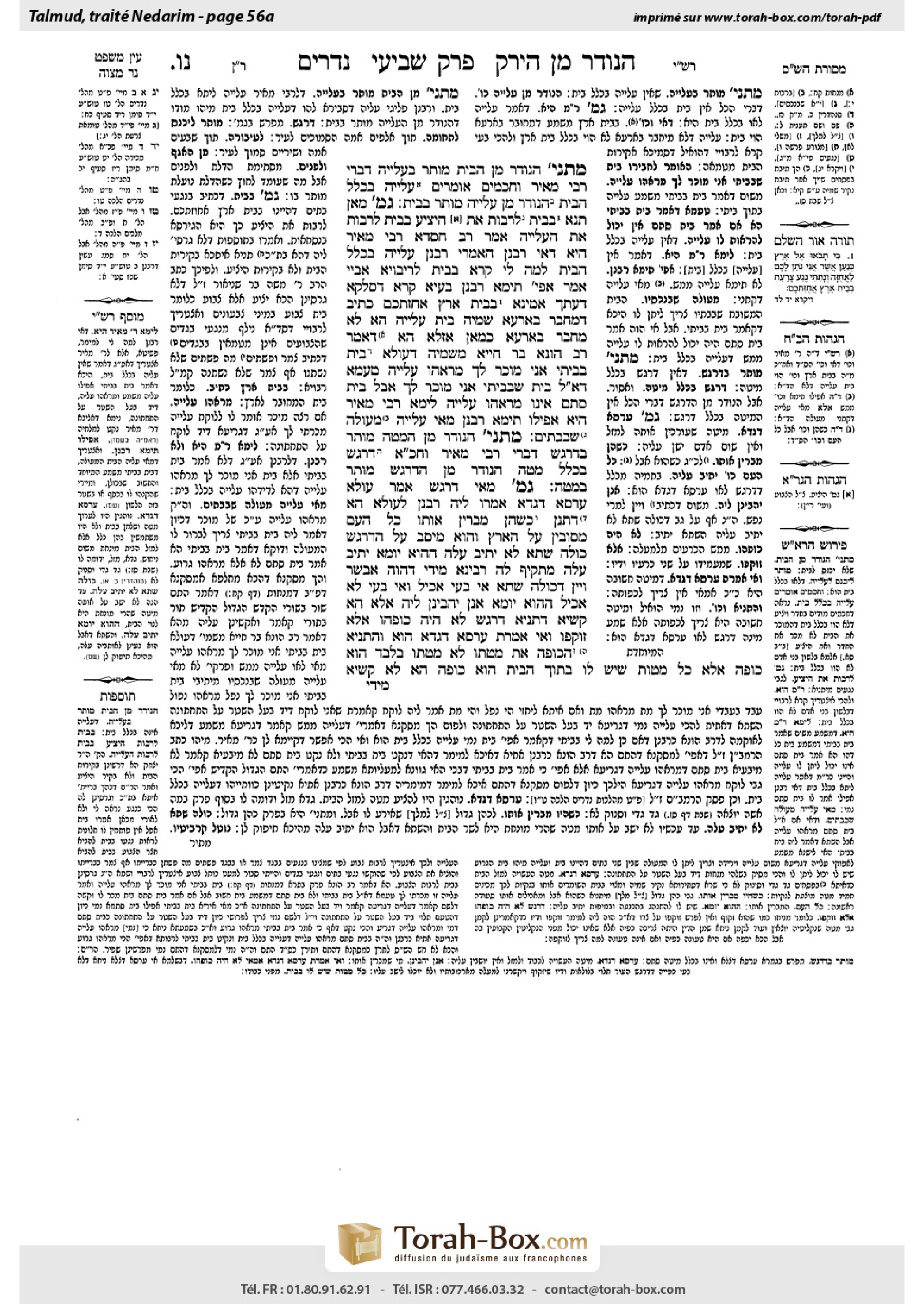
Nedarim 56a: Talmud study for Daf Yomi
Daf Yomi is the daily study of one Talmud folio. Explore 37 tractates with scans, Hebrew text, Sefaria English and AI-generated French translations where annotated.
Passage selection and English or AI-generated French translation are available where the scan has annotations. Daf Study is independent of Torah-Box and Sefaria.
Browse Nedarim · נדרים · All tractatesNedarim 56a text and translations
This page of Nedarim includes the Aramaic text, an English translation and an AI-generated French translation, alongside the scan above.
נדרים נ״ו א · Aramaic and Hebrew text
מַתְנִי׳ הַנּוֹדֵר מִן הַבַּיִת — מוּתָּר בַּעֲלִיָּיה, דִּבְרֵי רַבִּי מֵאִיר. וַחֲכָמִים אוֹמְרִים: עֲלִיָּיה בִּכְלַל הַבַּיִת. הַנּוֹדֵר מִן עֲלִיָּיה — מוּתָּר בְּבַיִת.
גְּמָ׳ מַאן תְּנָא ״בְּבֵית״ לְרַבּוֹת אֶת הַיָּצִיעַ, ״בְּבֵית״ לְרַבּוֹת אֶת הָעֲלִיָּיה? אָמַר רַב חִסְדָּא: רַבִּי מֵאִיר הִיא, דְּאִי רַבָּנַן, הָאָמְרִי רַבָּנַן: עֲלִיָּיה בִּכְלַל הַבַּיִת, לְמָה לִי קְרָא ״בְּבֵית״ לְרִיבּוּיָא?
אַבָּיֵי אָמַר: אֲפִילּוּ תֵּימָא רַבָּנַן, בָּעֲיָא קְרָא. דְּסָלְקָא דַּעְתָּךְ אָמֵינָא ״בְּבֵית אֶרֶץ אֲחֻזַּתְכֶם״ כְּתִיב. דִּמְחַבַּר בְּאַרְעָא — שְׁמֵיהּ בַּיִת, עֲלִיָּיה — הָא לָא מְחַבַּר בְּאַרְעָא.
כְּמַאן אָזְלָא הָא דְּאָמַר רַב הוּנָא בַּר חִיָּיא מִשְּׁמֵיהּ דְּעוּלָּא: ״בַּיִת בְּבֵיתִי אֲנִי מוֹכֵר לָךְ״ — מַרְאֵהוּ עֲלִיָּיה. טַעְמָא דַּאֲמַר לֵיהּ ״בַּיִת שֶׁבְּבֵיתִי אֲנִי מוֹכֵר לָךְ״, אֲבָל ״בַּיִת״ סְתָם — אֵינוֹ מַרְאֵהוּ עֲלִיָּיה. לֵימָא, רַבִּי מֵאִיר הִיא? אֲפִילּוּ תֵּימָא רַבָּנַן, מַאי ״עֲלִיָּיה״ — מְעוּלָּה שֶׁבַּבָּתִּים.
מַתְנִי׳ הַנּוֹדֵר מִן הַמִּטָּה — מוּתָּר בַּדַּרְגֵּשׁ, דִּבְרֵי רַבִּי מֵאִיר. וַחֲכָמִים אוֹמְרִים: דַּרְגֵּשׁ בִּכְלַל מִטָּה. הַנּוֹדֵר מִן הַדַּרְגֵּשׁ — מוּתָּר בַּמִּטָּה.
גְּמָ׳ מַאי דַּרְגֵּשׁ? אָמַר עוּלָּא: עַרְסָא דְגַדָּא. אֲמַרוּ לֵיהּ רַבָּנַן לְעוּלָּא, הָא דִּתְנַן: כְּשֶׁהֵן מַבְרִין אוֹתוֹ, כׇּל הָעָם מְסוּבִּין עַל הָאָרֶץ וְהוּא מֵיסֵב עַל הַדַּרְגֵּשׁ. כּוּלָּהּ שַׁתָּא לָא יָתֵיב עֲלֵהּ, הָהוּא יוֹמָא יָתֵיב עֲלֵהּ? מַתְקֵיף לַהּ רָבִינָא: מִידֵּי דְּהָוֵה אַבָּשָׂר וְיַיִן, דְּכוּלַּהּ שַׁתָּא אִי בָּעֵי — אָכֵיל, וְאִי בָּעֵי — לָא אָכֵיל, הָהוּא יוֹמָא אֲנַן יָהֲבִינַן לֵיהּ!
אֶלָּא הָא קַשְׁיָא, דְּתַנְיָא: דַּרְגֵּשׁ לֹא הָיָה כּוֹפֵהוּ, אֶלָּא זוֹקְפוֹ. וְאִי אָמְרַתְּ עַרְסָא דְגַדָּא הוּא, וְהָתַנְיָא: הַכּוֹפֶה אֶת מִטָּתוֹ — לֹא מִטָּתוֹ בִּלְבַד הוּא כּוֹפֶה, אֶלָּא כׇּל מִטּוֹת שֶׁיֵּשׁ לוֹ בְּתוֹךְ הַבַּיִת הוּא כּוֹפֶה! הָא לָא קַשְׁיָא,
Nedarim 56a · English translation
MISHNA: For one who vows that a house is forbidden to him, entry is permitted for him in the upper story of the house; this is the statement of Rabbi Meir. And the Rabbis say: An upper story is included in the house, and therefore, entry is prohibited there as well. However, for one who vows that an upper story is forbidden to him, entry is permitted in the house, as the ground floor is not included in the upper story.
GEMARA: The Gemara asks: Who is the tanna who taught with regard to the halakhot of leprosy that in the verse “it appears to me as it were a plague in the house” (Leviticus 14:35), the term “in the house” comes to include the gallery, a half story above the ground floor, and “in the house” comes to include the upper story? Rav Ḥisda said: The tanna is Rabbi Meir, as, if the tanna were the Rabbis, didn’t the Rabbis say that a second story is included in the house? Why then do I need the verse containing the phrase “in the house” to include the second story?
Abaye said: Even if you would say that the tanna is the Rabbis, they too require a verse to include the second story in this case, as it might enter your mind to say that since it is written: “In a house of the land of your possession” (Leviticus 14:34), only that which is attached to the ground has the status of a house but with regard to a second story, that is not attached to the ground. Even according to the Rabbis, the verse is necessary to prevent the conclusion that the legal status of a second story is not that of a house with regard to leprosy.
The Gemara asks: In accordance with whose opinion is that which Rav Huna bar Ḥiyya said in the name of Ulla? If the seller says to the buyer: A house in my house I am selling to you, he may show the buyer that he purchased the second story [aliyya]. The Gemara infers: The reason is that the seller said to him: A house in my house I am selling to you. However, if he sold him a house, unspecified, he may not show him a second story. Let us say that this is the opinion of Rabbi Meir, who states that the second story is not included in the house. The Gemara rejects this claim: Even if you would say that it is in accordance with the opinion of the Rabbis, what is the meaning of the term aliyya in this context? It does not mean second story; it means the most outstanding of the houses. Rav Huna bar Ḥiyya said in the name of Ulla that when one says a house in my house, he must show him the most outstanding part of his house. However, if he sold him a house without specification, he may show him a second story.
MISHNA: For one who vows that a bed is forbidden to him, it is permitted to lie in a dargash, which is not commonly called a bed; this is the statement of Rabbi Meir. And the Rabbis say: A dargash is included in the category of a bed. Everyone agrees that for one who vows that a dargash is forbidden to him, it is permitted to lie in a bed.
GEMARA: The Gemara asks: What is a dargash? Ulla said: It is a bed of good fortune, placed in the house as a fortuitous omen, and not designated for sleeping. The Rabbis said to Ulla: That which we learned in a mishna: When the people serve the king the meal of comfort after he buries a relative, all the people recline on the ground and the king reclines on a dargash during the meal. According to your explanation, during the entire year he does not sit on the bed; on that day of the funeral he sits on it? Ravina objects to the question of the Rabbis: This anomaly is just as it is with regard to meat and wine, as throughout the entire year if he wishes he eats them, and if he wishes he does not eat them; on that day of the funeral, we give him meat and wine in the meal of comfort.
Rather, this is difficult, as it is taught in a baraita with regard to the custom of overturning the beds in the house of a mourner: With regard to a dargash in his house, the mourner would not overturn it, but he merely stands it on its side. And if you say that a dargash is a bed of fortune, isn’t it taught in a baraita: A mourner who is required to overturn his bed is required to overturn not only his own bed, but to overturn all of the beds that he has inside his house, even those not used for sleeping. Why, then, is he not required to overturn the dargash? The Gemara rejects this contention: This is not difficult;
Nedarim 56a · Traduction française (IA)
MICHNA : Celui qui fait vœu de s’interdire une maison peut entrer dans l’étage supérieur de celle-ci ; telle est l’opinion de Rabbi Meïr. Les Sages disent : l’étage supérieur est inclus dans la maison et il lui est donc également interdit d’y entrer. En revanche, celui qui fait vœu de s’interdire un étage supérieur peut entrer dans la maison, car le rez-de-chaussée n’est pas inclus dans l’étage supérieur.
GUEMARA : La Guemara demande : Qui est le tanna qui a enseigné, à propos des lois de la lèpre, que dans le verset « Il me semble qu’il y a comme une plaie dans la maison » (Lévitique 14:35), l’expression « dans la maison » vient inclure la galerie, située à mi-hauteur au-dessus du rez-de-chaussée, et que l’expression « dans la maison » vient inclure l’étage supérieur ? Rav Ḥisda dit : Le tanna est Rabbi Meïr. En effet, si le tanna était l’un des Sages, ceux-ci n’ont-ils pas dit qu’un étage supérieur est inclus dans la maison ? Pourquoi donc aurait-on besoin du verset contenant l’expression « dans la maison » pour inclure l’étage supérieur ?
Abayé dit : Même si tu dis que le tanna est l’un des Sages, eux aussi ont besoin d’un verset pour inclure l’étage supérieur dans ce cas, car on pourrait penser que, puisqu’il est écrit : « Dans une maison du pays dont vous prendrez possession » (Lévitique 14:34), seule une construction rattachée au sol a le statut de maison, tandis qu’un étage supérieur n’est pas rattaché au sol. Même selon les Sages, le verset est donc nécessaire pour éviter de conclure qu’en matière de lèpre, un étage supérieur n’a pas le statut de maison.
La Guemara demande : De l’avis de qui est ce que Rav Houna bar Ḥiyya a dit au nom d’Oulla ? Si le vendeur dit à l’acheteur : « Je te vends une maison parmi mes maisons », il peut lui montrer l’étage supérieur [aliyya] comme étant la maison qu’il a achetée. La Guemara en déduit que c’est parce que le vendeur lui a dit : « Je te vends une maison parmi mes maisons ». Mais s’il lui a vendu une maison sans autre précision, il ne peut pas lui montrer un étage supérieur. Ne faut-il pas en conclure que c’est l’avis de Rabbi Meïr, qui affirme que l’étage supérieur n’est pas inclus dans la maison ? La Guemara rejette cette conclusion : même si tu dis que cela est conforme à l’avis des Sages, que signifie ici le terme aliyya ? Il ne signifie pas « étage supérieur », mais « la plus remarquable des maisons ». Rav Houna bar Ḥiyya a dit au nom d’Oulla que, lorsqu’on dit « une maison parmi mes maisons », il faut montrer à l’acheteur la partie la plus remarquable de la maison. En revanche, s’il lui a vendu une maison sans autre précision, il peut lui montrer un étage supérieur.
MICHNA : Celui qui fait vœu de s’interdire un lit peut s’allonger sur un dargash, qui n’est pas couramment appelé un lit ; telle est l’opinion de Rabbi Meïr. Les Sages disent : le dargash est inclus dans la catégorie des lits. Tous reconnaissent que celui qui fait vœu de s’interdire un dargash peut s’allonger sur un lit.
GUEMARA : La Guemara demande : Qu’est-ce qu’un dargash ? Oulla dit : C’est un lit de bon augure, placé dans la maison comme présage favorable et non destiné au sommeil. Les Sages dirent à Oulla : Nous avons appris dans une Michna que, lorsque les gens offrent au roi le repas de consolation après qu’il a enterré un proche, tous s’allongent à même le sol, tandis que le roi s’allonge sur un dargash pendant le repas. Selon ton explication, durant toute l’année, il ne s’assied pas sur ce lit ; et, le jour des funérailles, il s’y assied ? Ravina objecte à la question des Sages : Cette anomalie est comparable à celle de la viande et du vin : durant toute l’année, s’il le souhaite, il en mange, et s’il ne le souhaite pas, il n’en mange pas ; le jour des funérailles, on lui sert de la viande et du vin lors du repas de consolation.
Mais voici une difficulté : une baraïta enseigne, à propos de l’usage de renverser les lits dans la maison d’un endeuillé : s’il y a un dargash dans sa maison, l’endeuillé ne le renverse pas, mais le met simplement sur le côté. Et si tu dis qu’un dargash est un lit de bon augure, n’est-il pas enseigné dans une baraïta qu’un endeuillé tenu de renverser son lit doit renverser non seulement son propre lit, mais aussi tous les lits qu’il a dans sa maison, même ceux qui ne servent pas à dormir ? Pourquoi, alors, n’est-il pas tenu de renverser le dargash ? La Guemara rejette cet argument : ce n’est pas difficile ;
Traduction française générée par IA à partir de l’édition anglaise de Sefaria. Vérifie toujours un passage avec le texte source.
Text from Sefaria: William Davidson Edition - Vocalized Aramaic (CC BY NC); William Davidson Edition - English (CC BY NC).