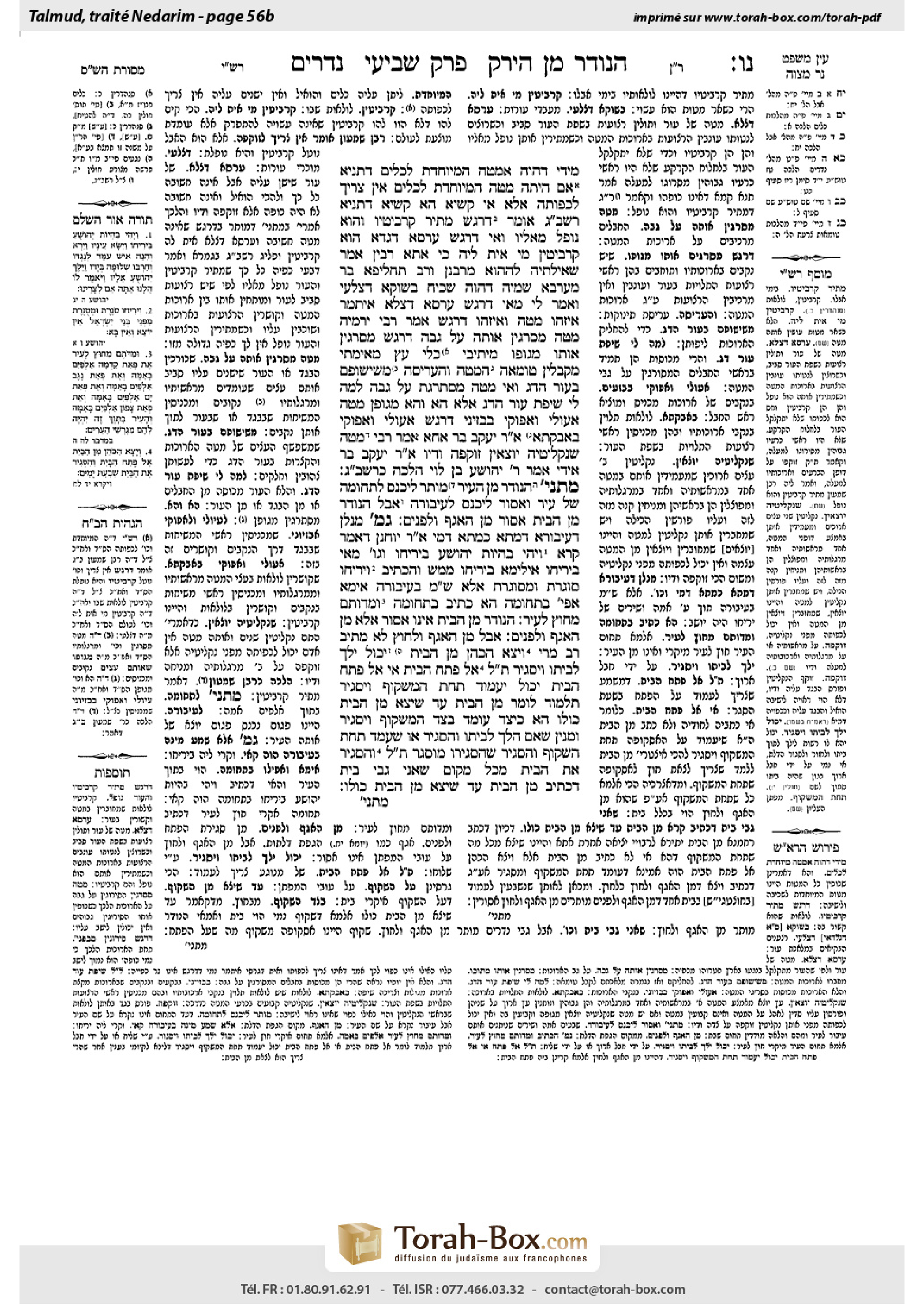
Nedarim 56b: Talmud study for Daf Yomi
Daf Yomi is the daily study of one Talmud folio. Explore 37 tractates with scans, Hebrew text, Sefaria English and AI-generated French translations where annotated.
Passage selection and English or AI-generated French translation are available where the scan has annotations. Daf Study is independent of Torah-Box and Sefaria.
Browse Nedarim · נדרים · All tractatesNedarim 56b text and translations
This page of Nedarim includes the Aramaic text, an English translation and an AI-generated French translation, alongside the scan above.
נדרים נ״ו ב · Aramaic and Hebrew text
מִידֵּי דְּהָוֵה אַמִּטָּה הַמְיוּחֶדֶת לְכֵלִים, דְּתַנְיָא: אִם הָיְתָה מִטָּה הַמְיוּחֶדֶת לְכֵלִים — אֵין צָרִיךְ לִכְפּוֹתָהּ.
אֶלָּא אִי קַשְׁיָא — הָא קַשְׁיָא, דְּתַנְיָא, רַבָּן שִׁמְעוֹן בֶּן גַּמְלִיאֵל אוֹמֵר: דַּרְגֵּשׁ — מַתִּיר קַרְבִּיטָיו וְהוּא נוֹפֵל מֵאֵלָיו. וְאִי דַּרְגֵּשׁ עַרְסָא דְגַדָּא הוּא, קַרְבִּיטִין מִי אִית לֵיהּ? כִּי אֲתָא רָבִין, אָמַר: שְׁאֵילְתֵּיהּ לְהָהוּא מֵרַבָּנַן וְרַב תַּחְלִיפָא בַּר מַעְרְבָא שְׁמֵיהּ, דַּהֲוָה שְׁכִיחַ בְּשׁוּקָא דְצַלָּעֵי, וְאָמַר לִי: מַאי דַּרְגֵּשׁ — עַרְסָא דְצַלָּא.
אִיתְּמַר, אֵיזֶהוּ מִטָּה וְאֵיזֶהוּ דַּרְגֵּשׁ? אָמַר רַבִּי יִרְמְיָה: מִטָּה — מְסָרְגִין אוֹתָהּ עַל גַּבָּהּ, דַּרְגֵּשׁ — מְסָרְגִין אוֹתוֹ מִגּוּפוֹ. מֵיתִיבִי: כְּלֵי עֵץ מֵאֵימָתַי מְקַבְּלִין טוּמְאָה? הַמִּטָּה וְהָעֲרִיסָה — מִשֶּׁיְּשׁוּפֵם בְּעוֹר הַדָּג. וְאִי מִטָּה מִסְתָּרֶגֶת עַל גַּבָּהּ, לְמָה לִי שִׁיפַת עוֹר הַדָּג?
אֶלָּא הָא וְהָא מִגּוּפָן. מִטָּה — אַעוֹלֵי וְאַפּוֹקֵי בְּבִזְיָנֵי, דַּרְגֵּשׁ — אַעוֹלֵי וְאַפּוֹקֵי בַּאֲבַקְתָּא.
אָמַר רַבִּי יַעֲקֹב בַּר אַחָא אָמַר רַבִּי: מִטָּה שֶׁנַּקְלִיטֶיהָ יוֹצְאִין, זוֹקְפָהּ וְדַיּוֹ. אָמַר רַבִּי יַעֲקֹב בַּר אִידֵּי אָמַר רַבִּי יְהוֹשֻׁעַ בֶּן לֵוִי: הֲלָכָה כְּרַבָּן שִׁמְעוֹן בֶּן גַּמְלִיאֵל.
מַתְנִי׳ הַנּוֹדֵר מִן הָעִיר — מוּתָּר לִיכָּנֵס לִתְחוּמָהּ שֶׁל עִיר, וְאָסוּר לִיכָּנֵס לְעִיבּוּרָהּ. אֲבָל הַנּוֹדֵר מִן הַבַּיִת — אָסוּר מִן הָאֲגַף וְלִפְנִים.
גְּמָ׳ מְנָלַן דְּעִיבּוּרָא דְמָתָא כְּמָתָא דָּמֵי? אָמַר רַבִּי יוֹחָנָן, דְּאָמַר קְרָא: ״וַיְהִי בִּהְיוֹת יְהוֹשֻׁעַ בִּירִיחוֹ וְגוֹ׳״, מַאי בִּירִיחוֹ? אִילֵּימָא בִּירִיחוֹ מַמָּשׁ, וְהָכְתִיב: ״וִירִיחוֹ סֹגֶרֶת וּמְסֻגֶּרֶת״! אֶלָּא שְׁמַע מִינַּהּ בְּעִיבּוּרָהּ.
אֵימָא אֲפִילּוּ בִּתְחוּמָהּ! הָא כְּתִיב בִּתְחוּמָהּ ״וּמַדֹּתֶם מִחוּץ לָעִיר״.
הַנּוֹדֵר מִן הַבַּיִת — אֵינוֹ אָסוּר אֶלָּא מִן הָאֲגַף וְלִפְנִים. אֲבָל מִן הָאֲגַף וְלַחוּץ — לֹא. מֵתִיב רַב מָרִי: ״וְיָצָא הַכֹּהֵן מִן הַבַּיִת״, יָכוֹל יֵלֵךְ לְבֵיתוֹ וְיַסְגִּיר — תַּלְמוּד לוֹמַר: ״אֶל פֶּתַח הַבָּיִת״. אִי אֶל פֶּתַח הַבָּיִת, יָכוֹל יַעֲמוֹד תַּחַת הַמַּשְׁקוֹף וְיַסְגִּיר — תַּלְמוּד לוֹמַר: ״מִן הַבַּיִת״, עַד שֶׁיֵּצֵא מִן הַבַּיִת כּוּלּוֹ.
הָא כֵּיצַד? עוֹמֵד בְּצַד הַמַּשְׁקוֹף וְיַסְגִּיר. וּמִנַּיִן שֶׁאִם הָלַךְ לְבֵיתוֹ וְהִסְגִּיר, אוֹ שֶׁעָמַד תַּחַת הַשָּׁקוֹף וְהִסְגִּיר, שֶׁהֶסְגֵּירוֹ מוּסְגָּר — תַּלְמוּד לוֹמַר: ״וְהִסְגִּיר אֶת הַבַּיִת״, מִכׇּל מָקוֹם. שָׁאנֵי גַּבֵּי בַּיִת, דִּכְתִיב: ״מִן הַבַּיִת״, עַד שֶׁיֵּצֵא מִן הַבַּיִת כּוּלּוֹ.
Nedarim 56b · English translation
this is just as it is with regard to the case of a bed designated exclusively for vessels, as it is taught in a baraita: If the bed in a mourner’s house was a bed designated for vessels and not for sleeping, one need not overturn it. The same is true with regard to the bed of fortune. Since it is not for sleeping, one need not overturn it.
Rather, if defining a dargash as a bed of fortune is difficult, this is difficult, as it is taught in a baraita that Rabban Shimon ben Gamliel says: A mourner need not overturn a dargash; rather, he loosens the loops that connect the straps that support the bedding to the bedframe, and it collapses on its own. And if a dargash is a bed of fortune, does it have loops [karvitin]? When Ravin came from Eretz Yisrael to Babylonia, he said: I asked one of the Sages about the meaning of dargash, and Rav Taḥalifa, from the West, was his name, who frequented the tanners’ market. And he said to me: What is a dargash? It is a leather bed.
It was stated: Which is a bed and which is a dargash? Rabbi Yirmeya said: In a bed, one fastens the supporting straps over the bedframe; in a dargash, one fastens the straps through holes in the bedframe itself. The Gemara raises an objection from a mishna in tractate Kelim (16:1): With regard to wooden vessels, from when are they considered finished vessels and susceptible to ritual impurity? A bed and a crib are susceptible from when he smooths them with the skin of a fish. And the objection is: If in a bed the straps are fastened over the bedframe, why do I need smoothing with the skin of a fish? The wood of the bedframe is obscured from view.
Rather, with regard to both this, a bed, and that, a dargash, one fastens the straps through holes in the bedframes themselves, and the difference between them is: In a bed, the straps are inserted and extracted through holes in the bedframe; in a dargash, the straps are inserted and extracted through loops attached to the bedframe, as Rabban Shimon ben Gamliel said that one loosens the loops and the bedding falls on its own.
Rabbi Ya’akov bar Aḥa said that Rabbi Yehuda HaNasi said: With regard to a bed whose two posts [nakliteha] protrude, rendering its overturning impossible, he stands it on its side, and that is sufficient for him. Rabbi Ya’akov bar Idi said that Rabbi Yehoshua ben Levi said: The halakha is in accordance with the opinion of Rabban Shimon ben Gamliel with regard to the overturning of a dargash.
MISHNA: For one who vows that the city is forbidden to him, it is permitted to enter the Shabbat boundary of that city, the two-thousand-cubit area surrounding the city, and it is prohibited to enter its outskirts, the seventy-cubit area adjacent to the city. However, for one who vows that a house is forbidden to him, it is prohibited to enter only from the doorstop and inward.
GEMARA: The Gemara asks: From where do we derive that the legal status of the outskirts of a city are like that of the city itself? Rabbi Yoḥanan said that it is as the verse states: “And it came to pass when Joshua was in Jericho, that he lifted up his eyes and looked” (Joshua 5:13). What is the meaning of “in Jericho”? If we say that it means in Jericho proper, isn’t it written: “And Jericho was completely shut” (Joshua 6:1)? Rather, learn from here that Joshua was in the outskirts of the city. And although he was in the outskirts, the verse states that he was in Jericho.
The Gemara asks: Say that the legal status of one located even in the Shabbat boundary of a city is like that of one inside the town itself, and perhaps although Joshua was merely within the Shabbat boundary, the verse characterizes him as being in Jericho. The Gemara rejects this: Isn’t it written with regard to the boundary of a city: “And you shall measure outside the city…two thousand cubits” (Numbers 35:5)? This indicates that the boundary of a city is considered outside the town and not part of the city itself.
§ We learned in the mishna: For one who vows that a house is forbidden to him, it is prohibited to enter only from the doorstop and inward. The Gemara infers: However, from the doorstop outward, no, it is permitted to enter. Rav Mari raised an objection based on a verse written with regard to leprosy: “And the priest shall go out from the house to the entrance of the house, and he shall quarantine the house” (Leviticus 14:38). And the question was raised in the halakhic midrash: One might have thought that the priest may go to his house and quarantine the leprous house that he examined from there. Therefore, the verse states: “To the entrance of the house” (Leviticus 14:38). If he may go only to the entrance of the house, one might have thought that he may stand beneath the lintel and quarantine the house from there. Therefore, the verse states: “And the priest shall go out from the house,” indicating that he may not quarantine the house until he goes out from the entire house.
How so? Ab initio, the priest stands outside, alongside the door jamb, and quarantines the house. And from where is it derived that if he went to his house and quarantined the house, or stood beneath the lintel and quarantined the house, that his quarantine is an effective quarantine after the fact? The verse states: “And he shall quarantine the house” (Leviticus 14:38), which means in any case. Apparently, the legal status of the area beneath the lintel is identical to the status inside the house, even if it is beyond the doorstop. The Gemara answers: It is different with regard to a leprous house, as it is written: “And the priest shall go out from the house,” indicating that he cannot quarantine the house until he goes out from the entire house.
Nedarim 56b · Traduction française (IA)
Il en va de même que dans le cas d’un lit exclusivement destiné aux ustensiles, comme l’enseigne une baraïta : si le lit qui se trouve dans la maison d’un endeuillé est destiné aux ustensiles et non au sommeil, il n’est pas nécessaire de le retourner. Il en va de même pour le lit de fortune : puisqu’il ne sert pas à dormir, il n’est pas nécessaire de le retourner.
En revanche, si l’on a du mal à définir un dargash comme un lit de fortune, voici ce qui pose difficulté : une baraïta enseigne que Rabban Shimon ben Gamliel dit : un endeuillé n’a pas besoin de retourner un dargash ; il desserre plutôt les boucles qui relient au cadre du lit les sangles soutenant la literie, et celle-ci tombe d’elle-même. Or, si un dargash est un lit de fortune, aurait-il des boucles [karvitin] ? Lorsque Ravin vint d’Eretz Israël en Babylonie, il dit : « J’ai interrogé l’un des Sages sur le sens de dargash. Il s’appelait Rav Taḥalifa, venait de l’Ouest et fréquentait le marché des tanneurs. Il m’a répondu : “Qu’est-ce qu’un dargash ? C’est un lit en cuir.” »
Il a été enseigné : qu’est-ce qu’un lit et qu’est-ce qu’un dargash ? Rabbi Yirmeya dit : pour un lit, on attache les sangles de soutien par-dessus le cadre ; pour un dargash, on les attache en les faisant passer dans des trous percés dans le cadre lui-même. La Guemara soulève une objection à partir d’une Michna du traité Kelim (16:1) : à partir de quand les objets en bois sont-ils considérés comme achevés et susceptibles de contracter l’impureté rituelle ? Un lit et un berceau le sont dès qu’on les lisse avec une peau de poisson. L’objection est la suivante : si, pour un lit, les sangles sont attachées par-dessus le cadre, pourquoi faut-il le lisser avec une peau de poisson ? Le bois du cadre est caché à la vue.
En réalité, tant pour le lit que pour le dargash, on attache les sangles en les faisant passer dans des trous percés dans les cadres eux-mêmes. La différence entre les deux est la suivante : pour un lit, on fait passer les sangles dans les trous du cadre et on les en retire ; pour un dargash, on les fait passer dans des boucles fixées au cadre et on les en retire, conformément à ce qu’a dit Rabban Shimon ben Gamliel : on desserre les boucles et la literie tombe d’elle-même.
Rabbi Ya’akov bar Aḥa dit au nom de Rabbi Yehuda HaNasi : pour un lit dont les deux montants [nakliteha] dépassent, de sorte qu’il est impossible de le retourner, on le met sur le côté, et cela suffit. Rabbi Ya’akov bar Idi dit au nom de Rabbi Yehoshua ben Levi : la halakha suit l’opinion de Rabban Shimon ben Gamliel concernant la manière de retourner un dargash.
MICHNA : Celui qui fait vœu de s’interdire une ville peut pénétrer dans son périmètre de Chabbat, c’est-à-dire la zone de deux mille coudées qui l’entoure, mais il lui est interdit de pénétrer dans ses abords, la zone de soixante-dix coudées contiguë à la ville. En revanche, celui qui fait vœu de s’interdire une maison ne peut y entrer qu’au-delà du seuil, vers l’intérieur.
GUEMARA : La Guemara demande : d’où déduisons-nous que les abords d’une ville ont le même statut que la ville elle-même ? Rabbi Yoḥanan dit que cela ressort du verset : « Or, comme Josué était à Jéricho, il leva les yeux et regarda » (Josué 5:13). Que signifie « à Jéricho » ? Si l’on dit que cela signifie dans Jéricho même, n’est-il pas écrit : « Jéricho était complètement fermée » (Josué 6:1) ? Il faut plutôt en déduire que Josué se trouvait dans les abords de la ville. Bien qu’il fût dans les abords, le verset dit qu’il était à Jéricho.
La Guemara demande : disons que celui qui se trouve même dans le périmètre de Chabbat d’une ville a le même statut que celui qui se trouve dans la ville elle-même ; peut-être Josué se trouvait-il simplement dans le périmètre de Chabbat, et le verset le décrit pourtant comme étant à Jéricho. La Guemara rejette cette possibilité : n’est-il pas écrit à propos des limites d’une ville : « Vous mesurerez à l’extérieur de la ville… deux mille coudées » (Nombres 35:5) ? Cela indique que le périmètre de la ville est considéré comme extérieur à la ville et n’en fait pas partie.
§ Nous avons appris dans la Michna : celui qui fait vœu de s’interdire une maison ne peut y entrer qu’au-delà du seuil, vers l’intérieur. La Guemara en déduit qu’il lui est permis d’entrer dans la partie située au-delà du seuil, vers l’extérieur. Rav Mari soulève une objection à partir d’un verset relatif à la lèpre : « Le prêtre sortira de la maison jusqu’à l’entrée de la maison et mettra la maison en quarantaine » (Lévitique 14:38). La question suivante a été soulevée dans le midrash halakhique : on aurait pu penser que le prêtre peut aller chez lui et, depuis cet endroit, mettre en quarantaine la maison lépreuse qu’il a examinée. Le verset dit donc : « Jusqu’à l’entrée de la maison » (Lévitique 14:38). Puisqu’il ne peut aller que jusqu’à l’entrée de la maison, on aurait pu penser qu’il peut se tenir sous le linteau et mettre la maison en quarantaine depuis là. Le verset dit donc : « Le prêtre sortira de la maison », ce qui indique qu’il ne peut mettre la maison en quarantaine qu’après être sorti de la maison tout entière.
Comment cela ? En principe, le prêtre se tient à l’extérieur, à côté du montant de la porte, et met la maison en quarantaine. D’où déduit-on que, s’il est allé chez lui et a mis la maison en quarantaine, ou s’il s’est tenu sous le linteau et l’a mise en quarantaine, cette mise en quarantaine est valable a posteriori ? Le verset dit : « Il mettra la maison en quarantaine » (Lévitique 14:38), ce qui signifie que cela vaut dans tous les cas. Apparemment, la zone située sous le linteau a le même statut que l’intérieur de la maison, même si elle se trouve au-delà du seuil. La Guemara répond : le cas d’une maison lépreuse est différent, car il est écrit : « Le prêtre sortira de la maison », ce qui indique qu’il ne peut mettre la maison en quarantaine qu’après être sorti de la maison tout entière.
Traduction française générée par IA à partir de l’édition anglaise de Sefaria. Vérifie toujours un passage avec le texte source.
Text from Sefaria: William Davidson Edition - Vocalized Aramaic (CC BY NC); William Davidson Edition - English (CC BY NC).