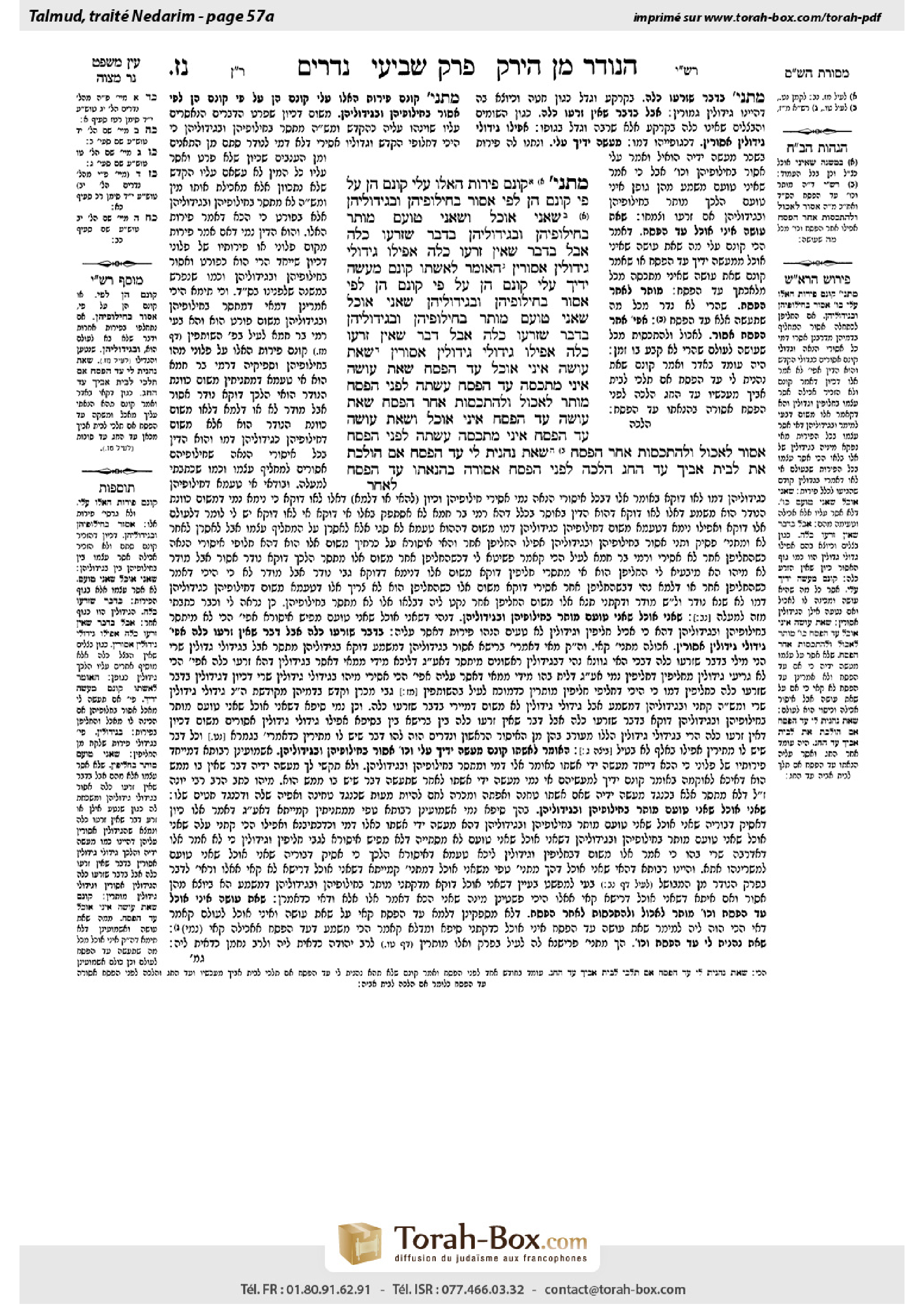
Nedarim 57a: Talmud study for Daf Yomi
Daf Yomi is the daily study of one Talmud folio. Explore 37 tractates with scans, Hebrew text, Sefaria English and AI-generated French translations where annotated.
Passage selection and English or AI-generated French translation are available where the scan has annotations. Daf Study is independent of Torah-Box and Sefaria.
Browse Nedarim · נדרים · All tractatesNedarim 57a text and translations
This page of Nedarim includes the Aramaic text, an English translation and an AI-generated French translation, alongside the scan above.
נדרים נ״ז א · Aramaic and Hebrew text
מַתְנִי׳ ״קֻוֽנָּם פֵּירוֹת הָאֵלּוּ עָלַי״, ״קֻוֽנָּם הֵן עַל פִּי״, ״קֻוֽנָּם הֵן לְפִי״ — אָסוּר בְּחִילּוּפֵיהֶן וּבְגִידּוּלֵיהֶן. ״שֶׁאֲנִי אוֹכֵל״, וְ״שֶׁאֲנִי טוֹעֵם — מוּתָּר בְּחִילּוּפֵיהֶן וּבְגִידּוּלֵיהֶן, בְּדָבָר שֶׁזַּרְעוֹ כָּלֶה. אֲבָל בְּדָבָר שֶׁאֵין זַרְעוֹ כָּלֶה — אֲפִילּוּ גִּידּוּלֵי גִידּוּלִין אֲסוּרִין.
הָאוֹמֵר לְאִשְׁתּוֹ ״קֻוֽנָּם מַעֲשֵׂה יָדַיִךְ עָלַי״, ״קֻוֽנָּם הֵן עַל פִּי״, ״קֻוֽנָּם הֵן לְפִי״ — אָסוּר בְּחִילּוּפֵיהֶן וּבְגִידּוּלֵיהֶן. ״שֶׁאֲנִי אוֹכֵל״, ״שֶׁאֲנִי טוֹעֵם״ — מוּתָּר בְּחִילּוּפֵיהֶן וּבְגִידּוּלֵיהֶן, בְּדָבָר שֶׁזַּרְעוֹ כָּלֶה. אֲבָל דָּבָר שֶׁאֵין זַרְעוֹ כָּלֶה — אֲפִילּוּ גִּידּוּלֵי גִידּוּלִין אֲסוּרִין.
״שֶׁאַתְּ עוֹשָׂה אֵינִי אוֹכֵל עַד הַפֶּסַח״, ״שֶׁאַתְּ עוֹשָׂה אֵינִי מִתְכַּסֶּה עַד הַפֶּסַח״, עָשְׂתָה לִפְנֵי הַפֶּסַח — מוּתָּר לֶאֱכוֹל וּלְהִתְכַּסּוֹת אַחַר הַפֶּסַח. ״שֶׁאַתְּ עוֹשָׂה עַד הַפֶּסַח אֵינִי אוֹכֵל״, וְ״שֶׁאַתְּ עוֹשָׂה עַד הַפֶּסַח אֵינִי מִתְכַּסֶּה״, עָשְׂתָה לִפְנֵי הַפֶּסַח — אָסוּר לֶאֱכוֹל וּלְהִתְכַּסּוֹת אַחַר הַפֶּסַח. ״שֶׁאַתְּ נֶהֱנֵית לִי עַד הַפֶּסַח אִם הוֹלֶכֶת אַתְּ לְבֵית אָבִיךְ עַד הֶחָג״, הָלְכָה לִפְנֵי הַפֶּסַח — אֲסוּרָה בַּהֲנָאָתוֹ עַד הַפֶּסַח.
Nedarim 57a · English translation
MISHNA: For one who says: This produce is konam upon me, or it is konam upon my mouth, or it is konam to my mouth, it is prohibited to partake of the produce, or of its replacements, or of anything that grows from it. If he says: This produce is konam for me, and for that reason I will not eat it, or for that reason I will not taste it, it is permitted for him to partake of its replacements or of anything that grows from it. This applies only with regard to an item whose seeds cease after it is sown. However, with regard to an item whose seeds do not cease after it is sown, e.g., bulbs, which flower and enter into a foliage period and repeat the process, it is prohibited for him to partake even of the growths of its growths, as the original, prohibited item remains intact.
For one who says to his wife: Your handicraft is konam upon me, or it is konam upon my mouth, or it is konam to my mouth, it is prohibited to benefit from her handicraft, and from their replacements and anything that grows from them. However, if he said to his wife: Your handicraft is konam for me only in the sense that I will not eat from your handicraft, or that I will not taste from your handicraft, it is permitted for him to benefit from their replacements and anything that grows from them. This applies only with regard to an item whose seeds cease after it is sown. However, with regard to an item whose seeds do not cease after it is sown, it is prohibited for him to benefit even from the growths of their growths.
If the husband said: From that which you prepare, I will not eat until Passover, or, with that which you prepare, I will not cover myself until Passover, then, if she prepared it before Passover, it is permitted for him to eat or to cover himself with them after Passover. If, however, he said: From that which you prepare until Passover, I will not eat, or from that which you prepare until Passover, I will not cover myself, then, if she prepared it before Passover, it is prohibited for him to eat or cover himself with it after Passover. If he said to her: Benefit from me until Passover if you go to your father’s house from now until the festival of Sukkot is forbidden for you, and she went to his house before Passover, it is prohibited for her to derive benefit from him until Passover.
Nedarim 57a · Traduction française (IA)
MICHNA : Celui qui dit : « Ce produit m’est konam », ou « ce produit est konam pour ma bouche », ou « ce produit est konam à ma bouche », n’a pas le droit de consommer ce produit, ses substituts ni ce qui en pousse. S’il dit : « Ce produit m’est konam, et pour cette raison je n’en mangerai pas », ou « pour cette raison je n’y goûterai pas », il lui est permis de consommer ses substituts ou ce qui en pousse. Cela ne concerne qu’un produit dont les graines disparaissent après avoir été semées. En revanche, pour un produit dont les graines ne disparaissent pas après avoir été semées, par exemple les bulbes, qui fleurissent, entrent dans une période de feuillage, puis recommencent le processus, il lui est interdit de consommer même les pousses issues des pousses, car le produit initial interdit demeure intact.
Celui qui dit à sa femme : « Ton travail m’est konam », ou « ton travail est konam pour ma bouche », ou « ton travail est konam à ma bouche », n’a pas le droit de tirer profit de son travail, de ses substituts ni de ce qui en pousse. Toutefois, s’il dit à sa femme : « Ton travail m’est konam », au sens où « je ne mangerai pas de ton travail » ou « je ne goûterai pas de ton travail », il lui est permis de tirer profit des substituts de son travail ou de ce qui en pousse. Cela ne concerne qu’un produit dont les graines disparaissent après avoir été semées. En revanche, pour un produit dont les graines ne disparaissent pas après avoir été semées, il lui est interdit de tirer profit même des pousses issues des pousses.
Si le mari dit : « Je ne mangerai pas de ce que tu prépares jusqu’à Pessa’h », ou « je ne me couvrirrai pas avec ce que tu prépares jusqu’à Pessa’h », alors, si elle l’a préparé avant Pessa’h, il lui est permis d’en manger ou de s’en couvrir après Pessa’h. En revanche, s’il dit : « Je ne mangerai pas de ce que tu prépares avant Pessa’h », ou « je ne me couvrirrai pas avec ce que tu prépares avant Pessa’h », alors, si elle l’a préparé avant Pessa’h, il lui est interdit d’en manger ou de s’en couvrir après Pessa’h. S’il lui dit : « Tu n’auras pas le droit de tirer profit de moi jusqu’à Pessa’h si tu vas chez ton père d’ici à la fête de Soukkot », et qu’elle se soit rendue chez son père avant Pessa’h, il lui est interdit de tirer profit de lui jusqu’à Pessa’h.
Traduction française générée par IA à partir de l’édition anglaise de Sefaria. Vérifie toujours un passage avec le texte source.
Text from Sefaria: William Davidson Edition - Vocalized Aramaic (CC BY NC); William Davidson Edition - English (CC BY NC).