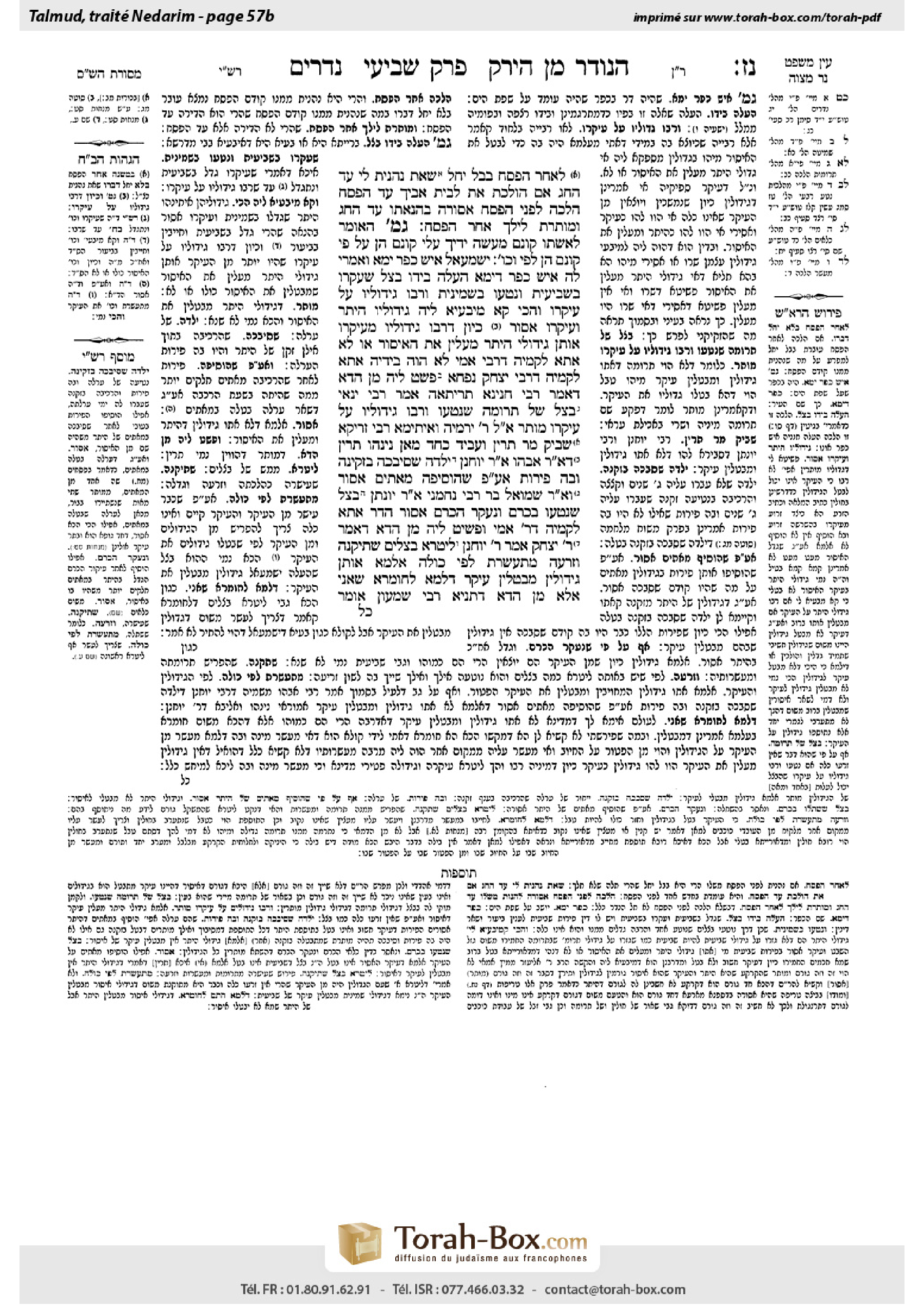
Nedarim 57b: Talmud study for Daf Yomi
Daf Yomi is the daily study of one Talmud folio. Explore 37 tractates with scans, Hebrew text, Sefaria English and AI-generated French translations where annotated.
Passage selection and English or AI-generated French translation are available where the scan has annotations. Daf Study is independent of Torah-Box and Sefaria.
Browse Nedarim · נדרים · All tractatesNedarim 57b text and translations
This page of Nedarim includes the Aramaic text, an English translation and an AI-generated French translation, alongside the scan above.
נדרים נ״ז ב · Aramaic and Hebrew text
לְאַחַר הַפֶּסַח — בְּ״בַל יַחֵל״. ״שֶׁאַתְּ נֶהֱנֵית לִי עַד הֶחָג אִם הוֹלֶכֶת אַתְּ לְבֵית אָבִיךָ עַד הַפֶּסַח״, הָלְכָה לִפְנֵי הַפֶּסַח — אֲסוּרָה בַּהֲנָאָתוֹ עַד הֶחָג, וּמוּתֶּרֶת לֵילֵךְ אַחַר הַפֶּסַח.
גְּמָ׳ הָאוֹמֵר לְאִשְׁתּוֹ ״קֻוֽנָּם מַעֲשֵׂה יָדַיִךְ עָלַי״, ״קֻוֽנָּם הֵן עַל פִּי״, ״קֻוֽנָּם הֵן לְפִי וְכוּ׳״, יִשְׁמָעֵאל אִישׁ כְּפַר יַמָּא, וְאָמְרִי לַהּ אִישׁ כְּפַר דְּיַמָּא, הֶעֱלָה בְּיָדוֹ בָּצָל שֶׁעֲקָרוֹ בַּשְּׁבִיעִית, וּנְטָעוֹ בַּשְּׁמִינִית, וְרַבּוּ גִּידּוּלָיו עַל עִיקָּרוֹ. וְהָכִי קָא מִיבַּעְיָא לֵיהּ: גִּידּוּלָיו הֶיתֵּר וְעִיקָּרוֹ אָסוּר, כֵּיוָן דְּרָבוּ גִּידּוּלָיו מֵעִיקָּרוֹ — אוֹתָן גִּידּוּלֵי הֶיתֵּר מַעֲלִין אֶת הָאִיסּוּר, אוֹ לָא? אֲתָא לְקַמֵּיהּ דְּרַבִּי אַמֵּי לָא הֲוָה בִּידֵיהּ.
אֲתָא לְקַמֵּיהּ דְּרַבִּי יִצְחָק נַפָּחָא, פְּשַׁט לֵיהּ מִן הָדָא דְּאָמַר רַבִּי חֲנִינָא תְּרִיתָאָה אָמַר רַבִּי יַנַּאי: בָּצָל שֶׁל תְּרוּמָה שֶׁנְּטָעוֹ, וְרַבּוּ גִּידּוּלָיו עַל עִיקָּרוֹ — מוּתָּר. אֲמַר לֵיהּ רַבִּי יִרְמְיָה וְאִיתֵּימָא רַבִּי זְרִיקָא: שָׁבֵיק מָר תְּרֵין וְעָבֵיד כְּחַד?!
מַאן נִינְהוּ תְּרֵין? דְּאָמַר רַבִּי אֲבָהוּ אָמַר רַבִּי יוֹחָנָן: יַלְדָּה שֶׁסִּיבְּכָהּ בִּזְקֵינָהּ, וּבָהּ פֵּירוֹת, אַף עַל פִּי שֶׁהוֹסִיפָה מָאתַיִם — אָסוּר.
וְאָמַר רַבִּי שְׁמוּאֵל בַּר רַבִּי נַחְמָנִי אָמַר רַבִּי יוֹנָתָן: בָּצָל שֶׁנְּטָעוֹ בַּכֶּרֶם, וְנֶעֱקַר הַכֶּרֶם — אָסוּר.
הֲדַר אֲתָא לְקַמֵּיהּ דְּרַבִּי אַמֵּי וּפְשַׁיט לֵיהּ מִן הָדָא דְּאָמַר רַבִּי יִצְחָק אָמַר רַבִּי יוֹחָנָן: לִיטְרָא בְּצָלִים שֶׁתִּיקְּנָה וּזְרָעָהּ, מִתְעַשֶּׂרֶת לְפִי כוּלָּהּ. אַלְמָא אוֹתָן גִידּוּלִין מְבַטְּלִין עִיקָּר.
דִּלְמָא לְחוּמְרָא שָׁאנֵי.
אֶלָּא, מִן הָדָא דְּתַנְיָא, רַבִּי שִׁמְעוֹן אוֹמֵר:
Nedarim 57b · English translation
If she derived benefit from him before Passover and went to visit her father after Passover, she is liable for violating the prohibition of: He shall not profane his word (Numbers 30:3), as the condition was fulfilled and she violated the vow retroactively. If the husband vowed: Benefit from me is konam for you until the Festival if you go to your father’s house from now until Passover, then if she went to his house before Passover, it is prohibited for her to derive benefit from him until the Festival, and it is permitted for her to go to her father’s house after Passover, as that time period is not included in his stipulation.
GEMARA: We learned in the mishna: For one who says to his wife: Your handicraft is konam upon me, or it is konam upon my mouth, or it is konam to my mouth, it is prohibited to benefit from her handicraft. Yishmael, a man of Kefar Yamma, and some say, a man of Kefar Dima, raised a dilemma with regard to an onion that one uprooted during the Sabbatical Year, which was therefore sanctified with the sanctity of the Sabbatical Year, and he then planted it during the eighth year, and its growths that developed in the eighth year exceeded its principal original Sabbatical-Year onion. And this is the dilemma that he raised: Its eighth-year growth is permitted, and its Sabbatical-Year principal is prohibited. Since its growth exceeded its principal, do those permitted growths neutralize the prohibition of the onion, or do they not? Yishmael came and raised the dilemma before Rabbi Ami, and he did not have an answer readily available.
Yishmael came and raised the dilemma before Rabbi Yitzḥak Nappaḥa, who resolved it for him from that which Rabbi Ḥanina Terita’a said that Rabbi Yannai said: With regard to an onion of teruma that one planted, if its growths exceeded its principal, it is permitted. Here too, the eighth-year growth should neutralize the prohibition of the Sabbatical-Year onion. Rabbi Yirmeya said, and some say it was Rabbi Zerika who said to Rabbi Yitzḥak Nappaḥa: Did the Master abandon the opinion of two Sages and conduct himself in accordance with the opinion of one Sage?
The Gemara asks: Who are they, the two Sages who disagree with his opinion? The Gemara answers: It is as Rabbi Abbahu said that Rabbi Yoḥanan said: With regard to a young vine within three years of its planting, whose fruits are orla and forbidden, that one grafted onto an old, permitted vine, and there were fruits on the younger vine, even though the younger vine added two hundred times the number of fruits that were there when it was grafted, and those additional fruits are permitted because they draw their nourishment from the older vine, the fruit that was on the younger vine before it was grafted is forbidden. Although, in principle, when the permitted part of the mixture is two hundred times the forbidden orla, the prohibition is neutralized, in this case, the prohibition is not neutralized, as the forbidden fruit was there from the outset.
And Rabbi Shmuel bar Rabbi Naḥmani said that Rabbi Yonatan said: With regard to an onion that one planted in a vineyard, creating a forbidden mixture of food crops in a vineyard, and then the vineyard was uprooted, and most of the onion grew in a permitted manner, it is forbidden. Apparently, both Rabbi Yoḥanan and Rabbi Yonatan disagree with the opinion of Rabbi Yannai, and therefore, there is no clear resolution to the dilemma.
Yishmael then came and raised the dilemma before Rabbi Ami, who resolved it for him from that which Rabbi Yitzḥak said that Rabbi Yoḥanan said: With regard to a litra of onions that one tithed, and then he sowed a field with the entire litra of onions, when the field yields the crop, it is tithed according to the entire crop. Although some of the onions that he sowed were already tithed, he is obligated to tithe them because the volume of the growths exceeds the volume of the original onions and the entire crop has untithed status. Apparently, those growths neutralize the prohibition of the primary, original, tithed onions.
The Gemara rejects that resolution: There is no proof from the ruling in the case of the litra of onions, as perhaps it is different when the ruling is a stringency. Perhaps, due to the concern that the growths neutralize the prohibition of the original, the ruling is that he must tithe the entire crop. However, there is no proof that the same would be true in cases where the ruling is a leniency, e.g., to neutralize the prohibition of the Sabbatical Year or teruma.
Rather, proof may be cited from this source; as it is taught in a baraita that Rabbi Shimon says:
Nedarim 57b · Traduction française (IA)
Si elle a tiré profit de lui avant Pessa’h et est allée rendre visite à son père après Pessa’h, elle est passible d’avoir transgressé l’interdit : « Il ne profanera pas sa parole » (Nombres 30, 3), car la condition s’est réalisée et elle a violé le vœu rétroactivement. Si le mari a formulé le vœu suivant : « Tirer profit de moi te sera konam jusqu’à la fête si tu vas chez ton père d’ici Pessa’h », alors, si elle est allée chez son père avant Pessa’h, il lui est interdit de tirer profit de lui jusqu’à la fête, mais elle peut aller chez son père après Pessa’h, car cette période n’est pas incluse dans sa condition.
GUEMARA : Nous avons appris dans la Michna : Celui qui dit à son épouse : « Ton travail manuel m’est konam », ou « est konam pour ma bouche », ou « est konam à ma bouche », ne peut pas tirer profit de son travail manuel. Yishmaël, un homme de Kefar Yamma — et certains disent un homme de Kefar Dima —, souleva une question au sujet d’un oignon arraché pendant l’année sabbatique, qui avait donc acquis la sainteté de l’année sabbatique, puis replanté pendant la huitième année, dont les pousses apparues pendant la huitième année dépassèrent le volume de l’oignon d’origine. Voici la question qu’il posa : Les pousses de la huitième année sont permises, mais l’oignon d’origine, provenant de l’année sabbatique, est interdit. Puisque les pousses permises dépassent l’oignon d’origine, annulent-elles l’interdit de l’oignon, ou non ? Yishmaël vint poser la question à Rabbi Ami, qui n’avait pas de réponse immédiate.
Yishmaël vint poser la question à Rabbi Yitzḥak Nappaḥa, qui la résolut pour lui en s’appuyant sur ce que Rabbi Ḥanina Terita’a dit au nom de Rabbi Yannai : au sujet d’un oignon de terouma que l’on a planté, si ses pousses dépassent l’oignon d’origine, il est permis. Ici aussi, les pousses de la huitième année devraient annuler l’interdit de l’oignon de l’année sabbatique. Rabbi Yirmeya — et certains disent que c’est Rabbi Zerika — dit à Rabbi Yitzḥak Nappaḥa : « Le Maître a-t-il abandonné l’avis de deux Sages pour se conformer à celui d’un seul Sage ? »
La Guemara demande : Qui sont ces deux Sages dont l’avis contredit le sien ? La Guemara répond : Il s’agit de ce que Rabbi Abbahu a dit au nom de Rabbi Yoḥanan : au sujet d’une jeune vigne plantée depuis moins de trois ans, dont les fruits sont orla et interdits, que l’on a greffée sur une vieille vigne dont les fruits sont permis, et qui portait des fruits, même si la jeune vigne a ensuite produit des fruits en quantité deux cents fois supérieure à celle qui s’y trouvait au moment de la greffe, ces fruits supplémentaires sont permis, car ils tirent leur nourriture de la vieille vigne ; toutefois, les fruits qui se trouvaient sur la jeune vigne avant la greffe sont interdits. En principe, lorsque la quantité de la partie permise d’un mélange représente deux cents fois celle de l’orla interdite, l’interdit est annulé ; mais ici, l’interdit n’est pas annulé, car les fruits interdits étaient présents dès le départ.
Et Rabbi Shmuel bar Rabbi Naḥmani a dit au nom de Rabbi Yonatan : au sujet d’un oignon que l’on a planté dans une vigne, créant ainsi un mélange interdit de cultures dans une vigne, puis dont on a arraché la vigne, et dont la majeure partie a poussé dans des conditions permises, l’oignon est interdit. Il apparaît donc que Rabbi Yoḥanan et Rabbi Yonatan sont tous deux en désaccord avec l’avis de Rabbi Yannai ; la question ne trouve donc pas de résolution claire.
Yishmaël vint alors poser la question à Rabbi Ami, qui la résolut pour lui en s’appuyant sur ce que Rabbi Yitzḥak a dit au nom de Rabbi Yoḥanan : au sujet d’une litra d’oignons dont on a prélevé la dîme, puis que l’on a semée dans un champ, lorsque le champ donne sa récolte, celle-ci doit être soumise à la dîme dans son intégralité. Bien que certains des oignons semés aient déjà été soumis à la dîme, il est tenu de prélever la dîme sur la récolte entière, car le volume des pousses dépasse celui des oignons d’origine et toute la récolte est considérée comme non soumise à la dîme. Il apparaît donc que ces pousses annulent l’interdit des oignons d’origine, qui avaient été soumis à la dîme.
La Guemara rejette cette résolution : on ne peut tirer aucune preuve de la décision concernant la litra d’oignons, car il se peut que le cas soit différent lorsque la décision est rigoureuse. Peut-être, par crainte que les pousses n’annulent l’interdit des oignons d’origine, la décision exige-t-elle de prélever la dîme sur toute la récolte. Toutefois, rien ne prouve qu’il en irait de même dans les cas où la décision est indulgente, par exemple pour annuler l’interdit de l’année sabbatique ou de la terouma.
On peut plutôt apporter une preuve de cette source, car il est enseigné dans une baraïta que Rabbi Shimon dit :
Traduction française générée par IA à partir de l’édition anglaise de Sefaria. Vérifie toujours un passage avec le texte source.
Text from Sefaria: William Davidson Edition - Vocalized Aramaic (CC BY NC); William Davidson Edition - English (CC BY NC).