Nedarim 58b: Talmud study for Daf Yomi
Daf Yomi is the daily study of one Talmud folio. Explore 37 tractates with scans, Hebrew text, Sefaria English and AI-generated French translations where annotated.
Passage selection and English or AI-generated French translation are available where the scan has annotations. Daf Study is independent of Torah-Box and Sefaria.
Browse Nedarim · נדרים · All tractatesNedarim 58b text and translations
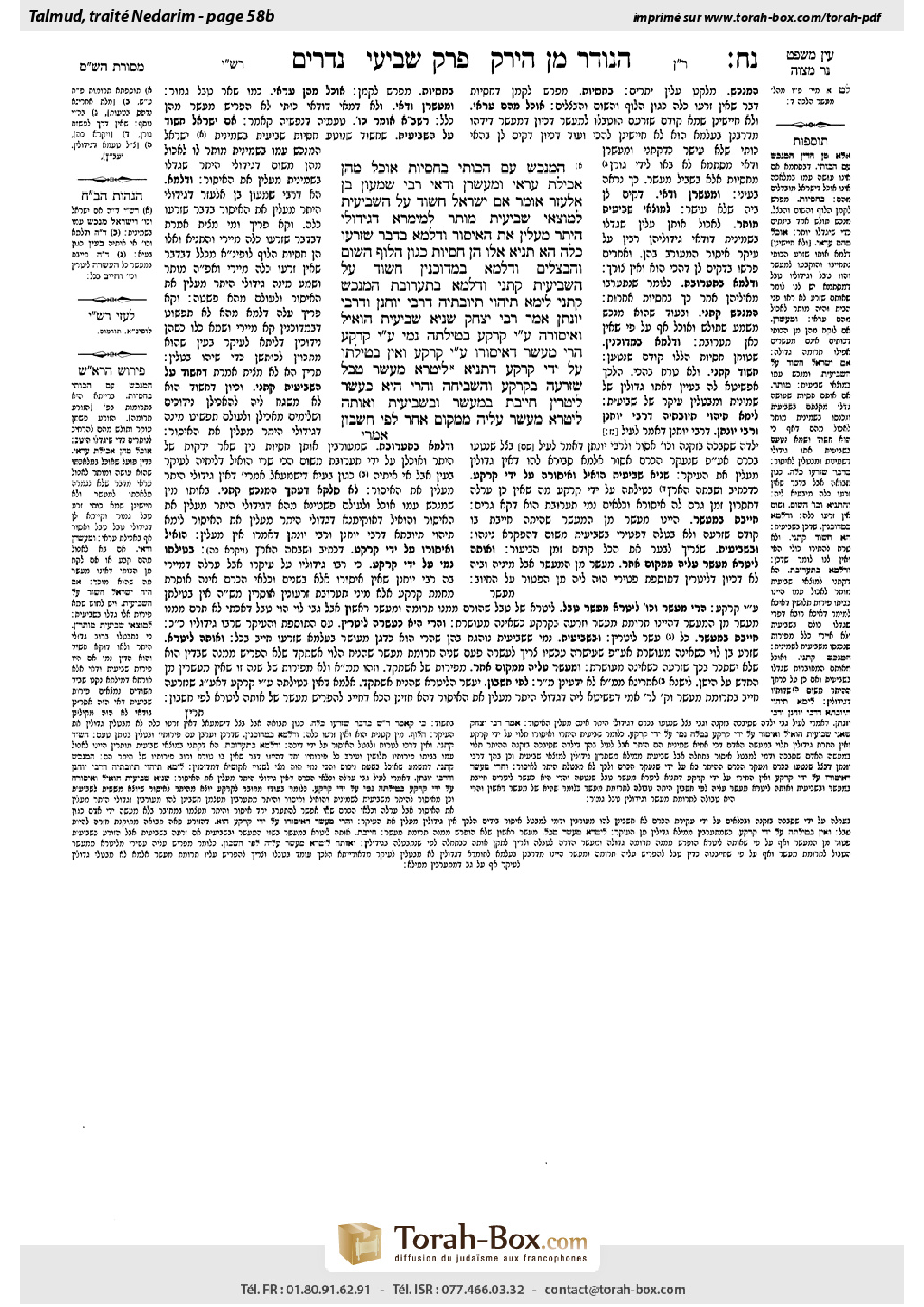
This page of Nedarim includes the Aramaic text, an English translation and an AI-generated French translation, alongside the scan above.
נדרים נ״ח ב · Aramaic and Hebrew text
הַמְנַכֵּשׁ עִם הַכּוּתִי בַּחֲסִיּוֹת — אוֹכֵל מֵהֶן אֲכִילַת עֲרַאי, וּמְעַשְּׂרָן וַדַּאי.
רַבִּי שִׁמְעוֹן בֶּן אֶלְעָזָר אוֹמֵר: אִם יִשְׂרָאֵל חָשׁוּד עַל הַשְּׁבִיעִית, לְמוֹצָאֵי שְׁבִיעִית — מוּתָּר. לְמֵימְרָא דְּגִידּוּלֵי הֶיתֵּר מַעֲלִין אֶת הָאִיסּוּר, וְדִלְמָא בְּדָבָר שֶׁזַּרְעוֹ כָּלֶה? הָא תַּנְיָא: אֵלּוּ הֵן חֲסִיּוֹת — כְּגוֹן הַלּוּף הַשּׁוּם וְהַבְּצָלִים.
וְדִלְמָא בִּמְדוּכָּנִין? ״חָשׁוּד עַל הַשְּׁבִיעִית״ קָתָנֵי. וְדִלְמָא בְּתַעֲרוֹבֶת? הַמְנַכֵּשׁ קָתָנֵי.
לֵימָא תֶּיהְוֵי תְּיוּבְתֵּיהּ דְּרַבִּי יוֹחָנָן וּדְרַבִּי יוֹנָתָן! אָמַר רַבִּי יִצְחָק: שַׁנְיָא שְׁבִיעִית, הוֹאִיל וְאִיסּוּרָהּ עַל יְדֵי קַרְקַע — בְּטִילָתָהּ נָמֵי עַל יְדֵי קַרְקַע.
הֲרֵי מַעֲשֵׂר, דְּאִיסּוּרוֹ עַל יְדֵי קַרְקַע, וְאֵין בְּטִילָתוֹ עַל יְדֵי קַרְקַע. דְּתַנְיָא: לִיטְרָא מַעֲשֵׂר טֶבֶל שֶׁזְּרָעָהּ בַּקַּרְקַע וְהִשְׁבִּיחָה, וַהֲרֵי הִיא כְּעֶשֶׂר לִיטְרִין — חַיֶּיבֶת בְּמַעֲשֵׂר וּבִשְׁבִיעִית. וְאוֹתָהּ לִיטְרָא, מְעַשֵּׂר עָלֶיהָ מִמָּקוֹם אַחֵר לְפִי חֶשְׁבּוֹן!
Nedarim 58b · English translation
One who weeds ḥasayot with a Samaritan may eat a casual meal from them without tithing, as any untithed produce may be eaten in the framework of a casual meal. And when he completes the labor on the ḥasayot, places them into a pile, and they require tithing, he tithes them as produce that is definitely obligated in tithing, not as doubtfully tithed produce, as the assumption is that the Samaritan did not tithe the ḥasayot.
Rabbi Shimon ben Elazar says: If the ḥasayot belong to a Jew who is suspect about observance of the Sabbatical Year, at the conclusion of the Sabbatical Year it is permitted to weed with him, as there is no concern that there might be Sabbatical-Year sanctity. The Gemara asks: Is this to say that the permitted growths of the eighth year neutralize the prohibition, and that is why there is no concern about Sabbatical-Year sanctity? The Gemara rejects that inference: And perhaps the tanna is speaking with regard to an item whose seeds cease after it is sown, whose growths neutralize the original prohibition? The Gemara rejects that possibility: Isn’t it taught in a baraita: These are ḥasayot, for example, arum, garlic, and onions, whose seeds do not cease?
The Gemara asks: And perhaps the tanna is speaking with regard to plants that were crushed before they sprouted growths? The Gemara answers: It is the case of one who is suspect about observance of the Sabbatical Year, that is taught in the baraita, and one who is suspect would not bother to eliminate the prohibition by crushing it. The Gemara asks: And perhaps the tanna is speaking with regard to a mixture of forbidden ḥasayot and permitted ones, and the reason that it is permitted is that the prohibition was neutralized by the majority of permitted ḥasayot? The Gemara answers: One who weeds, is taught in the baraita, indicating that he is eating the leaves as he weeds them, leaving no opportunity for the ḥasayot to be mixed with others.
The Gemara suggests: Let us say that this is a conclusive refutation of the opinions of Rabbi Yoḥanan and Rabbi Yonatan, who stated regarding orla and food crops in a vineyard that their permitted growth does not neutralize the prohibition of the original fruit or food crops respectively. Rabbi Yitzḥak said: The Sabbatical-Year produce is different. Since its prohibition is engendered by means of the ground, its nullification is effected by means of the ground as well. The prohibition can be neutralized by means of the growth that results from replanting the forbidden plant in a permitted manner.
The Gemara asks: Isn’t there the case of tithe, whose prohibition is engendered by means of the ground, but its nullification is not effected by means of the ground? As it is taught in a baraita: With regard to a litra of untithed first tithe from which the teruma of the tithe was not taken, which one sowed in the ground, and it grew and it is now approximately ten litra, that additional growth is obligated to have tithe taken and is subject to the halakhot of Sabbatical-Year produce. And with regard to that original litra of untithed first tithe that he sowed, one tithes for it from produce in a different place, and not from the litra itself, based on a calculation of how much teruma of the tithe needed to be taken from that litra. Apparently, the growth that results from sowing the first tithe in the ground does not neutralize its prohibition.
Nedarim 58b · Traduction française (IA)
Celui qui désherbe des ḥasayot avec un Samaritain peut en manger un repas occasionnel sans prélever la dîme, car tout produit non soumis à la dîme peut être consommé dans le cadre d’un repas occasionnel. Lorsqu’il achève le travail sur les ḥasayot et les rassemble en un tas, elles deviennent soumises à la dîme ; il la prélève alors sur elles comme sur un produit certainement soumis à la dîme, et non comme sur un produit dont le statut est douteux, car on présume que le Samaritain n’a pas prélevé la dîme sur les ḥasayot.
Rabbi Shimon ben Elazar dit : Si les ḥasayot appartiennent à un Juif soupçonné de ne pas respecter l’année sabbatique, à la fin de cette année, il est permis de désherber avec lui, car il n’y a pas lieu de craindre qu’elles soient frappées de la sainteté de l’année sabbatique. La Guemara demande : Cela signifie-t-il que les pousses permises de la huitième année annulent l’interdiction, et que c’est pourquoi il n’y a pas lieu de craindre la sainteté de l’année sabbatique ? La Guemara rejette cette déduction : peut-être le tanna parle-t-il d’une plante dont les graines disparaissent après les semailles, et dont les pousses annulent l’interdiction initiale ? La Guemara écarte cette possibilité : n’est-il pas enseigné dans une baraïta que les ḥasayot comprennent, par exemple, l’arum, l’ail et les oignons, dont les graines ne disparaissent pas ?
La Guemara demande : Peut-être le tanna parle-t-il de plantes qui ont été broyées avant que des pousses n’apparaissent ? La Guemara répond : La baraïta enseigne le cas d’un homme soupçonné de ne pas respecter l’année sabbatique, et un tel homme ne prendrait pas la peine d’annuler l’interdiction en broyant la plante. La Guemara demande : Peut-être le tanna parle-t-il d’un mélange de ḥasayot interdites et permises, et est-ce permis parce que l’interdiction a été annulée par la majorité des ḥasayot permises ? La Guemara répond : La baraïta enseigne le cas de celui qui désherbe, ce qui indique qu’il mange les feuilles au fur et à mesure qu’il les arrache, sans laisser aux ḥasayot l’occasion de se mélanger à d’autres.
La Guemara propose : Disons que cela constitue une réfutation décisive des opinions de Rabbi Yoḥanan et de Rabbi Yonatan, qui ont déclaré, au sujet de l’orla et des cultures alimentaires dans une vigne, que les pousses permises n’annulent pas, respectivement, l’interdiction des fruits initiaux et celle des cultures alimentaires initiales. Rabbi Yitzḥak dit : Le produit de l’année sabbatique est différent. Puisque son interdiction provient du sol, son annulation s’effectue elle aussi par le sol. L’interdiction peut être annulée par les pousses produites lorsqu’on replante la plante interdite de manière permise.
La Guemara demande : N’y a-t-il pas le cas de la dîme, dont l’interdiction provient du sol, mais dont l’annulation ne s’effectue pas par le sol ? Car il est enseigné dans une baraïta : une litra de première dîme non prélevée, dont la terouma de la dîme n’a pas été prélevée et qu’on a semée en terre, a poussé jusqu’à atteindre environ dix litra. Ces pousses supplémentaires sont soumises au prélèvement de la dîme et aux halakhot du produit de l’année sabbatique. Quant à la litra initiale de première dîme non prélevée qu’il a semée, on prélève pour elle la dîme sur un produit provenant d’un autre endroit, et non sur la litra elle-même, en calculant la quantité de terouma de la dîme qui devait en être prélevée. Apparemment, les pousses résultant de la mise en terre de la première dîme n’annulent pas son interdiction.
Traduction française générée par IA à partir de l’édition anglaise de Sefaria. Vérifie toujours un passage avec le texte source.
Text from Sefaria: William Davidson Edition - Vocalized Aramaic (CC BY NC); William Davidson Edition - English (CC BY NC).