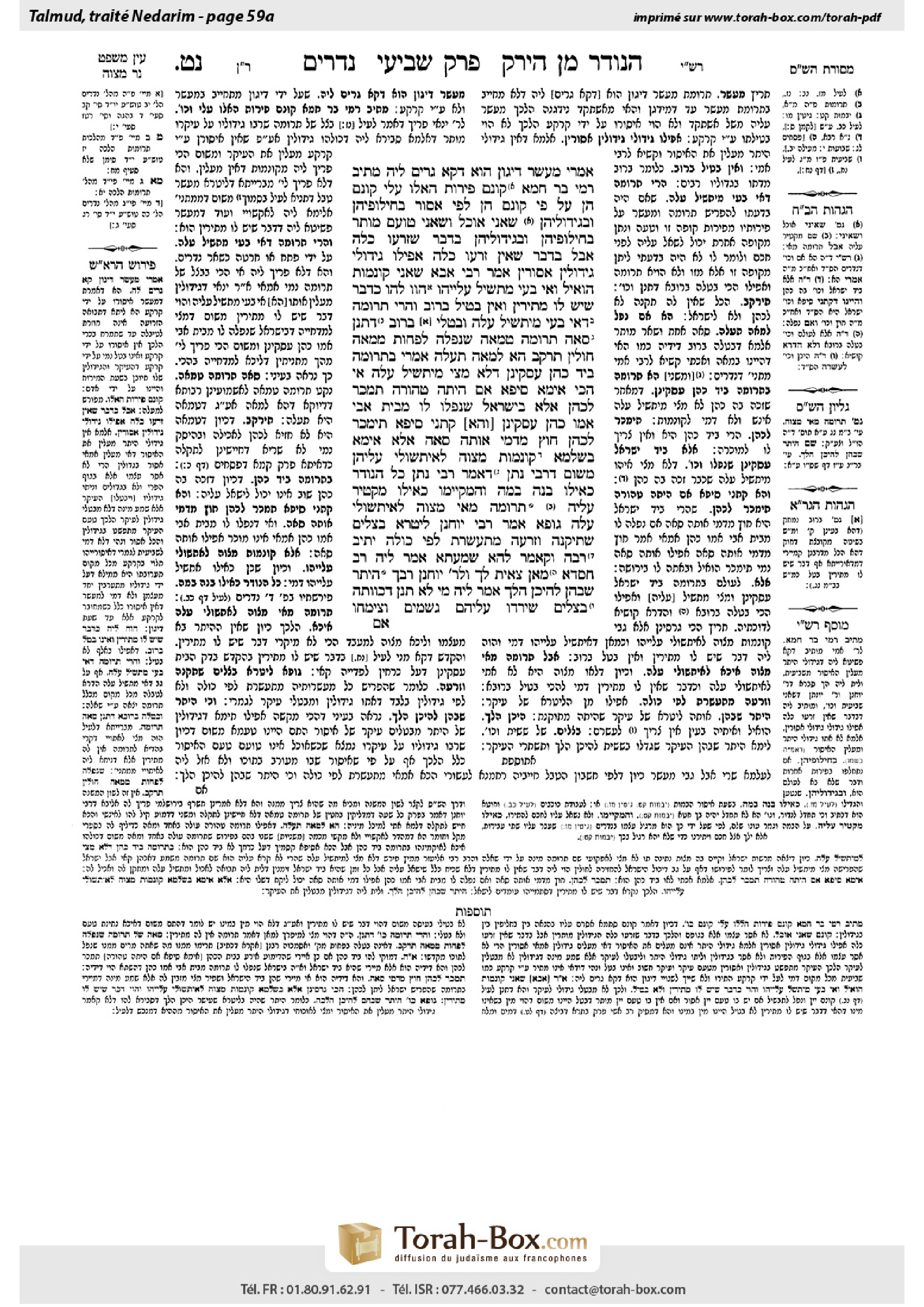
Nedarim 59a: Talmud study for Daf Yomi
Daf Yomi is the daily study of one Talmud folio. Explore 37 tractates with scans, Hebrew text, Sefaria English and AI-generated French translations where annotated.
Passage selection and English or AI-generated French translation are available where the scan has annotations. Daf Study is independent of Torah-Box and Sefaria.
Browse Nedarim · נדרים · All tractatesNedarim 59a text and translations
This page of Nedarim includes the Aramaic text, an English translation and an AI-generated French translation, alongside the scan above.
נדרים נ״ט א · Aramaic and Hebrew text
אָמְרִי: מַעֲשֵׂר, דִּיגּוּן הוּא דְּקָא גָרֵים לֵיהּ.
מֵתִיב רָמֵי בַּר חָמָא: ״קֻוֽנָּם פֵּירוֹת הָאֵלּוּ עָלַי״, ״קֻוֽנָּם הֵן עַל פִּי״, ״קֻוֽנָּם הֵן לְפִי״ — אָסוּר בְּחִילּוּפֵיהֶן וּבְגִידּוּלֵיהֶן. ״שֶׁאֲנִי אוֹכֵל״, וְ״שֶׁאֲנִי טוֹעֵם״ — מוּתָּר בְּחִילּוּפֵיהֶן וּבְגִידּוּלֵיהֶן בְּדָבָר שֶׁזַּרְעוֹ כָּלֶה, אֲבָל בְּדָבָר שֶׁאֵין זַרְעוֹ כָּלֶה — אֲפִילּוּ גִּידּוּלֵי גִידּוּלִין אֲסוּרִין.
אָמַר רַבִּי אַבָּא: שָׁאנֵי קוֹנָמוֹת, הוֹאִיל וְאִי בָּעֵי מִתְּשִׁיל עֲלַיְיהוּ — הָווּ לְהוּ כְּדָבָר שֶׁיֵּשׁ לוֹ מַתִּירִין, וְאֵין בָּטֵיל בָּרוֹב.
וַהֲרֵי תְּרוּמָה, דְּאִי בָּעֵי מִיתְּשִׁיל עֲלַהּ, וּבָטְלִי בְּרוֹב. דִּתְנַן: סְאָה תְּרוּמָה טְמֵאָה שֶׁנָּפְלָה לְפָחוֹת מִמֵּאָה חוּלִּין — תֵּרָקֵב. הָא לְמֵאָה — תַּעֲלֶה! אָמְרִי: בִּתְרוּמָה בְּיַד כֹּהֵן עָסְקִינַן, דְּלָא מָצֵי מִיתְּשִׁיל עֲלַהּ.
אִי הָכִי, אֵימָא סֵיפָא: אִם הָיְתָה טְהוֹרָה תִּמָּכֵר לְכֹהֵן! אֶלָּא בְּיִשְׂרָאֵל שֶׁנָּפְלוּ לוֹ מִבֵּית אֲבִי אִמּוֹ כֹּהֵן עָסְקִינַן.
[וְהָא] קָתָנֵי סֵיפָא: תִּימָּכֵר לְכֹהֵן חוּץ מִדְּמֵי אוֹתָהּ סְאָה?
אֶלָּא אֵימָא: בִּשְׁלָמָא קוּנָּמוֹת — מִצְוָה לְאִיתְּשׁוֹלֵי עֲלֵיהֶן, מִשּׁוּם דְּרַבִּי נָתָן. דְּאָמַר רַבִּי נָתָן: כׇּל הַנּוֹדֵר — כְּאִילּוּ בָּנָה בָּמָה, וְהַמְקַיְּימוֹ — כְּאִילּוּ מַקְטִיר עָלֶיהָ. תְּרוּמָה מַאי מִצְוָה לְאִיתְּשׁוֹלֵי עֲלַהּ?
גּוּפָא, אָמַר רַבִּי יוֹחָנָן: לִיטְרָא בְּצָלִים שֶׁתִּיקְּנָהּ וּזְרָעָהּ — מִתְעַשֶּׂרֶת לְפִי כוּלָּהּ. יָתֵיב רַבָּה וְקָאָמַר לְהָא שְׁמַעְתָּא. אֲמַר לֵיהּ רַב חִסְדָּא: מַאן צָאֵית לָךְ וּלְרַבִּי יוֹחָנָן רַבָּךְ! הֶיתֵּר שֶׁבָּהֶן לְהֵיכָן הָלַךְ? אֲמַר לֵיהּ: מִי לָא תְּנַן דִּכְווֹתַהּ: בְּצָלִים שֶׁיָּרְדוּ עֲלֵיהֶם גְּשָׁמִים וְצִימְּחוּ,
Nedarim 59a · English translation
The Sages of the Gemara say: With regard to tithe, the ground does not engender the obligation; placement of the produce in a pile engenders the obligation, as it is only at that point that one is obligated to tithe his produce. Therefore neutralization of the prohibition is not effected by planting it in the ground.
Rami bar Ḥama raised an objection to the opinion of Rabbi Yannai based on the mishna (57a): For one who says: This produce is konam upon me, or it is konam upon my mouth, or it is konam to my mouth, it is prohibited to partake of the produce, or of its replacements, or of anything that grows from it. If he says: This produce is konam for me, and for that reason I will not eat it, or for that reason I will not taste it, it is permitted for him to partake of its replacements or of anything that grows from it. This applies only with regard to an item whose seeds cease after it is sown. However, with regard to an item whose seeds do not cease after it is sown, it is prohibited for him to partake even of the growths of its growths. Apparently, permitted growths do not neutralize the prohibition.
Rabbi Abba said: Konamot are different; since if he wishes to do so he can request that a halakhic authority dissolve the vows and render the objects of the vows permitted, their legal status is like that of an item that can become permitted, and its prohibition is not nullified by a majority of permitted items.
The Gemara asks: And isn’t there the case of teruma, in which if he wishes he can request that a halakhic authority dissolve the designation of the produce as teruma and yet it is nullified by a majority of permitted items? As we learned in a mishna (Terumot 5:1): A se’a of ritually impure teruma that fell into less than one hundred se’a of non-sacred produce must be left to decay. The impure teruma, which is forbidden to all, renders the entire mixture forbidden. The Gemara infers: If it fell into one hundred se’a of non-sacred produce, its prohibition is neutralized. The Sages of the Gemara say in response: We are dealing with teruma that is in the possession of a priest, for which the owner can no longer request that a halakhic authority dissolve the designation. However, as long as the teruma is in the owner’s possession he can request that its designation be dissolved, and therefore its prohibition cannot be neutralized.
The Gemara asks: If so, say the latter clause of that mishna: If the teruma mixed with the non-sacred produce was ritually pure, it may be sold to a priest, who treats all the produce as though it were teruma. This indicates that the mishna is dealing with teruma in its owner’s possession that was not yet given to a priest. Rather, we are dealing with the case of an Israelite who inherited the produce from a member of the house of his mother’s father, who is a priest. The heir owns the teruma; however, since he was not the one who designated it as teruma, he may not request that the designation be dissolved.
The Gemara asks: But isn’t it taught in that latter clause of that mishna: It must be sold to a priest; however, the price must reflect the value of the entire mixture except for the value of that se’a of teruma that fell into the non-sacred produce, as the teruma belongs to the priest. If the mishna is referring to the case of an heir who owns the teruma, why can he not collect the value of that se’a as well, as it is his property?
Rather, say that there is another distinction between konamot and other cases where one may request dissolution by a halakhic authority. Granted, in the case of konamot, there is a mitzva to request that a halakhic authority dissolve them, due to the statement of Rabbi Natan, as Rabbi Natan said: Anyone who vows, it is as if he built a personal altar outside the Temple, and one who fulfills that vow, it is as though he burns an offering upon it. However, in the case of teruma, what mitzva is there to request that a halakhic authority dissolve its designation? Therefore, items forbidden by konamot are considered items that can become permitted, and teruma is not.
§ With regard to the matter itself, Rabbi Yoḥanan said: With regard to a litra of onions that one tithed, and then sowed, it is tithed according to the entire crop. Rabba sat and stated this halakha. Rav Ḥisda said to him: Who listens to you and Rabbi Yoḥanan, your teacher? The permitted part of the litra, to where did it go? The original litra that he sowed was permitted by virtue of the fact that he tithed it, but why is he obligated to tithe the entire crop? The original litra should be subtracted from the crop that must be tithed. Rabba said to Rav Ḥisda: Didn’t we learn a corresponding halakha in a mishna (Shevi’it 6:3): With regard to sixth-year onions upon which rain fell during the Sabbatical Year, and they sprouted,
Nedarim 59a · Traduction française (IA)
Les Sages de la Guemara disent : en matière de dîme, ce n’est pas la terre qui fait naître l’obligation, mais la mise en tas des produits, car ce n’est qu’à ce moment-là que l’on est tenu de prélever la dîme sur ses produits. Par conséquent, l’interdiction n’est pas annulée en plantant le produit dans la terre.
Rami bar Ḥama objecta à l’opinion de Rabbi Yannai en s’appuyant sur la Michna (57a) : Celui qui dit : « Ce produit est konam pour moi », « il est konam pour ma bouche » ou « il est konam à ma bouche » ne peut consommer ni le produit, ni ses produits de remplacement, ni rien de ce qui en pousse. S’il dit : « Ce produit est konam pour moi, et c’est pourquoi je n’en mangerai pas », ou : « c’est pourquoi je n’y goûterai pas », il lui est permis de consommer ses produits de remplacement ou ce qui en pousse. Cela ne s’applique qu’à un produit dont les graines disparaissent après avoir été semées. En revanche, si les graines ne disparaissent pas après avoir été semées, il lui est interdit de consommer même les pousses de ces pousses. Il apparaît donc que les pousses permises n’annulent pas l’interdiction.
Rabbi Abba dit : Les konamot sont différents ; en effet, s’il le souhaite, il peut demander à une autorité halakhique de délier ses vœux et de rendre permis les objets concernés. Leur statut juridique est donc celui d’objets susceptibles de devenir permis, et leur interdiction n’est pas annulée par une majorité d’éléments permis.
La Guemara demande : Mais n’y a-t-il pas le cas de la terouma, pour laquelle on peut, si on le souhaite, demander à une autorité halakhique de délier la désignation des produits comme terouma, et qui est pourtant annulée par une majorité d’éléments permis ? En effet, nous avons appris dans une Michna (Teroumot 5:1) : Un séa de terouma rituellement impure qui est tombé dans moins de cent séas de produits non consacrés doit être laissé à se décomposer. La terouma impure, interdite à tous, rend tout le mélange interdit. La Guemara en déduit que si elle est tombée dans cent séas de produits non consacrés, son interdiction est annulée. Les Sages de la Guemara répondent : Nous parlons d’une terouma en possession d’un prêtre, pour laquelle le propriétaire ne peut plus demander à une autorité halakhique de délier la désignation. En revanche, tant que la terouma est en possession de son propriétaire, celui-ci peut demander que sa désignation soit déliée ; son interdiction ne peut donc pas être annulée.
La Guemara demande : Dans ce cas, que dire de la dernière clause de cette Michna : Si la terouma mélangée aux produits non consacrés était rituellement pure, elle peut être vendue à un prêtre, qui traite tous les produits comme de la terouma. Cela indique que la Michna parle d’une terouma en possession de son propriétaire, qui ne l’a pas encore remise à un prêtre. Il s’agit plutôt du cas d’un Israélite qui a hérité des produits d’un membre de la famille du père de sa mère, qui était prêtre. L’héritier possède la terouma ; toutefois, comme ce n’est pas lui qui l’a désignée comme terouma, il ne peut pas demander que cette désignation soit déliée.
La Guemara demande : Mais n’est-il pas enseigné dans cette dernière clause de la Michna : Elle doit être vendue à un prêtre ; toutefois, le prix doit correspondre à la valeur de tout le mélange, déduction faite de la valeur de ce séa de terouma tombé dans les produits non consacrés, puisque la terouma appartient au prêtre. Si la Michna parle du cas d’un héritier qui possède la terouma, pourquoi ne peut-il pas également percevoir la valeur de ce séa, puisqu’il s’agit de son bien ?
Il faut plutôt dire qu’il existe une autre différence entre les konamot et les autres cas où l’on peut demander à une autorité halakhique de délier un vœu. Certes, dans le cas des konamot, il y a une mitsva de demander à une autorité halakhique de les délier, en raison de la déclaration de Rabbi Natan, car Rabbi Natan a dit : Quiconque prononce un vœu, c’est comme s’il construisait un autel privé à l’extérieur du Temple ; et celui qui accomplit ce vœu, c’est comme s’il y faisait brûler une offrande. Mais, dans le cas de la terouma, quelle mitsva y a-t-il de demander à une autorité halakhique de délier sa désignation ? Par conséquent, les objets interdits par des konamot sont considérés comme susceptibles de devenir permis, contrairement à la terouma.
§ À propos de cette question elle-même, Rabbi Yoḥanan a dit : Pour une litra d’oignons dont on a prélevé la dîme, puis qu’on a semée, il faut prélever la dîme sur toute la récolte. Rabba était assis et enseignait cette halakha. Rav Ḥisda lui dit : Qui prêterait attention à toi et à Rabbi Yoḥanan, ton maître ? Où est passée la partie permise de la litra ? La litra initiale qu’il a semée était permise parce qu’il en avait prélevé la dîme ; pourquoi est-il donc tenu de prélever la dîme sur toute la récolte ? Il faudrait déduire la litra initiale de la récolte soumise à la dîme. Rabba dit à Rav Ḥisda : N’avons-nous pas appris une halakha correspondante dans une Michna (Shevi’it 6:3) : À propos d’oignons de la sixième année sur lesquels la pluie est tombée pendant l’année sabbatique et qui ont germé,
Traduction française générée par IA à partir de l’édition anglaise de Sefaria. Vérifie toujours un passage avec le texte source.
Text from Sefaria: William Davidson Edition - Vocalized Aramaic (CC BY NC); William Davidson Edition - English (CC BY NC).