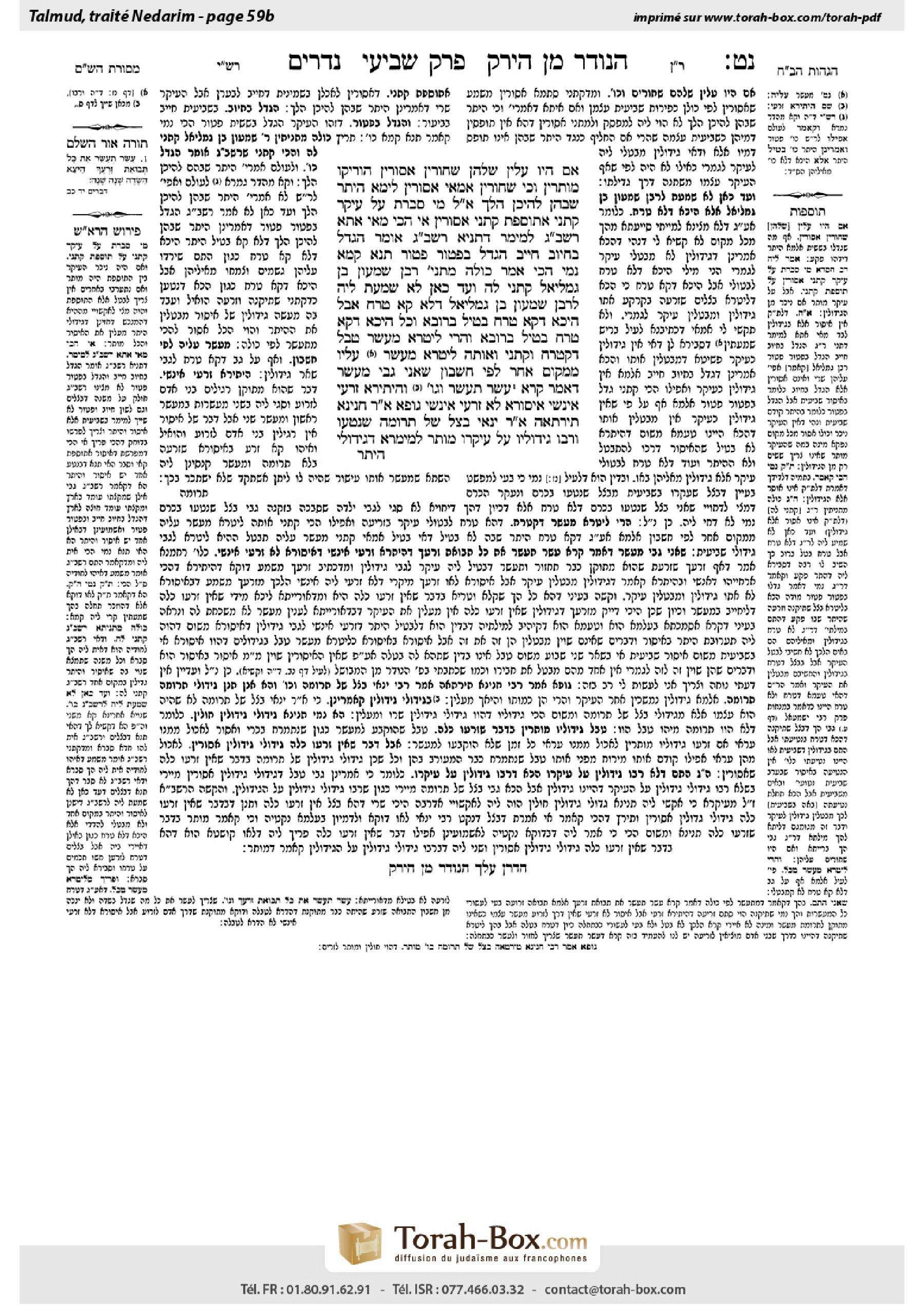
Nedarim 59b: Talmud study for Daf Yomi
Daf Yomi is the daily study of one Talmud folio. Explore 37 tractates with scans, Hebrew text, Sefaria English and AI-generated French translations where annotated.
Passage selection and English or AI-generated French translation are available where the scan has annotations. Daf Study is independent of Torah-Box and Sefaria.
Browse Nedarim · נדרים · All tractatesNedarim 59b text and translations
This page of Nedarim includes the Aramaic text, an English translation and an AI-generated French translation, alongside the scan above.
נדרים נ״ט ב · Aramaic and Hebrew text
אִם הָיוּ עָלִין שֶׁלָּהֶן שְׁחוֹרִין — אֲסוּרִין, הוֹרִיקוּ — מוּתָּרִין. וְכִי שְׁחוֹרִין אַמַּאי אֲסוּרִין? לֵימָא: הֶיתֵּר שֶׁבָּהֶן לְהֵיכָן הָלַךְ? אֲמַר לֵיהּ: מִי סָבְרַתְּ עַל עִיקָּר קָתָנֵי? אַתּוֹסֶפֶת קָתָנֵי אֲסוּרִין. אִי הָכִי, מַאי אֲתָא רַבָּן שִׁמְעוֹן בֶּן גַּמְלִיאֵל לְמֵימַר? דְּתַנְיָא, רַבָּן שִׁמְעוֹן בֶּן גַּמְלִיאֵל אוֹמֵר: הַגָּדֵל בְּחִיּוּב — חַיָּיב, הַגָּדֵל בִּפְטוּר — פָּטוּר. תַּנָּא קַמָּא נָמֵי הָכִי אָמַר!
כּוּלָּהּ מַתְנִיתִין רַבָּן שִׁמְעוֹן בֶּן גַּמְלִיאֵל קָתָנֵי לַהּ. וְעַד כָּאן לָא שָׁמְעַתְּ לֵיהּ לְרַבָּן שִׁמְעוֹן בֶּן גַּמְלִיאֵל דְּלָא קָא טָרַח, אֲבָל הֵיכָא דְּקָא טָרַח — בָּטֵיל בְּרוּבָּא.
וְכֹל הֵיכָא דְּקָא טָרַח בָּטֵיל בְּרוּבָּא? וַהֲרֵי לִיטְרָא מַעֲשֵׂר טֶבֶל, דְּקָטָרַח, וְקָתָנֵי: וְאוֹתָהּ לִיטְרָא מְעַשֵּׂר עָלָיו מִמָּקוֹם אַחֵר לְפִי חֶשְׁבּוֹן! שָׁאנֵי גַּבֵּי מַעֲשֵׂר, דְּאָמַר קְרָא ״עַשֵּׂר תְּעַשֵּׂר וְגוֹ׳״, וְהֶיתֵּירָא — זָרְעִי אִינָשֵׁי, אִיסּוּרָא — לָא זָרְעִי אִינָשֵׁי.
גּוּפָא, אָמַר רַבִּי חֲנִינָא תִּירְתָּאָה אָמַר רַבִּי יַנַּאי: בָּצָל שֶׁל תְּרוּמָה שֶׁנְּטָעוֹ, וְרַבּוּ גִּידּוּלָיו עַל עִיקָּרוֹ — מוּתָּר. לְמֵימְרָא דְּגִידּוּלֵי
Nedarim 59b · English translation
if their leaves were black, the onions are forbidden. If their leaves turned green, the onions are permitted. And if the leaves are black, why are the onions forbidden? Let us say in this case too: The permitted part, the original onion, to where did it go? Rav Ḥisda said to Rabba: Do you maintain that this halakha is taught about the primary, original onion, that it is prohibited? It is taught with regard to the additional growth that sprouted, and it is those leaves that are forbidden. The Gemara asks: If so, what is Rabban Shimon ben Gamliel, who apparently disagrees with the tanna of the mishna, coming to say? As it is taught in a baraita that Rabban Shimon ben Gamliel says: That which grew during a period of liability is liable and is considered Sabbatical-Year produce, and that which grew during a period of exemption is exempt. According to Rav Ḥisda’s explanation, the first tanna, cited in the mishna, also said that.
The Gemara explains: This is not difficult, as this entire mishna, Rabban Shimon ben Gamliel taught it. In the baraita Rabban Shimon ben Gamliel is not disagreeing with the opinion of the first tanna of the mishna; he is merely restating it. And nevertheless, the mishna and the baraita pose no difficulty with regard to the opinion of Rabba, as you heard that Rabban Shimon ben Gamliel said that the prohibition of the primary, original part is not neutralized only in a case where he did not exert himself, and the leaves sprouted on their own. However, in the case where he exerted himself, e.g., by sowing or planting, the prohibition of the original onions is neutralized by the majority.
The Gemara asks: And anywhere that one exerts himself, is the original part nullified by the majority? The Gemara asks: And isn’t there the case of one who sowed a litra of untithed tithe, where he exerts himself to sow it, and it is taught: And that original litra of untithed first tithe that he sowed, one proportionally tithes for it from produce in a different place, and its prohibition is not neutralized by the growth. The Gemara answers: It is different with regard to tithe, as the verse states: “You shall tithe all the produce of your seed that is brought forth in the field” (Deuteronomy 14:22), indicating that all permitted seeds that are sown must be tithed, since permitted seeds that were tithed, people typically sow. Forbidden seeds that were not tithed, people do not typically sow, but the Sages penalized one who sowed untithed seeds and required him to tithe that which he was originally obligated to tithe and decreed that it is not neutralized by the majority.
§ With regard to the matter itself, Rabbi Ḥanina Tirta’a said that Rabbi Yannai said: With regard to an onion of teruma that one planted, if its growths exceeded its principal, it is permitted. The Gemara asks: Is this to say that growths that are
Nedarim 59b · Traduction française (IA)
Si leurs feuilles sont noires, les oignons sont interdits. Si leurs feuilles sont devenues vertes, les oignons sont permis. Mais si les feuilles sont noires, pourquoi les oignons sont-ils interdits ? Disons aussi, dans ce cas : où est passée la partie permise, l’oignon initial ? Rav Ḥisda dit à Rabba : Penses-tu que cette halakha porte sur l’oignon initial, qui serait interdit ? Elle porte sur la croissance supplémentaire qui a poussé, et ce sont ces feuilles qui sont interdites. La Guemara demande : Dans ce cas, que vient dire Rabban Shimon ben Gamliel, qui semble contredire le tanna de la Michna ? Car il est enseigné dans une baraïta que Rabban Shimon ben Gamliel dit : Ce qui a poussé pendant une période d’assujettissement est assujetti et est considéré comme un produit de l’année sabbatique ; ce qui a poussé pendant une période d’exemption est exempt. Selon l’explication de Rav Ḥisda, le premier tanna, cité dans la Michna, a lui aussi dit cela.
La Guemara explique : Il n’y a pas de difficulté, car c’est Rabban Shimon ben Gamliel qui a enseigné toute cette Michna. Dans la baraïta, Rabban Shimon ben Gamliel ne contredit pas l’avis du premier tanna de la Michna ; il ne fait que le reformuler. Pourtant, la Michna et la baraïta ne soulèvent aucune difficulté quant à l’avis de Rabba, car tu as entendu Rabban Shimon ben Gamliel dire que l’interdiction de la partie initiale n’est pas annulée uniquement dans le cas où la personne ne s’est pas donné de peine et où les feuilles ont poussé d’elles-mêmes. En revanche, si elle s’est donné de la peine, par exemple en semant ou en plantant, l’interdiction des oignons initiaux est annulée par la majorité.
La Guemara demande : Partout où quelqu’un se donne de la peine, la partie initiale est-elle annulée par la majorité ? La Guemara demande : Mais il y a le cas de celui qui a semé une litra de première dîme non prélevée, alors qu’il s’est donné de la peine pour la semer. Or, il est enseigné : Pour cette litra initiale de première dîme non prélevée qu’il a semée, on prélève proportionnellement la dîme sur des produits provenant d’un autre endroit, et son interdiction n’est pas annulée par la croissance. La Guemara répond : Le cas de la dîme est différent, car le verset dit : « Tu prélèveras la dîme de toute la récolte de tes semailles qui pousse dans les champs » (Deutéronome 14,22), ce qui indique que toutes les semences permises que l’on sème doivent être soumises à la dîme, car les gens ont l’habitude de semer des semences permises, déjà soumises à la dîme. En revanche, les gens n’ont pas l’habitude de semer des semences interdites qui n’ont pas été soumises à la dîme. Mais les Sages ont imposé une pénalité à celui qui a semé des semences non soumises à la dîme : ils lui ont imposé de prélever la dîme sur la quantité qu’il était initialement tenu de prélever et ont décrété qu’elle n’est pas annulée par la majorité.
§ À propos de ce sujet même, Rabbi Ḥanina Tirta’a a dit au nom de Rabbi Yannai : À propos d’un oignon de terouma qu’on a planté, si ses pousses dépassent son volume initial, il est permis. La Guemara demande : Cela signifie-t-il que les pousses qui sont
Traduction française générée par IA à partir de l’édition anglaise de Sefaria. Vérifie toujours un passage avec le texte source.
Text from Sefaria: William Davidson Edition - Vocalized Aramaic (CC BY NC); William Davidson Edition - English (CC BY NC).