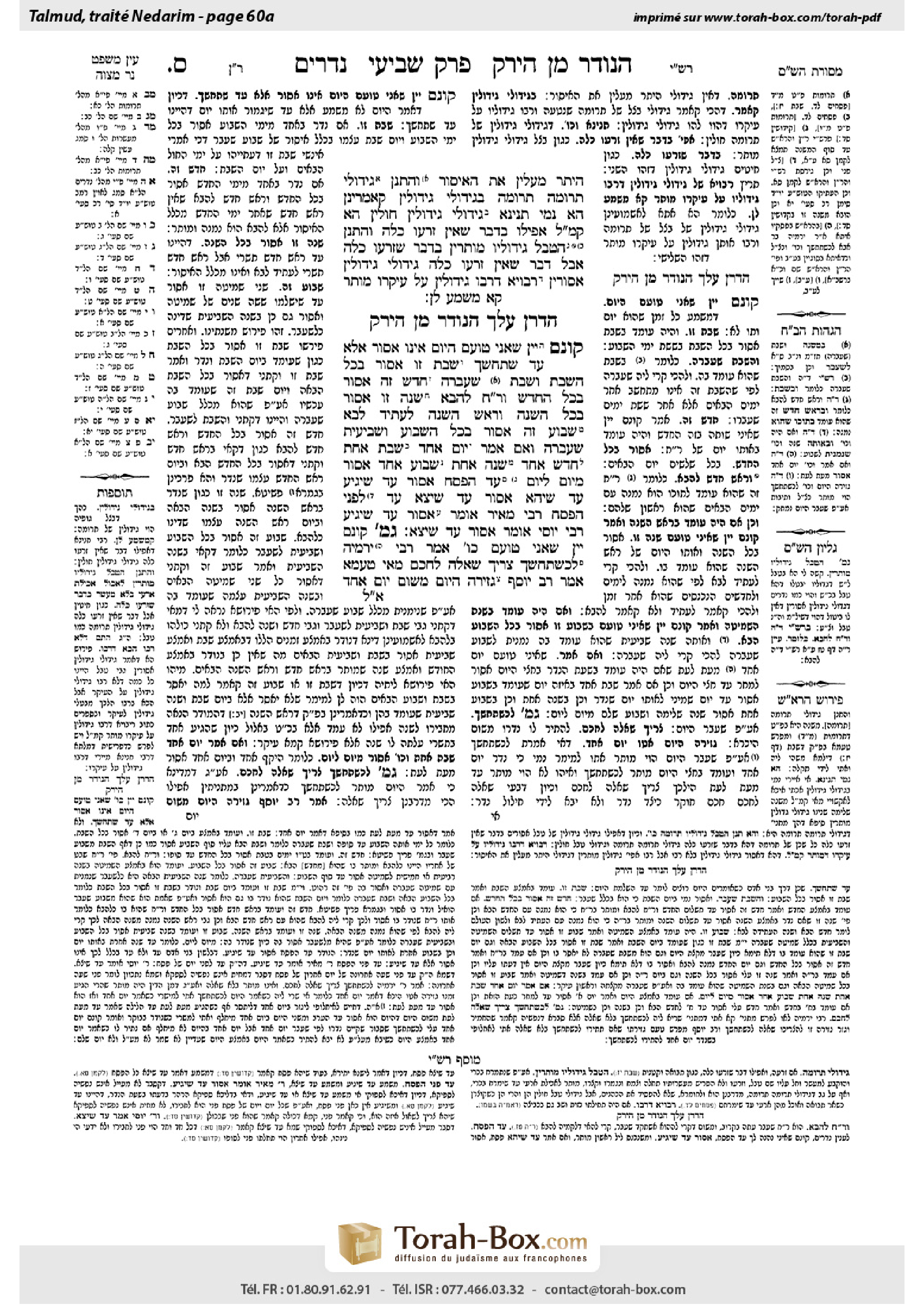
Nedarim 60a: Talmud study for Daf Yomi
Daf Yomi is the daily study of one Talmud folio. Explore 37 tractates with scans, Hebrew text, Sefaria English and AI-generated French translations where annotated.
Passage selection and English or AI-generated French translation are available where the scan has annotations. Daf Study is independent of Torah-Box and Sefaria.
Browse Nedarim · נדרים · All tractatesNedarim 60a text and translations
This page of Nedarim includes the Aramaic text, an English translation and an AI-generated French translation, alongside the scan above.
נדרים ס׳ א · Aramaic and Hebrew text
הֶיתֵּר מַעֲלִין אֶת הָאִיסּוּר? וְהָתְנַן: גִּידּוּלֵי תְרוּמָה תְּרוּמָה! בְּגִידּוּלֵי גִידּוּלִין קָאָמְרִינַן. הָא נָמֵי תְּנֵינָא: גִּידּוּלֵי גִידּוּלִין חוּלִּין! הָא קָא מַשְׁמַע לַן: אֲפִילּוּ בְּדָבָר שֶׁאֵין זַרְעוֹ כָּלֶה.
וְהָתְנַן: הַטֶּבֶל — גִּידּוּלָיו מוּתָּרִין בְּדָבָר שֶׁזַּרְעוֹ כָּלֶה. אֲבָל דָּבָר שֶׁאֵין זַרְעוֹ כָּלֶה — גִּידּוּלֵי גִידּוּלִין אֲסוּרִין! רִבּוּיָא דְּרַבּוּ גִידּוּלִין עַל עִיקָּרוֹ מוּתָּר קָא מַשְׁמַע לַן.
הַדְרָן עֲלָךְ הַנּוֹדֵר מִן הַיָּרָק
״קוּנָּם יַיִן שֶׁאֲנִי טוֹעֵם הַיּוֹם״ — אֵינוֹ אָסוּר אֶלָּא עַד שֶׁתֶּחְשַׁךְ. ״שַׁבָּת זוֹ״ — אָסוּר בְּכׇל הַשַּׁבָּת, וְשַׁבָּת שֶׁעָבְרָה. ״חֹדֶשׁ זֶה״ — אָסוּר בְּכׇל הַחֹדֶשׁ, וְרֹאשׁ חֹדֶשׁ לְהַבָּא.
״שָׁנָה זוֹ״ — אָסוּר בְּכׇל הַשָּׁנָה, וְרֹאשׁ הַשָּׁנָה לֶעָתִיד לָבֹא. ״שָׁבוּעַ זֶה״ — אָסוּר בְּכׇל הַשָּׁבוּעַ, וּשְׁבִיעִית שֶׁעָבְרָה.
וְאִם אָמַר ״יוֹם אֶחָד״, ״שַׁבָּת אַחַת״, ״חֹדֶשׁ אֶחָד״, ״שָׁנָה אַחַת״, ״שָׁבוּעַ אֶחָד״ — אָסוּר מִיּוֹם לְיוֹם.
״עַד הַפֶּסַח״ — אָסוּר עַד שֶׁיַּגִּיעַ, ״עַד שֶׁיְּהֵא״ — אָסוּר עַד שֶׁיֵּצֵא. ״עַד לִפְנֵי הַפֶּסַח״, רַבִּי מֵאִיר אוֹמֵר: אָסוּר עַד שֶׁיַּגִּיעַ, רַבִּי יוֹסֵי אוֹמֵר: אָסוּר עַד שֶׁיֵּצֵא.
גְּמָ׳ קוּנָּם יַיִן שֶׁאֲנִי טוֹעֵם כּוּ׳. אָמַר רַבִּי יִרְמְיָה: לִכְשֶׁתֶּחֱשַׁךְ צָרִיךְ שְׁאֵלָה לְחָכָם.
מַאי טַעְמָא? אָמַר רַב יוֹסֵף: גְּזֵירָה ״הַיּוֹם״ מִשּׁוּם ״יוֹם אֶחָד״.
Nedarim 60a · English translation
permitted neutralize the prohibition? But didn’t we learn in a mishna: The growths of teruma are teruma, indicating that they do not neutralize the prohibition of the original part of the plant? The Gemara answers: We are speaking of the growths of growths. Rabbi Yannai permits the teruma, not due to the majority of direct growths of teruma; he permitted it due to the majority of growths that sprouted from its growths. The Gemara asks: We already learned that too: The status of growths of growths of teruma is that of non-sacred produce. The Gemara answers: This teaches us that the growths of growths are permitted even in items whose seeds do not cease, e.g., onions.
The Gemara asks: But didn’t we learn in a mishna: With regard to untithed produce, its growths are permitted in items whose seeds cease; however, concerning items whose seeds do not cease, the growths of growths are forbidden. The Gemara answers: It teaches us that if the increase of the growths of growths exceeded its primary, original part, that original part is permitted.
MISHNA: If one vows: Wine is forbidden to me as if it were an offering [konam], and for that reason I will not taste it today, he is prohibited from drinking wine only until the conclusion of that day at nightfall, and not for a twenty-four hour period. If one vows not to drink wine this week, he is prohibited from drinking wine for the entire remainder of the week. And as Shabbat is considered part of the week that passed, i.e., it is the end of the week, he is prohibited from drinking wine on the upcoming Shabbat. If one vows not to drink wine this month, wine is forbidden to him for the entire remainder of the month; and as the New Moon of the following month is considered part of the next month, he is permitted to drink wine on that day.
If he vowed not to drink wine this year, he is prohibited from drinking wine for the entire remainder of the year; and as Rosh HaShana is considered to be part of the upcoming year, not the current one, he is permitted to drink wine on that day. If he vowed not to drink wine during this seven-year Sabbatical cycle, wine is forbidden to him for the entire remainder of the seven-year cycle; and as the Sabbatical Year is considered part of the cycle that passed, he is prohibited from drinking wine during the upcoming Sabbatical Year.
All this applies if he said that he would not drink wine on this day or this week, but if he said that wine is forbidden to him for one day, or one week, or one month, or one year, or one seven-year cycle, he is prohibited from drinking wine from the day and time he took the vow to the same time the next day, or week, etc.
If he takes a vow that wine is forbidden to him until Passover, it is forbidden to him until Passover arrives. If he said: Until it will be Passover, it is forbidden to him until Passover ends, as he may have intended for the vow to apply as long as it was still Passover (Rosh). If he said: Until before Passover, Rabbi Meir says: It is forbidden to him until Passover arrives. Rabbi Yosei says: It is forbidden to him until it ends.
GEMARA: We learned in the mishna that if one says: Wine is forbidden to me as if it were an offering [konam], and for that reason I will not taste it today, he is prohibited from drinking wine only until nightfall. Rabbi Yirmeya said: Even when darkness falls he is not permitted to drink wine immediately; rather, he is required to request that a halakhic authority dissolve his vow.
The Gemara poses a question: What is the reason that he must request the dissolution of the vow once it has already expired? The Gemara answers that Rav Yosef said: The Sages issued a rabbinic decree in the case of one who said that his vow applies today, due to the confusion that might be caused in a case where one said that his vow applies for one day, and is therefore forbidden to drink wine for twenty-four hours. There is a concern that if one who said that his vow applies today is permitted to drink wine that night, one who took a vow for one day will think that his vow also expires as soon as it is nightfall.
Nedarim 60a · Traduction française (IA)
… neutralisent-elles l’interdit ? Mais n’avons-nous pas appris dans une Michna : « Les repousses de terouma ont le statut de terouma », ce qui indique qu’elles ne neutralisent pas l’interdit de la partie initiale de la plante ? La Guemara répond : Nous parlons des repousses des repousses. Rabbi Yannai permet la terouma, non pas parce que les repousses directes de terouma sont majoritaires, mais parce que les repousses issues de ses repousses sont majoritaires. La Guemara demande : N’avons-nous pas déjà appris cela aussi : « Les repousses des repousses de terouma ont le statut de produits profanes » ? La Guemara répond : Cela nous enseigne que les repousses des repousses sont permises même dans le cas de végétaux dont les graines ne cessent pas de germer, par exemple les oignons.
La Guemara demande : Mais n’avons-nous pas appris dans une Michna : « Pour les produits non soumis à la dîme, les repousses sont permises lorsque les graines cessent de germer ; en revanche, lorsque les graines ne cessent pas de germer, les repousses des repousses sont interdites » ? La Guemara répond : Cela nous enseigne que si l’accroissement des repousses des repousses a dépassé la partie initiale de la plante, cette partie initiale est permise.
MICHNA : Si quelqu’un fait le vœu suivant : « Le vin m’est interdit comme une offrande [konam], et, pour cette raison, je n’en goûterai pas aujourd’hui », il lui est interdit de boire du vin seulement jusqu’à la tombée de la nuit de ce jour, et non pendant une période de vingt-quatre heures. Si quelqu’un fait le vœu de ne pas boire de vin cette semaine, il lui est interdit d’en boire pendant tout le reste de la semaine. Comme le Chabbat est considéré comme faisant partie de la semaine écoulée, c’est-à-dire qu’il en marque la fin, il lui est interdit de boire du vin le Chabbat qui vient. Si quelqu’un fait le vœu de ne pas boire de vin ce mois-ci, le vin lui est interdit pendant tout le reste du mois ; et comme la nouvelle lune du mois suivant est considérée comme faisant partie de ce mois suivant, il lui est permis de boire du vin ce jour-là.
S’il a fait le vœu de ne pas boire de vin cette année, il lui est interdit d’en boire pendant tout le reste de l’année ; et comme Roch Hachana est considéré comme faisant partie de l’année à venir, et non de l’année en cours, il lui est permis de boire du vin ce jour-là. S’il a fait le vœu de ne pas boire de vin pendant ce cycle de sept ans, le vin lui est interdit pendant tout le reste du cycle ; et comme l’année sabbatique est considérée comme faisant partie du cycle écoulé, il lui est interdit de boire du vin pendant l’année sabbatique à venir.
Tout cela s’applique s’il a dit qu’il ne boirait pas de vin ce jour-ci ou cette semaine-ci. Mais s’il a dit que le vin lui est interdit pendant un jour, une semaine, un mois, une année ou un cycle de sept ans, il lui est interdit d’en boire à partir du jour et de l’heure où il a fait son vœu, jusqu’au même moment le lendemain, la semaine suivante, etc.
S’il fait le vœu que le vin lui soit interdit jusqu’à Pessa’h, il lui est interdit d’en boire jusqu’à l’arrivée de Pessa’h. S’il dit : « Jusqu’à ce que ce soit Pessa’h », il lui est interdit d’en boire jusqu’à la fin de Pessa’h, car il a pu vouloir que son vœu s’applique tant que Pessa’h n’est pas terminé (Rosh). S’il dit : « Jusqu’avant Pessa’h », Rabbi Meïr dit : Il lui est interdit d’en boire jusqu’à l’arrivée de Pessa’h. Rabbi Yossi dit : Il lui est interdit d’en boire jusqu’à la fin de Pessa’h.
GUEMARA : Nous avons appris dans la Michna que si quelqu’un dit : « Le vin m’est interdit comme une offrande [konam], et, pour cette raison, je n’en goûterai pas aujourd’hui », il lui est interdit de boire du vin seulement jusqu’à la tombée de la nuit. Rabbi Yirmeya a dit : Même à la tombée de la nuit, il ne peut pas boire de vin immédiatement ; il doit d’abord demander à une autorité compétente en halakha de délier son vœu.
La Guemara pose une question : Pourquoi doit-il demander la dissolution du vœu alors que celui-ci a déjà pris fin ? La Guemara répond que Rav Yosef a dit : Les Sages ont institué un décret rabbinique dans le cas de celui qui a dit que son vœu s’applique aujourd’hui, en raison de la confusion qui pourrait survenir dans le cas de celui qui a dit que son vœu s’applique pendant un jour et qui, par conséquent, ne peut pas boire de vin pendant vingt-quatre heures. On craint que, si celui qui a dit que son vœu s’applique aujourd’hui est autorisé à boire du vin dès la nuit, celui qui a fait un vœu pour un jour pense que son vœu prend lui aussi fin dès la tombée de la nuit.
Traduction française générée par IA à partir de l’édition anglaise de Sefaria. Vérifie toujours un passage avec le texte source.
Text from Sefaria: William Davidson Edition - Vocalized Aramaic (CC BY NC); William Davidson Edition - English (CC BY NC).