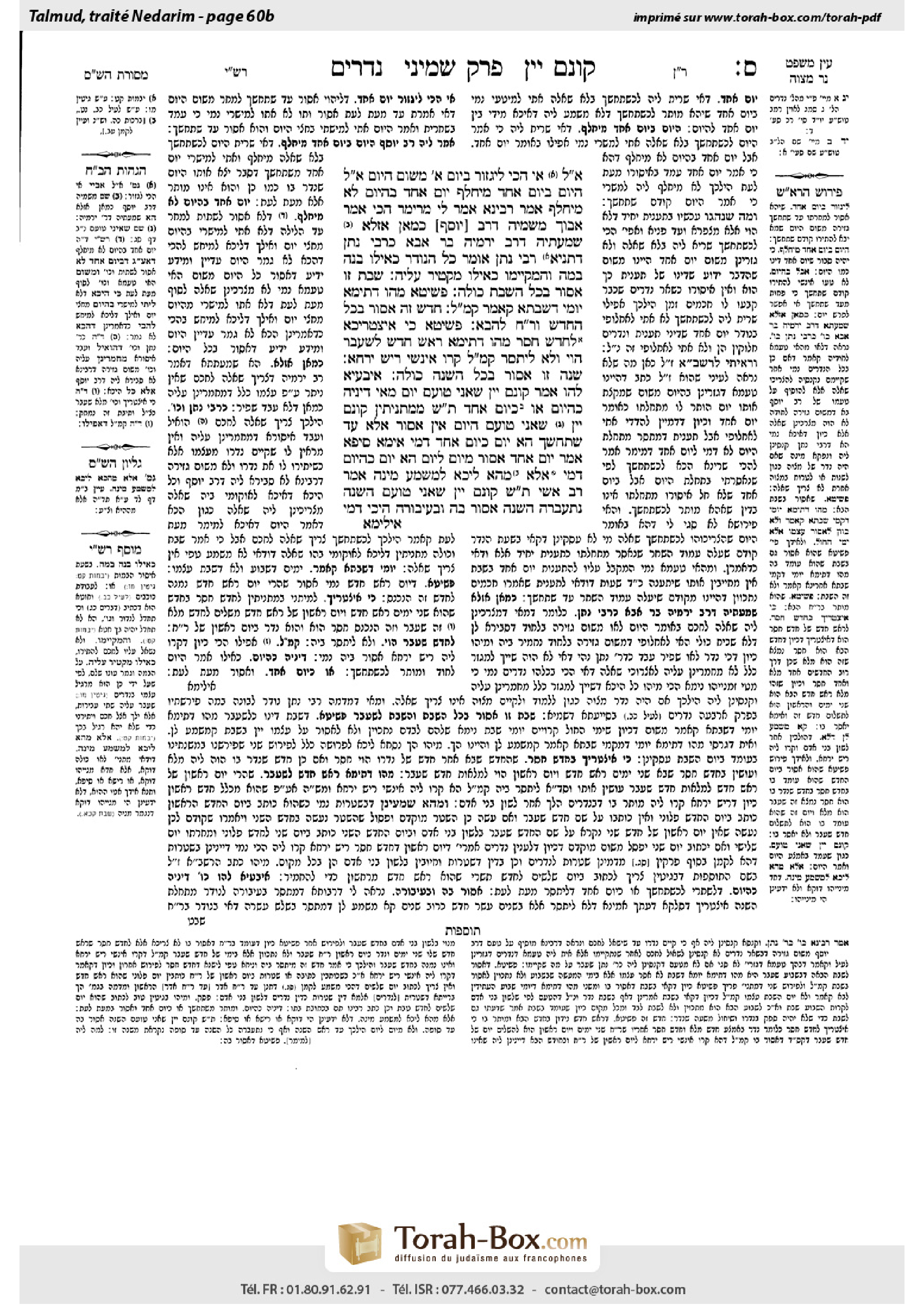
Nedarim 60b: Talmud study for Daf Yomi
Daf Yomi is the daily study of one Talmud folio. Explore 37 tractates with scans, Hebrew text, Sefaria English and AI-generated French translations where annotated.
Passage selection and English or AI-generated French translation are available where the scan has annotations. Daf Study is independent of Torah-Box and Sefaria.
Browse Nedarim · נדרים · All tractatesNedarim 60b text and translations
This page of Nedarim includes the Aramaic text, an English translation and an AI-generated French translation, alongside the scan above.
נדרים ס׳ ב · Aramaic and Hebrew text
אֲמַר לֵיהּ: אִי הָכִי, לִיגְזוֹר בְּ״יוֹם אֶחָד״ מִשּׁוּם ״הַיּוֹם״!
אֲמַר לֵיהּ: ״הַיּוֹם״ בְּ״יוֹם אֶחָד״ מִיחַלַּף, ״יוֹם אֶחָד״ בְּ״הַיּוֹם״ לָא מִיחַלַּף.
אָמַר רָבִינָא: אֲמַר לִי מָרִימָר, הָכִי אֲמַר אֲבוּךְ מִשְּׁמֵיהּ דְּרַב [יוֹסֵף]: כְּמַאן אָזְלָא שְׁמַעְתֵּיהּ דְּרַב יִרְמְיָה בַּר אַבָּא — כְּרַבִּי נָתָן. דְּתַנְיָא, רַבִּי נָתָן אוֹמֵר: כֹּל הַנּוֹדֵר — כְּאִילּוּ בָּנָה בָּמָה, וְהַמְקַיְּימוֹ — כְּאִילּוּ מַקְטִיר עָלֶיהָ.
״שַׁבָּת זוֹ״ — אָסוּר בְּכׇל הַשַּׁבָּת כּוּלָּהּ. פְּשִׁיטָא! מַהוּ דְּתֵימָא: יוֹמֵי דְשַׁבְּתָא קָאָמַר, קָא מַשְׁמַע לַן.
״חֹדֶשׁ זֶה״ — אָסוּר בְּכׇל הַחֹדֶשׁ, וְרֹאשׁ חֹדֶשׁ לְהַבָּא. פְּשִׁיטָא! כִּי אִיצְטְרִיכָא לְחֹדֶשׁ חָסֵר,
מַהוּ דְּתֵימָא: רֹאשׁ חֹדֶשׁ לְשֶׁעָבַר הָוֵי, וְלָא לִיתְּסַר, קָא מַשְׁמַע לַן קָרוּ אִינָשֵׁי רֵישׁ יַרְחָא.
״שָׁנָה זוֹ״ — אָסוּר בְּכׇל הַשָּׁנָה כּוּלָּהּ.
אִיבַּעְיָא לְהוּ, אָמַר: ״קֻוֽנָּם יַיִן שֶׁאֲנִי טוֹעֵם יוֹם״ — מַאי דִּינֵיהּ? כְּ״הַיּוֹם״, אוֹ כְּ״יוֹם אֶחָד״?
תָּא שְׁמַע מִמַּתְנִיתִין: ״קֻוֽנָּם יַיִן שֶׁאֲנִי טוֹעֵם הַיּוֹם״ — אֵין אָסוּר אֶלָּא עַד שֶׁתֶּחְשַׁךְ. הָא ״יוֹם״ כְּ״יוֹם אֶחָד״ דָּמֵי.
אֵימָא סֵיפָא, אָמַר: ״יוֹם אֶחָד״ — אָסוּר מִיּוֹם לְיוֹם. הָא ״יוֹם״ כְּ״הַיּוֹם״ דָּמֵי. אֶלָּא מֵהָא לֵיכָּא לְמִשְׁמַע מִינַּהּ.
אָמַר רַב אָשֵׁי, תָּא שְׁמַע: ״קֻוֽנָּם יַיִן שֶׁאֲנִי טוֹעֵם הַשָּׁנָה״, נִתְעַבְּרָה הַשָּׁנָה — אָסוּר בָּהּ וּבְעִיבּוּרָהּ. הֵיכִי דָּמֵי?
Nedarim 60b · English translation
Abaye said to him: If so, the Sages should likewise decree in the case of one who takes a vow for one day that he must keep the vow until nightfall of the following day, due to the confusion that might be caused in a case where one said that his vow applies today. If the vow expires in the middle of the day, twenty-four hours after he took the vow, people might think that if one takes a vow in the morning and applies it to this day, it also expires in the middle of the day.
Rav Yosef said to him: A vow taken for this day might be interchanged with a vow taken for one day, and one might erroneously conclude that a vow taken for one day expires at nightfall. However, a vow taken for one day is not interchanged with a vow taken for today, and there is no concern that one who takes a vow for today will erroneously conclude that it expires in the middle of the day.
Ravina said: Mareimar said to me: Your father said as follows, in the name of Rav Yosef: In accordance with whose opinion is this halakha taught by Rav Yirmeya bar Abba? It is in accordance with the opinion of Rabbi Natan, as it is taught in a baraita: Rabbi Natan says: Anyone who vows, it is as if he has built a personal altar, which is forbidden because one must bring all offerings to the Temple. And one who fulfills the vow, is as though he burns portions meant for the altar in the Temple upon it, i.e., the personal altar, thereby increasing his sin. Consequently, even after he has fulfilled the vow, it is preferable for him to ask a halakhic authority to annul it entirely, so that it will be as if he never took a vow.
§ The mishna stated that one who says: Wine is konam for me, and for that reason I will not taste it this week, is prohibited from drinking wine for the entire remainder of the week, including Shabbat. The Gemara poses a question: Isn’t it obvious that this is the case? The Gemara answers: It is necessary, lest you say that he said the days of the week, i.e., he meant for his vow to apply only on the weekdays. The tanna therefore teaches us that the phrase this week includes Shabbat.
The mishna stated: If one says: This month, it is forbidden to him for the entire remainder of the month, and the New Moon is considered part of the next month. The Gemara asks: Isn’t this obvious? The Gemara answers: When it was necessary to teach this halakha it was for a New Moon preceding a deficient, twenty-nine-day month. In such a case the New Moon is celebrated for two days, the first of which is the thirtieth day of the previous month and the second of which is the first day of the new month. The case here is one where he took the vow on the first day of the New Moon.
This is lest you say that the first day of the New Moon is part of the previous month, and therefore the vow should expire at the end of that day, and wine should not be forbidden to him during the upcoming month. The tanna therefore teaches us that since people call it the New Moon of the upcoming month, it is viewed as part of the upcoming month, and the vow applies to the new month.
§ The mishna states that if one says: This year, it is forbidden to him for the entire remainder of the year, and that Rosh HaShana is considered part of the upcoming year.
A dilemma was raised before the scholars: If one said: Wine is konam for me, and for that reason I will not taste it for a day, what is the halakha in his case? Is it considered as though he said today, and he is prohibited from consuming wine until nightfall, or is it considered as though he said one day, in which case the vow takes effect for a period of twenty-four hours?
The Gemara suggests: Come and hear a proof from the mishna: If one says: Wine is konam for me, and for that reason I will not taste it today, he is prohibited from drinking wine only until the conclusion of that day, at nightfall. The Gemara infers that this halakha only applies if he said the word today; therefore, if he said the vow applies for a day, it is considered comparable to a case where he said one day, and the vow is in effect for twenty-four hours.
The Gemara rejects this proof: But say the latter clause of the mishna: If he said that wine is forbidden to him for one day, he is prohibited from drinking wine from the day he took the vow to the same time on the following day. This indicates that it is only if he said: One day, that the vow takes effect for twenty-four hours; but if he said it takes effect for a day, it is comparable to a case where he said today, and the vow takes effect only until nightfall. Rather, no inference is to be learned from this mishna.
Rav Ashi said: Come and hear a resolution to this question from the following mishna (63a): If one vowed: Wine is konam for me, and for that reason I will not taste it this year, then if the year was extended, i.e., declared to be a leap year, he is prohibited from drinking wine in it and its intercalated month. The Gemara inquires: What are the circumstances?
Nedarim 60b · Traduction française (IA)
Abayé lui dit : Si tel est le cas, les Sages devraient également décréter que celui qui fait un vœu pour un jour doit le respecter jusqu’à la tombée de la nuit du lendemain, en raison de la confusion que pourrait entraîner le cas où quelqu’un dirait que son vœu s’applique aujourd’hui. Si le vœu expire au milieu de la journée, vingt-quatre heures après qu’il l’a prononcé, les gens pourraient penser que si quelqu’un fait un vœu le matin et le fait porter sur cette journée, celui-ci expire lui aussi au milieu de la journée.
Rav Yossef lui dit : Un vœu portant sur aujourd’hui pourrait être confondu avec un vœu portant sur un jour, et l’on pourrait en conclure par erreur qu’un vœu portant sur un jour expire à la tombée de la nuit. En revanche, un vœu portant sur un jour ne peut pas être confondu avec un vœu portant sur aujourd’hui ; il n’y a donc pas lieu de craindre que celui qui fait un vœu portant sur aujourd’hui conclue par erreur qu’il expire au milieu de la journée.
Ravina dit : Marémar m’a dit : « Ton père a dit ceci au nom de Rav Yossef : Selon l’opinion de qui la halakha enseignée par Rav Yirmeya bar Abba est-elle conforme ? Elle est conforme à celle de Rabbi Natan, comme l’enseigne une baraïta : Rabbi Natan dit : Quiconque fait un vœu, c’est comme s’il avait construit un autel privé, ce qui est interdit, car toutes les offrandes doivent être apportées au Temple. Et celui qui accomplit son vœu, c’est comme s’il brûlait sur cet autel privé des portions destinées à l’autel du Temple, aggravant ainsi sa faute. Par conséquent, même après avoir accompli son vœu, il vaut mieux qu’il demande à une autorité halakhique de l’annuler entièrement, afin que ce soit comme s’il n’avait jamais fait de vœu. »
§ La Michna a enseigné que celui qui dit : « Le vin m’est interdit par konam, et pour cette raison je n’en goûterai pas cette semaine », n’a pas le droit de boire du vin pendant tout le reste de la semaine, y compris Chabbat. La Guemara demande : N’est-ce pas évident ? La Guemara répond : C’est nécessaire, de peur que tu ne dises qu’il a parlé des jours de la semaine, c’est-à-dire qu’il voulait que son vœu ne s’applique qu’aux jours de semaine. Le tanna nous enseigne donc que l’expression « cette semaine » inclut Chabbat.
La Michna a enseigné : S’il dit « ce mois-ci », le vin lui est interdit pendant tout le reste du mois, et la néoménie est considérée comme faisant partie du mois suivant. La Guemara demande : N’est-ce pas évident ? La Guemara répond : Cette halakha devait être enseignée au sujet d’une néoménie précédant un mois déficient de vingt-neuf jours. Dans ce cas, la néoménie est célébrée pendant deux jours : le premier est le trentième jour du mois précédent, et le second, le premier jour du nouveau mois. Le cas envisagé ici est celui où il a fait son vœu le premier jour de la néoménie.
Cela est nécessaire, de peur que tu ne dises que le premier jour de la néoménie fait partie du mois précédent et que le vœu devrait donc expirer à la fin de ce jour, de sorte que le vin ne lui serait pas interdit pendant le mois à venir. Le tanna nous enseigne donc que, puisque les gens l’appellent « néoménie du mois à venir », on le considère comme faisant partie du mois à venir, et le vœu s’applique au nouveau mois.
§ La Michna enseigne que si quelqu’un dit : « Cette année », le vin lui est interdit pendant tout le reste de l’année, et que Roch Hachana est considéré comme faisant partie de l’année à venir.
Une question fut posée aux sages : Si quelqu’un dit : « Le vin m’est interdit par konam, et pour cette raison je n’en goûterai pas pendant un jour », quelle est la halakha dans son cas ? Faut-il considérer qu’il a dit « aujourd’hui », auquel cas il lui est interdit de boire du vin jusqu’à la tombée de la nuit, ou faut-il considérer qu’il a dit « un jour », auquel cas le vœu s’applique pendant vingt-quatre heures ?
La Guemara propose : Viens entendre une preuve tirée de la Michna : Si quelqu’un dit : « Le vin m’est interdit par konam, et pour cette raison je n’en goûterai pas aujourd’hui », il lui est interdit de boire du vin seulement jusqu’à la fin de cette journée, à la tombée de la nuit. La Guemara en déduit que cette halakha ne s’applique que s’il a prononcé le mot « aujourd’hui » ; par conséquent, s’il a dit que son vœu s’applique pendant un jour, cela est comparable au cas où il aurait dit « un jour », et le vœu reste en vigueur pendant vingt-quatre heures.
La Guemara rejette cette preuve : Mais considère la clause suivante de la Michna : S’il a dit que le vin lui est interdit pendant un jour, il lui est interdit d’en boire depuis le jour où il a fait son vœu jusqu’à la même heure le lendemain. Cela indique que c’est uniquement s’il a dit « un jour » que le vœu s’applique pendant vingt-quatre heures ; mais s’il a dit qu’il s’applique pendant un jour, cela est comparable au cas où il aurait dit « aujourd’hui », et le vœu ne s’applique que jusqu’à la tombée de la nuit. Il ne faut donc tirer aucune déduction de cette Michna.
Rav Ashi dit : Viens entendre la résolution de cette question à partir de la Michna suivante (63a) : Si quelqu’un a fait un vœu en disant : « Le vin m’est interdit par konam, et pour cette raison je n’en goûterai pas cette année », alors, si l’année a été prolongée, c’est-à-dire déclarée embolismique, il lui est interdit de boire du vin pendant toute cette année, y compris au cours de son mois intercalaire. La Guemara demande : Dans quelles circonstances ?
Traduction française générée par IA à partir de l’édition anglaise de Sefaria. Vérifie toujours un passage avec le texte source.
Text from Sefaria: William Davidson Edition - Vocalized Aramaic (CC BY NC); William Davidson Edition - English (CC BY NC).