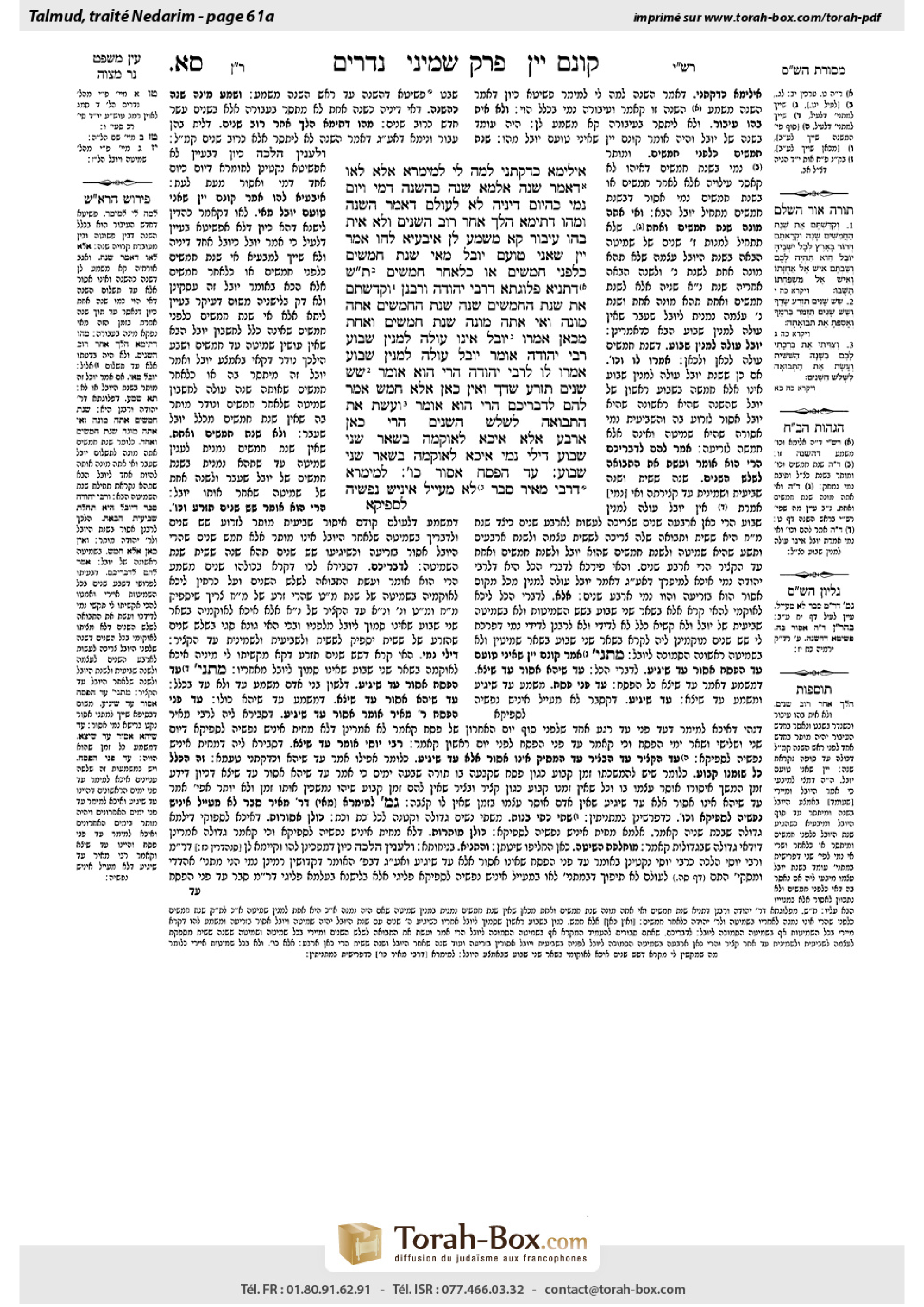
Nedarim 61a: Talmud study for Daf Yomi
Daf Yomi is the daily study of one Talmud folio. Explore 37 tractates with scans, Hebrew text, Sefaria English and AI-generated French translations where annotated.
Passage selection and English or AI-generated French translation are available where the scan has annotations. Daf Study is independent of Torah-Box and Sefaria.
Browse Nedarim · נדרים · All tractatesNedarim 61a text and translations
This page of Nedarim includes the Aramaic text, an English translation and an AI-generated French translation, alongside the scan above.
נדרים ס״א א · Aramaic and Hebrew text
אִילֵּימָא כִּדְקָתָנֵי — לְמָה לִי לְמֵימְרָא? אֶלָּא לָאו, דַּאֲמַר ״שָׁנָה״. אַלְמָא ״שָׁנָה״ כְּ״הַשָּׁנָה״ דָּמֵי, וְ״יוֹם״ נָמֵי כְּ״הַיּוֹם״ דִּינֵיהּ.
לָא, לְעוֹלָם דְּאָמַר ״הַשָּׁנָה״, וּמַהוּ דְּתֵימָא: הַלֵּךְ אַחַר רוֹב הַשָּׁנִים, וְלָא אִית בְּהוּ עִיבּוּר, קָא מַשְׁמַע לַן.
אִיבַּעְיָא לְהוּ: אָמַר ״יַיִן שֶׁאֲנִי טוֹעֵם יוֹבֵל״ מַאי? שְׁנַת חֲמִשִּׁים כְּלִפְנֵי חֲמִשִּׁים, אוֹ כִּלְאַחַר חֲמִשִּׁים?
תָּא שְׁמַע, דְּתַנְיָא פְּלוּגְתָּא דְּרַבִּי יְהוּדָה וְרַבָּנַן: ״וְקִדַּשְׁתֶּם אֵת שְׁנַת הַחֲמִשִּׁים שָׁנָה״. שְׁנַת הַחֲמִשִּׁים אַתָּה מוֹנֶה, וְאִי אַתָּה מוֹנֶה שְׁנַת חֲמִשִּׁים וְאַחַת. מִכָּאן אָמְרוּ: יוֹבֵל אֵינוֹ עוֹלֶה לְמִנְיַן שָׁבוּעַ. רַבִּי יְהוּדָה אוֹמֵר: יוֹבֵל עוֹלֶה לְמִנְיַן שָׁבוּעַ.
אָמְרוּ לוֹ לְרַבִּי יְהוּדָה: הֲרֵי הוּא אוֹמֵר ״שֵׁשׁ שָׁנִים תִּזְרַע שָׂדֶךָ״, וְאֵין כָּאן אֶלָּא חָמֵשׁ!
אָמַר לָהֶם: לְדִבְרֵיכֶם, הֲרֵי הוּא אוֹמֵר ״וְעָשָׂת אֶת הַתְּבוּאָה לִשְׁלֹשׁ הַשָּׁנִים״. הֲרֵי כָּאן אַרְבַּע!
אֶלָּא — אִיכָּא לְאוֹקֹמַהּ בִּשְׁאָר שְׁנֵי שָׁבוּעַ, דִילִי נָמֵי אִיכָּא לְאוֹקֹמַהּ בִּשְׁאָר שְׁנֵי שָׁבוּעַ.
״עַד הַפֶּסַח״ — אָסוּר כּוּ׳. לְמֵימְרָא דְּרַבִּי מֵאִיר סָבַר: לָא מְעַיֵּיל אִינִישׁ נַפְשֵׁיהּ
Nedarim 61a · English translation
If we say that it is exactly as it teaches, why do I need to state this halakha? It is obvious that a year means that entire year, even if it is a leap year. Rather, is it not referring to a case where he did not say that the vow applies this year, but rather, he said that it applies for a year, and the mishna teaches that the vow applies for the remainder of that year? Apparently, saying that a vow applies for a year is comparable to saying it applies this year; and similarly, the halakha in a case where one accepts a vow for a day should also be like the halakha in a case where one accepts a vow for today.
The Gemara refutes this argument: No, actually, the case in the mishna is that he said his vow should apply this year, and it was necessary to state this halakha lest you say: Follow the majority of years, which do not have an intercalated month, and his vow should be understood as referring to a twelve month period. The tanna therefore teaches us that the phrase this year means that the vow should last until the end of the year.
A dilemma was raised before the Sages: If one said: Any wine that I taste for a Jubilee is hereby forbidden to me, what is the halakha? Is the fiftieth year considered as before fifty, i.e., is it included in the vow, or is it considered as after fifty, in which case it is not included in the vow?
The Gemara answers: Come and hear, as it is taught in a baraita that there is a dispute between Rabbi Yehuda and the Rabbis: The verse states: “And you shall sanctify the fiftieth year” (Leviticus 25:10), from which it is derived: You count it as the fiftieth year, i.e., the Jubilee Year, but you do not count it as both the fiftieth year and the first year of the next Sabbatical and Jubilee cycles. From here they stated: The Jubilee Year is not included in the counting of the seven-year cycle of the Sabbatical Year. Rather, the year following the Jubilee Year is considered the first year of the next seven-year cycle. Rabbi Yehuda says: The Jubilee Year is included in the counting of the following seven-year cycle of the Sabbatical Year.
The Rabbis said to Rabbi Yehuda: Doesn’t the verse state: “Six years you shall sow your field” (Leviticus 25:3)? But according to your opinion there are only five years here, in the Sabbatical cycle following the Jubilee Year, as the first year would be the Jubilee Year, when it is forbidden to sow one’s field.
Rabbi Yehuda said to them: There is a difficulty according to your statement as well. Doesn’t the verse state: “And it shall bring forth produce for the three years” (Leviticus 25:21)? The Torah promises the Jewish people that in the year preceding the Sabbatical Year, the land will bring forth enough produce to last for the duration of that year, for the Sabbatical Year, and for part of the following year, until the new produce grows. However, in the case of the Jubilee, there are four years to account for, as agricultural labor is prohibited in the forty-ninth year, which is a Sabbatical Year, and in the following year, which is the Jubilee Year.
Rather, you must say that it is possible to establish the verse as referring to the other years of seven-year cycles, i.e., other Sabbatical Years apart from the Sabbatical Year right before the Jubilee Year. With regard to my opinion also, it is possible to establish the verse you presented as a difficulty as referring to the other years of seven-year cycles, i.e., other Sabbatical cycles apart from the cycle immediately following the Jubilee. With regard to the dilemma cited previously, according to the Rabbis, just as the Jubilee Year does not count as part of the ensuing Jubilee cycle because it is considered the end of the previous Jubilee cycle, if one takes a vow and states that it applies for the Jubilee cycle, the Jubilee Year is included in the vow. According to Rabbi Yehuda, the Jubilee Year itself actually begins the next Jubilee cycle, and therefore if one takes a vow for the current Jubilee cycle, the Jubilee Year itself is not included.
§ It was taught in the mishna that if one vows that wine is forbidden to him until Passover, he is prohibited from drinking wine until the Festival arrives. However, if one vows that wine is forbidden to him until before Passover, there is a dispute as to whether the vow remains in effect until the beginning or the end of the Festival. The Gemara asks: Is this to say that Rabbi Meir, who holds that it is prohibited only until the beginning of Passover, maintains that a person does not place himself
Nedarim 61a · Traduction française (IA)
Si nous disons que la Michna enseigne exactement cela, pourquoi faut-il préciser cette halakha ? Il est évident qu’une année désigne toute cette année, même s’il s’agit d’une année embolismique. Il faut donc plutôt comprendre qu’il s’agit d’un cas où il n’a pas dit que son vœu s’appliquait cette année, mais qu’il a dit qu’il s’appliquait pendant un an ; et la Michna enseigne que le vœu s’applique jusqu’à la fin de cette année. Il apparaît donc que dire qu’un vœu s’applique pendant un an équivaut à dire qu’il s’applique cette année ; de même, la halakha dans le cas où quelqu’un prend un vœu pour un jour devrait être identique à celle du cas où il prend un vœu pour aujourd’hui.
La Guemara réfute cet argument : Non, en réalité, dans le cas de la Michna, il a dit que son vœu s’appliquerait cette année, et il fallait enseigner cette halakha de peur que tu ne dises : Suivons la majorité des années, qui ne comportent pas de mois intercalaire, et comprenions que son vœu vise une période de douze mois. Le tanna nous enseigne donc que l’expression « cette année » signifie que le vœu dure jusqu’à la fin de l’année.
Une question fut posée aux Sages : si quelqu’un dit : « Tout vin que je goûterai pendant un Jubilé m’est interdit », quelle est la halakha ? La cinquantième année est-elle considérée comme antérieure à cinquante, c’est-à-dire incluse dans le vœu, ou comme postérieure à cinquante, auquel cas elle n’est pas incluse dans le vœu ?
La Guemara répond : Viens et entends, car une baraïta enseigne qu’il existe une controverse entre Rabbi Yehouda et les Sages. Le verset déclare : « Vous sanctifierez la cinquantième année » (Lévitique 25:10). On en déduit : Vous la comptez comme la cinquantième année, c’est-à-dire l’année du Jubilé, mais vous ne la comptez pas à la fois comme la cinquantième année et comme la première année des cycles sabbatique et jubilaire suivants. De là, ils ont dit : L’année du Jubilé n’est pas incluse dans le décompte du cycle sabbatique de sept ans. Au contraire, l’année qui suit l’année du Jubilé est considérée comme la première année du cycle sabbatique de sept ans suivant. Rabbi Yehouda dit : L’année du Jubilé est incluse dans le décompte du cycle sabbatique de sept ans suivant.
Les Sages dirent à Rabbi Yehouda : Le verset ne déclare-t-il pas : « Pendant six ans, tu ensemenceras ton champ » (Lévitique 25:3) ? Or, selon ton opinion, il n’y a ici que cinq années dans le cycle sabbatique qui suit l’année du Jubilé, puisque la première année serait l’année du Jubilé, pendant laquelle il est interdit d’ensemencer son champ.
Rabbi Yehouda leur dit : Votre propos présente lui aussi une difficulté. Le verset ne déclare-t-il pas : « Elle donnera des produits pour les trois années » (Lévitique 25:21) ? La Torah promet au peuple juif que, l’année précédant l’année sabbatique, la terre donnera suffisamment de produits pour durer pendant cette année, pendant l’année sabbatique et pendant une partie de l’année suivante, jusqu’à ce que les nouveaux produits poussent. Cependant, dans le cas du Jubilé, il faut tenir compte de quatre années, car les travaux agricoles sont interdits durant la quarante-neuvième année, qui est une année sabbatique, et durant l’année suivante, qui est l’année du Jubilé.
Il faut donc plutôt dire qu’il est possible de comprendre que le verset se rapporte aux autres années des cycles de sept ans, c’est-à-dire aux autres années sabbatiques, à l’exception de l’année sabbatique qui précède immédiatement l’année du Jubilé. Quant à mon opinion, il est également possible de comprendre que le verset que vous avez cité comme soulevant une difficulté se rapporte aux autres cycles de sept ans, c’est-à-dire aux autres cycles sabbatiques, à l’exception du cycle qui suit immédiatement l’année du Jubilé. Quant à la question posée précédemment, selon les Sages, de même que l’année du Jubilé ne compte pas comme faisant partie du cycle jubilaire suivant, car elle est considérée comme la fin du cycle jubilaire précédent, si quelqu’un prononce un vœu et déclare qu’il s’applique pendant le cycle jubilaire, l’année du Jubilé est incluse dans le vœu. Selon Rabbi Yehouda, l’année du Jubilé elle-même inaugure en réalité le cycle jubilaire suivant ; par conséquent, si quelqu’un prononce un vœu pour le cycle jubilaire en cours, l’année du Jubilé elle-même n’est pas incluse.
§ Il a été enseigné dans la Michna que si quelqu’un fait vœu de s’interdire le vin jusqu’à Pessa’h, il lui est interdit de boire du vin jusqu’à l’arrivée de la fête. Cependant, si quelqu’un fait vœu de s’interdire le vin jusqu’avant Pessa’h, une controverse porte sur la question de savoir si le vœu reste en vigueur jusqu’au début ou jusqu’à la fin de la fête. La Guemara demande : Faut-il en conclure que Rabbi Meïr, qui soutient que le vin n’est interdit que jusqu’au début de Pessa’h, considère qu’une personne ne se place pas
Traduction française générée par IA à partir de l’édition anglaise de Sefaria. Vérifie toujours un passage avec le texte source.
Text from Sefaria: William Davidson Edition - Vocalized Aramaic (CC BY NC); William Davidson Edition - English (CC BY NC).