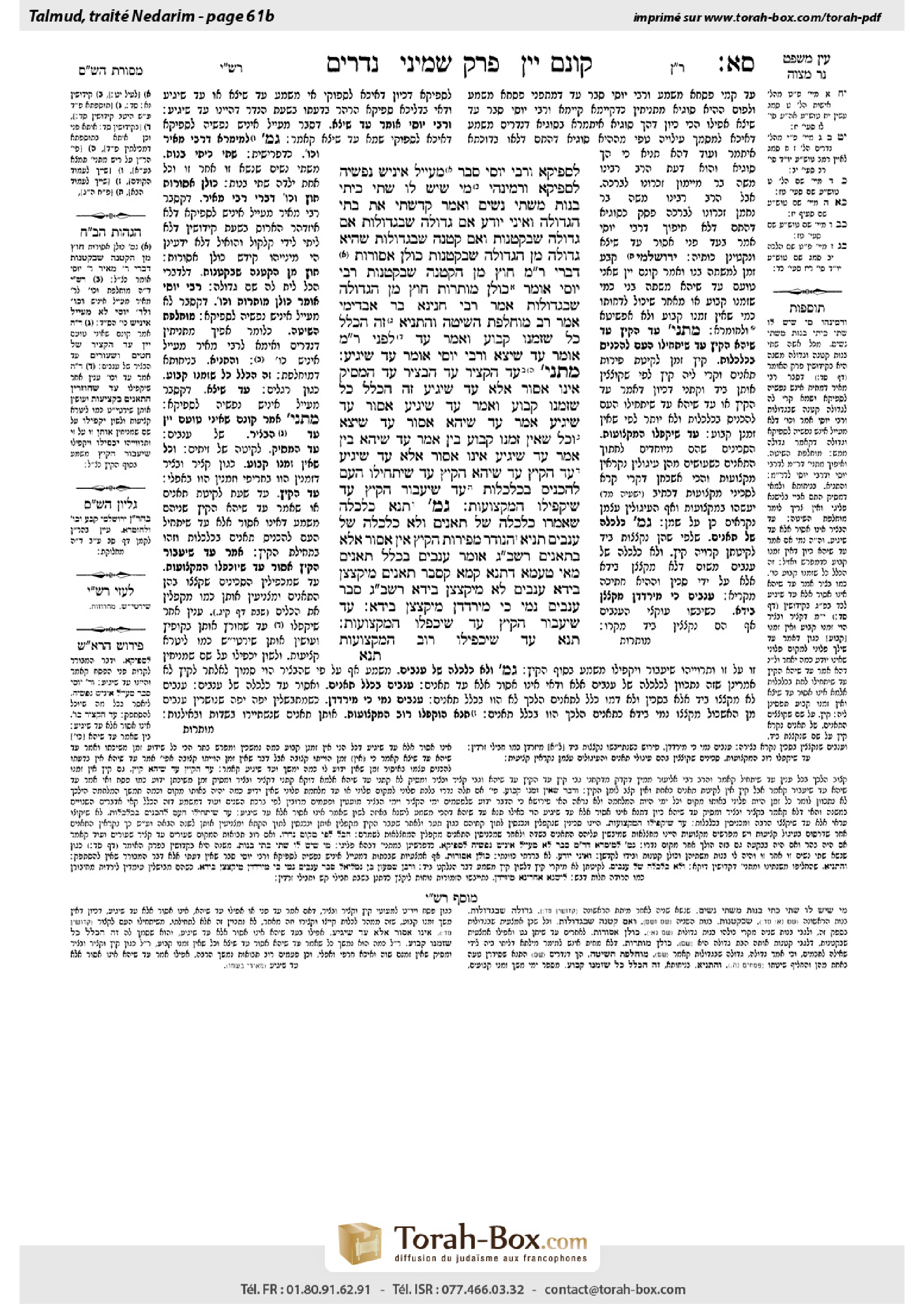
Nedarim 61b: Talmud study for Daf Yomi
Daf Yomi is the daily study of one Talmud folio. Explore 37 tractates with scans, Hebrew text, Sefaria English and AI-generated French translations where annotated.
Passage selection and English or AI-generated French translation are available where the scan has annotations. Daf Study is independent of Torah-Box and Sefaria.
Browse Nedarim · נדרים · All tractatesNedarim 61b text and translations
This page of Nedarim includes the Aramaic text, an English translation and an AI-generated French translation, alongside the scan above.
נדרים ס״א ב · Aramaic and Hebrew text
לִסְפֵיקָא, וְרַבִּי יוֹסֵי סָבַר: מְעַיֵּיל אִינִישׁ נַפְשֵׁיהּ לִסְפֵיקָא.
וּרְמִינְהִי: מִי שֶׁיֵּשׁ לוֹ שְׁתֵּי כִּיתֵּי בָנוֹת מִשְׁתֵּי נָשִׁים, וְאָמַר: קִדַּשְׁתִּי אֶת בִּתִּי הַגְּדוֹלָה, וְאֵינִי יוֹדֵעַ אִם גְּדוֹלָה שֶׁבַּגְּדוֹלוֹת, אִם גְּדוֹלָה שֶׁבַּקְּטַנּוֹת, וְאִם קְטַנָּה שֶׁבַּגְּדוֹלוֹת שֶׁהִיא גְּדוֹלָה מִן הַגְּדוֹלָה שֶׁבַּקְּטַנּוֹת — כּוּלָּן אֲסוּרוֹת, דִּבְרֵי רַבִּי מֵאִיר. חוּץ מִן הַקְּטַנָּה שֶׁבַּקְּטַנּוֹת.
רַבִּי יוֹסֵי אוֹמֵר: כּוּלָּן מוּתָּרוֹת, חוּץ מִן הַגְּדוֹלָה שֶׁבַּגְּדוֹלוֹת.
אָמַר רַבִּי חֲנִינָא בַּר אַבְדִּימִי אָמַר רַב: מוּחְלֶפֶת הַשִּׁיטָה. וְהָתַנְיָא, זֶה הַכְּלָל: כֹּל שֶׁזְּמַנּוֹ קָבוּעַ וְאָמַר ״עַד לִפְנֵי״ — רַבִּי מֵאִיר אוֹמֵר: עַד שֶׁיֵּצֵא, וְרַבִּי יוֹסֵי אוֹמֵר: עַד שֶׁיַּגִּיעַ.
מַתְנִי׳ ״עַד הַקָּצִיר״, ״עַד הַבָּצִיר״, ״עַד הַמָּסִיק״ — אֵינוֹ אָסוּר אֶלָּא עַד שֶׁיַּגִּיעַ. זֶה הַכְּלָל: כֹּל שֶׁזְּמַנּוֹ קָבוּעַ, וְאָמַר: ״עַד שֶׁיַּגִּיעַ״ — אָסוּר עַד שֶׁיַּגִּיעַ. אָמַר: ״עַד שֶׁיְּהֵא״ — אָסוּר עַד שֶׁיֵּצֵא. וְכֹל שֶׁאֵין זְמַנּוֹ קָבוּעַ, בֵּין אָמַר ״עַד שֶׁיְּהֵא״, בֵּין אָמַר ״עַד שֶׁיַּגִּיעַ״ — אֵינוֹ אָסוּר אֶלָּא עַד שֶׁיַּגִּיעַ.
״עַד הַקַּיִץ״, ״עַד שֶׁיְּהֵא הַקַּיִץ״ — עַד שֶׁיַּתְחִילוּ הָעָם לְהַכְנִיס בְּכַלְכַּלּוֹת. ״עֵד שֶׁיַּעֲבוֹר הַקַּיִץ״ — עַד שֶׁיַּקְפִּילוּ הַמִּקְצוֹעוֹת.
גְּמָ׳ תָּנָא: ״כַּלְכַּלָּה״ שֶׁאָמְרוּ — כַּלְכַּלָּה שֶׁל תְּאֵנִים, וְלֹא כַּלְכַּלָּה שֶׁל עֲנָבִים. תַּנְיָא: הַנּוֹדֵר מִפֵּירוֹת הַקַּיִץ — אֵין אָסוּר אֶלָּא בִּתְאֵנִים. רַבָּן שִׁמְעוֹן בֶּן גַּמְלִיאֵל אוֹמֵר: עֲנָבִים בִּכְלַל תְּאֵנִים.
מַאי טַעְמָא דְּתַנָּא קַמָּא? קָסָבַר: תְּאֵנִים מִיקַּצְצָן בִּידָא, עֲנָבִים לָא מִיקַּצְצָן בִּידָא. רַבָּן שִׁמְעוֹן בֶּן גַּמְלִיאֵל סָבַר: עֲנָבִים נָמֵי, כִּי מִירַדְּדָן — מִיקַּצְצָן בִּידָא.
״עַד שֶׁיַּעֲבוֹר הַקַּיִץ״, עַד שֶׁיִּכָּפְלוּ הַמַּקְצוּעוֹת. תָּנָא: עַד שֶׁיַּכְפִּילוּ רוֹב הַמַּקְצוּעוֹת.
Nedarim 61b · English translation
in a position of uncertainty, and Rabbi Yosei holds that a person does place himself in a position of uncertainty?
The Gemara raises a contradiction from the following mishna (Kiddushin 64b): In the case of one who has two groups of two daughters born to him from two women, e.g., he has two daughters from his first wife, and after his first wife died he remarried and had two daughters with his second wife, and he said: I betrothed my older daughter to someone, but I do not know if I meant the older of the older group of daughters; or if I meant the older daughter of the younger group; or if I meant the younger daughter of the older group, who is nevertheless older than the older daughter of the younger group, then all three of those daughters are prohibited to marry another man due to the uncertainty, as he failed to clarify which daughter was betrothed. This applies to all the daughters apart from the younger daughter of the younger group, who is certainly not betrothed. This is the statement of Rabbi Meir.
Rabbi Yosei says: They are all permitted to marry, apart from the older daughter of the older group. This demonstrates that according to Rabbi Meir, one must take into account any of the possible meanings of the imprecise expression: My older daughter, whereas Rabbi Yosei maintains that only the narrowest possible meaning of the phrase is taken into account. This contradicts the mishna here.
In response to this question, Rabbi Ḥanina bar Avdimi said that Rav said: The attribution of the opinions is reversed, i.e., the views stated in the mishna here must be reversed in order to reconcile them with the mishna in Kiddushin. And it is indeed taught in a baraita that this is the principle: With regard to any vow which specifies a fixed time, i.e., an event that occurs on a particular date, and one said that the vow applies until before that event, Rabbi Meir says the vow applies until the event ends, and Rabbi Yosei says that the vow is in effect only until the event arrives. This is another proof that the opinions in the mishna here must be reversed.
MISHNA: If one takes a vow that something is forbidden to him until the grain harvest, or until the grape harvest, or until the olive harvest, it is forbidden to him only until the arrival of that season. This is the principle: With regard to any occasion whose time is fixed, and one said: Until it arrives, it is forbidden to him until the specified occasion arrives. If he said: Until it will be, it is forbidden to him until the specified occasion ends. And with regard to any occasion whose time is not fixed, i.e., it does not fall on a precise date, whether he said: Until it will be, or: Until it arrives, it is forbidden to him only until the specified occasion arrives.
If he said: Until the summer [kayitz], or: Until it will be summer, the vow remains in effect until the people begin to bring fruit into their houses in baskets. If he said: Until the summer has passed, the vow remains in effect until the people set aside [yakpilu] the knives [hamaktzuot] with which the figs are cut after being harvested, and return them to their place of storage.
GEMARA: The Sage taught: The basket about which they spoke in the mishna is a basket of figs, and not a basket of grapes, which are gathered later than figs. It is taught in a baraita: One who vows that summer [kayitz] produce is forbidden to him is prohibited from partaking only of figs, as the fig harvest is called kayitz. Rabban Shimon ben Gamliel says: Grapes are included in the category of the summer produce, along with figs.
The Gemara asks: What is the reason of the first tanna? The Gemara answers: He holds that since figs are plucked [mikkatzetzan] by hand, while grapes are plucked not by hand but with tools, it is only figs that are considered summer [kayitz] produce. Conversely, Rabban Shimon ben Gamliel holds that grapes, too, when they are sufficiently ripe, are plucked by hand. Therefore, they can be considered summer produce as well.
§ The mishna states that if one said: Until the summer has passed, then the vow remains in effect until the people set aside the knives used to cut the figs. It was taught: This means until most people set aside their knives, even if there are still some individuals who have yet to do so.
Nedarim 61b · Traduction française (IA)
dans une situation d’incertitude, et Rabbi Yosei estime-t-il qu’une personne se place effectivement dans une situation d’incertitude ?
La Guemara soulève une contradiction à partir de la Michna suivante (Kiddouchine 64b) : dans le cas d’un homme qui a deux groupes de deux filles, nées de deux femmes différentes — par exemple, il a deux filles de sa première épouse, puis, après la mort de celle-ci, il se remarie et a deux filles de sa seconde épouse — et qui dit : « J’ai fiancé ma fille aînée à quelqu’un », sans savoir s’il voulait parler de l’aînée du groupe des filles aînées, de l’aînée du groupe des filles plus jeunes, ou de la cadette du groupe des filles aînées, qui est néanmoins plus âgée que l’aînée du groupe des filles plus jeunes, alors ces trois filles ne peuvent pas épouser un autre homme, en raison de l’incertitude, puisqu’il n’a pas précisé laquelle de ses filles était fiancée. Cela concerne toutes les filles, sauf la cadette du groupe des filles plus jeunes, dont on sait avec certitude qu’elle n’est pas fiancée. Telle est l’opinion de Rabbi Meïr.
Rabbi Yosei dit : Elles peuvent toutes se marier, à l’exception de l’aînée du groupe des filles aînées. Il ressort de là que, selon Rabbi Meïr, il faut tenir compte de toutes les interprétations possibles de l’expression imprécise « ma fille aînée », tandis que Rabbi Yosei estime que seul le sens le plus restreint possible de cette expression doit être retenu. Cela contredit la Michna ici.
Pour répondre à cette question, Rabbi Ḥanina bar Avdimi a dit au nom de Rav : l’attribution des opinions est inversée, c’est-à-dire qu’il faut inverser les opinions rapportées dans la Michna ici pour les concilier avec la Michna de Kiddouchine. Et une baraïta enseigne effectivement le principe suivant : pour tout vœu qui fixe une échéance, c’est-à-dire un événement qui survient à une date précise, si quelqu’un dit que le vœu s’applique jusqu’avant cet événement, Rabbi Meïr dit qu’il s’applique jusqu’à la fin de l’événement, tandis que Rabbi Yosei dit qu’il ne s’applique que jusqu’à l’arrivée de l’événement. Cela constitue une autre preuve qu’il faut inverser les opinions dans la Michna ici.
MICHNA : Si quelqu’un prononce un vœu interdisant une chose jusqu’à la récolte des céréales, jusqu’à celle du raisin ou jusqu’à celle des olives, cette chose lui est interdite seulement jusqu’à l’arrivée de la saison correspondante. Voici le principe : pour toute occasion dont la date est fixe, s’il a dit : « Jusqu’à son arrivée », la chose lui est interdite jusqu’à l’arrivée de l’occasion indiquée. S’il a dit : « Jusqu’à ce qu’elle ait lieu », elle lui est interdite jusqu’à la fin de l’occasion indiquée. Pour toute occasion dont la date n’est pas fixe, c’est-à-dire qui ne survient pas à une date précise, qu’il ait dit : « Jusqu’à ce qu’elle ait lieu » ou « Jusqu’à son arrivée », la chose lui est interdite seulement jusqu’à l’arrivée de l’occasion indiquée.
S’il a dit : « Jusqu’à l’été [kayitz] » ou « Jusqu’à ce que ce soit l’été », le vœu reste en vigueur jusqu’à ce que les gens commencent à apporter les fruits chez eux dans des paniers. S’il a dit : « Jusqu’à ce que l’été soit passé », le vœu reste en vigueur jusqu’à ce que les gens rangent [yakpilu] les couteaux [hamaktzuot] avec lesquels les figues sont coupées après la récolte et les remettent à leur place de rangement.
GUEMARA : Le Sage a enseigné : le panier dont parle la Michna est un panier de figues, et non un panier de raisin, que l’on récolte plus tard que les figues. Une baraïta enseigne : celui qui fait un vœu interdisant les produits d’été [kayitz] ne peut consommer que des figues, car la récolte des figues est appelée kayitz. Rabban Shimon ben Gamliel dit : le raisin aussi est inclus, avec les figues, dans la catégorie des produits d’été.
La Guemara demande : quelle est la raison du premier tanna ? La Guemara répond : il estime que, puisque les figues sont cueillies [mikkatzetzan] à la main, tandis que le raisin est cueilli non pas à la main, mais à l’aide d’outils, seules les figues sont considérées comme des produits d’été [kayitz]. À l’inverse, Rabban Shimon ben Gamliel estime que le raisin aussi, lorsqu’il est suffisamment mûr, est cueilli à la main. Il peut donc lui aussi être considéré comme un produit d’été.
§ La Michna enseigne que si quelqu’un a dit : « Jusqu’à ce que l’été soit passé », le vœu reste en vigueur jusqu’à ce que les gens rangent les couteaux utilisés pour couper les figues. Il a été enseigné que cela signifie jusqu’à ce que la majorité des gens rangent leurs couteaux, même s’il reste quelques personnes qui ne l’ont pas encore fait.
Traduction française générée par IA à partir de l’édition anglaise de Sefaria. Vérifie toujours un passage avec le texte source.
Text from Sefaria: William Davidson Edition - Vocalized Aramaic (CC BY NC); William Davidson Edition - English (CC BY NC).