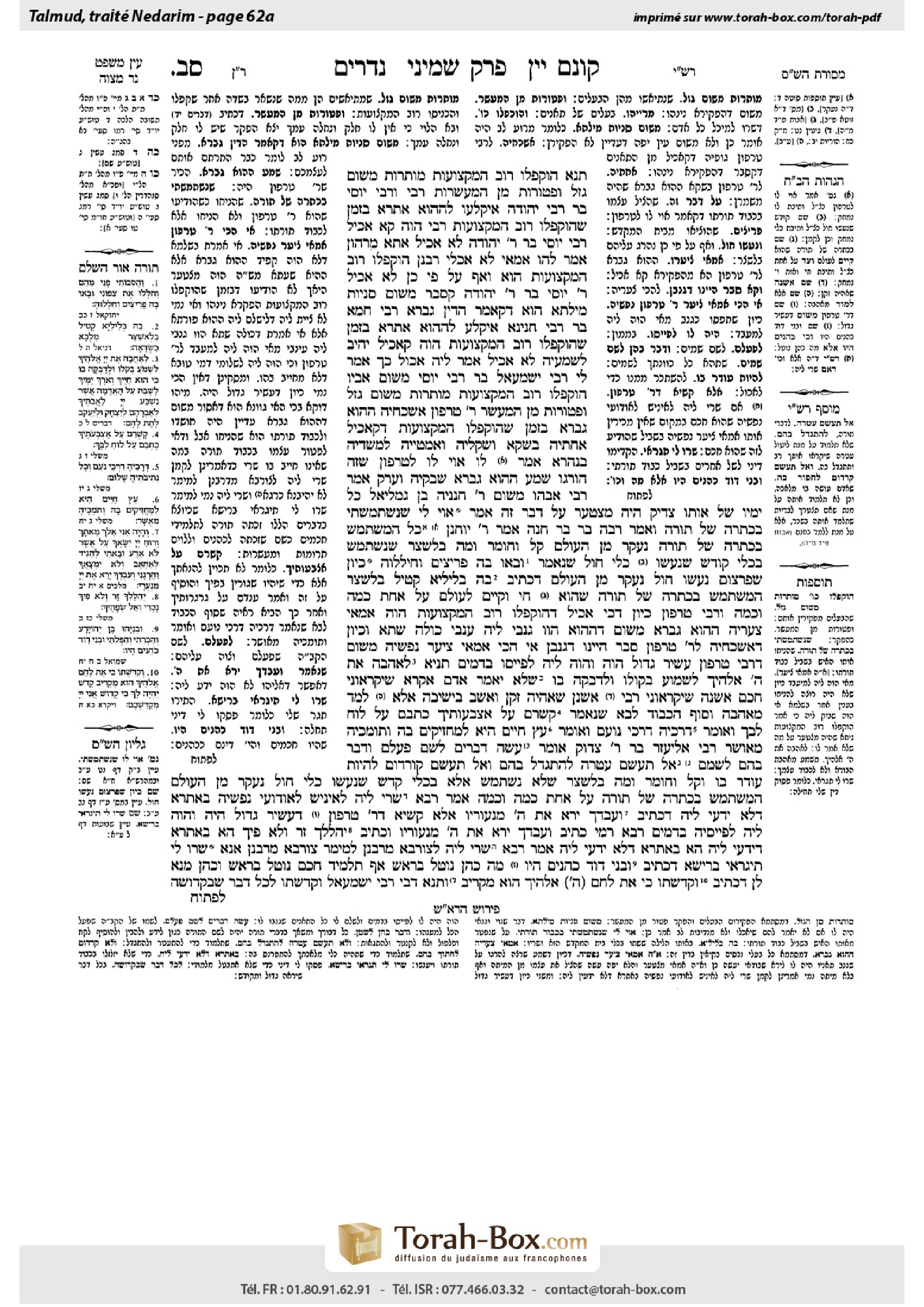
Nedarim 62a: Talmud study for Daf Yomi
Daf Yomi is the daily study of one Talmud folio. Explore 37 tractates with scans, Hebrew text, Sefaria English and AI-generated French translations where annotated.
Passage selection and English or AI-generated French translation are available where the scan has annotations. Daf Study is independent of Torah-Box and Sefaria.
Browse Nedarim · נדרים · All tractatesNedarim 62a text and translations
This page of Nedarim includes the Aramaic text, an English translation and an AI-generated French translation, alongside the scan above.
נדרים ס״ב א · Aramaic and Hebrew text
תָּנָא: הוּקְפְּלוּ רוֹב הַמַּקְצוּעוֹת — מוּתָּרוֹת מִשּׁוּם גֵּזֶל, וּפְטוּרוֹת מִן הַמַּעַשְׂרוֹת.
רַבִּי וְרַבִּי יוֹסֵי בַּר רַבִּי יְהוּדָה אִיקְּלַעוּ לְהָהוּא אַתְרָא בִּזְמַן שֶׁהוּקְפְּלוּ רוֹב הַמַּקְצוּעוֹת, רַבִּי הֲוָה קָא אָכֵיל, רַבִּי יוֹסֵי בַּר רַבִּי יְהוּדָה לָא אָכֵיל. אֲתָא מָרְהוֹן, אֲמַר לְהוּ: אַמַּאי לָא אָכְלִי רַבָּנַן? הוּקְפְּלוּ רוֹב הַמַּקְצוּעוֹת הוּא! וְאַף עַל פִּי כֵן לָא אָכֵיל רַבִּי יוֹסֵי בַּר רַבִּי יְהוּדָה, קָסָבַר: מִשּׁוּם סַנְיוּת מִילְּתָא הוּא דְּקָאָמַר הָדֵין גַּבְרָא.
רַבִּי חָמָא בַּר רַבִּי חֲנִינָא אִיקְּלַע לְהָהוּא אַתְרָא בִּזְמַן שֶׁהוּקְפְּלוּ רוֹב הַמַּקְצוּעוֹת, הֲוָה קָאָכֵיל, יָהֵיב לְשַׁמָּעֵיהּ לָא אָכֵיל. אֲמַר לֵיהּ: אֱכוֹל, כָּךְ אָמַר לִי רַבִּי יִשְׁמָעֵאל בַּר רַבִּי יוֹסֵי מִשּׁוּם אָבִיו: הוּקְפְּלוּ רוֹב הַמַּקְצוּעוֹת — מוּתָּרוֹת מִשּׁוּם גֵּזֶל וּפְטוּרוֹת מִן הַמַּעֲשֵׂר.
רַבִּי טַרְפוֹן אַשְׁכְּחֵיהּ הָהוּא גַּבְרָא בִּזְמַן שֶׁהוּקְפְּלוּ הַמַּקְצוּעוֹת דְּקָאָכֵיל. אַחֲתֵיהּ בְּשַׂקָּא וְשַׁקְלֵיהּ וְאַמְטְיֵיהּ לְמִשְׁדֵּיהּ בְּנַהֲרָא. אָמַר לוֹ: אוֹי לוֹ לְטַרְפוֹן שֶׁזֶּה הוֹרְגוֹ! שְׁמַע הָהוּא גַּבְרָא שַׁבְקֵיהּ וַעֲרַק. אָמַר רַבִּי אֲבָהוּ מִשּׁוּם רַבִּי חֲנַנְיָה בֶּן גַּמְלִיאֵל: כׇּל יָמָיו שֶׁל אוֹתוֹ צַדִּיק הָיָה מִצְטַעֵר עַל דָּבָר זֶה, אָמַר: אוֹי לִי שֶׁנִּשְׁתַּמַּשְׁתִּי בְּכִתְרָהּ שֶׁל תּוֹרָה.
וְאָמַר רַבָּה בַּר בַּר חָנָה אָמַר רַבִּי יוֹחָנָן: כׇּל הַמִּשְׁתַּמֵּשׁ בְּכִתְרָהּ שֶׁל תּוֹרָה נֶעְקָר מִן הָעוֹלָם. קַל וָחוֹמֶר: וּמָה בֵּלְשַׁצַּר שֶׁנִּשְׁתַּמֵּשׁ בִּכְלֵי קוֹדֶשׁ שֶׁנַּעֲשׂוּ כְּלֵי חוֹל, שֶׁנֶּאֱמַר: ״וּבָאוּ בָהּ פָּרִיצִים וְחִילְּלוּהָ״, כֵּיוָן שֶׁפְּרָצוּם נַעֲשׂוּ חוֹל — נֶעְקַר מִן הָעוֹלָם, דִּכְתִיב: ״בֵּהּ בְּלֵילְיָא קְטִיל בֵּלְשַׁצַּר״, הַמִּשְׁתַּמֵּשׁ בְּכִתְרָהּ שֶׁל תּוֹרָה, שֶׁהוּא חַי וְקַיָּים לְעוֹלָם — עַל אַחַת כַּמָּה וְכַמָּה.
וְרַבִּי טַרְפוֹן, כֵּיוָן דְּכִי אָכֵיל דְּהוּקְפְּלוּ רוֹב הַמַּקְצוּעוֹת הֲוָה, אַמַּאי צַעֲרֵיהּ הָהוּא גַּבְרָא? מִשּׁוּם דְּהָהוּא הֲווֹ גָּנְבִי לֵיהּ עִנְבֵי כּוּלַּהּ שַׁתָּא, וְכֵיוָן דְּאַשְׁכְּחֵיהּ לְרַבִּי טַרְפוֹן סָבַר: הַיְינוּ דְּגַנְבַן. אִי הָכִי אַמַּאי צַיעַר נַפְשֵׁיהּ? מִשּׁוּם דְּרַבִּי טַרְפוֹן עָשִׁיר גָּדוֹל הֲוָה, וַהֲוָה לֵיהּ לְפַיְּיסוֹ בְּדָמִים.
תַּנְיָא: ״לְאַהֲבָה אֶת ה׳ אֱלֹהֶיךָ לִשְׁמוֹעַ בְּקֹלוֹ וּלְדׇבְקָה בוֹ״, שֶׁלֹּא יֹאמַר אָדָם: אֶקְרָא שֶׁיִּקְרָאוּנִי ״חָכָם״, אֶשְׁנֶה שֶׁיִּקְרָאוּנִי ״רַבִּי״, אֲשַׁנֵּן שֶׁאֶהְיֶה זָקֵן וְאֵשֵׁב בִּישִׁיבָה.
אֶלָּא לְמַד מֵאַהֲבָה, וְסוֹף הַכָּבוֹד לָבֹא. שֶׁנֶּאֱמַר: ״קׇשְׁרֵם עַל אֶצְבְּעֹתֶיךָ כׇּתְבֵם עַל לוּחַ לִבֶּךָ״. וְאוֹמֵר: ״דְּרָכֶיהָ דַרְכֵי נוֹעַם״, וְאוֹמֵר: ״עֵץ חַיִּים הִיא לַמַּחֲזִיקִים בָּהּ וְתֹמְכֶיהָ מְאֻשָּׁר״.
רַבִּי אֱלִיעֶזֶר בַּר רַבִּי צָדוֹק אוֹמֵר: עֲשֵׂה דְּבָרִים לְשֵׁם פׇּעֳלָם, וְדַבֵּר בָּהֶם לִשְׁמָם. אַל תַּעֲשֵׂם עֲטָרָה לְהִתְגַּדֵּל בָּהֶם, וְאַל תַּעֲשֵׂם קוּרְדּוֹם לִהְיוֹת עוֹדֵר בּוֹ. וְקַל וָחוֹמֶר: וּמָה בֵּלְשַׁצַּר שֶׁלֹּא נִשְׁתַּמֵּשׁ אֶלָּא בִּכְלֵי קֹדֶשׁ שֶׁנַּעֲשׂוּ כְּלֵי חוֹל — נֶעְקַר מִן הָעוֹלָם, הַמִּשְׁתַּמֵּשׁ בְּכִתְרָהּ שֶׁל תּוֹרָה — עַל אַחַת כַּמָּה וְכַמָּה.
אָמַר רָבָא: שְׁרֵי לֵיהּ לְאִינִישׁ לְאוֹדוֹעֵי נַפְשֵׁיהּ בְּאַתְרָא דְּלָא יָדְעִי לֵיהּ — דִּכְתִיב: ״וְעַבְדְּךָ יָרֵא אֶת ה׳ מִנְּעוּרָיו״, אֶלָּא קַשְׁיָא דְּרַבִּי טַרְפוֹן! עָשִׁיר גָּדוֹל הָיָה, וַהֲוָה לֵיהּ לְפַיֹּיסֵיהּ בְּדָמִים.
רָבָא רָמֵי, כְּתִיב: ״וְעַבְדְּךָ יָרֵא אֶת ה׳ מִנְּעוּרָיו״, וּכְתִיב: ״יְהַלֶּלְךָ זָר וְלֹא פִיךָ״! הָא — בְּאַתְרָא דְּיָדְעִי לֵיהּ, הָא — בְּאַתְרָא דְּלָא יָדְעִי לֵיהּ.
אָמַר רָבָא: שְׁרֵי לֵיהּ לְצוּרְבָּא מֵרַבָּנַן לְמֵימַר ״צוּרְבָּא מֵרַבָּנַן אֲנָא, שְׁרוֹ לִי תִּיגְרַאי בְּרֵישָׁא״, דִּכְתִיב: ״וּבְנֵי דָוִד כֹּהֲנִים הָיוּ״ — מָה כֹּהֵן נוֹטֵל בָּרֹאשׁ, אַף תַּלְמִיד חָכָם נוֹטֵל בָּרֹאשׁ. וְכֹהֵן מְנָא לַן? דִּכְתִיב: ״וְקִדַּשְׁתּוֹ כִּי אֶת לֶחֶם (ה׳) אֱלֹהֶיךָ הוּא מַקְרִיב״, וְתָנָא דְּבֵי רַבִּי יִשְׁמָעֵאל: ״וְקִדַּשְׁתּוֹ״ — לְכׇל דָּבָר שֶׁבִּקְדוּשָּׁה,
Nedarim 62a · English translation
The Sages taught: If most of the knives have been set aside, the figs left in the field are permitted with regard to the laws of stealing and are exempt from tithes, since their owners presumably do not want them and the figs are therefore considered ownerless property.
The Gemara relates: Rabbi Yehuda HaNasi and Rabbi Yosei bar Rabbi Yehuda arrived at a certain place at a time when most of the knives had been set aside. Rabbi Yehuda HaNasi ate the figs left in the field, but Rabbi Yosei bar Rabbi Yehuda did not eat. The owner of the field came and said to them: Why are the Sages not eating? It is now the period when most of the knives have been set aside. The Gemara notes: But nevertheless, Rabbi Yosei bar Rabbi Yehuda did not eat, since he thought that it was only due to embarrassment over the matter that that man said his comment, but he did not really mean to declare his figs ownerless.
The Gemara relates another incident: Rabbi Ḥama bar Rabbi Ḥanina arrived at a certain place at a time when most of the knives had been set aside. He ate from the figs that were left in the field, but when he gave some to his attendant the latter did not eat. Rabbi Ḥama said to him: Eat, as Rabbi Yishmael bar Rabbi Yosei said to me the following ruling in the name of his father: If most of the knives have been set aside, the figs are permitted with regard to the laws of stealing and are exempt from the tithe.
The Gemara relates another incident: A certain man found Rabbi Tarfon eating figs from his field at the time when most of the knives had been set aside. He placed Rabbi Tarfon in a sack, lifted him up, and carried him to throw him into the river. Rabbi Tarfon said to him: Woe to Tarfon, for this man is killing him. When that man heard that he was carrying the great Rabbi Tarfon, he left him and fled. Rabbi Abbahu said in the name of Rabbi Ḥananya ben Gamliel: All the days of that righteous man, Rabbi Tarfon, he was distressed over this matter, saying: Woe is me, for I made use of the crown of Torah, as Rabbi Tarfon was only released out of respect for his Torah learning.
And with regard to this statement, Rabba bar bar Ḥana said that Rabbi Yoḥanan said: Whoever makes use of the crown of Torah is uprooted from the world. This can be derived by means of an a fortiori inference: If Belshazzar, who made use of the sacred Temple vessels, which had already become non-sacred vessels by that time, as after their forcible removal from the Temple the vessels lost their sanctity, as it is stated in the verse: “And robbers shall enter into it, and profane it” (Ezekiel 7:22), showing that once the Temple vessels have been robbed they become non-sacred, was uprooted from the world for his actions, as it is written: “On that night Belshazzar the Chaldean king was killed” (Daniel 5:30); one who makes use of the crown of Torah, which lives and endures forever and whose sanctity cannot be removed, all the more so shall he be uprooted.
The Gemara returns to the incident involving Rabbi Tarfon. And in the case of Rabbi Tarfon, since he was eating during the time when most of the knives had been set aside, why did that man trouble him? The Gemara explains: It was because someone had been stealing grapes from that man all year, and when he found Rabbi Tarfon he thought: This is the one who stole from me the entire year. The Gemara asks: If so, why did Rabbi Tarfon berate himself? Clearly he was justified in saving himself. The Gemara answers: Since Rabbi Tarfon was very wealthy, he should have sought to appease him with money in order to save himself, rather than relying on his status as a Torah scholar.
Apropos the story of Rabbi Tarfon’s regret for gaining personal benefit from his status as a Torah scholar, the Gemara cites similar teachings. It is taught in a baraita: The verse states: “To love the Lord your God, to listen to His voice, and to cleave to Him” (Deuteronomy 30:20). This verse indicates that a person should not say: I will read the written Torah so that they will call me a Sage; I will study Mishna so that they will call me Rabbi; I will review my studies so that I will be an Elder and will sit in the academy.
Rather, learn out of love, as the verse states: “To love the Lord your God.” And the honor will eventually come of its own accord, as it is stated: “Bind them upon your fingers; write them on the tablet of your heart” (Proverbs 7:3), and it states: “Its ways are ways of pleasantness, and all its paths are peace” (Proverbs 3:17), and it states: “It is a tree of life to those who grasp it; happy is everyone who holds it fast” (Proverbs 3:17). Consequently, one who studies in order to master Torah for its own sake, as reflected in the verse “bind them upon your fingers,” will eventually merit pleasantness, peace, and happiness.
Rabbi Eliezer bar Rabbi Tzadok says: Do things for the sake of their performance, not for any ulterior motive, and speak words of Torah for their own sake. Do not make them a crown with which to become glorified, nor make them a dolabra [kordom] with which to hoe, i.e., do not use Torah study as a means of earning a livelihood. And this is an a fortiori inference: If Belshazzar, who made use only of sacred vessels that had become non-sacred vessels, was uprooted from the world, one who makes use of the crown of Torah, whose sanctity is permanent, all the more so shall he be uprooted from the world.
Rava said: In a time of need, it is permitted for a person to make himself known in a place where people do not know him. The proof is from what Obadiah said to Elijah in order to identify himself, as it is written: “But I, your servant, have feared the Lord from my youth” (I Kings 18:12). The Gemara asks: But this is difficult with regard to the story about Rabbi Tarfon, who was distraught because he revealed his identity to the man who placed him in the sack. The Gemara answers: The case of Rabbi Tarfon is different, as he was very wealthy, and therefore he should have sought to appease him with money.
Rava raises a contradiction: It is written that Obadiah spoke highly of himself: “But I, your servant, have feared the Lord from my youth.” And it is written: “Let another praise you, and not your own mouth” (Proverbs 27:2). He answers: This verse is referring to a place where people know him, where he should not praise himself, whereas that verse is referring to a place where people do not know him.
Rava said further: It is permitted for a Torah scholar to say: I am a Torah scholar, so resolve my case first, as it is written: “And the sons of David were priests” (II Samuel 8:18). The sons of David could not have been actual priests, as David was not a priest. Rather, the verse indicates that just as a priest takes his portion first, so too, a Torah scholar takes his portion first. And a priest, from where do we derive that he takes his portion first? As it is written: “And you shall sanctify him, for he offers the bread of your God” (Leviticus 21:8). And the school of Rabbi Yishmael taught: The phrase “and you shall sanctify him” applies with regard to every matter of sanctity:
Nedarim 62a · Traduction française (IA)
Les Sages ont enseigné : Si la plupart des couteaux ont été rangés, les figues laissées dans le champ sont permises au regard des lois du vol et exemptées de la dîme, car leurs propriétaires ne les veulent vraisemblablement plus et elles sont donc considérées comme des biens sans maître.
La Guemara rapporte : Rabbi Yehouda HaNassi et Rabbi Yosei bar Rabbi Yehouda arrivèrent en un certain lieu à une époque où la plupart des couteaux avaient été rangés. Rabbi Yehouda HaNassi mangea les figues laissées dans le champ, mais Rabbi Yosei bar Rabbi Yehouda n’en mangea pas. Le propriétaire du champ vint et leur dit : « Pourquoi les Sages ne mangent-ils pas ? C’est maintenant la période où la plupart des couteaux ont été rangés. » La Guemara note : Pourtant, Rabbi Yosei bar Rabbi Yehouda n’en mangea pas, car il pensa que cet homme n’avait fait cette remarque que par gêne, sans vouloir réellement déclarer ses figues sans maître.
La Guemara rapporte un autre épisode : Rabbi Ḥama bar Rabbi Ḥanina arriva en un certain lieu à une époque où la plupart des couteaux avaient été rangés. Il mangea les figues restées dans le champ, mais, lorsqu’il en donna à son serviteur, celui-ci n’en mangea pas. Rabbi Ḥama lui dit : « Mange, car Rabbi Yishmael bar Rabbi Yosei m’a transmis la halakha suivante au nom de son père : Si la plupart des couteaux ont été rangés, les figues sont permises au regard des lois du vol et exemptées de la dîme. »
La Guemara rapporte un autre épisode : Un homme surprit Rabbi Tarfon en train de manger des figues dans son champ, à l’époque où la plupart des couteaux avaient été rangés. Il plaça Rabbi Tarfon dans un sac, le souleva et l’emporta pour le jeter dans le fleuve. Rabbi Tarfon lui dit : « Malheur à Tarfon, car cet homme est en train de le tuer. » Lorsque cet homme apprit qu’il portait le grand Rabbi Tarfon, il le lâcha et s’enfuit. Rabbi Abbahou dit au nom de Rabbi Ḥananya ben Gamliel : Toute sa vie, ce juste, Rabbi Tarfon, fut tourmenté par cette affaire et disait : « Malheur à moi, car j’ai tiré profit de la couronne de la Torah », puisque Rabbi Tarfon ne fut libéré que par respect pour son érudition en Torah.
À propos de cette déclaration, Rabba bar bar Ḥana rapporte que Rabbi Yoḥanan a dit : Quiconque tire profit de la couronne de la Torah est déraciné du monde. On peut le déduire par raisonnement a fortiori : si Belshazzar, qui avait utilisé les objets sacrés du Temple, lesquels étaient déjà devenus profanes à cette époque, car, après avoir été arrachés de force au Temple, ils avaient perdu leur sainteté, comme le dit le verset : « Des brigands y entreront et le profaneront » (Ézéchiel 7:22), ce qui montre que les objets du Temple deviennent profanes une fois qu’ils ont été volés, fut déraciné du monde pour ses actes, comme il est écrit : « Cette même nuit, Belshazzar, roi des Chaldéens, fut tué » (Daniel 5:30), à plus forte raison celui qui tire profit de la couronne de la Torah, qui vit et perdure à jamais et dont la sainteté ne peut être ôtée, sera-t-il déraciné du monde.
La Guemara revient à l’épisode de Rabbi Tarfon. Puisqu’il mangeait à l’époque où la plupart des couteaux avaient été rangés, pourquoi cet homme s’en prit-il à lui ? La Guemara explique : Quelqu’un volait des raisins à cet homme depuis toute l’année et, lorsqu’il trouva Rabbi Tarfon, il pensa : « C’est lui qui m’a volé toute l’année. » La Guemara demande : Dans ce cas, pourquoi Rabbi Tarfon se reprocha-t-il sa conduite ? Il était manifestement fondé à se sauver. La Guemara répond : Rabbi Tarfon étant très riche, il aurait dû chercher à l’apaiser en lui donnant de l’argent afin de se sauver, plutôt que de s’appuyer sur son statut d’érudit en Torah.
À propos du regret de Rabbi Tarfon d’avoir tiré un avantage personnel de son statut d’érudit en Torah, la Guemara cite des enseignements similaires. Il est enseigné dans une baraïta : Le verset dit : « Pour aimer le Seigneur ton Dieu, écouter sa voix et t’attacher à lui » (Deutéronome 30:20). Ce verset indique qu’une personne ne doit pas dire : « Je lirai la Torah écrite afin qu’on me considère comme un Sage ; j’étudierai la Michna afin qu’on m’appelle Rabbi ; je réviserai mes études afin de devenir un Ancien et de siéger à l’académie. »
Au contraire, étudie par amour, comme le dit le verset : « Pour aimer le Seigneur ton Dieu. » L’honneur viendra finalement de lui-même, comme il est dit : « Attache-les à tes doigts ; inscris-les sur la tablette de ton cœur » (Proverbes 7:3), et encore : « Ses voies sont des voies agréables, et tous ses sentiers sont paisibles » (Proverbes 3:17), puis : « Elle est un arbre de vie pour ceux qui la saisissent ; heureux celui qui s’y attache » (Proverbes 3:18). Ainsi, celui qui étudie afin de maîtriser la Torah pour elle-même, comme l’exprime le verset « Attache-les à tes doigts », finira par mériter l’agrément, la paix et le bonheur.
Rabbi Eliezer bar Rabbi Tzadok dit : Accomplissez les actes pour eux-mêmes, et non dans un but intéressé, et prononcez des paroles de Torah pour elles-mêmes. N’en faites pas une couronne pour vous glorifier, ni une houe [kordom] pour bêcher, c’est-à-dire ne vous servez pas de l’étude de la Torah comme moyen de gagner votre vie. Voici un raisonnement a fortiori : si Belshazzar, qui n’avait utilisé que des objets sacrés devenus profanes, fut déraciné du monde, à plus forte raison celui qui tire profit de la couronne de la Torah, dont la sainteté est permanente, sera-t-il déraciné du monde.
Rava dit : En cas de nécessité, il est permis à une personne de faire connaître son identité dans un lieu où on ne la connaît pas. La preuve en est ce qu’Obadiah dit à Élie pour s’identifier, comme il est écrit : « Mais moi, ton serviteur, je crains le Seigneur depuis ma jeunesse » (I Rois 18:12). La Guemara demande : Mais cela pose une difficulté au regard de l’épisode de Rabbi Tarfon, qui fut bouleversé d’avoir révélé son identité à l’homme qui l’avait placé dans le sac. La Guemara répond : Le cas de Rabbi Tarfon est différent, car il était très riche et aurait donc dû chercher à l’apaiser en lui donnant de l’argent.
Rava soulève une contradiction : Il est écrit qu’Obadiah a parlé de lui-même en termes élogieux : « Mais moi, ton serviteur, je crains le Seigneur depuis ma jeunesse. » Et il est écrit : « Qu’un autre te loue, et non ta propre bouche » (Proverbes 27:2). Il répond : Ce verset concerne un lieu où les gens le connaissent, où il ne doit pas faire son propre éloge, tandis que l’autre verset concerne un lieu où les gens ne le connaissent pas.
Rava dit encore : Il est permis à un érudit en Torah de dire : « Je suis un érudit en Torah ; réglez donc mon affaire en premier », comme il est écrit : « Les fils de David étaient prêtres » (II Samuel 8:18). Les fils de David ne pouvaient pas être de véritables prêtres, car David n’était pas prêtre. Le verset indique plutôt que, tout comme un prêtre reçoit sa part en premier, un érudit en Torah reçoit lui aussi sa part en premier. Et d’où déduit-on qu’un prêtre reçoit sa part en premier ? Du verset : « Tu le tiendras pour saint, car il offre la nourriture de ton Dieu » (Lévitique 21:8). L’école de Rabbi Yishmael a enseigné : L’expression « tu le tiendras pour saint » s’applique à toute question de sainteté :
Traduction française générée par IA à partir de l’édition anglaise de Sefaria. Vérifie toujours un passage avec le texte source.
Text from Sefaria: William Davidson Edition - Vocalized Aramaic (CC BY NC); William Davidson Edition - English (CC BY NC).