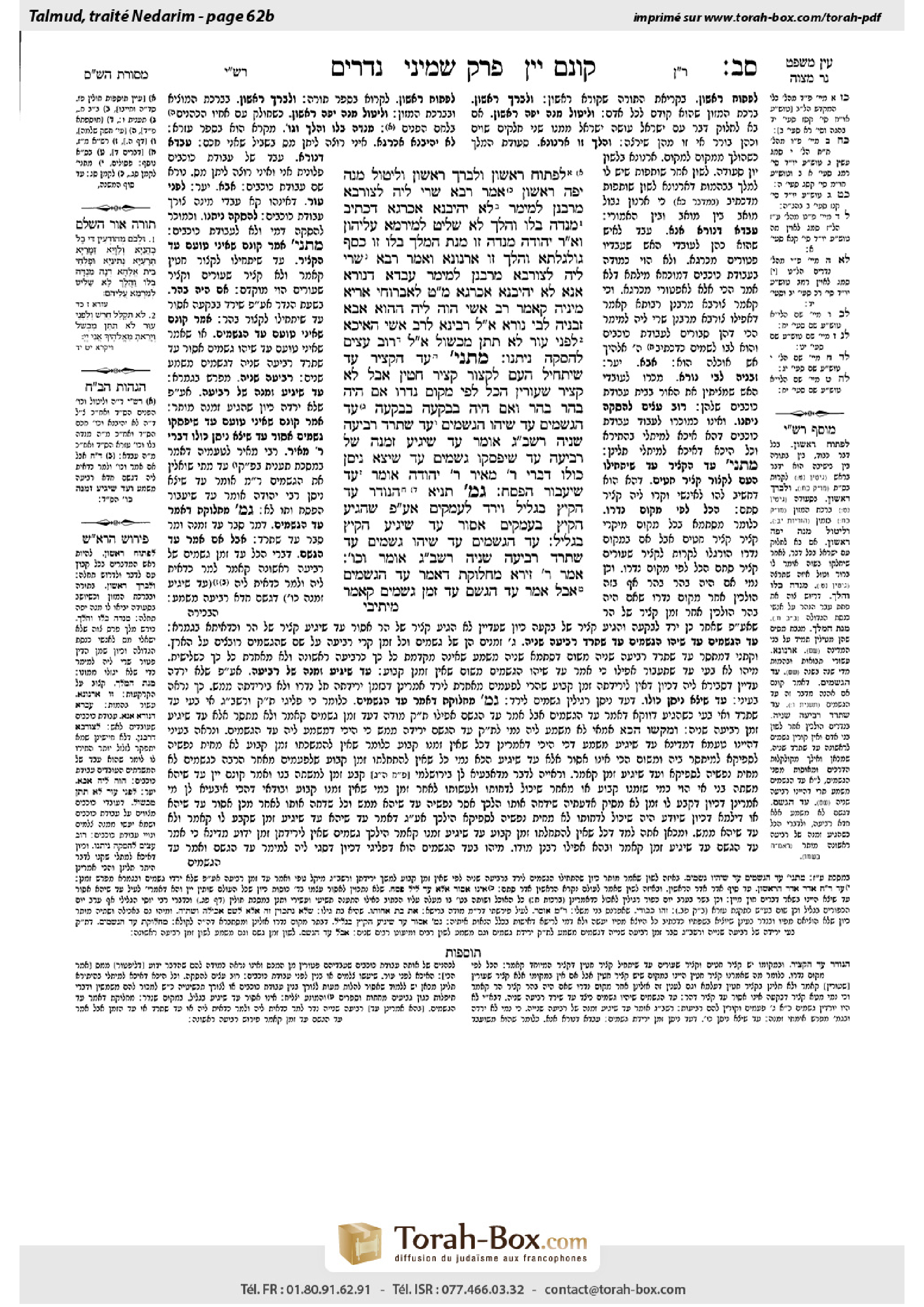
Nedarim 62b: Talmud study for Daf Yomi
Daf Yomi is the daily study of one Talmud folio. Explore 37 tractates with scans, Hebrew text, Sefaria English and AI-generated French translations where annotated.
Passage selection and English or AI-generated French translation are available where the scan has annotations. Daf Study is independent of Torah-Box and Sefaria.
Browse Nedarim · נדרים · All tractatesNedarim 62b text and translations
This page of Nedarim includes the Aramaic text, an English translation and an AI-generated French translation, alongside the scan above.
נדרים ס״ב ב · Aramaic and Hebrew text
לִפְתּוֹחַ רִאשׁוֹן, וּלְבָרֵךְ רִאשׁוֹן, וְלִיטּוֹל מָנָה יָפָה רִאשׁוֹן.
אָמַר רָבָא: שְׁרֵי לֵיהּ לְצוּרְבָּא מֵרַבָּנַן לְמֵימַר: לָא יָהֵיבְנָא אַכְּרָגָא, דִּכְתִיב ״מִנְדָּה בְלוֹ וַהֲלָךְ לָא שַׁלִּיט לְמִירְמֵא עֲלֵיהוֹן״. וְאָמַר רַבִּי יְהוּדָה: ״מִנְדָּה״ — זוֹ מְנָת הַמֶּלֶךְ, ״בְּלוֹ״ — זוֹ כֶּסֶף גֻּולְגָּלְתָּא, ״וַהֲלָךְ״ — זוֹ אַרְנוֹנָא.
וְאָמַר רָבָא: שְׁרֵי לֵיהּ לְצוּרְבָּא מֵרַבָּנַן לְמֵימַר: ״עַבְדָּא דְנוּרָא אֲנָא לָא יָהֵיבְנָא אַכְּרָגָא״. מַאי טַעְמָא — לְאַבְרוֹחֵי אַרְיָא מִינֵּיהּ קָאָמַר.
רַב אָשֵׁי הֲוָה לֵיהּ הָהוּא אִבָּא, זַבְּנֵיהּ לְבֵי נוּרָא. אֲמַר לֵיהּ רָבִינָא לְרַב אָשֵׁי: הָאִיכָּא ״לִפְנֵי עִוֵּר לֹא תִתֵּן מִכְשׁוֹל״! אֲמַר לֵיהּ: רוֹב עֵצִים לְהַסָּקָה נִיתְּנוּ.
מַתְנִי׳ ״עַד הַקָּצִיר״ — עַד שֶׁיַּתְחִיל הֶעָם לִקְצוֹר קְצִיר חִטִּין, אֲבָל לֹא קְצִיר שְׂעוֹרִין, הַכֹּל לְפִי מְקוֹם נִדְרוֹ. אִם הָיָה בָּהָר — בָּהָר, וְאִם הָיָה בַּבִּקְעָה — בַּבִּקְעָה.
״עַד הַגְּשָׁמִים״, ״עַד שֶׁיְּהוּ הַגְּשָׁמִים״ — עַד שֶׁתֵּרֵד רְבִיעָה שְׁנִיָּה. רַבָּן שִׁמְעוֹן בֶּן גַּמְלִיאֵל אוֹמֵר: עַד שֶׁיַּגִּיעַ זְמַנָּהּ שֶׁל רְבִיעָה. ״עַד שֶׁיִּפְסְקוּ גְּשָׁמִים״ — עַד שֶׁיֵּצֵא נִיסָן כּוּלּוֹ, דִּבְרֵי רַבִּי מֵאִיר. רַבִּי יְהוּדָה אוֹמֵר: עַד שֶׁיַּעֲבוֹר הַפֶּסַח.
גְּמָ׳ תַּנְיָא: הַנּוֹדֵר ״עַד הַקַּיִץ״ בַּגָּלִיל, וְיָרַד לָעֲמָקִים, אַף עַל פִּי שֶׁהִגִּיעַ הַקַּיִץ בָּעֲמָקִים — אָסוּר עַד שֶׁיַּגִּיעַ הַקַּיִץ בַּגָּלִיל.
״עַד הַגְּשָׁמִים״, ״עַד שֶׁיְּהוּ גְּשָׁמִים״ — עַד שֶׁתֵּרֵד רְבִיעָה שְׁנִיָּה, רַבָּן שִׁמְעוֹן בֶּן גַּמְלִיאֵל אוֹמֵר וְכוּ׳. אָמַר רַבִּי זֵירָא: מַחֲלוֹקֶת דְּאָמַר ״עַד הַגְּשָׁמִים״, אֲבָל אָמַר ״עַד הַגֶּשֶׁם״ — עַד זְמַן גְּשָׁמִים קָאָמַר.
Nedarim 62b · English translation
To open the Torah reading first, to recite a blessing first, and to take a fine portion first. When portions are distributed equally, a priest can choose his share first. The verse with regard to the sons of David proves that the same halakha applies to Torah scholars.
Furthermore, Rava said: It is permitted for a Torah scholar to say: I will not pay the head tax [karga], as it is written that the king of Persia wrote to Ezra, with regard to the priests, the Levites, and others who worked in the Temple: “It shall not be lawful to impose minda, belo, and halakh upon them” (Ezra 7:24). And Rabbi Yehuda said: Minda; this is the king’s portion. Belo; this is the money of the head tax. And halakh; this is arnona, a levy on people and their animals to perform physical labor in the service of the ruling authority. Since a Torah scholar is considered equivalent to a priest, as he is also dedicated to a sacred task, this exemption applies to him as well.
And Rava said further: It is permitted for a Torah scholar to say: I am a servant of the priests of fire worship and therefore I will not pay the head tax. Rava maintains that a scholar may issue a statement of this kind in a place where the priests of fire-worshippers are exempt from the head tax, because he actually is declaring himself a servant of God, who is referred to as “a devouring fire” (Deuteronomy 4:24). What is the reason that he is allowed to make this statement? He is saying it merely in order to chase a lion away from him, i.e., to avoid suffering a loss.
The Gemara relates that Rav Ashi had a particular forest, and he sold it for its wood to the temple of fire worship. Ravina said to Rav Ashi: Isn’t there the prohibition: “You shall not put a stumbling block before the blind” (Leviticus 19:14), which prohibits assisting others in committing transgressions? And yet you are providing assistance to an idolatrous cult. He said to him: Most of the wood they use is for kindling, not for their ritual service. Consequently, I need not be concerned that the particular wood that I have sold them will be used for idolatry.
MISHNA: If one takes a vow until the harvest, the vow remains in effect until people begin to harvest. This is referring to the wheat harvest but not the barley harvest. As for the exact date of this event, all is determined according to the place where he took his vow. If he was on a mountain, it is assumed that he referred to the time of the harvest on the mountain, and if he was in a valley, it is assumed that he meant the time of the harvest in the valley.
If one takes a vow until the rains, or until there are rains, the vow remains in effect until the second rain of the rainy season falls. Rabban Shimon ben Gamliel says: Until the time of the second rainfall arrives, even if rain does not fall. If one takes a vow until the rains end, the vow remains in effect until the entire month of Nisan has ended; this is the statement of Rabbi Meir. Rabbi Yehuda says: Until Passover has passed.
GEMARA: It is taught in a baraita: With regard to one who vows until the summer in the Galilee and subsequently descends to the valleys, even if the summer season has already arrived in the valleys, the subject of his vow remains forbidden to him until summer arrives in the Galilee, in accordance with the mishna’s ruling that the duration of a vow is in accordance with the place where it was made.
The mishna states that if one takes a vow until the rains, or until there are rains, he means until the second rain of the rainy season. Rabban Shimon ben Gamliel says: Until the time of the second rainfall arrives. The Gemara comments: Rabbi Zeira said: The dispute is in a case where one said: Until the rains. However, if he says: Until the rain, everyone agrees that he is saying that the vow should remain in effect until the time of the rains, but not necessarily until the rain actually falls.
Nedarim 62b · Traduction française (IA)
Être appelé en premier à la lecture de la Torah, réciter une bénédiction en premier et recevoir en premier une belle part. Lorsque les parts sont distribuées à égalité, un prêtre peut choisir sa part en premier. Le verset concernant les fils de David prouve que la même halakha s’applique aux érudits en Torah.
De plus, Rava a dit : Il est permis à un érudit en Torah de dire : « Je ne paierai pas l’impôt par tête [karga] », comme il est écrit que le roi de Perse écrivit à Ezra, au sujet des prêtres, des lévites et des autres personnes qui officiaient dans le Temple : « Il ne sera pas permis de leur imposer minda, belo et halakh » (Ezra 7:24). Rabbi Yehouda a expliqué : Minda désigne la part du roi ; belo, l’argent de l’impôt par tête ; et halakh, l’arnona, un prélèvement sur les personnes et leurs animaux afin qu’ils accomplissent un travail physique au service du pouvoir. Puisqu’un érudit en Torah est considéré comme l’équivalent d’un prêtre, car lui aussi est voué à une tâche sacrée, cette exemption s’applique également à lui.
Rava a encore dit : Il est permis à un érudit en Torah de dire : « Je suis au service des prêtres adorateurs du feu et, par conséquent, je ne paierai pas l’impôt par tête. » Selon Rava, un érudit peut faire une telle déclaration dans un lieu où les prêtres des adorateurs du feu sont exemptés de cet impôt, car, en réalité, il se déclare au service de Dieu, qui est appelé « un feu dévorant » (Deutéronome 4:24). Pourquoi lui est-il permis de faire cette déclaration ? Il ne la fait que pour éloigner de lui un lion, c’est-à-dire pour éviter de subir une perte.
La Guemara rapporte que Rav Ashi possédait une certaine forêt et qu’il en vendit le bois au temple des adorateurs du feu. Ravina lui dit : N’y a-t-il pas l’interdiction « Tu ne placeras pas d’obstacle devant un aveugle » (Lévitique 19:14), qui interdit d’aider autrui à commettre des transgressions ? Pourtant, tu apportes ton aide à un culte idolâtre. Il lui répondit : La plus grande partie du bois qu’ils utilisent sert à allumer des feux, et non à leur service rituel. Par conséquent, je n’ai pas à craindre que le bois que je leur ai vendu soit utilisé pour l’idolâtrie.
MICHNA : Si quelqu’un fait un vœu jusqu’à la récolte, celui-ci reste en vigueur jusqu’à ce que les gens commencent à récolter. Il s’agit de la récolte du blé, et non de celle de l’orge. Quant à la date exacte, tout dépend du lieu où il a fait son vœu. S’il se trouvait sur une montagne, on suppose qu’il faisait référence à la période de la récolte sur la montagne ; et s’il se trouvait dans une vallée, on suppose qu’il faisait référence à la période de la récolte dans la vallée.
Si quelqu’un fait un vœu jusqu’aux pluies, ou jusqu’à ce qu’il pleuve, celui-ci reste en vigueur jusqu’à la deuxième pluie de la saison des pluies. Rabban Shimon ben Gamliel dit : Jusqu’à l’arrivée de la période de la deuxième pluie, même s’il ne pleut pas. Si quelqu’un fait un vœu jusqu’à la fin des pluies, celui-ci reste en vigueur jusqu’à la fin du mois entier de Nissan ; telle est l’opinion de Rabbi Meïr. Rabbi Yehouda dit : Jusqu’à ce que Pessa’h soit passé.
GUEMARA : Il est enseigné dans une baraïta : Celui qui fait un vœu jusqu’à l’été en Galilée, puis descend dans les vallées, reste tenu par l’interdiction concernant l’objet de son vœu jusqu’à l’arrivée de l’été en Galilée, même si l’été est déjà arrivé dans les vallées, conformément à la décision de la Michna selon laquelle la durée d’un vœu dépend du lieu où il a été prononcé.
La Michna enseigne que si quelqu’un fait un vœu jusqu’aux pluies, ou jusqu’à ce qu’il pleuve, il entend par là jusqu’à la deuxième pluie de la saison des pluies. Rabban Shimon ben Gamliel dit : Jusqu’à l’arrivée de la période de la deuxième pluie. La Guemara commente : Rabbi Zeira a dit : La controverse porte sur le cas où quelqu’un a dit : « Jusqu’aux pluies. » En revanche, s’il dit : « Jusqu’à la pluie », tous conviennent qu’il veut dire que le vœu doit rester en vigueur jusqu’à la période des pluies, mais pas nécessairement jusqu’à ce qu’il pleuve effectivement.
Traduction française générée par IA à partir de l’édition anglaise de Sefaria. Vérifie toujours un passage avec le texte source.
Text from Sefaria: William Davidson Edition - Vocalized Aramaic (CC BY NC); William Davidson Edition - English (CC BY NC).