Nedarim 63a: Talmud study for Daf Yomi
Daf Yomi is the daily study of one Talmud folio. Explore 37 tractates with scans, Hebrew text, Sefaria English and AI-generated French translations where annotated.
Passage selection and English or AI-generated French translation are available where the scan has annotations. Daf Study is independent of Torah-Box and Sefaria.
Browse Nedarim · נדרים · All tractatesNedarim 63a text and translations
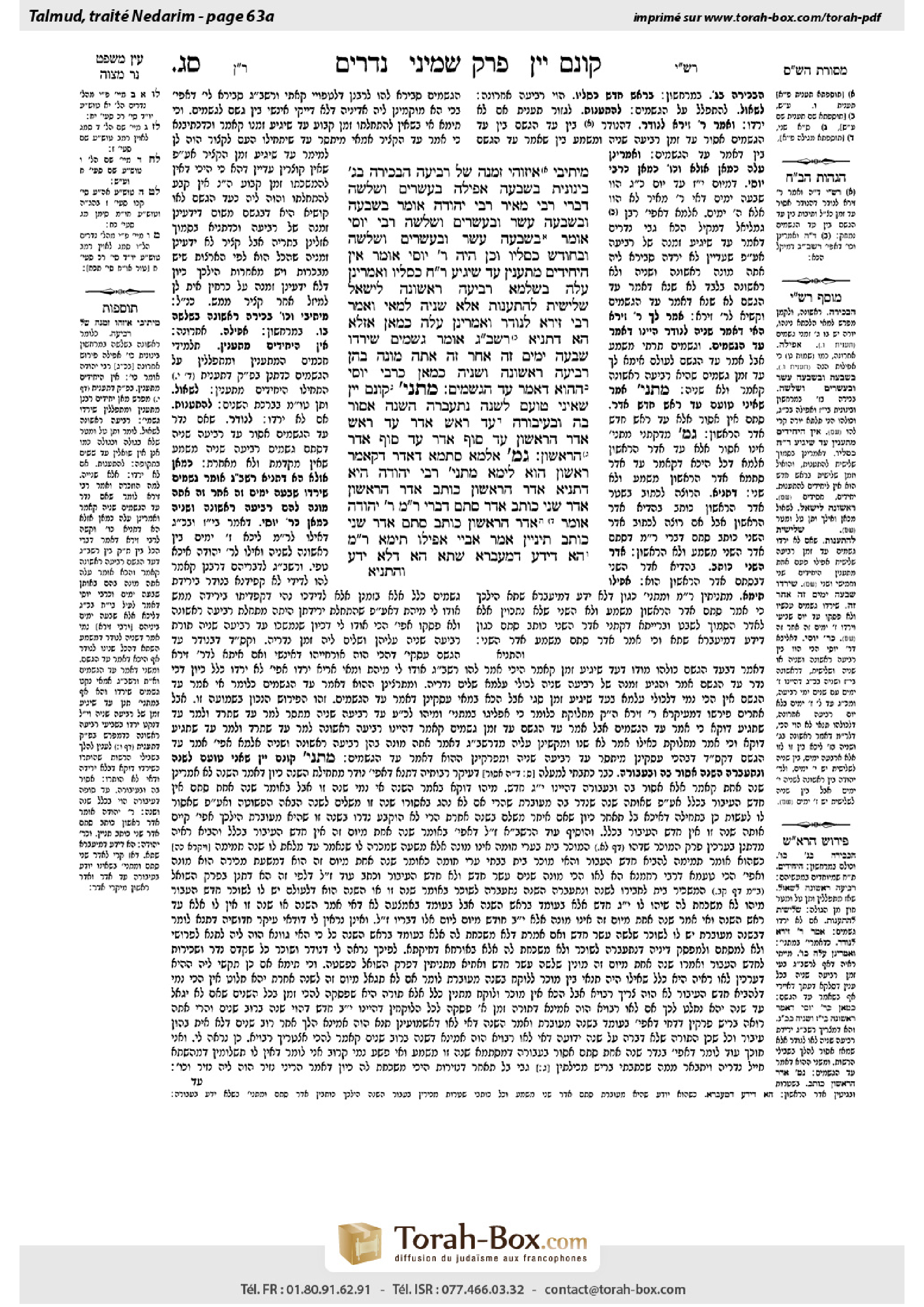
This page of Nedarim includes the Aramaic text, an English translation and an AI-generated French translation, alongside the scan above.
נדרים ס״ג א · Aramaic and Hebrew text
מֵיתִיבִי: אֵיזוֹהִי זְמַנָּהּ שֶׁל רְבִיעָה? הַבְּכִירָה — בִּשְׁלֹשָׁה, בֵּינוֹנִית — בְּשִׁבְעָה, אֲפִילָה — בְּעֶשְׂרִים וּשְׁלֹשָׁה, דִּבְרֵי רַבִּי מֵאִיר. רַבִּי יְהוּדָה אוֹמֵר: בְּשִׁבְעָה, וּבְשִׁבְעָה עָשָׂר, וּבְעֶשְׂרִים וּשְׁלֹשָׁה.
רַבִּי יוֹסֵי אוֹמֵר: בְּשִׁבְעָה עָשָׂר, וּבְעֶשְׂרִים וּשְׁלֹשָׁה, וּבְחוֹדֶשׁ כִּסְלֵיו. וְכֵן הָיָה רַבִּי יוֹסֵי אוֹמֵר: אֵין הַיְּחִידִים מִתְעַנִּין עַד שֶׁיַּגִּיעַ רֹאשׁ חֹדֶשׁ כִּסְלֵיו.
וְאָמְרִינַן עֲלַהּ: בִּשְׁלָמָא רְבִיעָה רִאשׁוֹנָה — לִישָּׁאֵל. שְׁלִישִׁית — לְהִתְעַנּוֹת. אֶלָּא שְׁנִיָּה לְמַאי? וְאָמַר רַבִּי זֵירָא: לְנוֹדֵר.
וְאָמְרִינַן עֲלַהּ: כְּמַאן אָזְלָא הָא דְּתַנְיָא, רַבָּן שִׁמְעוֹן בֶּן גַּמְלִיאֵל אוֹמֵר: גְּשָׁמִים שֶׁיָּרְדוּ שִׁבְעָה יָמִים זֶה אַחַר זֶה — אַתָּה מוֹנֶה בָּהֶן רְבִיעָה רִאשׁוֹנָה וּשְׁנִיָּה. כְּמַאן? כְּרַבִּי יוֹסֵי!
הַהוּא דְּאָמַר ״עַד הַגְּשָׁמִים״.
מַתְנִי׳ ״קֻוֽנָּם יַיִן שֶׁאֵינִי טוֹעֵם לְשָׁנָה״, נִתְעַבְּרָה הַשָּׁנָה — אָסוּר בָּהּ וּבְעִיבּוּרָהּ. ״עַד רֹאשׁ אֲדָר״ — עַד רֹאשׁ אֲדָר הָרִאשׁוֹן. ״עַד סוֹף אֲדָר״ — עַד סוֹף אֲדָר הָרִאשׁוֹן.
גְּמָ׳ אַלְמָא סְתָמָא דַּ״אֲדָר״ דְּקָאָמַר — רִאשׁוֹן הוּא.
לֵימָא מַתְנִיתִין רַבִּי יְהוּדָה הִיא, דְּתַנְיָא: אֲדָר הָרִאשׁוֹן — כּוֹתֵב ״אֲדָר הָרִאשׁוֹן״, אֲדָר שֵׁנִי — כּוֹתֵב ״אֲדָר״ סְתָם, דִּבְרֵי רַבִּי מֵאִיר. רַבִּי יְהוּדָה אוֹמֵר: אֲדָר הָרִאשׁוֹן — כּוֹתֵב סְתָם, אֲדָר שֵׁנִי — כּוֹתֵב ״תִּינְיָין״.
אָמַר אַבָּיֵי: אֲפִילּוּ תֵּימָא רַבִּי מֵאִיר, הָא דְּיָדַע דִּמְעַבְּרָא שַׁתָּא, הָא דְּלָא יָדַע.
Nedarim 63a · English translation
The Gemara raises an objection against the statement by Rabbi Zeira from the following baraita: When is the time of the rainfall? The early rainfall occurs on the third of the month of Marḥeshvan; the intermediate rainfall is on the seventh of the month, while the late rainfall is on the twenty-third of the month. This is the statement of Rabbi Meir. Rabbi Yehuda says: The respective dates are on the seventh, on the seventeenth, and on the twenty-third of Marḥeshvan.
Rabbi Yosei says: The first two time periods are on the seventeenth and on the twenty-third of Marḥeshvan, and the last period is at the beginning of the month of Kislev. And so too, Rabbi Yosei would say: The learned individuals, who would start to fast due to a drought at an earlier time than the rest of the community, do not start to fast until the New Moon of Kislev arrives and no rain has fallen.
And we say about this: Granted, they disagreed over the time of the first rainfall, as this time is relevant with regard to asking for rain through prayer. The time when the third rainfall is expected is relevant with regard to fasting due to lack of rain. But as for the expected time for the second rainfall, for what purpose did they disagree about its date? And Rabbi Zeira said: It is significant for one who vows until the rain.
And furthermore, we say about this: In accordance with whose opinion is that which is taught in the baraita: Rabban Shimon ben Gamliel says: In the case of rains that fell for seven days, one after another, you count them as the first rainfall and the second. In accordance with whose opinion is this statement? In accordance with the opinion of Rabbi Yosei, who is the only tanna who holds that the first and second periods of rainfall span seven days. It is evident from this discussion that Rabban Shimon ben Gamliel argues that one who vows until the rain must wait until after the second actual rainfall. This contradicts the statement of Rabbi Zeira that until the rain is referring to the date when rain is supposed to fall.
The Gemara answers: That baraita is referring to one who said: Until the rains, rather than: Until the rain. Consequently, the expiration of his vow is determined by the actual time of rainfall.
MISHNA: In the case of one who said: Wine is konam for me, and for that reason I will not taste it for the entire year, if the year was extended, i.e., it was declared to be a leap year, he is prohibited from drinking wine during the year and its intercalated month. If he vowed until the beginning of the month of Adar, the vow remains in effect until the beginning of the first Adar. Similarly, if he says that his vow applies until the end of Adar, the vow remains in effect until the end of the first Adar.
GEMARA: The Gemara comments on the statement in the mishna that if one takes a vow until the beginning of Adar, it remains in effect until the beginning of the first Adar. Apparently, when one says Adar without specification, his statement is understood as a reference to the first Adar.
The Gemara asks: Shall we say that the mishna is in accordance with the opinion of Rabbi Yehuda? As it is taught in a baraita: In the first month of Adar, when dating a document, one writes that the document was composed in the first Adar. During the second Adar, one writes the name of the month of Adar without specification; this is the statement of Rabbi Meir. Rabbi Yehuda says the reverse: During the first Adar one writes the name of the month without specification, and in the second Adar he writes that the document was composed in the second Adar.
Abaye said: You can even say that the mishna is in accordance with the opinion of Rabbi Meir, as there is a difference between the cases: In this baraita, the case is one where the individual who took the vow knew that the year was extended, i.e., declared as a leap year, and the disagreement concerns which Adar is considered the principal one. Conversely, that mishna is referring to a case where he did not know that it is a leap year and that there are two months of Adar. Consequently, when he referred to Adar, all agree that he meant the first Adar.
Nedarim 63a · Traduction française (IA)
La Guemara soulève une objection à l’affirmation de Rabbi Zeira à partir de la baraïta suivante : Quand tombent les pluies ? La première pluie tombe le trois Marḥeshvan, la pluie intermédiaire le sept du mois et la pluie tardive le vingt-trois du mois. Telle est l’opinion de Rabbi Meïr. Rabbi Yehouda dit : les dates respectives sont le sept, le dix-sept et le vingt-trois Marḥeshvan.
Rabbi Yossi dit : les deux premières périodes tombent le dix-sept et le vingt-trois Marḥeshvan, et la dernière période commence au début du mois de Kislev. De même, Rabbi Yossi disait que les érudits, qui commencent à jeûner en raison d’une sécheresse plus tôt que le reste de la communauté, ne commencent à jeûner qu’à l’arrivée de la nouvelle lune de Kislev, si aucune pluie n’est tombée.
Et nous disons à ce sujet : il est compréhensible qu’ils soient en désaccord sur la date de la première pluie, puisque cette date est pertinente pour la demande de pluie dans la prière. La date prévue pour la troisième pluie est pertinente pour les jeûnes dus au manque de pluie. Mais à quoi sert leur désaccord sur la date prévue pour la deuxième pluie ? Rabbi Zeira a dit : elle importe pour celui qui fait un vœu jusqu’à la pluie.
Et nous disons encore à ce sujet : de qui relève l’enseignement de cette baraïta : « Rabban Shimon ben Gamliel dit : dans le cas de pluies tombées pendant sept jours consécutifs, on les compte comme la première et la deuxième pluie » ? De Rabbi Yossi, qui est le seul tanna à considérer que les première et deuxième périodes de pluie sont espacées de sept jours. Il ressort de cette discussion que Rabban Shimon ben Gamliel soutient que celui qui fait un vœu jusqu’à la pluie doit attendre que la deuxième pluie soit effectivement tombée. Cela contredit l’affirmation de Rabbi Zeira selon laquelle « jusqu’à la pluie » désigne la date à laquelle la pluie est censée tomber.
La Guemara répond : cette baraïta parle de celui qui a dit : « Jusqu’aux pluies », et non : « Jusqu’à la pluie ». Par conséquent, l’expiration de son vœu est déterminée par le moment où la pluie tombe effectivement.
MICHNA : Dans le cas de celui qui a dit : « Le vin m’est konam, et pour cette raison je n’en boirai pas pendant toute l’année », si l’année est prolongée, c’est-à-dire déclarée année embolismique, il lui est interdit de boire du vin pendant l’année et son mois intercalaire. S’il a fait un vœu jusqu’au début du mois d’Adar, le vœu reste en vigueur jusqu’au début du premier Adar. De même, s’il dit que son vœu s’applique jusqu’à la fin d’Adar, le vœu reste en vigueur jusqu’à la fin du premier Adar.
GUEMARA : La Guemara commente l’affirmation de la Michna selon laquelle, si quelqu’un fait un vœu jusqu’au début d’Adar, celui-ci reste en vigueur jusqu’au début du premier Adar. Apparemment, lorsqu’on dit « Adar » sans précision, on comprend qu’il s’agit du premier Adar.
La Guemara demande : faut-il en conclure que la Michna suit l’opinion de Rabbi Yehouda ? Car il est enseigné dans une baraïta : au cours du premier mois d’Adar, lorsqu’on date un document, on écrit qu’il a été rédigé pendant le premier Adar. Au cours du deuxième Adar, on écrit le nom du mois d’Adar sans autre précision ; telle est l’opinion de Rabbi Meïr. Rabbi Yehouda dit l’inverse : au cours du premier Adar, on écrit le nom du mois sans autre précision, et au cours du deuxième Adar, on écrit que le document a été rédigé pendant le deuxième Adar.
Abayé a dit : on peut même dire que la Michna suit l’opinion de Rabbi Meïr, car les cas diffèrent. Dans cette baraïta, il s’agit d’une personne qui a fait un vœu en sachant que l’année avait été prolongée, c’est-à-dire déclarée année embolismique, et le désaccord porte sur celui des deux mois d’Adar qui est considéré comme le mois principal. En revanche, cette Michna parle d’un cas où la personne ne savait pas que l’année était embolismique et qu’elle comptait deux mois d’Adar. Par conséquent, lorsqu’elle a dit « Adar », tous reconnaissent qu’elle entendait le premier Adar.
Traduction française générée par IA à partir de l’édition anglaise de Sefaria. Vérifie toujours un passage avec le texte source.
Text from Sefaria: William Davidson Edition - Vocalized Aramaic (CC BY NC); William Davidson Edition - English (CC BY NC).