Nedarim 64a: Talmud study for Daf Yomi
Daf Yomi is the daily study of one Talmud folio. Explore 37 tractates with scans, Hebrew text, Sefaria English and AI-generated French translations where annotated.
Passage selection and English or AI-generated French translation are available where the scan has annotations. Daf Study is independent of Torah-Box and Sefaria.
Browse Nedarim · נדרים · All tractatesNedarim 64a text and translations
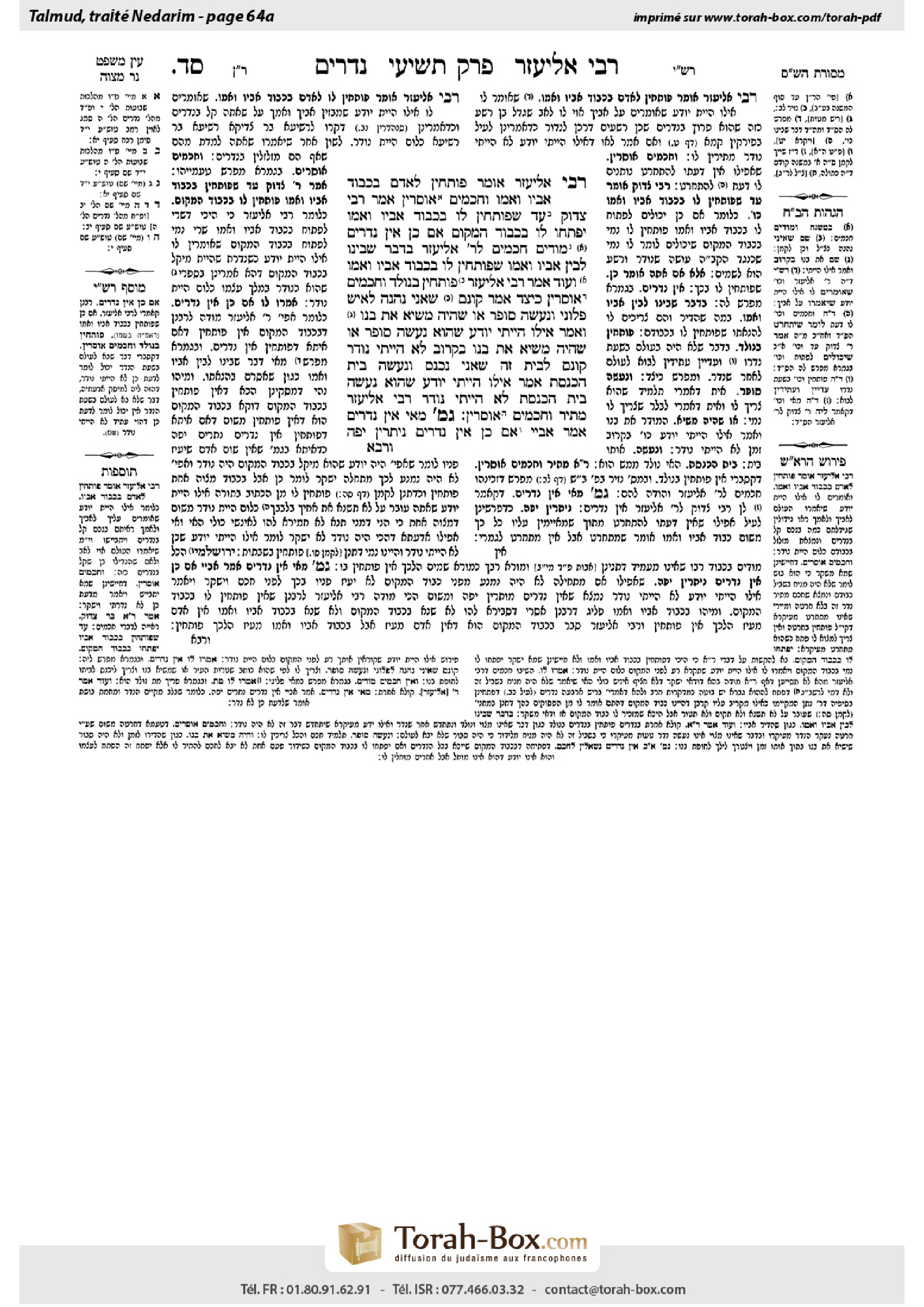
This page of Nedarim includes the Aramaic text, an English translation and an AI-generated French translation, alongside the scan above.
נדרים ס״ד א · Aramaic and Hebrew text
רַבִּי אֱלִיעֶזֶר אוֹמֵר: פּוֹתְחִין לְאָדָם בִּכְבוֹד אָבִיו וְאִמּוֹ, וַחֲכָמִים אוֹסְרִין.
אָמַר רַבִּי צָדוֹק: עַד שֶׁפּוֹתְחִין לוֹ בִּכְבוֹד אָבִיו וְאִמּוֹ, יִפְתְּחוּ לוֹ בִּכְבוֹד הַמָּקוֹם, אִם כֵּן — אֵין נְדָרִים! מוֹדִים חֲכָמִים לְרַבִּי אֱלִיעֶזֶר בְּדָבָר שֶׁבֵּינוֹ לְבֵין אָבִיו וְאִמּוֹ, שֶׁפּוֹתְחִין לוֹ בִּכְבוֹד אָבִיו וְאִמּוֹ.
וְעוֹד אָמַר רַבִּי אֱלִיעֶזֶר: פּוֹתְחִין בַּנּוֹלָד, וַחֲכָמִים אוֹסְרִין. כֵּיצַד? אָמַר: ״קֻוֽנָּם שֶׁאֲנִי נֶהֱנֶה לְאִישׁ פְּלוֹנִי״ וְנַעֲשָׂה סוֹפֵר, אוֹ שֶׁהָיָה מַשִּׂיא אֶת בְּנוֹ, וְאָמַר: ״אִילּוּ הָיִיתִי יוֹדֵעַ שֶׁהוּא נַעֲשֶׂה סוֹפֵר אוֹ שֶׁהָיָה מַשִּׂיא אֶת בְּנוֹ בְּקָרוֹב — לֹא הָיִיתִי נוֹדֵר״.
״קֻוֽנָּם לְבַיִת זֶה שֶׁאֲנִי נִכְנָס״ וְנַעֲשָׂה בֵּית הַכְּנֶסֶת, אָמַר: ״אִילּוּ הָיִיתִי יוֹדֵעַ שֶׁהוּא נַעֲשָׂה בֵּית הַכְּנֶסֶת — לֹא הָיִיתִי נוֹדֵר״. רַבִּי אֱלִיעֶזֶר מַתִּיר, וַחֲכָמִים אוֹסְרִין.
גְּמָ׳ מַאי ״אֵין נְדָרִים״? אָמַר אַבָּיֵי: אִם כֵּן, אֵין נְדָרִים נִיתָּרִין יָפֶה.
Nedarim 64a · English translation
MISHNA: Rabbi Eliezer says: When halakhic authorities are approached with regard to the dissolution of a vow, they may broach dissolution with a person who took a vow by raising the issue of how taking the vow ultimately degraded the honor of his father and mother, asking him the following: Had you known that your parents would experience public shame due to your lax attitude toward your vow, would you still have taken the vow? But the Rabbis disagree with Rabbi Eliezer and prohibit broaching dissolution of a vow with this particular question.
To support the opinion of the Rabbis, Rabbi Tzadok said: Instead of broaching dissolution with him by raising the issue of the honor of his father and mother, let them broach dissolution with him by raising the issue of the honor of the Omnipresent. They should point out that a vow taken in the name of God lessens the honor of God, so they could ask him: If you had known that your vow would diminish the honor of God, would you have taken your vow? And if so, if this is a valid method of broaching dissolution, there are no vows. Nevertheless, the Rabbis concede to Rabbi Eliezer with regard to a vow concerning a matter that is between him and his father and mother, that they may broach dissolution with him by raising the issue of the honor of his father and mother, as in this case the extenuation is connected to this particular vow.
And Rabbi Eliezer further said: They may broach dissolution by asking about a new situation, but the Rabbis prohibit it. How might they broach dissolution by asking about a new situation? If one said: It is forbidden to me like an offering [konam] that I will therefore not derive benefit from so-and-so, and that person later became a scribe [sofer], and the one who took the vow now requires his services, or if the one forbidden by the vow was marrying off his son and prepared a feast for all the residents of his town, and the one that had taken the vow said: Had I known that he would become a scribe, or that he would be marrying off his son in the near future, I would not have vowed.
The mishna cites another example of a new situation. If one said: Entering this house is konam for me, and that house became a synagogue, and he said: Had I known that it would become a synagogue, I would not have vowed, in this and all such cases Rabbi Eliezer permits the halakhic authority to use this as a basis for the dissolution of the vow, and the Rabbis prohibit it.
GEMARA: The Gemara clarifies the meaning of the statement made by Rabbi Tzadok. What does: If so, there are no vows, mean? Abaye said: It means: If so, vows are not dissolved properly. The one who took the vow might say he regrets doing so only because he is not willing to publicly state that he would have taken his vow despite knowing that it diminishes the honor of God. He may not actually regret having taken the vow, and this will lead to the improper dissolution of the vow.
Nedarim 64a · Traduction française (IA)
MICHNA : Rabbi Eliezer dit : Lorsque des autorités halakhiques sont saisies d’une demande d’annulation d’un vœu, elles peuvent en proposer la dissolution à celui qui l’a prononcé en lui faisant remarquer que son attitude désinvolte envers son vœu a finalement porté atteinte à l’honneur de son père et de sa mère. Elles peuvent lui demander : « Si tu avais su que tes parents seraient publiquement couverts de honte à cause de ton attitude désinvolte envers ton vœu, l’aurais-tu tout de même prononcé ? » Mais les Rabbins sont en désaccord avec Rabbi Eliezer et interdisent de proposer la dissolution d’un vœu au moyen de cette question particulière.
Pour appuyer l’opinion des Rabbins, Rabbi Tsadok dit : Au lieu de proposer la dissolution en soulevant la question de l’honneur de son père et de sa mère, qu’ils la proposent en soulevant celle de l’honneur du Tout-Puissant. Ils devraient lui faire remarquer qu’un vœu prononcé au nom de Dieu amoindrit l’honneur de Dieu ; ils pourraient donc lui demander : « Si tu avais su que ton vœu amoindrirait l’honneur de Dieu, l’aurais-tu prononcé ? » Et si tel est le cas, si cette manière de proposer la dissolution est valable, alors il n’y a plus de vœux. Néanmoins, les Rabbins reconnaissent le bien-fondé de l’opinion de Rabbi Eliezer au sujet d’un vœu portant sur une affaire entre celui qui l’a prononcé et son père et sa mère : ils peuvent lui proposer la dissolution en soulevant la question de l’honneur de ses parents, car, dans ce cas, le motif d’allègement est lié à ce vœu particulier.
Rabbi Eliezer dit également : Ils peuvent proposer la dissolution en interrogeant la personne au sujet d’une situation nouvelle, mais les Rabbins l’interdisent. Comment peuvent-ils proposer la dissolution en interrogeant au sujet d’une situation nouvelle ? Si quelqu’un a dit : « Il m’est interdit, comme une offrande [konam], de tirer profit d’untel », et que cette personne est ensuite devenue scribe [sofer], si bien que celui qui a prononcé le vœu a maintenant besoin de ses services ; ou si la personne dont le vœu interdit de tirer profit marie son fils et prépare un festin pour tous les habitants de sa ville, celui qui a prononcé le vœu dit : « Si j’avais su qu’il deviendrait scribe, ou qu’il marierait son fils dans un avenir proche, je n’aurais pas prononcé ce vœu. »
La Michna cite un autre exemple de situation nouvelle. Si quelqu’un a dit : « Il m’est interdit d’entrer dans cette maison, comme un konam », et que cette maison est devenue une synagogue, puis qu’il dit : « Si j’avais su qu’elle deviendrait une synagogue, je n’aurais pas prononcé ce vœu », dans ce cas, comme dans tous les cas semblables, Rabbi Eliezer autorise l’autorité halakhique à s’appuyer sur cela pour annuler le vœu, tandis que les Rabbins l’interdisent.
GUEMARA : La Guemara précise le sens de la déclaration de Rabbi Tsadok. Que signifie : « Si tel est le cas, il n’y a plus de vœux » ? Abayé dit : Cela signifie que, dans ce cas, les vœux ne sont pas annulés correctement. Celui qui a prononcé le vœu pourrait prétendre le regretter uniquement parce qu’il ne veut pas déclarer publiquement qu’il l’aurait prononcé même en sachant qu’il amoindrit l’honneur de Dieu. Il se peut qu’en réalité il ne regrette pas d’avoir prononcé le vœu, ce qui entraînerait une annulation irrégulière du vœu.
Traduction française générée par IA à partir de l’édition anglaise de Sefaria. Vérifie toujours un passage avec le texte source.
Text from Sefaria: William Davidson Edition - Vocalized Aramaic (CC BY NC); William Davidson Edition - English (CC BY NC).