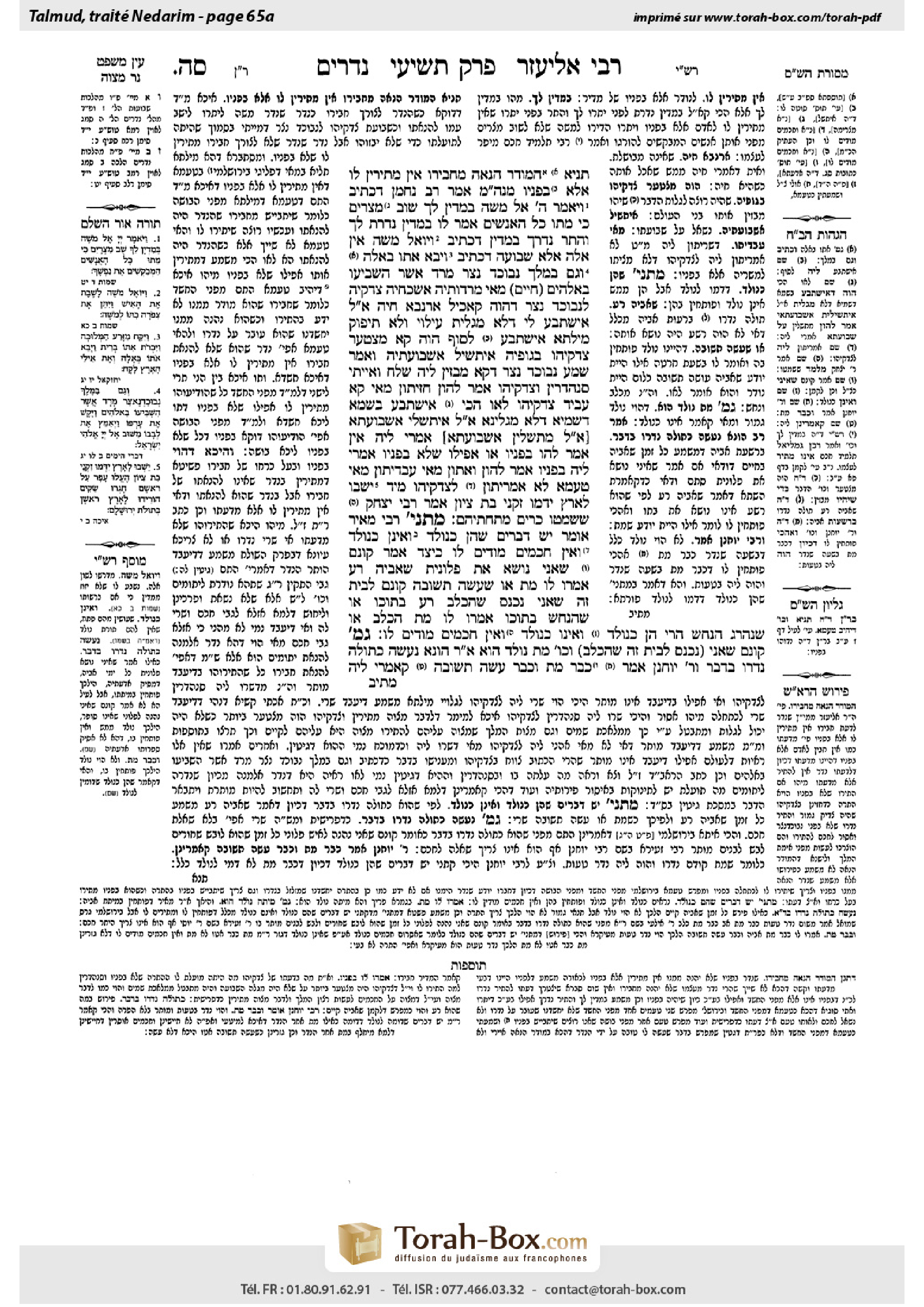
Nedarim 65a: Talmud study for Daf Yomi
Daf Yomi is the daily study of one Talmud folio. Explore 37 tractates with scans, Hebrew text, Sefaria English and AI-generated French translations where annotated.
Passage selection and English or AI-generated French translation are available where the scan has annotations. Daf Study is independent of Torah-Box and Sefaria.
Browse Nedarim · נדרים · All tractatesNedarim 65a text and translations
This page of Nedarim includes the Aramaic text, an English translation and an AI-generated French translation, alongside the scan above.
נדרים ס״ה א · Aramaic and Hebrew text
תַּנְיָא: הַמּוּדָּר הֲנָאָה מֵחֲבֵירוֹ אֵין מַתִּירִין לוֹ אֶלָּא בְּפָנָיו. מְנָא הָנֵי מִילֵּי? אָמַר רַב נַחְמָן: דִּכְתִיב: ״וַיֹּאמֶר ה׳ אֶל מֹשֶׁה בְּמִדְיָן לֵךְ שֻׁב מִצְרָיִם כִּי מֵתוּ כׇּל הָאֲנָשִׁים״. אָמַר לוֹ: בְּמִדְיָן נָדַרְתָּ — לֵךְ וְהַתֵּר נִדְרְךָ בְּמִדְיָן. דִּכְתִיב: ״וַיּוֹאֶל מֹשֶׁה״ — אֵין אָלָה אֶלָּא שְׁבוּעָה, דִּכְתִיב: ״וַיָּבֵא אֹתוֹ בְּאָלָה״.
״וְגַם בַּמֶּלֶךְ נְבוּכַדְנֶאצַּר מָרָד אֲשֶׁר הִשְׁבִּיעוֹ בֵּאלֹהִים (חַיִּים)״. מַאי מַרְדּוּתֵיהּ? אַשְׁכְּחֵיהּ צִדְקִיָּה לִנְבוּכַדְנֶצַּר דַּהֲוָה קָאָכֵיל אַרְנְבָא חַיָּה. אֲמַר לֵיהּ: אִישְׁתְּבַע לִי דְּלָא מְגַלֵּית עִילָּוַי וְלָא תִּיפּוֹק מִילְּתָא. אִישְׁתְּבַע.
לְסוֹף הֲוָה קָא מִצְטַעַר צִדְקִיָּהוּ בְּגוּפֵיהּ. אִיתְּשִׁיל אַשְּׁבוּעֲתֵיהּ, וַאֲמַר. שְׁמַע נְבוּכַדְנֶצַּר דְּקָא מְבַזִּין לֵיהּ, שְׁלַח וְאַיְיתִי סַנְהֶדְרִין וְצִדְקִיָּהוּ. אֲמַר לְהוֹן: חֲזֵיתוּן מַאי קָא עָבֵיד צִדְקִיָּהוּ? לָאו הָכִי אִישְׁתְּבַע בִּשְׁמָא דִשְׁמַיָּא דְּ״לָא מְגַלֵּינָא״? אֲמַר לֵיהּ: אִיתְּשַׁלִי אַשְּׁבוּעֲתָא.
[אֲמַר לְהוּ: מִתַּשְׁלִין אַשְּׁבוּעֲתָא?] אָמְרִי לֵיהּ: אִין. אֲמַר לְהוּ: בְּפָנָיו, אוֹ אֲפִילּוּ שֶׁלֹּא בְּפָנָיו? אָמְרִי לֵיהּ: בְּפָנָיו. אֲמַר לְהוֹן: וְאַתּוּן מַאי עָבְדִיתוּן, מַאי טַעְמָא לָא אָמְרִיתוּן לְצִדְקִיָּהוּ? מִיָּד ״יֵשְׁבוּ לָאָרֶץ יִדְּמוּ זִקְנֵי בַת צִיּוֹן״. אָמַר רַבִּי יִצְחָק: שֶׁשָּׁמְטוּ כָּרִים מִתַּחְתֵּיהֶם.
מַתְנִי׳ רַבִּי מֵאִיר אוֹמֵר: יֵשׁ דְּבָרִים שֶׁהֵן כַּנּוֹלָד וְאֵינָן כַּנּוֹלָד, וְאֵין חֲכָמִים מוֹדִים לוֹ. כֵּיצַד? אָמַר ״קֻוֽנָּם שֶׁאֲנִי נוֹשֵׂא אֶת פְּלוֹנִית, שֶׁאָבִיהָ רַע״, אָמְרוּ לוֹ: מֵת, אוֹ שֶׁעָשָׂה תְּשׁוּבָה. ״קֻוֽנָּם לְבַיִת זֶה שֶׁאֲנִי נִכְנָס, שֶׁהַכֶּלֶב רַע בְּתוֹכוֹ״, אוֹ ״שֶׁהַנָּחָשׁ בְּתוֹכוֹ״, אָמְרוּ לוֹ: מֵת הַכֶּלֶב, אוֹ שֶׁנֶּהֱרַג הַנָּחָשׁ — הֲרֵי הֵן כַּנּוֹלָד, וְאֵינוֹ כַּנּוֹלָד. וְאֵין חֲכָמִים מוֹדִים לוֹ.
גְּמָ׳ ״קֻוֽנָּם שֶׁאֲנִי נִכְנָס לְבַיִת זֶה שֶׁהַכֶּלֶב וְכוּ׳״ — מֵת נוֹלָד הוּא! אָמַר רַב הוּנָא: נַעֲשָׂה כְּתוֹלֶה נִדְרוֹ בְּדָבָר. וְרַבִּי יוֹחָנָן אָמַר: כְּבָר מֵת וּכְבָר עָשָׂה תְּשׁוּבָה, קָאָמְרִי לֵיהּ.
Nedarim 65a · English translation
§ It is taught in a baraita (Tosefta 2:12): With regard to one prohibited by a vow from deriving benefit from another, they dissolve the vow for him only in the presence of the one who is the subject of the vow. The Gemara asks: From where are these matters derived? Rav Naḥman said: As it is written: “And the Lord said to Moses in Midian: Go, return to Egypt; for all the men are dead” (Exodus 4:19). Rav Naḥman notes that the verse specifies where God spoke to Moses, and explains that God said to him: In Midian you vowed to Yitro that you would not return to Egypt, go and dissolve your vow in Midian. And where does it say that Moses vowed to Yitro? For it is written: “And Moses was content [vayo’el] to dwell with the man” (Exodus 2:21). The word vayo’el is related to the word ala, and ala means nothing other than an oath, as it is written: “And he…brought him under an oath [ala]” (Ezekiel 17:13), and the halakhot of dissolution of oaths are identical to those of dissolution of vows.
The Gemara cites another proof that one may dissolve such a vow or oath only in the presence of the party affected by the vow or oath. It states with regard to King Zedekiah: “And he also rebelled against King Nebuchadnezzar, who had made him swear by God” (II Chronicles 36:13). The Gemara asks: What was his rebellion? The Gemara answers: Zedekiah found Nebuchadnezzar eating a live rabbit, and the latter was ashamed to be seen doing this. He said to him: Take an oath to me that you will not reveal my behavior and this matter will not emerge in public. Zedekiah took an oath to him.
Later, Zedekiah was physically suffering, as he wanted to tell people what he had seen, but he could not do so due to his oath. He requested dissolution of his oath from the judges of the Sanhedrin, who dissolved it for him, and he publicly said what he had witnessed. Nebuchadnezzar heard that he was being ridiculed for his behavior. He sent for and brought the Sanhedrin and Zedekiah before him. He said to them: Did you see what Zedekiah has done? Did he not take an oath in the name of Heaven: That I will not reveal? They said to him: He requested dissolution of the oath.
He said to them: Can one request the dissolution of an oath? They said to him: Yes. He said to them: Must this be done in the presence of the person he took an oath to, or even not in his presence? They said to him: It must be dissolved in his presence. He said to them: And you, what did you do? What is the reason you did not say to Zedekiah that he can have his oath dissolved only in my presence? Immediately, they fulfilled the verse: “They sit upon the ground, and keep silence, the elders of the daughter of Zion” (Lamentations 2:10). Rabbi Yitzḥak said: This means that they removed the cushions upon which they sat from underneath them, as a sign that they had erred in halakha.
MISHNA: As a continuation of the opinion of the Rabbis in the previous mishna that they may not broach dissolution of a vow based on a new situation, Rabbi Meir says: There are matters that are, at first glance, like a new situation but are not in fact like a new situation, and the Rabbis do not concede to him. How so? For example, one said: Marrying so-and-so is konam for me, as her father is evil, and they told him that her father died, or that he repented. Or he said: Entering this house is konam for me, as there is a bad dog inside it, or a snake inside it, and they told him that the dog died, or that the snake was killed. This is at first glance perceived like a new situation, and yet it is not in fact like a new situation, and this claim may be used to broach dissolution. But the Rabbis do not concede to him.
GEMARA: The mishna taught that according to Rabbi Meir certain matters are similar to, but in fact do not constitute a new situation, such as a vow which states: Entering this house is konam for me, as there is a bad dog there, where the halakha is that if the dog dies, it is not considered to be a new situation. The Gemara asks: Certainly death is a new situation. Rav Huna said: He is considered like one who makes his vow dependent on a matter. In other words, his vow is interpreted as conditional, that he will not enter the house as long as the dog is alive, for he explicitly stated that this was the reason for his vow. Therefore, when the dog dies, the vow is dissolved. And Rabbi Yoḥanan said it means that they say to him: The dog had already died, or: The father had already repented, before the vow, and it was a mistaken vow from the outset that never took effect.
Nedarim 65a · Traduction française (IA)
§ Il est enseigné dans une baraïta (Tosefta 2:12) : Lorsqu’un homme s’est interdit par un vœu de tirer profit d’autrui, on ne lui délie son vœu qu’en présence de celui qui en est l’objet. La Guemara demande : D’où tire-t-on ces règles ? Rav Naḥman dit : Comme il est écrit : « Le Seigneur dit à Moïse, en Madian : Va, retourne en Égypte, car tous les hommes sont morts » (Exode 4:19). Rav Naḥman relève que le verset précise où Dieu parla à Moïse et explique que Dieu lui dit : En Madian, tu as fait le vœu à Yitro de ne pas retourner en Égypte ; va donc faire délier ton vœu en Madian. Où est-il écrit que Moïse fit un vœu à Yitro ? Car il est écrit : « Moïse consentit [vayo’el] à demeurer avec cet homme » (Exode 2:21). Le mot vayo’el est apparenté au mot ala, et ala ne signifie rien d’autre qu’un serment, comme il est écrit : « Il le […] fit prêter serment [ala] » (Ézéchiel 17:13) ; or, les règles de la déliaison des serments sont identiques à celles de la déliaison des vœux.
La Guemara cite une autre preuve qu’on ne peut délier un tel vœu ou serment qu’en présence de la personne concernée par le vœu ou le serment. À propos du roi Sédécias, il est écrit : « Il se révolta aussi contre le roi Nabuchodonosor, qui lui avait fait prêter serment par Dieu » (II Chroniques 36:13). La Guemara demande : En quoi consistait sa révolte ? Elle répond : Sédécias surprit Nabuchodonosor en train de manger un lapin vivant, et celui-ci eut honte qu’on le voie ainsi. Il lui dit : Jure-moi que tu ne révéleras pas mon comportement et que cette affaire ne sera pas divulguée publiquement. Sédécias lui prêta serment.
Par la suite, Sédécias souffrait physiquement, car il voulait raconter aux gens ce qu’il avait vu, mais son serment l’en empêchait. Il demanda aux juges du Sanhédrin de délier son serment, et ils le firent ; il raconta alors publiquement ce dont il avait été témoin. Nabuchodonosor apprit qu’on se moquait de lui à cause de son comportement. Il fit venir le Sanhédrin et Sédécias devant lui. Il leur dit : Avez-vous vu ce que Sédécias a fait ? N’a-t-il pas prêté serment au nom du Ciel : « Je ne révélerai pas » ? Ils lui répondirent : Il a demandé la déliaison de son serment.
Il leur dit : Peut-on demander la déliaison d’un serment ? Ils lui répondirent : Oui. Il leur dit : Faut-il le faire en présence de celui à qui l’on a prêté serment, ou peut-on aussi le faire en son absence ? Ils lui répondirent : Il faut le délier en sa présence. Il leur dit : Et vous, qu’avez-vous fait ? Pourquoi n’avez-vous pas dit à Sédécias qu’il ne pouvait faire délier son serment qu’en ma présence ? Aussitôt, ils accomplirent le verset : « Ils sont assis à terre et se taisent, les anciens de la fille de Sion » (Lamentations 2:10). Rabbi Yitzḥak dit : Cela signifie qu’ils retirèrent de dessous eux les coussins sur lesquels ils étaient assis, en signe qu’ils s’étaient trompés dans la halakha.
MICHNA : Dans le prolongement de l’opinion des Rabbins, dans la Michna précédente, selon laquelle on ne peut suggérer la déliaison d’un vœu en s’appuyant sur une situation nouvelle, Rabbi Meïr dit : Il existe des cas qui, à première vue, ressemblent à une situation nouvelle, mais qui n’en sont pas réellement une, et les Rabbins ne sont pas d’accord avec lui. De quoi s’agit-il ? Par exemple, quelqu’un a dit : « Épouser telle femme m’est interdit par un konam, car son père est méchant », puis on lui a annoncé que son père était mort ou s’était repenti. Ou bien il a dit : « Entrer dans cette maison m’est interdit par un konam, car il y a un chien dangereux à l’intérieur », ou encore « car il y a un serpent à l’intérieur », puis on lui a annoncé que le chien était mort ou que le serpent avait été tué. À première vue, cela ressemble à une situation nouvelle, mais ce n’en est pas réellement une ; cet argument peut donc servir à suggérer la déliaison. Toutefois, les Rabbins ne sont pas d’accord avec lui.
GUEMARA : La Michna enseignait que, selon Rabbi Meïr, certains cas ressemblent à une situation nouvelle sans en être réellement une. Par exemple, un vœu stipule : « Entrer dans cette maison m’est interdit par un konam, car il y a là un chien dangereux » ; si le chien meurt, cela n’est pas considéré comme une situation nouvelle. La Guemara demande : Pourtant, la mort constitue assurément une situation nouvelle. Rav Huna dit : On considère que l’homme a subordonné son vœu à une condition. Autrement dit, son vœu s’interprète comme étant conditionnel : il n’entrera pas dans la maison tant que le chien sera vivant, puisqu’il a explicitement indiqué que c’était la raison de son vœu. Par conséquent, lorsque le chien meurt, le vœu est annulé. Rabbi Yoḥanan dit que cela signifie qu’on lui dit : Le chien était déjà mort, ou le père s’était déjà repenti, avant le vœu ; celui-ci était donc erroné dès le départ et n’a jamais pris effet.
Traduction française générée par IA à partir de l’édition anglaise de Sefaria. Vérifie toujours un passage avec le texte source.
Text from Sefaria: William Davidson Edition - Vocalized Aramaic (CC BY NC); William Davidson Edition - English (CC BY NC).