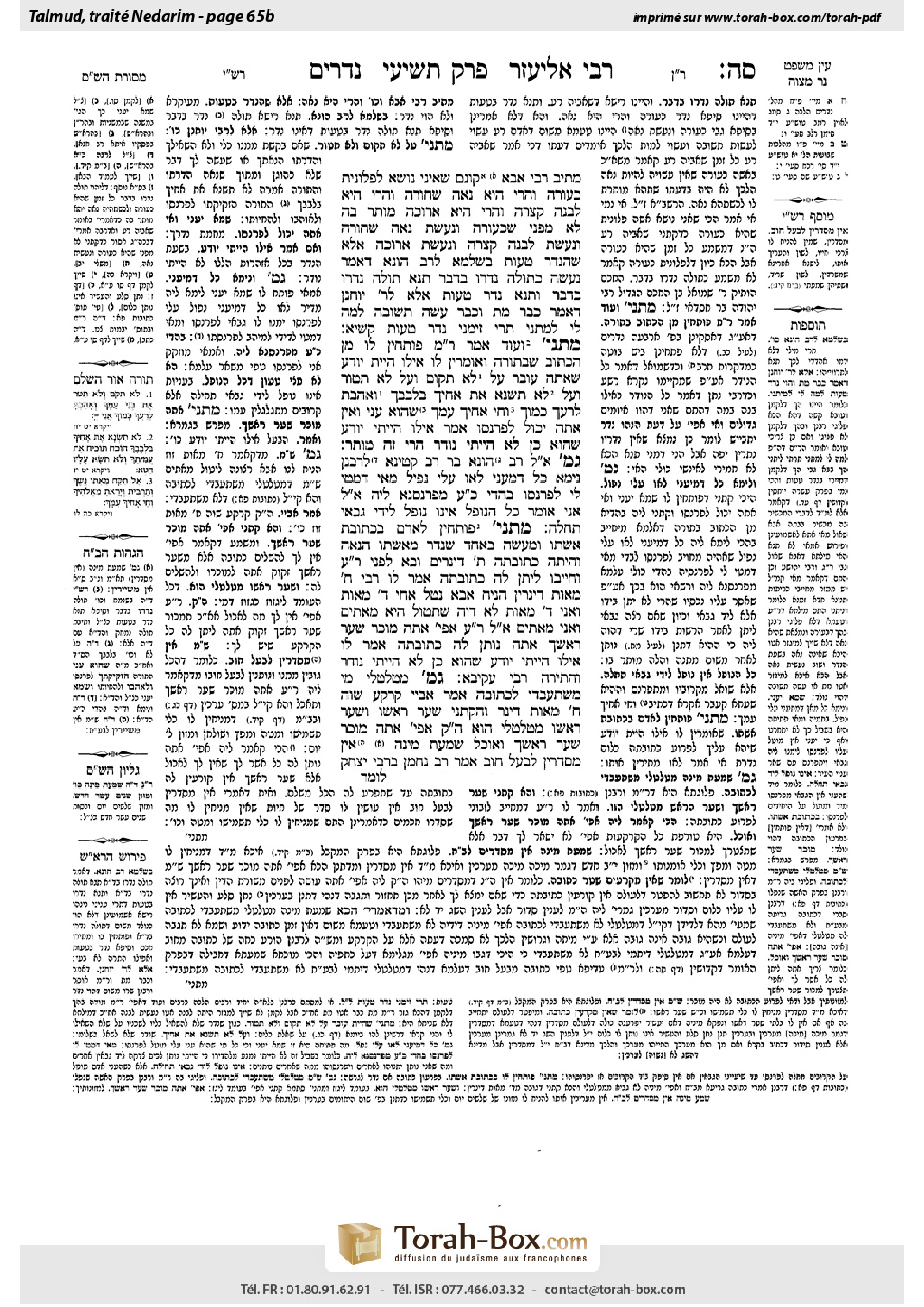
Nedarim 65b: Talmud study for Daf Yomi
Daf Yomi is the daily study of one Talmud folio. Explore 37 tractates with scans, Hebrew text, Sefaria English and AI-generated French translations where annotated.
Passage selection and English or AI-generated French translation are available where the scan has annotations. Daf Study is independent of Torah-Box and Sefaria.
Browse Nedarim · נדרים · All tractatesNedarim 65b text and translations
This page of Nedarim includes the Aramaic text, an English translation and an AI-generated French translation, alongside the scan above.
נדרים ס״ה ב · Aramaic and Hebrew text
מֵתִיב רַבִּי אַבָּא: ״קֻוֽנָּם שֶׁאֵינִי נוֹשֵׂא לִפְלוֹנִית כְּעוּרָה״, וַהֲרֵי הִיא נָאָה. ״שְׁחוֹרָה״, וַהֲרֵי הִיא לְבָנָה. ״קְצָרָה״, וַהֲרֵי הִיא אֲרוּכָּה — מוּתָּר בָּהּ. לֹא מִפְּנֵי שֶׁכְּעוּרָה וְנַעֲשֵׂת נָאֶה, שְׁחוֹרָה וְנַעֲשֵׂת לְבָנָה, קְצָרָה וְנַעֲשֵׂת אֲרוּכָּה — אֶלָּא שֶׁהַנֶּדֶר טָעוּת. בִּשְׁלָמָא לְרַב הוּנָא דְּאָמַר נַעֲשָׂה כְּתוֹלֶה נִדְרוֹ בְּדָבָר: תְּנָא תּוֹלֶה נִדְרוֹ בְּדָבָר, וּתְנָא נֶדֶר טָעוּת. אֶלָּא לְרַבִּי יוֹחָנָן, דְּאָמַר כְּבָר מֵת וּכְבָר עָשָׂה תְּשׁוּבָה, לְמָה לִי לְמִתְנֵי תְּרֵי זִימְנֵי נֶדֶר טָעוּת? קַשְׁיָא.
מַתְנִי׳ וְעוֹד אָמַר רַבִּי מֵאִיר: פּוֹתְחִין לוֹ מִן הַכָּתוּב שֶׁבַּתּוֹרָה, וְאוֹמְרִין לוֹ: אִילּוּ הָיִיתָ יוֹדֵעַ שֶׁאַתָּה עוֹבֵר עַל ״לֹא תִקֹּם״, וְעַל ״לֹא תִטֹּר״, וְעַל ״לֹא תִשְׂנָא אֶת אָחִיךָ בִּלְבָבֶךָ״, ״וְאָהַבְתָּ לְרֵעֲךָ כָּמוֹךָ״, ״וְחֵי אָחִיךָ עִמָּךְ״, שֶׁהוּא עָנִי וְאֵין אַתָּה יָכוֹל לְפַרְנָסוֹ. אָמַר: אִילּוּ הָיִיתִי יוֹדֵעַ שֶׁהוּא כֵּן, לֹא הָיִיתִי נוֹדֵר — הֲרֵי זֶה מוּתָּר.
גְּמָ׳ אָמַר לְהוּ רַב הוּנָא בַּר רַב קַטִּינָא לְרַבָּנַן: נֵימָא, כֹּל דְּמִעֲנֵי לָאו עֲלַי נָפֵיל. מַאי דְּמָטֵי לִי לְפַרְנְסוֹ — בַּהֲדֵי כּוּלֵּי עָלְמָא מְפַרְנַסְנָא לֵיהּ. אָמְרִי לֵיהּ: אֲנִי אוֹמֵר כׇּל הַנּוֹפֵל, אֵינוֹ נוֹפֵל לִידֵי גַבַּאי תְּחִלָּה.
מַתְנִי׳ פּוֹתְחִין לָאָדָם בִּכְתוּבַּת אִשְׁתּוֹ.
וּמַעֲשֶׂה בְּאֶחָד שֶׁנָּדַר מֵאִשְׁתּוֹ הֲנָאָה, וְהָיְתָה כְּתוּבָּתָהּ אַרְבַּע מֵאוֹת דִּינָרִים. וּבָא לִפְנֵי רַבִּי עֲקִיבָא, וְחִיְּיבוֹ לִיתֵּן לָהּ כְּתוּבָּתָהּ. אָמַר לוֹ: רַבִּי, שְׁמוֹנֶה מֵאוֹת דִּינָרִין הִנִּיחַ אַבָּא. נָטַל אָחִי אַרְבַּע מֵאוֹת, וַאֲנִי אַרְבַּע מֵאוֹת. לֹא דַּיָּה שֶׁתִּטּוֹל הִיא מָאתַיִם וַאֲנִי מָאתַיִם? אָמַר לוֹ רַבִּי עֲקִיבָא: אֲפִילּוּ אַתָּה מוֹכֵר שְׂעַר רֹאשְׁךָ — אַתָּה נוֹתֵן לָהּ כְּתוּבָּתָהּ. אָמַר לוֹ: אִילּוּ הָיִיתִי יוֹדֵעַ שֶׁהוּא כֵּן — לֹא הָיִיתִי נוֹדֵר. וְהִתִּירָהּ רַבִּי עֲקִיבָא.
גְּמָ׳ מִטַּלְטְלֵי מִי מִשְׁתַּעְבְּדִי לִכְתוּבָה? אָמַר אַבָּיֵי: קַרְקַע שָׁוָה שְׁמוֹנֶה מֵאוֹת דִּינָר. וְהָקָתָנֵי: ״שְׂעַר רֹאשׁוֹ״, וּשְׂעַר רֹאשׁוֹ מִטַּלְטְלֵי הוּא! הָכִי קָאָמַר: אֲפִילּוּ אַתָּה מוֹכֵר שְׂעַר רֹאשְׁךָ וְאוֹכֵל.
שָׁמְעַתְּ מִינַּהּ אֵין מְסַדְּרִין לְבַעַל חוֹב? אָמַר רַב נַחְמָן בְּרַבִּי יִצְחָק:
Nedarim 65b · English translation
Rabbi Abba raised an objection from a later mishna (66a): If one said: I will not marry ugly so-and-so as that is konam for me, and she is in fact beautiful, or if he called her black, and she is in fact white, or if he called her short, and she is in fact tall, he is permitted to her. Not because she was ugly and became beautiful, black and became white, or short and became tall, but rather, because the vow was mistaken from the outset. Granted, according to Rav Huna, who said that he is considered like one who makes his vow dependent on a matter, the mishna here taught the case of one who makes his vow dependent on a matter, and it taught there the case of a mistaken vow. But according to Rabbi Yoḥanan, who said that the mishna here is referring to a situation where the dog had already died, or the father had already repented, why do I need the mishna to teach the halakha of a mistaken vow twice? The Gemara comments: This is difficult.
MISHNA: And Rabbi Meir further said: The halakhic authorities may broach dissolution with him from that which is written in the Torah, and they may say to him: Had you known that through your vow you are transgressing the prohibition “you shall not take vengeance” (Leviticus 19:18) and the prohibition “nor bear any grudge” (Leviticus 19:18), and the prohibition “you shall not hate your brother in your heart” (Leviticus 19:17), and “you shall love your neighbor as yourself” (Leviticus 19:18), as well as “and your brother should live with you” (Leviticus 25:36), as he, the one prohibited by the vow, is poor and now you are not able to provide him with a livelihood due to your vow, would you have vowed in that case? If he said in reply: Had I known that it is so, that my vow involved all these prohibitions, I would not have vowed; it is dissolved.
GEMARA: Rav Huna bar Rav Ketina said to the Sages: But let the one who stated the vow say with regard to the last claim: All who become poor do not fall upon me; it is not my responsibility to provide for this specific poor person. What is placed upon me to provide for him together with everyone else, I will provide to him when I give money to those collecting for the communal charity fund. They said to him: I say that anyone who falls into poverty and requires assistance does not fall into the hands of the charity collector first. Rather, his descent begins when he encounters hard times, and it is at this stage that he may require individual, direct support to prevent him from plunging into a state of absolute poverty.
MISHNA: The halakhic authorities may broach dissolution with a man by raising the issue of his wife’s marriage contract. If one takes a vow that would require him to divorce his wife, e.g., he prohibits her from deriving benefit from him, his vow may be dissolved by asking him whether he had considered how difficult it would be to pay her marriage contract.
The mishna relates: And an incident occurred with regard to one who vowed against his wife deriving benefit from him, and her marriage contract was worth four hundred dinars. And he came before Rabbi Akiva, and he obligated him to give her the payment of her marriage contract. He said to Rabbi Akiva: My teacher, my father left eight hundred dinars as our inheritance, of which my brother took four hundred and I took four hundred. Isn’t it enough for my wife to take two hundred and I will have two hundred? Rabbi Akiva said to him: Your claim is not accepted, as even if you sell the hair on your head, you must give her the full payment of her marriage contract. He said to him: Had I known that it was so, that I would have to give her all my property, I would not have vowed. And Rabbi Akiva permitted her to derive benefit from him.
GEMARA: The Gemara questions the comment made by Rabbi Akiva, that even if the man were to sell the hair on his head, he must pay her the full sum of her marriage contract: Is movable property mortgaged for the payment of a marriage contract? The Rabbis maintain that only land owned by the husband is mortgaged for the payment of a marriage contract, so why should he have to sell the hair on his head? Abaye said: He said that the father had left land worth eight hundred dinars, and he received four hundred dinars’ worth of land, so all of his land is equal in value to his wife’s marriage contract. The Gemara raises a difficulty: But the mishna teaches that he must pay even from: The hair on his head, and the hair on his head is movable property. The Gemara answers: This is what he said: You must pay the marriage contract from the land even if you will need to sell the hair on your head and use the proceeds from the sale in order to eat, as you will have no other source of income.
The Gemara poses a question: Should you conclude from the mishna that arrangements are not made with a creditor, but instead, the entire sum is collected immediately, without reaching an agreement with the husband’s creditors to leave him some money to support himself? The Gemara refutes this suggestion: Rav Naḥman, son of Rabbi Yitzḥak, said:
Nedarim 65b · Traduction française (IA)
Rabbi Abba soulève une objection à partir d’une Michna ultérieure (66a) : Si quelqu’un dit : « Telle femme laide m’est interdite comme un konam », alors qu’elle est en réalité belle ; ou s’il la qualifie de noire alors qu’elle est en réalité blanche ; ou de petite alors qu’elle est en réalité grande, elle lui est permise. Non pas parce qu’elle aurait été laide avant de devenir belle, noire avant de devenir blanche, ou petite avant de devenir grande, mais parce que le vœu était erroné dès le départ. C’est cohérent selon Rav Houna, qui dit qu’il est considéré comme ayant fait dépendre son vœu d’une condition : la Michna enseigne ici le cas d’un vœu dépendant d’une condition et, là-bas, celui d’un vœu erroné. Mais selon Rabbi Yoḥanan, qui dit que la Michna traite ici d’une situation où le chien était déjà mort ou le père s’était déjà repenti, pourquoi la Michna devrait-elle enseigner deux fois la halakha du vœu erroné ? La Guemara fait remarquer : C’est difficile.
MICHNA : Rabbi Meïr a également dit : Les autorités halakhiques peuvent lui suggérer un motif de dissolution tiré de la Torah et lui dire : « Si tu avais su qu’en faisant ton vœu tu transgressais l’interdiction de te venger (Lévitique 19,18), celle de garder rancune (Lévitique 19,18) et celle de haïr ton frère dans ton cœur (Lévitique 19,17), ainsi que les commandements “Tu aimeras ton prochain comme toi-même” (Lévitique 19,18) et “Ton frère vivra avec toi” (Lévitique 25,36) — puisque celui à qui ton vœu interdit de tirer profit de toi est pauvre et que, du fait de ton vœu, tu ne peux pas lui assurer de quoi vivre — aurais-tu fait ce vœu ? » S’il répond : « Si j’avais su qu’il en était ainsi, que mon vœu m’impliquait dans toutes ces interdictions, je ne l’aurais pas fait », le vœu est dissous.
GUEMARA : Rav Houna bar Rav Ketina dit aux Sages : Mais que celui qui a prononcé le vœu réponde au sujet du dernier argument : « Tous ceux qui deviennent pauvres ne retombent pas à ma charge ; je ne suis pas tenu de subvenir aux besoins de ce pauvre en particulier. La part que je dois lui fournir, comme à tous les autres, je la lui donnerai lorsque je verserai de l’argent à ceux qui recueillent les dons pour le fonds de charité communautaire. » Ils lui répondirent : « Selon nous, celui qui tombe dans la pauvreté et a besoin d’aide ne commence pas par dépendre du collecteur de charité. Sa descente commence lorsqu’il traverse des moments difficiles ; c’est à ce stade qu’il peut avoir besoin d’un soutien direct et individuel pour l’empêcher de sombrer dans une pauvreté absolue. »
MICHNA : Les autorités halakhiques peuvent suggérer à un homme un motif de dissolution en soulevant la question de la ketouba de sa femme. Si quelqu’un fait un vœu qui l’obligerait à divorcer de sa femme — par exemple, s’il lui interdit de tirer profit de lui —, son vœu peut être dissous en lui demandant s’il avait envisagé la difficulté qu’il aurait à payer la ketouba.
La Michna rapporte : Un homme avait fait le vœu d’interdire à sa femme de tirer profit de lui, et sa ketouba s’élevait à quatre cents dinars. Il se présenta devant Rabbi Akiva, qui l’obligea à lui verser le montant de sa ketouba. Il dit à Rabbi Akiva : « Mon maître, mon père nous a laissé huit cents dinars en héritage ; mon frère en a pris quatre cents et moi quatre cents. Ne suffit-il pas que ma femme prenne deux cents et que je garde deux cents ? » Rabbi Akiva lui dit : « Ta demande n’est pas recevable, car même si tu vends les cheveux de ta tête, tu dois lui verser la totalité du montant de sa ketouba. » Il lui dit : « Si j’avais su qu’il en serait ainsi, que je devrais lui donner tous mes biens, je n’aurais pas fait ce vœu. » Rabbi Akiva lui permit alors de tirer profit de lui.
GUEMARA : La Guemara s’interroge sur la remarque de Rabbi Akiva, selon laquelle l’homme devait payer la totalité de la ketouba de sa femme même s’il devait vendre les cheveux de sa tête : les biens mobiliers sont-ils grevés en garantie du paiement d’une ketouba ? Les Sages estiment que seuls les biens fonciers appartenant au mari sont grevés en garantie du paiement d’une ketouba ; pourquoi devrait-il donc vendre les cheveux de sa tête ? Abayé dit : Le père avait laissé des terres d’une valeur de huit cents dinars, et l’homme avait reçu des terres d’une valeur de quatre cents dinars ; toutes ses terres équivalaient donc à la valeur de la ketouba de sa femme. La Guemara soulève une difficulté : Pourtant, la Michna enseigne qu’il doit payer même avec les cheveux de sa tête, et les cheveux de sa tête sont des biens mobiliers. La Guemara répond : Voici ce qu’il lui a dit : « Tu dois payer la ketouba sur tes terres, même si tu dois vendre les cheveux de ta tête et utiliser le produit de cette vente pour te nourrir, car tu n’auras pas d’autre source de revenus. »
La Guemara pose une question : Faut-il conclure de la Michna qu’aucun arrangement n’est conclu avec un créancier, mais que la somme entière est recouvrée immédiatement, sans qu’un accord soit conclu avec les créanciers du mari pour lui laisser de quoi subvenir à ses besoins ? La Guemara réfute cette suggestion : Rav Naḥman, fils de Rabbi Yitzḥak, dit :
Traduction française générée par IA à partir de l’édition anglaise de Sefaria. Vérifie toujours un passage avec le texte source.
Text from Sefaria: William Davidson Edition - Vocalized Aramaic (CC BY NC); William Davidson Edition - English (CC BY NC).