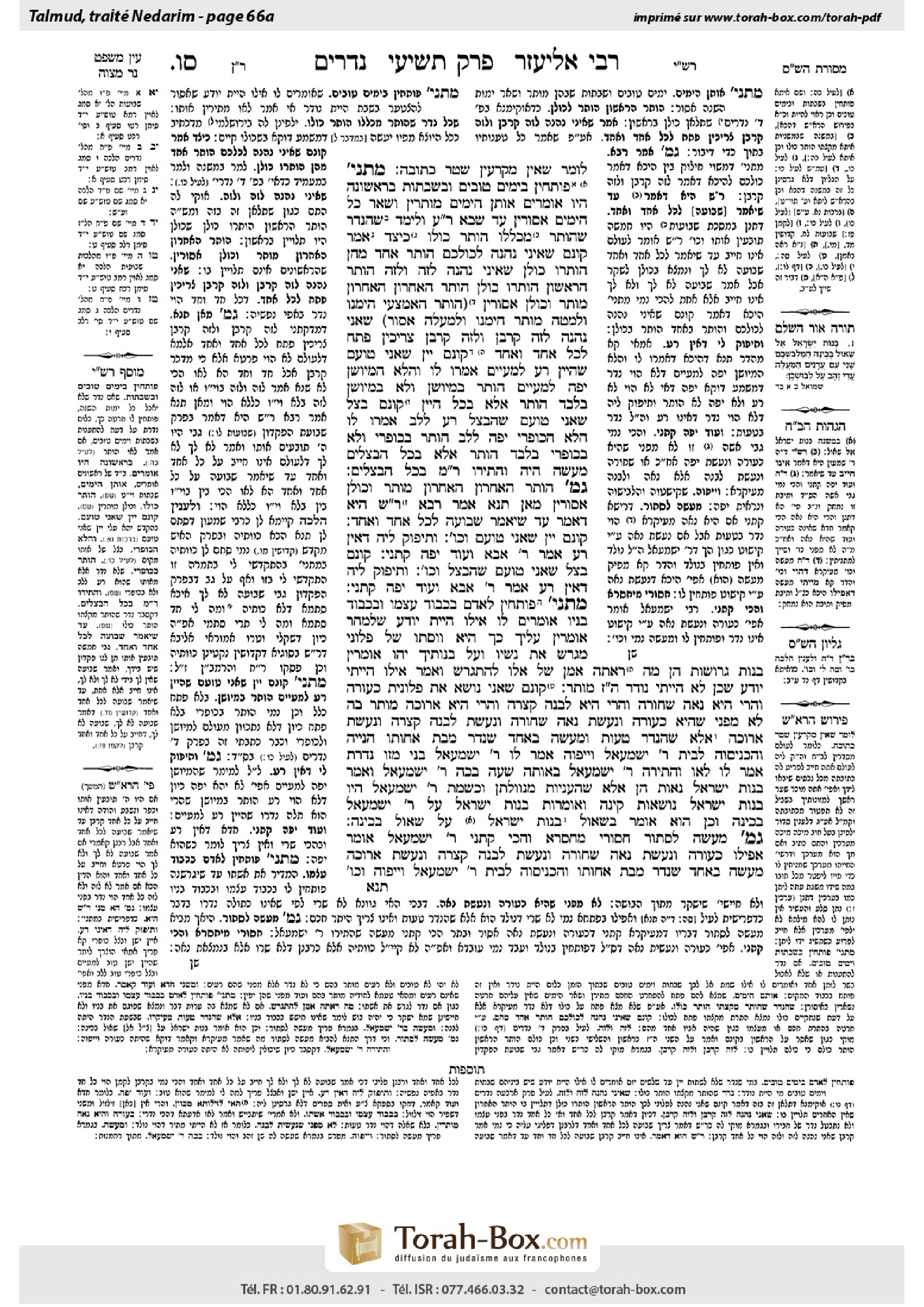
Nedarim 66a: Talmud study for Daf Yomi
Daf Yomi is the daily study of one Talmud folio. Explore 37 tractates with scans, Hebrew text, Sefaria English and AI-generated French translations where annotated.
Passage selection and English or AI-generated French translation are available where the scan has annotations. Daf Study is independent of Torah-Box and Sefaria.
Browse Nedarim · נדרים · All tractatesNedarim 66a text and translations
This page of Nedarim includes the Aramaic text, an English translation and an AI-generated French translation, alongside the scan above.
נדרים ס״ו א · Aramaic and Hebrew text
לוֹמַר שֶׁאֵין מְקָרְעִין שְׁטַר כְּתוּבָּה.
מַתְנִי׳ פּוֹתְחִין בְּיָמִים טוֹבִים וּבְשַׁבָּתוֹת. בָּרִאשׁוֹנָה הָיוּ אוֹמְרִים: אוֹתָן הַיָּמִים — מוּתָּרִין, וּשְׁאָר כׇּל הַיָּמִים אֲסוּרִין. עַד שֶׁבָּא רַבִּי עֲקִיבָא וְלִימֵּד שֶׁהַנֶּדֶר שֶׁהוּתַּר מִכְּלָלוֹ — הוּתַּר כּוּלּוֹ.
כֵּיצַד? אָמַר ״קֻוֽנָּם שֶׁאֵינִי נֶהֱנֶה לְכוּלְּכֶם״, הוּתַּר אֶחָד מֵהֶן — הוּתְּרוּ כּוּלָּן.
״שֶׁאֵינִי נֶהֱנֶה לָזֶה וְלָזֶה״, הוּתַּר הָרִאשׁוֹן — הוּתְּרוּ כּוּלָּן, הוּתַּר הָאַחֲרוֹן — הָאַחֲרוֹן מוּתָּר וְכוּלָּן אֲסוּרִין. הוּתַּר הָאֶמְצָעִי, הֵימֶנּוּ וּלְמַטָּה — מוּתָּר, הֵימֶנּוּ וּלְמַעְלָה — אָסוּר.
״שֶׁאֲנִי נֶהֱנֶה לָזֶה קׇרְבָּן וְלָזֶה קׇרְבָּן״ — צְרִיכִין פֶּתַח לְכׇל אֶחָד וְאֶחָד.
״קֻוֽנָּם יַיִן שֶׁאֲנִי טוֹעֵם, שֶׁהַיַּיִן רַע לַמֵּעַיִים״, אָמְרוּ לוֹ: וַהֲלֹא הַמְיוּשָּׁן יָפֶה לַמֵּעַיִים! הוּתַּר בִּמְיוּשָּׁן. וְלֹא בִּמְיוּשָּׁן בִּלְבַד הוּתַּר, אֶלָּא בְּכׇל הַיַּיִן. ״קֻוֽנָּם בָּצָל שֶׁאֵינִי טוֹעֵם, שֶׁהַבָּצָל רַע לַלֵּב״, אָמְרוּ לוֹ: הֲלֹא הַכּוּפְרִי יָפֶה לַלֵּב! הוּתַּר בַּכּוּפְרִי. וְלֹא בַּכּוּפְרִי בִּלְבַד הוּתַּר, אֶלָּא בְּכׇל הַבְּצָלִים. מַעֲשֶׂה הָיָה, וְהִתִּירוֹ רַבִּי מֵאִיר בְּכׇל הַבְּצָלִים.
גְּמָ׳ הוּתַּר הָאַחֲרוֹן — הָאַחֲרוֹן מוּתָּר, וְכוּלָּן אֲסוּרִין. מַאן תַּנָּא?
אָמַר רָבָא: רַבִּי שִׁמְעוֹן הִיא, דְּאָמַר: עַד שֶׁיֹּאמַר ״שְׁבוּעָה״ לְכׇל אֶחָד וְאֶחָד.
קֻוֽנָּם יַיִן שֶׁאֲנִי טוֹעֵם וְכוּ׳. וְתִיפּוֹק לֵיהּ דְּאֵין רַע! אָמַר רַבִּי אַבָּא: וְעוֹד, ״יָפֶה״ קָתָנֵי.
קֻוֽנָּם בָּצָל שֶׁאֲנִי טוֹעֵם שֶׁהַבָּצָל וְכוּ׳. וְתִיפּוֹק לֵיהּ דְּאֵין רַע! אָמַר רַבִּי אַבָּא: וְעוֹד, ״יָפֶה״ קָתָנֵי.
מַתְנִי׳ פּוֹתְחִין לָאָדָם בִּכְבוֹד עַצְמוֹ וּבִכְבוֹד בָּנָיו. אוֹמְרִים לוֹ: אִילּוּ הָיִיתָ יוֹדֵעַ שֶׁלְּמָחָר אוֹמְרִין עָלֶיךָ ״כָּךְ הִיא וִוסְתּוֹ שֶׁל פְּלוֹנִי, מְגָרֵשׁ אֶת נָשָׁיו״, וְעַל בְּנוֹתֶיךָ יְהוּ אוֹמְרִין ״בְּנוֹת גְּרוּשׁוֹת הֵן״, ״מָה רָאֲתָה אִמָּן שֶׁל אֵלּוּ לְהִתְגָּרֵשׁ״. וְאָמַר: ״אִילּוּ הָיִיתִי יוֹדֵעַ שֶׁכֵּן, לֹא הָיִיתִי נוֹדֵר״ — הֲרֵי זֶה מוּתָּר.
״קֻוֽנָּם שֶׁאֲנִי נוֹשֵׂא אֶת פְּלוֹנִית כְּעוּרָה״ וַהֲרֵי הִיא נָאָה, ״שְׁחוֹרָה״ וַהֲרֵי הִיא לְבָנָה, ״קְצָרָה״ וַהֲרֵי הִיא אֲרוּכָּה — מוּתָּר בָּהּ. לֹא מִפְּנֵי שֶׁהִיא כְּעוּרָה וְנַעֲשֵׂת נָאָה, שְׁחוֹרָה וְנַעֲשֵׂת לְבָנָה, קְצָרָה וְנַעֲשֵׂת אֲרוּכָּה — אֶלָּא שֶׁהַנֶּדֶר טָעוּת.
וּמַעֲשֶׂה בְּאֶחָד שֶׁנָּדַר מִבַּת אֲחוֹתוֹ הֲנָיָיה, וְהִכְנִיסוּהָ לְבֵית רַבִּי יִשְׁמָעֵאל וְיִיפּוּהָ. אָמַר לוֹ רַבִּי יִשְׁמָעֵאל: בְּנִי, מִזּוֹ נָדַרְתָּ? אָמַר לוֹ: לָאו, וְהִתִּירָהּ רַבִּי יִשְׁמָעֵאל.
בְּאוֹתָהּ שָׁעָה בָּכָה רַבִּי יִשְׁמָעֵאל וְאָמַר: בְּנוֹת יִשְׂרָאֵל נָאוֹת הֵן, אֶלָּא שֶׁהָעֲנִיּוּת מְנַוַּולְתָּן. וּכְשֶׁמֵּת רַבִּי יִשְׁמָעֵאל הָיוּ בְּנוֹת יִשְׂרָאֵל נוֹשְׂאוֹת קִינָה, וְאוֹמְרוֹת: ״בְּנוֹת יִשְׂרָאֵל עַל רַבִּי יִשְׁמָעֵאל בְּכֶינָה״, וְכֵן הוּא אוֹמֵר בְּשָׁאוּל: ״בְּנוֹת יִשְׂרָאֵל עַל שָׁאוּל בְּכֶינָה״.
גְּמָ׳ מַעֲשֶׂה לִסְתּוֹר?! חַסּוֹרֵי מְחַסְּרָא וְהָכִי קָתָנֵי: רַבִּי יִשְׁמָעֵאל אוֹמֵר: אֲפִילּוּ כְּעוּרָה וְנַעֲשֵׂת נָאָה, שְׁחוֹרָה וְנַעֲשֵׂת לְבָנָה, קְצָרָה וְנַעֲשֵׂת אֲרוּכָּה. מַעֲשֶׂה בְּאֶחָד שֶׁנָּדַר מִבַּת אֲחוֹתוֹ וְהִכְנִיסוּהָ לְבֵית רַבִּי יִשְׁמָעֵאל וְיִיפּוּהָ וְכוּ׳.
Nedarim 66a · English translation
In fact, arrangements are made with creditors. Rather, Rabbi Akiva is saying that they do not tear the document of the marriage contract. Even if in practice he is left with enough to survive on, the debt remains in force, so that when he will have more money, she will be paid in full.
MISHNA: If one vowed that certain food or drink or all food and drink be forbidden to him, the halakhic authorities may broach dissolution by raising the issue of Festivals and Shabbatot. They ask him whether he realized at the time he stated his vow that he would have to uphold it on these festive days as well. At first they said that on those days that he did not intend to include in his vow, that item is permitted, but on all the rest of the days, food and drink are still forbidden by his vow, until Rabbi Akiva came and taught that a vow that is partially dissolved is dissolved entirely.
How so? In the case of one who said to a group of people: I will not benefit from all of you as it is konam for me, if benefit from one of them was permitted for whatever reason, benefit from all of them is permitted.
However, if one said: I will not benefit from this one and from that one as it is konam for me, then if benefit from the first one was permitted for whatever reason, benefit from all of them is permitted. But if benefit from the last one was permitted, benefit from the last one alone is permitted, but benefit from all the others is forbidden, as the benefit from each is considered to have been prohibited by a separate vow. If benefit from the middle one was permitted, then from him and below, i.e., all those enumerated after him, benefit is permitted; from him and above, i.e., those listed before him, benefit is forbidden.
The mishna gives another example of interconnected vows: If one stated: I will not benefit from this one, as if he were an offering, and from that one, as if he were an offering, then an extenuation enabling the dissolution of a vow is required for each and every one, as they have the status of separate vows.
The mishna gives another example of a vow that was partially dissolved. If one stated in a vow: Wine is konam for me and I will not taste it, as wine is bad for the intestines, and they said to him: But aged wine is good for the intestines, then the vow is dissolved with regard to aged wine. And not only with regard to aged wine is it dissolved, but with regard to all types of wine, since a vow that has been partially dissolved is entirely dissolved. Likewise, if one stated in a vow: Onions are konam for me and I will not taste them, as onions are bad for the heart, and they said to him: But the kuferi onion is good for the heart, then, in this case too, it is dissolved with regard to kuferi onions, and not only with regard to kuferi onions is it dissolved, but with regard to all types of onions. The mishna relates that an incident of this kind occurred, and Rabbi Meir dissolved the vow with regard to all types of onions.
GEMARA: The mishna taught: If benefit from the last one was permitted, benefit from the last one alone is permitted but benefit from all the others is forbidden. If one stated: I will not benefit from this one, as if he were an offering, and from that one, as if he were an offering, then an extenuation enabling the dissolution of a vow is required for each and every one. The Gemara poses a question: Who is the tanna that taught this mishna?
Rava said: It is taught in accordance with the opinion of Rabbi Shimon, who said that one who utters a false oath to several people at once is not liable to bring an offering for each false oath unless he says: An oath, in his oath to each and every one (Shevuot 38a). If he said: An oath, only once, even if he specified each person by saying: Not to you, not to you, it is still considered to be a single oath. Otherwise, it is viewed as one oath. The mishna, which requires a separate extenuation for each person only if he stated: As if he were an offering, with regard to each of them, is in accordance with the opinion of Rabbi Shimon stated with regard to oaths.
The mishna taught that if one said: Wine is konam for me and I will not taste it, as wine is bad for the intestines, his vow is dissolved, for aged wine is good for the intestines. The Gemara asks: And let him derive that the vow is dissolved from the fact that aged wine is not bad for the intestines. Even if it is not actively good for the intestines, the vow should nevertheless be considered mistaken. Rabbi Abba said: The mishna teaches: And furthermore, it is good. In other words, even if aged wine is merely not harmful to the intestines the vow is dissolved, and they strengthened their claim by pointing out that it is in fact beneficial.
The mishna taught: If one said: Onions are konam for me and I will not taste them, as onions are bad for the heart, his vow is dissolved, for kuferi onions are good for the heart. The Gemara asks: And let him derive that the vow is dissolved from the fact that the kuferi onion is not bad for the heart. Rabbi Abba said: The mishna teaches: And furthermore, it is good. Here too, they added that the kuferi onion is actually good for the heart, but this addition was not needed to justify the dissolution of the vow.
MISHNA: The halakhic authorities may broach dissolution for a person by raising the issue of his own honor and the honor of his children. For example, if he took a vow that resulted in his needing to divorce his wife, they may say to him: Had you known that tomorrow people will say about you: This is the habit [veset] of so-and-so, that he divorces his wives due to vows, and they will say about your daughters: They are daughters of divorce, or they will ask: What did their mother see to divorce, thereby giving them a bad reputation. And if the man who vowed said: Had I known it was so, I would not have vowed, it is dissolved.
The Mishna continues: If a man said: Marrying ugly so-and-so is konam for me, and she is in fact beautiful, or if, in vowing not to marry her, he called her black, and she is in fact white, or if, in vowing not to marry her, he called her short, and she is in fact tall, he is permitted to her. Not because she was ugly and became beautiful, black and became white, or short and became tall, but rather, because the vow was mistaken from the outset.
The Mishna relates: And an incident occurred with regard to one who vowed against deriving benefit from the daughter of his sister, as he did not wish to marry her. And they brought her into the house of Rabbi Yishmael and he beautified her. When she was later brought before the one who took the vow, Rabbi Yishmael said to him: My son, did you vow that you would not derive benefit from this woman? He said to him: No, and Rabbi Yishmael permitted her to him, as he demonstrated that the vow had been made in error.
At that time Rabbi Yishmael wept and said: The daughters of Israel are beautiful, but poverty makes them ugly. And when Rabbi Yishmael died, the daughters of Israel raised a lamentation, saying: Daughters of Israel, weep for Rabbi Yishmael. And it likewise states about Saul, who also concerned himself with the welfare of the daughters of Israel: “Daughters of Israel, weep over Saul, who clothed you in scarlet with other delights, who put ornaments of gold upon your apparel” (II Samuel 1:24).
GEMARA: The Gemara poses a question: Was an incident cited to contradict what was just taught? It first taught that if she was ugly and was later beautified, the vow is not dissolved, and then the mishna quoted an incident involving Rabbi Yishmael where he did dissolve the vow. The Gemara answers: The mishna is incomplete and this is what it is teaching: Rabbi Yishmael says: Even if she was ugly and became beautiful, black and became white, short and became tall, the vow can be dissolved. An incident occurred with regard to one who vowed against having benefit from the daughter of his sister, as he did not wish to marry her. And they brought her into Rabbi Yishmael’s house and he beautified her.
Nedarim 66a · Traduction française (IA)
En réalité, des arrangements sont conclus avec les créanciers. Rabbi Akiva veut plutôt dire qu’on ne déchire pas l’acte de mariage. Même si, en pratique, il lui reste de quoi subsister, la dette demeure en vigueur, de sorte que, lorsqu’il aura davantage d’argent, elle sera payée intégralement.
Michna : Si quelqu’un a fait vœu de s’interdire un aliment ou une boisson, ou tous les aliments et toutes les boissons, les autorités halakhiques peuvent lui suggérer un motif de dissolution en soulevant la question des fêtes et des Chabbatot. Elles lui demandent s’il avait conscience, au moment où il a prononcé son vœu, qu’il devrait aussi le respecter pendant ces jours de fête. Au début, on disait que, pour les jours qu’il n’avait pas l’intention d’inclure dans son vœu, l’aliment ou la boisson était permis, mais que, tous les autres jours, les aliments et les boissons demeuraient interdits par son vœu, jusqu’à ce que Rabbi Akiva vienne enseigner qu’un vœu partiellement dissous l’est entièrement.
Comment cela ? Dans le cas de quelqu’un qui dit à un groupe de personnes : « Que tirer profit de vous tous me soit interdit comme un konam », si, pour quelque raison que ce soit, il est permis de tirer profit de l’une d’entre elles, il est permis de tirer profit de toutes.
En revanche, si quelqu’un dit : « Que tirer profit de celui-ci et de celui-là me soit interdit comme un konam », alors, si, pour quelque raison que ce soit, il est permis de tirer profit du premier, il est permis de tirer profit de tous. Mais si le dernier est autorisé, il est permis de tirer profit de lui seul, tandis qu’il est interdit de tirer profit de tous les autres, car le profit de chacun est considéré comme ayant été interdit par un vœu distinct. Si celui qui se trouve au milieu est autorisé, il est permis de tirer profit de lui et de ceux qui le suivent, c’est-à-dire de tous ceux qui ont été énumérés après lui ; en revanche, il est interdit de tirer profit de lui et de ceux qui le précèdent, c’est-à-dire de ceux qui ont été énumérés avant lui.
La Michna donne un autre exemple de vœux liés entre eux : si quelqu’un dit : « Que tirer profit de celui-ci me soit interdit comme s’il était une offrande, et de celui-là comme s’il était une offrande », il faut trouver un motif permettant la dissolution du vœu pour chacun d’eux, car ils ont le statut de vœux distincts.
La Michna donne un autre exemple de vœu partiellement dissous. Si quelqu’un fait le vœu suivant : « Que le vin me soit interdit comme un konam et je n’en goûterai pas, car le vin est mauvais pour les intestins », et qu’on lui dise : « Mais le vin vieux est bon pour les intestins », alors le vœu est dissous en ce qui concerne le vin vieux. Et il n’est pas seulement dissous en ce qui concerne le vin vieux, mais aussi pour toutes les sortes de vin, puisqu’un vœu partiellement dissous l’est entièrement. De même, si quelqu’un fait le vœu suivant : « Que les oignons me soient interdits comme un konam et je n’en goûterai pas, car les oignons sont mauvais pour le cœur », et qu’on lui dise : « Mais l’oignon kuferi est bon pour le cœur », alors, dans ce cas également, le vœu est dissous en ce qui concerne les oignons kuferi ; et il n’est pas seulement dissous pour les oignons kuferi, mais aussi pour toutes les sortes d’oignons. La Michna rapporte qu’un cas de ce genre s’est produit et que Rabbi Meir a dissous le vœu pour toutes les sortes d’oignons.
Guemara : La Michna a enseigné que, si le dernier est autorisé, il est permis de tirer profit de lui seul, mais qu’il est interdit de tirer profit de tous les autres. Elle a aussi enseigné que, si quelqu’un dit : « Que tirer profit de celui-ci me soit interdit comme s’il était une offrande, et de celui-là comme s’il était une offrande », il faut trouver un motif permettant la dissolution du vœu pour chacun d’eux. La Guemara demande : Quel tanna a enseigné cette Michna ?
Rava a dit : Elle est conforme à l’opinion de Rabbi Shimon, qui a dit que celui qui prononce un faux serment visant plusieurs personnes à la fois n’est tenu d’apporter un sacrifice pour chaque faux serment que s’il dit « serment » dans son serment à chacune d’entre elles (Chevouot 38a). S’il dit « serment » une seule fois, même s’il désigne chaque personne en disant : « pas à toi, pas à toi », cela est néanmoins considéré comme un seul serment. Autrement, cela est considéré comme un seul serment. La Michna, qui exige un motif distinct pour chaque personne uniquement si l’on a dit « comme s’il était une offrande » à propos de chacune d’entre elles, est conforme à l’opinion de Rabbi Shimon exprimée au sujet des serments.
La Michna a enseigné que, si quelqu’un dit : « Que le vin me soit interdit comme un konam et je n’en goûterai pas, car le vin est mauvais pour les intestins », son vœu est dissous, car le vin vieux est bon pour les intestins. La Guemara demande : Ne pourrait-on pas conclure que le vœu est dissous du simple fait que le vin vieux n’est pas mauvais pour les intestins ? Même s’il n’est pas bénéfique pour les intestins, le vœu devrait néanmoins être considéré comme ayant été fait par erreur. Rabbi Abba a dit : La Michna enseigne : « Et de plus, il est bon. » Autrement dit, même si le vin vieux est simplement inoffensif pour les intestins, le vœu est dissous ; ils ont renforcé leur argument en précisant qu’il est en fait bénéfique.
La Michna a enseigné que, si quelqu’un dit : « Que les oignons me soient interdits comme un konam et je n’en goûterai pas, car les oignons sont mauvais pour le cœur », son vœu est dissous, car les oignons kuferi sont bons pour le cœur. La Guemara demande : Ne pourrait-on pas conclure que le vœu est dissous du simple fait que l’oignon kuferi n’est pas mauvais pour le cœur ? Rabbi Abba a dit : La Michna enseigne : « Et de plus, il est bon. » Ici aussi, ils ont ajouté que l’oignon kuferi est effectivement bon pour le cœur, mais cet ajout n’était pas nécessaire pour justifier la dissolution du vœu.
Michna : Les autorités halakhiques peuvent suggérer à quelqu’un un motif de dissolution en soulevant la question de son propre honneur et de celui de ses enfants. Par exemple, s’il a fait un vœu qui l’oblige à divorcer de sa femme, elles peuvent lui dire : « Aurais-tu su que, demain, les gens diraient de toi : “C’est l’habitude [veset] d’un tel, de divorcer de ses femmes à cause de ses vœux”, et qu’ils diraient de tes filles : “Ce sont les filles d’un divorcé”, ou qu’ils demanderaient : “Qu’a donc vu leur mère pour divorcer ?”, leur donnant ainsi une mauvaise réputation ? » Si l’homme qui a fait le vœu répond : « Si j’avais su qu’il en serait ainsi, je n’aurais pas fait de vœu », le vœu est dissous.
La Michna poursuit : si un homme dit : « Épouser telle personne laide me soit interdit comme un konam », alors qu’elle est en réalité belle, ou s’il la qualifie de noire en faisant vœu de ne pas l’épouser, alors qu’elle est en réalité blanche, ou s’il la qualifie de petite, alors qu’elle est en réalité grande, il lui est permis de l’épouser. Non pas parce qu’elle était laide et qu’elle est devenue belle, noire et qu’elle est devenue blanche, ou petite et qu’elle est devenue grande, mais parce que le vœu était erroné dès le départ.
La Michna rapporte un cas concernant quelqu’un qui avait fait vœu de ne pas tirer profit de la fille de sa sœur, car il ne souhaitait pas l’épouser. On la fit entrer dans la maison de Rabbi Yishmael, qui l’embellit. Lorsqu’on la présenta ensuite à celui qui avait fait le vœu, Rabbi Yishmael lui dit : « Mon fils, as-tu fait vœu de ne pas tirer profit de cette femme ? » Il répondit : « Non. » Rabbi Yishmael lui permit alors de l’épouser, démontrant ainsi que le vœu avait été fait par erreur.
À ce moment-là, Rabbi Yishmael pleura et dit : « Les filles d’Israël sont belles, mais la pauvreté les rend laides. » Lorsque Rabbi Yishmael mourut, les filles d’Israël élevèrent une lamentation en disant : « Filles d’Israël, pleurez Rabbi Yishmael. » Il est également dit au sujet de Saül, qui se souciait lui aussi du bien-être des filles d’Israël : « Filles d’Israël, pleurez sur Saül, qui vous vêtait d’écarlate et d’autres délices, qui mettait des ornements d’or sur vos vêtements » (II Samuel 1:24).
Guemara : La Guemara demande : A-t-on rapporté un cas pour contredire ce qui vient d’être enseigné ? On a d’abord enseigné que, si elle était laide et qu’elle est ensuite devenue belle, le vœu n’est pas dissous ; puis la Michna a cité un cas concernant Rabbi Yishmael, dans lequel il a effectivement dissous le vœu. La Guemara répond : La Michna est incomplète, et voici ce qu’elle enseigne : Rabbi Yishmael dit que, même si elle était laide et qu’elle est devenue belle, noire et qu’elle est devenue blanche, petite et qu’elle est devenue grande, le vœu peut être dissous. Un cas s’est produit concernant quelqu’un qui avait fait vœu de ne pas tirer profit de la fille de sa sœur, car il ne souhaitait pas l’épouser. On la fit entrer dans la maison de Rabbi Yishmael, qui l’embellit.
Traduction française générée par IA à partir de l’édition anglaise de Sefaria. Vérifie toujours un passage avec le texte source.
Text from Sefaria: William Davidson Edition - Vocalized Aramaic (CC BY NC); William Davidson Edition - English (CC BY NC).