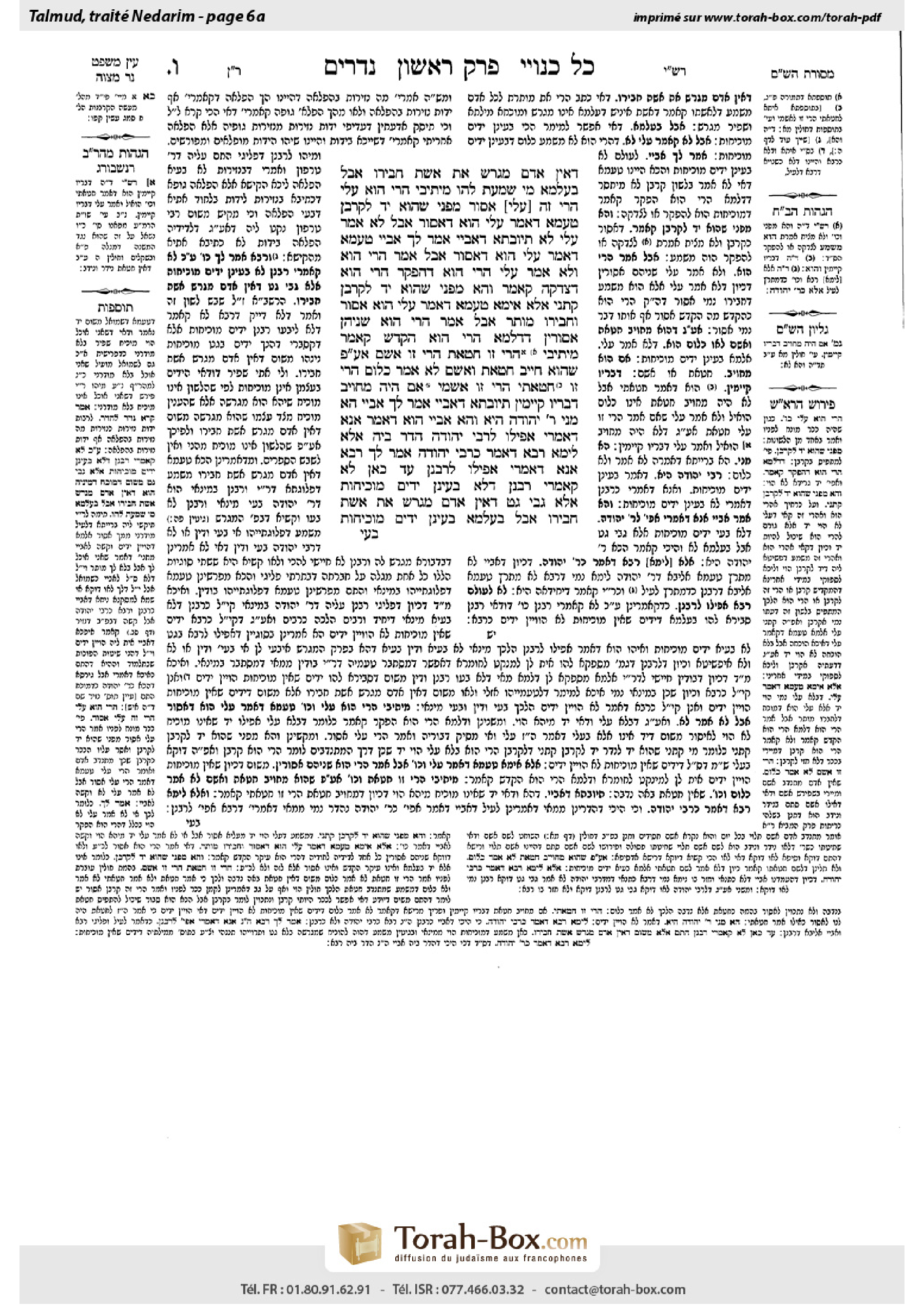
Nedarim 6a: Talmud study for Daf Yomi
Daf Yomi is the daily study of one Talmud folio. Explore 37 tractates with scans, Hebrew text, Sefaria English and AI-generated French translations where annotated.
Passage selection and English or AI-generated French translation are available where the scan has annotations. Daf Study is independent of Torah-Box and Sefaria.
Browse Nedarim · נדרים · All tractatesNedarim 6a text and translations
This page of Nedarim includes the Aramaic text, an English translation and an AI-generated French translation, alongside the scan above.
נדרים ו׳ א · Aramaic and Hebrew text
דְּאֵין אָדָם מְגָרֵשׁ אֶת אֵשֶׁת חֲבֵירוֹ, אֲבָל בְּעָלְמָא — מִי שָׁמְעַתְּ לְהוּ?
מֵיתִיבִי: ״הֲרֵי הוּא עָלַי״, ״הֲרֵי זֶה [עָלַי]״ — אָסוּר, מִפְּנֵי שֶׁהוּא יָד לְקׇרְבָּן. טַעְמָא דְּאָמַר ״עָלַי״ — הוּא דְּאָסוּר, אֲבָל לָא אָמַר ״עָלַי״ — לָא. תְּיוּבְתָּא דְאַבָּיֵי!
אָמַר לָךְ אַבָּיֵי: טַעְמָא דְּאָמַר ״עָלַי״ — הוּא דְּאָסוּר. אֲבָל אָמַר ״הֲרֵי הוּא״, וְלָא אָמַר ״עָלַי״, ״הֲרֵי הוּא דְּהֶפְקֵר״ ״הֲרֵי הוּא דִּצְדָקָה״ קָאָמַר. וְהָא ״מִפְּנֵי שֶׁהוּא יָד לְקׇרְבָּן״ קָתָנֵי!
אֶלָּא אֵימָא: טַעְמָא דְּאָמַר ״עָלַי״ — הוּא אָסוּר וַחֲבֵירוֹ מוּתָּר, אֲבָל אָמַר ״הֲרֵי הוּא״ — שְׁנֵיהֶן אֲסוּרִין, דְּדִלְמָא ״הֲרֵי הוּא הֶקְדֵּשׁ״ קָאָמַר.
מֵיתִיבִי: ״הֲרֵי זוֹ חַטָּאת״ ״הֲרֵי זוֹ אָשָׁם״, אַף עַל פִּי שֶׁהוּא חַיָּיב חַטָּאת וְאָשָׁם — לֹא אָמַר כְּלוּם. ״הֲרֵי זוֹ חַטָּאתִי״ ״הֲרֵי זוֹ אֲשָׁמִי״, אִם הָיָה מְחוּיָּב — דְּבָרָיו קַיָּימִין. תְּיוּבְתָּא דְּאַבָּיֵי!
אָמַר לָךְ אַבָּיֵי: הָא מַנִּי — רַבִּי יְהוּדָה הִיא. וְהָא אַבָּיֵי הוּא דְּאָמַר: אֲנָא דַּאֲמַרִי — אֲפִילּוּ לְרַבִּי יְהוּדָה! הֲדַר בֵּיהּ.
אֶלָּא לֵימָא, רָבָא דְּאָמַר כְּרַבִּי יְהוּדָה?
אָמַר לָךְ רָבָא: אֲנָא דַּאֲמַרִי — אֲפִילּוּ לְרַבָּנַן. עַד כָּאן לָא קָאָמְרִי רַבָּנַן דְּלָא בָּעִינַן יָדַיִם מוֹכִיחוֹת אֶלָּא גַּבֵּי גֵּט, דְּאֵין אָדָם מְגָרֵשׁ אֶת אֵשֶׁת חֲבֵירוֹ. אֲבָל בְּעָלְמָא בָּעִינַן יָדַיִם מוֹכִיחוֹת.
Nedarim 6a · English translation
as a man does not divorce the wife of his fellow, so it is obvious that he is writing the bill of divorce to his wife. However, did you hear them state generally that ambiguous intimations are valid intimations?
The Gemara raises an objection based upon the following baraita: If one says with regard to an object lying before him: It is upon me, or: This is hereby upon me, it is forbidden, because it is an intimation that he is rendering the object forbidden to himself like an offering. This baraita indicates that the reason it is forbidden is that he specifically said: Upon me. However, if he did not say: Upon me, no, it is not forbidden, because this expression is an ambiguous intimation. This is a conclusive refutation of the opinion of Abaye, who holds that even ambiguous intimations are valid intimations.
The Gemara answers: Abaye could have said to you that the reason it is forbidden is that he specifically said: Upon me. However, if he said: It is hereby, and did not say: Upon me, his statement is not considered an intimation of a vow at all, as he could have been saying: It is hereby ownerless property, or: It is hereby charity. The Gemara asks: But the baraita teaches that the object is forbidden because his statement is an intimation that he is rendering the object forbidden to himself like an offering. With regard to consecrating an offering, even the statement: This is, without the additional phrase: Upon me, is considered an intimation. Nevertheless, the baraita indicates that if one does not say: Upon me, the vow does not take effect. This must be because an ambiguous intimation is not a vow.
Rather, say the following: The reason is that he specifically said: Upon me; consequently, he is prohibited from benefiting from the object, but another person is permitted to benefit from it. However, if he said: It is hereby, and did not add the expression: Upon me, both of them are prohibited from benefiting from it because perhaps he is saying: It is hereby consecrated property. In other words, there is concern that he may have actually consecrated the object rather than taking a vow that it is forbidden to him as though it were consecrated.
The Gemara raises an objection to this on the basis of the following baraita: If one says: This is hereby a sin-offering, or: This is hereby a guilt-offering, then even if he is liable to bring a sin-offering or guilt-offering he has said nothing, as this is an ambiguous intimation. However, if he said: This is hereby my sin-offering, or: This is hereby my guilt-offering, then if he was liable to bring that offering his statement takes effect, because this is an obvious intimation. This is a conclusive refutation of the opinion of Abaye.
The Gemara answers: Abaye could have said to you: In accordance with whose opinion is this baraita? It is in accordance with the opinion of Rabbi Yehuda, who holds that ambiguous intimations are not intimations. The Gemara asks: Wasn’t it Abaye who said: I say that ambiguous intimations are valid intimations even according to the opinion of Rabbi Yehuda? The Gemara answers: He retracted this statement and admitted that Rabbi Yehuda holds that ambiguous intimations are not valid intimations.
The Gemara asks: But shall we say that just as Abaye retracted his statement that his opinion can be stated even according to Rabbi Yehuda, Rava, who said that ambiguous intimations are not valid intimations, also retracted his initial statement and admitted that his opinion is only in accordance with the opinion of Rabbi Yehuda and is not in accordance with the opinion of the Rabbis?
The Gemara answers: Rava could have said to you: I say my statement even according to the opinion of the Rabbis. The Rabbis say that we do not require obvious intimations only with regard to a bill of divorce, as a man does not divorce the wife of his fellow, so it is obvious that he is writing the bill of divorce to his wife. However, generally we require obvious intimations.
Nedarim 6a · Traduction française (IA)
De même qu’un homme ne répudie pas la femme de son prochain, il est évident qu’il rédige l’acte de divorce pour sa femme. Cependant, les a-t-on entendus affirmer de manière générale que les allusions ambiguës sont valables ?
La Guemara soulève une objection à partir de la baraïta suivante : si quelqu’un dit au sujet d’un objet qui se trouve devant lui : « Il est sur moi », ou : « Celui-ci est sur moi », l’objet lui est interdit, car ses paroles laissent entendre qu’il le rend interdit pour lui-même comme une offrande. Cette baraïta indique que l’objet lui est interdit parce qu’il a précisément dit : « Sur moi ». En revanche, s’il n’a pas dit « sur moi », l’objet ne lui est pas interdit, car cette expression constitue une allusion ambiguë. C’est une réfutation définitive de l’opinion d’Abayé, qui soutient que même les allusions ambiguës sont valables.
La Guemara répond : Abayé aurait pu te dire que l’objet lui est interdit parce qu’il a précisément dit : « Sur moi ». En revanche, s’il a dit : « Celui-ci est », sans ajouter « sur moi », sa déclaration n’est pas du tout considérée comme une allusion à un vœu, car il aurait pu vouloir dire : « Celui-ci est sans propriétaire », ou : « Celui-ci est destiné à la charité ». La Guemara demande : mais la baraïta enseigne que l’objet est interdit parce que sa déclaration laisse entendre qu’il le rend interdit pour lui-même comme une offrande. Or, lorsqu’il s’agit de consacrer une offrande, la déclaration « Celui-ci est », sans l’ajout « sur moi », est également considérée comme une allusion. Pourtant, la baraïta indique que si l’on ne dit pas « sur moi », le vœu ne prend pas effet. Cela doit donc être parce qu’une allusion ambiguë ne constitue pas un vœu.
Il faut plutôt dire ceci : la raison est qu’il a précisément dit : « Sur moi » ; par conséquent, il lui est interdit de tirer profit de l’objet, mais une autre personne est autorisée à en tirer profit. En revanche, s’il a dit : « Celui-ci est », sans ajouter « sur moi », il est interdit à tous deux de tirer profit de l’objet, car il a peut-être voulu dire : « Celui-ci est un bien consacré ». Autrement dit, on craint qu’il ait effectivement consacré l’objet, plutôt que de faire un vœu par lequel il se l’interdit comme s’il était consacré.
La Guemara soulève une objection contre cela à partir de la baraïta suivante : si quelqu’un dit : « Celui-ci est un sacrifice expiatoire », ou : « Celui-ci est un sacrifice de culpabilité », même s’il est tenu d’apporter un sacrifice expiatoire ou un sacrifice de culpabilité, il n’a rien dit, car il s’agit d’une allusion ambiguë. En revanche, s’il a dit : « Celui-ci est mon sacrifice expiatoire », ou : « Celui-ci est mon sacrifice de culpabilité », sa déclaration prend effet s’il était tenu d’apporter le sacrifice en question, car il s’agit d’une allusion évidente. C’est une réfutation définitive de l’opinion d’Abayé.
La Guemara répond : Abayé aurait pu te dire : selon l’opinion de qui cette baraïta a-t-elle été enseignée ? Selon celle de Rabbi Yehouda, qui estime que les allusions ambiguës ne sont pas valables. La Guemara demande : n’est-ce pas Abayé qui a dit : « Je soutiens que les allusions ambiguës sont valables, même selon l’opinion de Rabbi Yehouda » ? La Guemara répond : il s’est rétracté et a admis que, selon Rabbi Yehouda, les allusions ambiguës ne sont pas valables.
La Guemara demande : faut-il donc dire que, de même qu’Abayé s’est rétracté sur son affirmation selon laquelle son opinion pouvait être soutenue même selon Rabbi Yehouda, Rava, qui a dit que les allusions ambiguës ne sont pas valables, s’est lui aussi rétracté sur sa déclaration initiale et a admis que son opinion ne correspond qu’à celle de Rabbi Yehouda, et non à celle des Rabbins ?
La Guemara répond : Rava aurait pu te dire : je soutiens cette affirmation même selon l’opinion des Rabbins. Les Rabbins disent que nous n’exigeons des allusions évidentes que pour un acte de divorce, car un homme ne répudie pas la femme de son prochain ; il est donc évident qu’il rédige l’acte de divorce pour sa femme. En revanche, de manière générale, nous exigeons des allusions évidentes.
Traduction française générée par IA à partir de l’édition anglaise de Sefaria. Vérifie toujours un passage avec le texte source.
Text from Sefaria: William Davidson Edition - Vocalized Aramaic (CC BY NC); William Davidson Edition - English (CC BY NC).