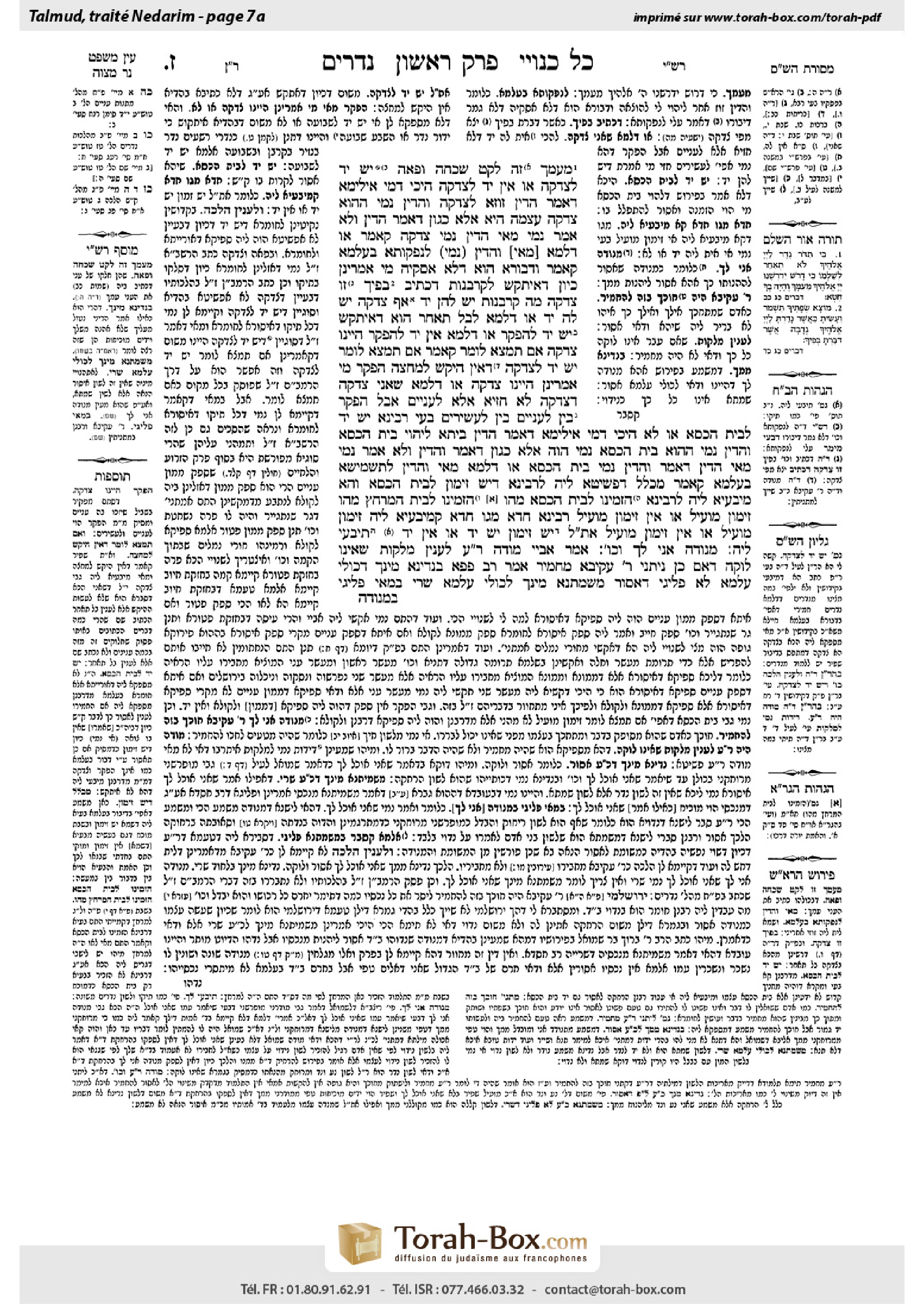
Nedarim 7a: Talmud study for Daf Yomi
Daf Yomi is the daily study of one Talmud folio. Explore 37 tractates with scans, Hebrew text, Sefaria English and AI-generated French translations where annotated.
Passage selection and English or AI-generated French translation are available where the scan has annotations. Daf Study is independent of Torah-Box and Sefaria.
Browse Nedarim · נדרים · All tractatesNedarim 7a text and translations
This page of Nedarim includes the Aramaic text, an English translation and an AI-generated French translation, alongside the scan above.
נדרים ז׳ א · Aramaic and Hebrew text
״מֵעִמָּךְ״, זֶה לֶקֶט שִׁכְחָה וּפֵאָה.
יֵשׁ יָד לִצְדָקָה, אוֹ אֵין יָד לִצְדָקָה? הֵיכִי דָמֵי? אִילֵימָא דְּאָמַר: ״הָדֵין זוּזָא לִצְדָקָה, וְהָדֵין נָמֵי״ — הָהוּא צְדָקָה עַצְמָהּ הִיא! אֶלָּא כְּגוֹן דְּאָמַר ״הָדֵין״ וְלָא אָמַר ״נָמֵי״, מַאי? ״הָדֵין נָמֵי צְדָקָה״ קָאָמַר, אוֹ דִּלְמָא [מַאי] ״וְהָדֵין״ (נָמֵי) — לְנַפְקוּתָא בְּעָלְמָא קָאָמַר, וְדִבּוּרָא הוּא דְּלָא אַסְּקֵיהּ.
מִי אָמְרִינַן: כֵּיוָן דְּאִיתַּקַּשׁ לְקׇרְבָּנוֹת, דִּכְתִיב: ״בְּפִיךְ״ — זוֹ צְדָקָה. מָה קׇרְבָּנוֹת יֵשׁ לָהֶן יָד, אַף צְדָקָה יֵשׁ לָהּ יָד. אוֹ דִלְמָא לְ״בַל תְּאַחֵר״ הוּא דְּאִיתַּקַּשׁ?
יֵשׁ יָד לְהֶפְקֵר, אוֹ דִלְמָא אֵין יָד לְהֶפְקֵר? הַיְינוּ צְדָקָה!
אִם תִּמְצָא לוֹמַר קָאָמַר. אִם תִּמְצָא לוֹמַר יֵשׁ יָד לִצְדָקָה, דְּאֵין הֶיקֵּשׁ לְמֶחֱצָה. הֶפְקֵר מִי אָמְרִינַן הַיְינוּ צְדָקָה, אוֹ דִּלְמָא שָׁאנֵי צְדָקָה, דִּצְדָקָה לָא חַזְיָא אֶלָּא לַעֲנִיִּים, אֲבָל הֶפְקֵר בֵּין לַעֲנִיִּים בֵּין לַעֲשִׁירִים?
בָּעֵי רָבִינָא: יֵשׁ יָד לְבֵית הַכִּסֵּא, אוֹ לָא? הֵיכִי דָמֵי? אִילֵימָא דַּאֲמַר ״הָדֵין בֵּיתָא לֶיהֱוֵי בֵּית הַכִּסֵּא, וְהָדֵין נָמֵי״, הַהוּא בֵּית הַכִּסֵּא נָמֵי הָוֵה! אֶלָּא כְּגוֹן דְּאָמַר ״וְהָדֵין״ וְלָא אָמַר ״נָמֵי״. מַאי ״הָדֵין״ דְּאָמַר — ״וְהָדֵין נָמֵי בֵּית הַכִּסֵּא״, אוֹ דִלְמָא מַאי ״וְהָדֵין״ — לְתַשְׁמִישָׁא בְּעָלְמָא קָאָמַר.
מִכְּלָל דִּפְשִׁיטָא לֵיהּ לְרָבִינָא דְּיֵשׁ זִימּוּן לְבֵית הַכִּסֵּא? וְהָא מִיבַּעְיָא לֵיהּ לְרָבִינָא: הִזְמִינוֹ לְבֵית הַכִּסֵּא מַהוּ? הִזְמִינוֹ לְבֵית הַמֶּרְחָץ מַהוּ? זִימּוּן מוֹעִיל, אוֹ אֵין זִימּוּן מוֹעִיל?
רָבִינָא חֲדָא מִגּוֹ חֲדָא קָמִיבַּעְיָא לֵיהּ: זִימּוּן מוֹעִיל אוֹ אֵין זִימּוּן מוֹעִיל. אִם תִּמְצָא לוֹמַר יֵשׁ זִימּוּן: יֵשׁ יָד אוֹ אֵין יָד תִּיבְּעֵי לֵיהּ.
מְנוּדֶּה אֲנִי לָךְ וְכוּ׳. אָמַר אַבָּיֵי: מוֹדֶה רַבִּי עֲקִיבָא לְעִנְיַן מַלְקוֹת שֶׁאֵינוֹ לוֹקֶה. דְּאִם כֵּן, נִיתְנֵי ״רַבִּי עֲקִיבָא מַחְמִיר״.
אָמַר רַב פָּפָּא: בִּ״נְדִינָא מִינָּךְ״ — דְּכוּלֵּי עָלְמָא לָא פְּלִיגִי דְּאָסוּר. ״מְשַׁמַּתְנָא מִינָּךְ״ — לְכוּלֵּי עָלְמָא שְׁרֵי. בְּמַאי פְּלִיגִי —
Nedarim 7a · English translation
The verse states with regard to offerings: “When you shall take a vow to the Lord your God, you shall not delay to pay it; for the Lord your God will surely require it of you” (Deuteronomy 23:22). With regard to the term “of you” the baraita states: This is a reference to gleanings, forgotten sheaves, and pe’a.
§ The Gemara asks: Is there intimation for charity or is there no intimation for charity? The Gemara clarifies the question: What are the circumstances of such a case? If we say that it is a case where one said: This dinar is for charity and this also, that itself is an explicit statement of donating to charity. Rather, it is a case where he said: This, and did not say: Also. What is his intention? Is he understood to be saying: This is also charity, or perhaps what is the meaning of: And this? He is saying that this coin is merely for general use, and he did not complete his statement.
The Gemara explains the two sides of this dilemma: Do we say that since charity is juxtaposed to offerings, as it is written in a verse following the prohibition against delaying an offering: “That you have spoken with your mouth” (Deuteronomy 23:24) and the Sages expounded that this is a reference to charity, therefore, just as there is intimation, i.e., intimation is effective, with regard to offerings, so too, there is intimation with regard to charity? Or perhaps it is only with regard to the prohibition: You shall not delay, that it is juxtaposed, but not with regard to other halakhot?
The Gemara asks further: Is there intimation for rendering one’s property ownerless, or perhaps there is no intimation for rendering one’s property ownerless. Does an incomplete expression employed by an owner to relinquish property take effect or not? The Gemara notes: This is the same as the previous question with regard to charity, which is comparable to rendering one’s property ownerless for the benefit of the poor.
The Gemara responds: This question is stated in the style of: If you say, as follows: If you say there is intimation for charity, as there is no partial analogy based on juxtaposition, do we say that rendering one’s property ownerless is the same as charity; or perhaps charity is different, as charity is suitable only for the poor, but ownerless property is suitable for both the poor and the wealthy, and therefore it cannot be derived from the halakha with regard to charity.
Ravina raised another dilemma: Is there intimation for designating a location as a bathroom or not? The Gemara asks: What are the circumstances of the case? If we say that it is a case where one said: Let this structure be a bathroom and this one also, that second structure is certainly also a bathroom. Rather, it is a case where he said: And this, and he did not say: Also. What is his intention? Is the expression: And this, that he said, understood to mean: And this shall also be a bathroom? Or perhaps what is the meaning of: And this? He is saying that it is designated for general use rather than as a bathroom.
The Gemara comments: Can it be derived by inference that it is obvious to Ravina that there is designation for a bathroom, i.e., that if one explicitly designates a location as a bathroom, it attains that status even before it is used for that purpose, so that one may not bring sacred items to that location? Didn’t Ravina raise this as a dilemma? He asked: If one designated a particular location as a bathroom, what is the halakha? If one designated it as a bathhouse, what is the halakha? In other words, is designation effective to grant the location a particular status, or is designation not effective?
The Gemara answers: Ravina raised one dilemma within another dilemma: Is designation effective or is designation not effective? And if you say there is designation, i.e., designation is effective, is there intimation or is there not intimation, i.e., is designation via intimation effective? The Gemara concludes: The dilemma remains unresolved.
§ It was taught in the mishna that if one said: I am ostracized from you, Rabbi Akiva was uncertain about the halakha but was inclined to rule stringently about this. Abaye said: Rabbi Akiva concedes with regard to flogging that one is not flogged if he violates a vow that was expressed in this way. As, if so, if Rabbi Akiva held that one is liable to be flogged, let the mishna teach: Rabbi Akiva is stringent. The fact that it states: Rabbi Akiva was uncertain but was inclined to rule stringently, indicates that although Rabbi Akiva holds that one may not violate this vow, he concedes that one is not liable to be flogged if he does violate the vow.
Rav Pappa said: With regard to a vow that one expressed with the phrase: I am distanced [nadeina] from you, everyone agrees that he is prohibited from deriving benefit from the other individual, as this is an intimation of a vow. If he employs the expression: I am excommunicated [meshamattena] from you everyone agrees that he is permitted to derive benefit from the other person, even though he meant to distance himself from the other individual, because this is not the terminology of a vow. With regard to what do they disagree?
Nedarim 7a · Traduction française (IA)
Le verset dit au sujet des offrandes : « Lorsque tu feras un vœu au Seigneur ton Dieu, tu ne tarderas pas à t’en acquitter, car le Seigneur ton Dieu te le réclamera certainement » (Deutéronome 23:22). À propos des mots « de toi », la baraïta enseigne qu’ils font référence aux glanures, aux gerbes oubliées et à la pe’a.
§ La Guemara demande : Existe-t-il une formulation implicite pour la tsedaka, ou non ? Elle précise la question : Dans quelles circonstances se présente ce cas ? Si l’on suppose qu’un homme a dit : « Ce dinar est pour la tsedaka, et celui-ci aussi », il s’agit déjà d’une déclaration explicite de don à la tsedaka. Il s’agit plutôt d’un cas où il a dit : « Celui-ci », sans dire : « aussi ». Quelle est son intention ? Comprend-on qu’il veut dire : « Celui-ci est également pour la tsedaka », ou bien que signifie « et celui-ci » ? Il veut dire que cette pièce est simplement destinée à un usage général, et qu’il n’a pas achevé sa phrase.
La Guemara explique les deux possibilités : Disons-nous que, puisque la tsedaka est rapprochée des offrandes, comme l’indique le verset qui suit l’interdiction de tarder à apporter une offrande : « Ce que tu as prononcé de ta bouche » (Deutéronome 23:24), que les Sages ont interprété comme faisant référence à la tsedaka, de même qu’une formulation implicite produit effet pour les offrandes, elle produit également effet pour la tsedaka ? Ou peut-être ce rapprochement ne concerne-t-il que l’interdiction de tarder, et non les autres halakhot ?
La Guemara demande encore : Existe-t-il une formulation implicite pour rendre ses biens hefker, c’est-à-dire sans propriétaire, ou non ? Une expression incomplète employée par un propriétaire pour renoncer à ses biens prend-elle effet ou non ? La Guemara note que cette question est identique à la précédente, concernant la tsedaka, qui est comparable au fait de rendre ses biens sans propriétaire au bénéfice des pauvres.
La Guemara répond : Cette question est formulée selon le schéma « Si tu dis », de la manière suivante : Si tu dis qu’il existe une formulation implicite pour la tsedaka, puisqu’il n’y a pas d’analogie partielle fondée sur le rapprochement, disons-nous que rendre ses biens sans propriétaire revient au même que la tsedaka ? Ou peut-être la tsedaka est-elle différente, car elle ne peut bénéficier qu’aux pauvres, tandis que les biens sans propriétaire peuvent bénéficier aussi bien aux pauvres qu’aux riches ; on ne peut donc pas déduire la halakha concernant ces biens de celle qui s’applique à la tsedaka.
Ravina souleva une autre question : Existe-t-il une formulation implicite pour désigner un endroit comme latrines, ou non ? La Guemara demande : Dans quelles circonstances se présente ce cas ? Si l’on suppose qu’un homme a dit : « Que cette structure serve de latrines, et celle-ci aussi », cette seconde structure sert certainement également de latrines. Il s’agit plutôt d’un cas où il a dit : « Et celle-ci », sans dire : « aussi ». Quelle est son intention ? Comprend-on l’expression « et celle-ci » qu’il a prononcée comme signifiant : « Et celle-ci servira également de latrines » ? Ou bien que signifie « et celle-ci » ? Il indique que cette structure est destinée à un usage général plutôt qu’à servir de latrines.
La Guemara fait remarquer : Peut-on déduire que Ravina tient pour évident qu’un endroit peut être désigné comme latrines, c’est-à-dire que si quelqu’un le désigne explicitement à cet usage, il acquiert ce statut avant même d’être utilisé à cette fin, de sorte qu’on ne peut y apporter d’objets sacrés ? Ravina n’a-t-il pas soulevé cette question : Si quelqu’un désigne un endroit particulier comme latrines, quelle est la halakha ? Et s’il le désigne comme bain public, quelle est la halakha ? Autrement dit, la désignation suffit-elle à conférer à l’endroit un statut particulier, ou est-elle sans effet ?
La Guemara répond : Ravina a soulevé une question à l’intérieur d’une autre question : La désignation est-elle efficace ou non ? Et si tu dis qu’elle l’est, existe-t-il une formulation implicite ou non, autrement dit, une désignation au moyen d’une formulation implicite est-elle efficace ? La Guemara conclut que la question reste sans réponse.
§ La Michna enseignait que, si quelqu’un dit : « Je suis mis au ban par rapport à toi », Rabbi Akiva était incertain quant à la halakha, mais penchait pour une décision rigoureuse. Abayé dit : Rabbi Akiva reconnaît qu’on ne flagelle pas celui qui transgresse un vœu formulé de cette manière. En effet, si Rabbi Akiva estimait que l’on encourt la flagellation, la Michna aurait dû enseigner : « Rabbi Akiva est rigoureux. » Le fait qu’elle dise : « Rabbi Akiva était incertain, mais penchait pour une décision rigoureuse » indique que, bien que Rabbi Akiva considère qu’on ne peut pas transgresser ce vœu, il reconnaît que celui qui le transgresse n’encourt pas la flagellation.
Rav Pappa dit : Lorsqu’un vœu est formulé par les mots « Je suis éloigné [nadeina] de toi », tous s’accordent à dire qu’il lui est interdit de tirer profit de l’autre personne, car il s’agit d’une formulation implicite de vœu. S’il emploie l’expression « Je suis excommunié [meshamattena] par rapport à toi », tous s’accordent à dire qu’il lui est permis de tirer profit de l’autre personne, même s’il entendait s’éloigner d’elle, car ces mots ne relèvent pas du vocabulaire des vœux. Sur quoi portent leurs divergences ?
Traduction française générée par IA à partir de l’édition anglaise de Sefaria. Vérifie toujours un passage avec le texte source.
Text from Sefaria: William Davidson Edition - Vocalized Aramaic (CC BY NC); William Davidson Edition - English (CC BY NC).