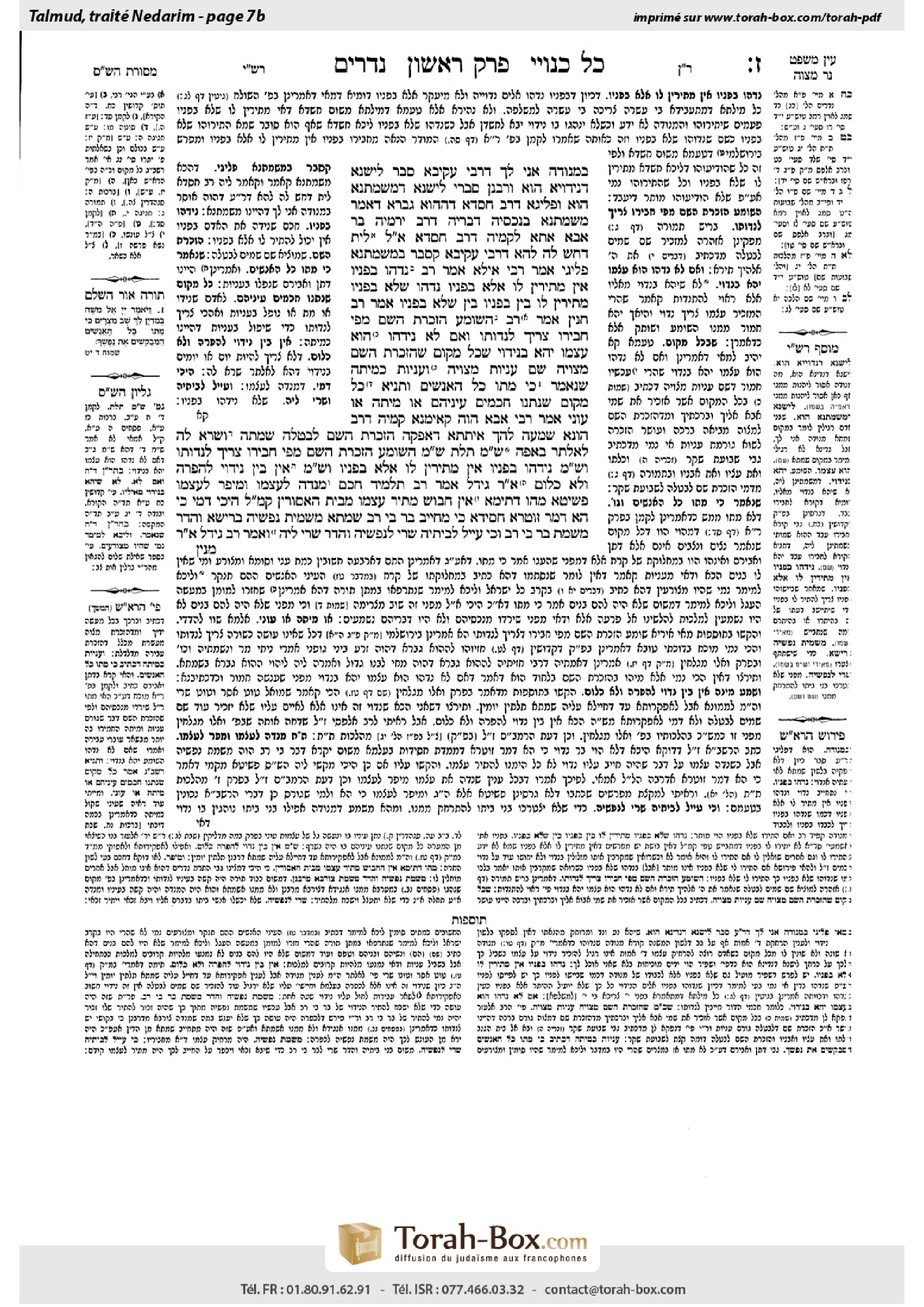
Nedarim 7b: Talmud study for Daf Yomi
Daf Yomi is the daily study of one Talmud folio. Explore 37 tractates with scans, Hebrew text, Sefaria English and AI-generated French translations where annotated.
Passage selection and English or AI-generated French translation are available where the scan has annotations. Daf Study is independent of Torah-Box and Sefaria.
Browse Nedarim · נדרים · All tractatesNedarim 7b text and translations
This page of Nedarim includes the Aramaic text, an English translation and an AI-generated French translation, alongside the scan above.
נדרים ז׳ ב · Aramaic and Hebrew text
בִּ״מְנוּדֶּה אֲנִי לָךְ״, דְּרַבִּי עֲקִיבָא סָבַר: לִישָּׁנָא דְנִידּוּיָא הוּא, וְרַבָּנַן סָבְרִי: לִישָּׁנָא דִמְשַׁמַּתְנָא הוּא.
וּפְלִיגָא דְּרַב חִסְדָּא. דְּהָהוּא גַּבְרָא דְּאָמַר ״מְשַׁמַּתְנָא בְּנִכְסֵיהּ דִּבְרֵיהּ דְּרַב יִרְמְיָה בַּר אַבָּא״ אֲתָא לְקַמֵּיהּ דְּרַב חִסְדָּא. אֲמַר לֵיהּ: לֵית דְּחָשׁ לַהּ לְהָא דְּרַבִּי עֲקִיבָא. קָסָבַר: בִּ״מְשַׁמַּתְנָא״ פְּלִיגִי.
אָמַר רַבִּי אִילָא אָמַר רַב: נִדָּהוּ בְּפָנָיו — אֵין מַתִּירִין לוֹ אֶלָּא בְּפָנָיו. נִדָּהוּ שֶׁלֹּא בְּפָנָיו — מַתִּירִין לוֹ בֵּין בְּפָנָיו בֵּין שֶׁלֹּא בְּפָנָיו.
אָמַר רַב חָנִין אָמַר רַב: הַשּׁוֹמֵעַ הַזְכָּרַת הַשֵּׁם מִפִּי חֲבֵירוֹ צָרִיךְ לְנַדּוֹתוֹ, וְאִם לֹא נִידָּהוּ — הוּא עַצְמוֹ יְהֵא בְּנִידּוּי. שֶׁכׇּל מָקוֹם שֶׁהַזְכָּרַת הַשֵּׁם מְצוּיָה, שָׁם עֲנִיּוּת מְצוּיָה.
וַעֲנִיּוּת, כְּמִיתָה, שֶׁנֶּאֱמַר: ״כִּי מֵתוּ כׇּל הָאֲנָשִׁים״, וְתַנְיָא: כׇּל מָקוֹם שֶׁ״נָּתְנוּ חֲכָמִים עֵינֵיהֶם״, אוֹ מִיתָה אוֹ עוֹנִי.
אָמַר רַבִּי אַבָּא: הֲוָה קָאֵימְנָא קַמֵּיהּ דְּרַב הוּנָא, שַׁמְעַהּ לְהָךְ אִיתְּתָא דְּאַפִּקָה הַזְכָּרַת הַשֵּׁם לְבַטָּלָה, שַׁמְּתַהּ וּשְׁרָא לַהּ לְאַלְתַּר בְּאַפַּהּ. שְׁמַע מִינַּהּ תְּלָת: שְׁמַע מִינַּהּ הַשּׁוֹמֵעַ הַזְכָּרַת הַשֵּׁם מִפִּי חֲבֵירוֹ צָרִיךְ לְנַדּוֹתוֹ, וּשְׁמַע מִינַּהּ: נִידָּהוּ בְּפָנָיו, אֵין מַתִּירִין לוֹ אֶלָּא בְּפָנָיו, וּשְׁמַע מִינַּהּ: אֵין בֵּין נִידּוּי לַהֲפָרָה וְלֹא כְּלוּם.
אָמַר רַב גִּידֵּל אָמַר רַב: תַּלְמִיד חָכָם מְנַדֶּה לְעַצְמוֹ, וּמֵיפֵר לְעַצְמוֹ. פְּשִׁיטָא? מַהוּ דְּתֵימָא: ״אֵין חָבוּשׁ מַתִּיר עַצְמוֹ מִבֵּית הָאֲסוּרִין״, קָא מַשְׁמַע לַן.
הֵיכִי דָּמֵי: כִּי הָא דְּמָר זוּטְרָא חֲסִידָא, כִּי מִחַיַּיב בַּר בֵּי רַב שַׁמְתָּא — מְשַׁמֵּית נַפְשֵׁיהּ בְּרֵישָׁא, וַהֲדַר מְשַׁמֵּת בַּר בֵּי רַב. וְכִי עָיֵיל לְבֵיתֵיהּ, שָׁרֵי לְנַפְשֵׁיהּ וַהֲדַר שָׁרֵי לֵיהּ.
וְאָמַר רַב גִּידֵּל אָמַר רַב:
Nedarim 7b · English translation
They disagree with regard to a case when the language one uses is: I am ostracized from you, as Rabbi Akiva holds that it is a language of distancing and therefore expresses a vow, and the Rabbis hold that it is a language of excommunication, and not the terminology with which people express vows.
The Gemara comments: And Rav Pappa disagrees with the opinion of Rav Ḥisda, as demonstrated in the following incident: There was a certain man who said: I am excommunicated from the property of the son of Rav Yirmeya bar Abba. He came before Rav Ḥisda to ask whether this statement was effective in generating a prohibition or not. Rav Ḥisda said to him: There is no one who, in practice, is concerned for that opinion of Rabbi Akiva. Apparently, Rav Ḥisda holds that they also disagree with regard to the phrase: I am excommunicated from you. This indicates that the dispute between the tanna’im is not with regard to specific terms but with regard to the more general question of whether terms of ostracism or excommunication are terms that can also express vows.
§ Rabbi Ila said that Rav said: If one ostracized another individual in his presence, one may dissolve it for him only in his presence. If one ostracized him not in his presence, one may dissolve it for him in his presence or not in his presence.
Rav Ḥanin said that Rav said: One who hears mention of the name of God in vain by another individual must ostracize him for doing so. And if he did not ostracize him, he himself, the listener, shall be ostracized, as wherever mention of God’s name in vain is common, poverty is also common there.
And poverty is so harsh that it is considered like death, as it is stated: “For all the men are dead who sought your life” (Exodus 4:19). The Sages had a tradition that Dathan and Abiram had sought to have Moses killed in Egypt and that they were the men referred to in the quoted verse (see 64b). They were still alive at that time but had become impoverished. And additionally, it is taught in a baraita: Wherever it says that the Sages set their eyes on a particular individual, the result was either death or poverty. This also indicates that death and poverty are equivalent.
Rabbi Abba said: I was standing before Rav Huna, and he heard a certain woman utter a mention of the name of God in vain. He excommunicated her and immediately dissolved the excommunication for her in her presence. The Gemara comments: Learn three things from this. Learn from this that one who hears mention of the name of God in vain by another individual must ostracize him; and learn from this that if one ostracized another in his presence, one may dissolve it for him only in his presence; and learn from this that there is nothing, i.e., no minimum time that must pass, between ostracism and nullification of the ostracism.
Rav Giddel said that Rav said: A Torah scholar can ostracize himself, and he can nullify the ostracism for himself. The Gemara asks: Isn’t it obvious that he can nullify the ostracism for himself, just as he is able to do for others? The Gemara answers: It states this lest you say, as per the popular maxim: A prisoner cannot free himself from prison, and since he is ostracized he cannot dissolve the ostracism for himself; therefore it teaches us that he can do so.
The Gemara asks: What are the circumstances where a Torah scholar might ostracize himself? It is like that case involving Mar Zutra Ḥasida. When a student in the academy was liable to receive excommunication, Mar Zutra Ḥasida would first excommunicate himself and then he would excommunicate the student of Torah. And when he would enter his home, he would dissolve the excommunication for himself and then dissolve the excommunication for the student.
And Rav Giddel said that Rav said:
Nedarim 7b · Traduction française (IA)
Ils sont en désaccord dans le cas où l’on emploie la formule : « Je suis mis au ban par toi » : Rabbi Akiva considère qu’elle exprime une prise de distance et, par conséquent, un vœu, tandis que les Rabbins estiment qu’il s’agit d’une formule d’excommunication, et non d’une expression par laquelle les gens formulent des vœux.
La Guemara fait remarquer que Rav Pappa est en désaccord avec l’avis de Rav Ḥisda, comme le montre l’incident suivant. Un homme dit : « Je suis excommunié des biens du fils de Rav Yirmeya bar Abba. » Il vint consulter Rav Ḥisda pour savoir si cette déclaration avait pour effet d’établir une interdiction ou non. Rav Ḥisda lui répondit : « En pratique, personne ne tient compte de cet avis de Rabbi Akiva. » Il semble donc que, selon Rav Ḥisda, ils sont également en désaccord sur la formule : « Je suis excommunié par toi. » Cela indique que le désaccord entre les tannaïm ne porte pas sur des expressions précises, mais sur la question plus générale de savoir si les termes de mise au ban ou d’excommunication peuvent également exprimer des vœux.
§ Rabbi Ila a dit au nom de Rav : Si quelqu’un a mis un autre individu au ban en sa présence, il ne peut lever cette mesure à son égard qu’en sa présence. S’il l’a mis au ban en son absence, il peut lever cette mesure à son égard en sa présence ou en son absence.
Rav Ḥanin a dit au nom de Rav : Celui qui entend un autre individu prononcer le nom de Dieu en vain doit le mettre au ban pour cela. S’il ne l’a pas mis au ban, c’est lui-même, l’auditeur, qui sera mis au ban, car partout où l’on prononce couramment le nom de Dieu en vain, la pauvreté est également courante.
La pauvreté est si dure qu’elle est considérée comme la mort, ainsi qu’il est dit : « Car tous les hommes qui en voulaient à ta vie sont morts » (Exode 4:19). Les Sages avaient reçu la tradition selon laquelle Dathan et Abiram avaient cherché à faire tuer Moïse en Égypte et étaient les hommes désignés dans le verset cité (voir 64b). À cette époque, ils étaient encore en vie, mais étaient devenus pauvres. De plus, il est enseigné dans une baraïta : partout où il est dit que les Sages ont posé les yeux sur un individu en particulier, il en a résulté soit la mort, soit la pauvreté. Cela indique également que la mort et la pauvreté sont équivalentes.
Rabbi Abba a dit : Je me tenais devant Rav Huna lorsqu’il entendit une femme prononcer le nom de Dieu en vain. Il la mit au ban, puis leva aussitôt la mesure à son égard, en sa présence. La Guemara fait remarquer : Apprends-en trois choses. Apprends-en que celui qui entend un autre individu prononcer le nom de Dieu en vain doit le mettre au ban ; apprends-en que si quelqu’un a mis un autre individu au ban en sa présence, il ne peut lever cette mesure à son égard qu’en sa présence ; et apprends-en qu’aucun délai minimum ne doit s’écouler entre la mise au ban et sa levée.
Rav Giddel a dit au nom de Rav : Un érudit en Torah peut se mettre lui-même au ban et lever lui-même cette mesure. La Guemara demande : N’est-il pas évident qu’il peut lever lui-même cette mesure, puisqu’il peut le faire pour autrui ? La Guemara répond : Cette précision est nécessaire, de peur que tu ne dises, conformément au dicton populaire : « Un prisonnier ne peut se libérer lui-même de prison » ; puisqu’il est lui-même mis au ban, il ne pourrait donc pas lever cette mesure. C’est pourquoi cela nous enseigne qu’il le peut.
La Guemara demande : Dans quelles circonstances un érudit en Torah pourrait-il se mettre lui-même au ban ? C’est ce qui se produisit dans le cas de Mar Zutra Ḥasida. Lorsqu’un élève de l’académie encourait l’excommunication, Mar Zutra Ḥasida commençait par se mettre lui-même au ban, puis il mettait l’élève en Torah au ban. Lorsqu’il rentrait chez lui, il levait la mesure à son propre égard, puis la levait à l’égard de l’élève.
Et Rav Giddel a dit au nom de Rav :
Traduction française générée par IA à partir de l’édition anglaise de Sefaria. Vérifie toujours un passage avec le texte source.
Text from Sefaria: William Davidson Edition - Vocalized Aramaic (CC BY NC); William Davidson Edition - English (CC BY NC).