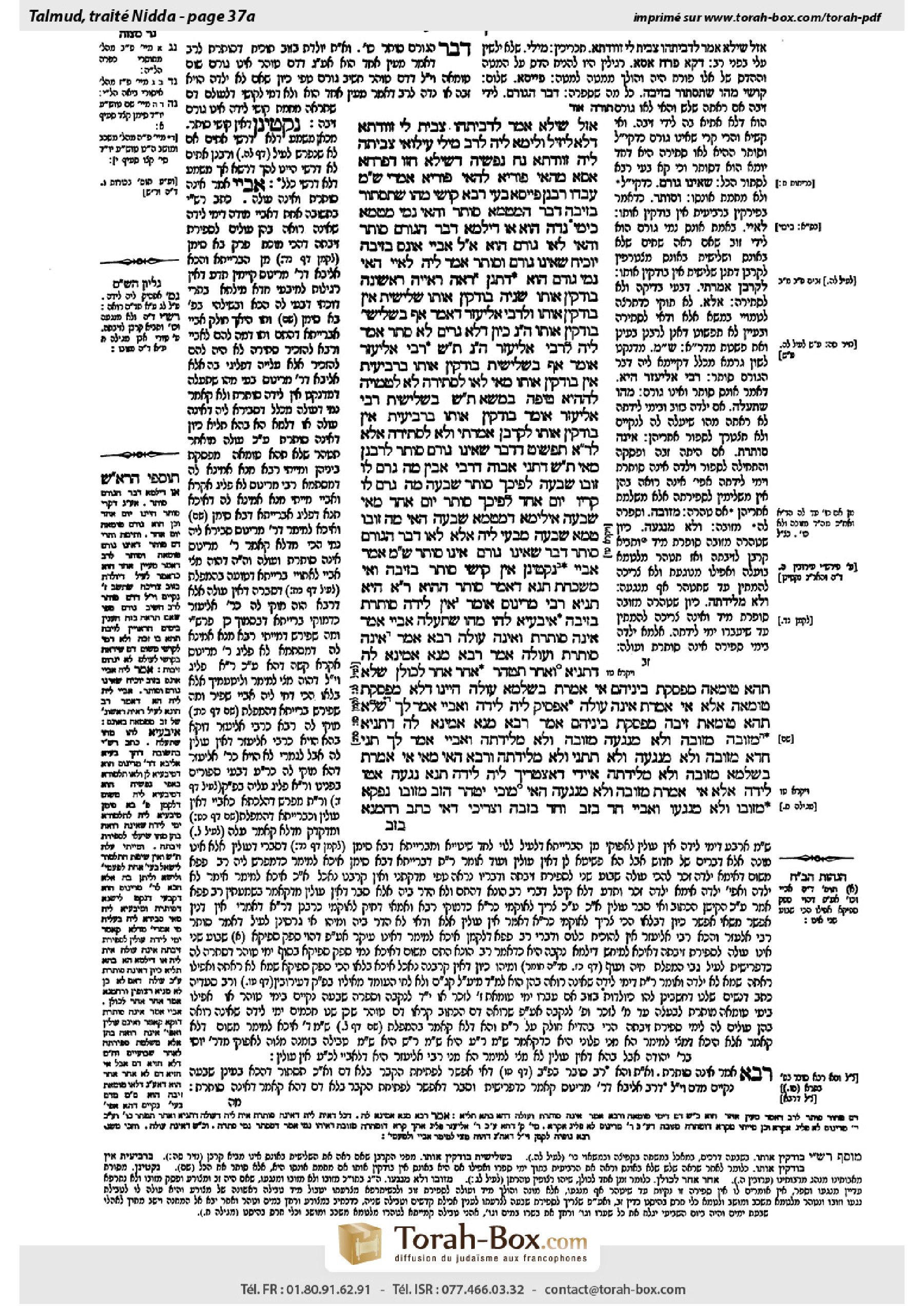
Niddah 37a: Talmud study for Daf Yomi
Daf Yomi is the daily study of one Talmud folio. Explore 37 tractates with scans, Hebrew text, Sefaria English and AI-generated French translations where annotated.
Passage selection and English or AI-generated French translation are available where the scan has annotations. Daf Study is independent of Torah-Box and Sefaria.
Browse Niddah · נידה · All tractatesNiddah 37a text and translations
This page of Niddah includes the Aramaic text, an English translation and an AI-generated French translation, alongside the scan above.
נידה ל״ז א · Aramaic and Hebrew text
אֲזַל שֵׁילָא, אֲמַר לִדְבֵיתְהוּ: צְבִית לִי זְוַודְתָּא דְּלָא לֵיזִיל וְלֵימָא לֵיהּ לְרַב מִילֵּי עִילָּוַאי. צְבִיתָה לֵיהּ זְוַודְתָּא. נָח נַפְשֵׁיהּ דְּשֵׁילָא, חֲזוֹ דְּפָרְחָא אָסָא מֵהַאי פּוּרְיָא לְהַאי פּוּרְיָא, אָמְרִי: שְׁמַע מִינַּהּ עֲבַדוּ רַבָּנַן פְּיָיסָא.
בָּעֵי רָבָא: קוֹשִׁי מַהוּ שֶׁתִּסְתּוֹר בְּזִיבָה?
דָּבָר הַמְטַמֵּא סוֹתֵר, וְהַאי נָמֵי מְטַמֵּא כִּימֵי נִדָּה הוּא, אוֹ דִילְמָא דָּבָר הַגּוֹרֵם סוֹתֵר, וְהַאי לָאו גּוֹרֵם הוּא?
אֲמַר לֵיהּ אַבָּיֵי: אוֹנֶס בְּזִיבָה יוֹכִיחַ, שֶׁאֵינוֹ גּוֹרֵם, וְסוֹתֵר!
אֲמַר לֵיהּ: לָאיֵי, הַאי נָמֵי גּוֹרֵם הוּא, דִּתְנַן: רָאָה רְאִיָּיה רִאשׁוֹנָה — בּוֹדְקִין אוֹתוֹ, שְׁנִיָּה — בּוֹדְקִין אוֹתוֹ, שְׁלִישִׁית — אֵין בּוֹדְקִין אוֹתוֹ.
וּלְרַבִּי אֱלִיעֶזֶר, דְּאָמַר: אַף בַּשְּׁלִישִׁית בּוֹדְקִין אוֹתוֹ, הָכִי נָמֵי כֵּיוָן דְּלָא גָרֵים לָא סָתַר? אֲמַר לֵיהּ: לְרַבִּי אֱלִיעֶזֶר, הָכִי נָמֵי.
תָּא שְׁמַע: רַבִּי אֱלִיעֶזֶר אוֹמֵר, אַף בַּשְּׁלִישִׁית בּוֹדְקִין אוֹתוֹ, בָּרְבִיעִית אֵין בּוֹדְקִין אוֹתוֹ. מַאי לַָאו לִסְתִירָה?
לָא, לְטַמּוֹיֵהּ לְהַהִיא טִיפָּה בְּמַשָּׂא.
תָּא שְׁמַע: בַּשְּׁלִישִׁית, רַבִּי אֱלִיעֶזֶר אוֹמֵר בּוֹדְקִין אוֹתוֹ, בָּרְבִיעִית אֵין בּוֹדְקִין אוֹתוֹ. לְקׇרְבָּן אָמַרְתִּי, וְלֹא לִסְתִירָה.
אֶלָּא לְרַבִּי אֱלִיעֶזֶר, תִּפְשׁוֹט דְּדָבָר שֶׁאֵינוֹ גּוֹרֵם סוֹתֵר, לְרַבָּנַן מַאי?
תָּא שְׁמַע, דְּתָנֵי אֲבוּהּ דְּרַבִּי אָבִין: מָה גָּרַם לוֹ זוֹבוֹ — שִׁבְעָה, לְפִיכָךְ סוֹתֵר שִׁבְעָה; מָה גָּרַם לוֹ קִרְיוֹ — יוֹם אֶחָד, לְפִיכָךְ סוֹתֵר יוֹם אֶחָד.
מַאי שִׁבְעָה? אִילֵּימָא דִּמְטַמֵּא שִׁבְעָה — הַאי ״מָה זוֹבוֹ טָמֵא שִׁבְעָה״ מִבָּעֵי לֵיהּ, אֶלָּא לָאו דָּבָר הַגּוֹרֵם סוֹתֵר, דָּבָר שֶׁאֵינוֹ גּוֹרֵם אֵינוֹ סוֹתֵר? שְׁמַע מִינַּהּ.
אָמַר אַבָּיֵי: נָקְטִינַן, אֵין קוֹשִׁי סוֹתֵר בְּזִיבָה. וְאִי מַשְׁכַּחַתְּ תַּנָּא דְּאָמַר סוֹתֵר — הָהוּא רַבִּי אֱלִיעֶזֶר הִיא.
תַּנְיָא, רַבִּי מָרִינוּס אוֹמֵר: אֵין לֵידָה סוֹתֶרֶת בְּזִיבָה. אִיבַּעְיָא לְהוּ: מַהוּ שֶׁתַּעֲלֶה? אַבָּיֵי אָמַר: אֵינָהּ סוֹתֶרֶת וְאֵינָהּ עוֹלָה. רָבָא אָמַר: אֵינָהּ סוֹתֶרֶת וְעוֹלָה.
אָמַר רָבָא: מְנָא אָמֵינָא לַהּ? דְּתַנְיָא: ״וְאַחַר תִּטְהָר״ — ״אַחַר״, ״אַחַר״ לְכוּלָּן, שֶׁלֹּא תְּהֵא טוּמְאָה מַפְסֶקֶת בֵּינֵיהֶם.
אִי אָמְרַתְּ בִּשְׁלָמָא עוֹלָה — הַיְינוּ דְּלָא מַפְסְקָה טוּמְאָה, אֶלָּא אִי אָמְרַתְּ אֵינָהּ עוֹלָה — אַפְסִיק לֵיהּ לֵידָה! וְאַבָּיֵי אָמַר לָךְ: שֶׁלֹּא תְּהֵא טוּמְאַת זִיבָה מַפְסֶקֶת בֵּינֵיהֶם.
אָמַר רָבָא: מְנָא אָמֵינָא לַהּ? דְּתַנְיָא: ״מִזּוֹבָהּ״ — ״מִזּוֹבָהּ״ וְלֹא מִנִּגְעָהּ, ״מִזּוֹבָהּ״ וְלֹא מִלֵּידָתָהּ. וְאַבָּיֵי אָמַר לָךְ: תְּנִי חֲדָא ״מִזּוֹבָהּ״ וְלֹא מִנִּגְעָהּ, וְלָא תִּתְנֵי ״וְלֹא מִלֵּידָתָהּ״.
וְרָבָא, הַאי מַאי? אִי אָמְרַתְּ בִּשְׁלָמָא ״מִזּוֹבָהּ״ וְלֹא מִלֵּידָתָהּ, אַיְּידֵי דְּאִצְטְרִיךְ לֵיהּ לֵידָה, תְּנָא נִגְעָהּ אַטּוּ לֵידָה. אֶלָּא אִי אָמְרַתְּ ״מִזּוֹבָהּ״ וְלֹא מִנִּגְעָהּ, הַאי מִ״וְּכִי יִטְהַר הַזָּב מִזּוֹבוֹ״ נָפְקָא — ״מִזּוֹבוֹ״ וְלֹא מִנִּגְעוֹ!
וְאַבָּיֵי — חַד בְּזָב וְחַד בְּזָבָה. וּצְרִיכִי, דְּאִי כְּתַב רַחֲמָנָא
Niddah 37a · English translation
Immediately upon Rav Asi’s death, Sheila bar Avina went and said to his wife: Prepare for me provisions [zevadata], i.e., shrouds for my burial, as I will soon die. This is in order that Rav Asi will not go and tell Rav matters of criticism about me, that I did not listen to Rav Asi and that I caused his death because I took offense when he excommunicated me. His wife prepared for him the provisions, and Sheila passed away. The biers of Rav Asi and Sheila bar Avina were brought together for burial. Those accompanying the dead saw that the myrtle that was customarily placed on a bier was flying from this bier to that bier. They said: Conclude from it that the Sages, i.e., Rav Asi and Sheila bar Avina, have made peace with one another.
§ The mishna teaches that a woman who experiences an emission of blood due to labor pains is not rendered a zava if she sees the blood in days when she can become a zava, but rather a menstruating woman if she sees the blood on days during which she can be a menstruating woman. In this regard Rava raises a dilemma: In general, if a zava experiences an emission of blood while counting seven clean days, her count is negated and she must begin a new count of seven clean days. But what is the halakha with regard to a zava who experienced an emission of blood due to labor pains? Does this emission negate her count with regard to ziva?
Rava elaborates: Does every substance that imparts impurity negate the count of seven clean days? If so, as this emission imparts impurity like blood of the days of menstruation, it negates her count as well. Or perhaps only a substance that causes a woman to become a zava negates her count, and as this blood is not a substance that causes her to become a zava it does not negate her count.
Abaye said to Rava: The case of an emission of ziva due to circumstances beyond one’s control will prove the halakha with regard to this dilemma, as such an emission does not cause one to be rendered a zav, and yet it negates one’s count of seven clean days.
Rava said to him: This is not so [la’ei], as this emission of ziva due to circumstances beyond one’s control is also a substance that causes one to be rendered a zav, as we learned in a mishna (Zavim 2:2): With regard to a man who saw a first sighting of ziva, one examines him to determine whether the discharge was caused by circumstances beyond his control. After the second sighting of ziva as well, one examines him. But after the third sighting one does not examine him, as even if the third sighting occurred due to circumstances beyond his control he is nevertheless rendered a zav on its account.
Abaye asked Rava: And according to Rabbi Eliezer, who said: Even after the third discharge one examines him, will you indeed say that since an emission of ziva due to circumstances beyond one’s control does not cause one to be rendered a zav, it does not negate his count? Rava said to Abaye: According to Rabbi Eliezer, this is indeed the case.
The Gemara attempts to reject Rava’s explanation of the opinion of Rabbi Eliezer: Come and hear a baraita: Rabbi Eliezer says: Even after the third discharge one examines him to establish whether he must bring an offering, but after the fourth discharge one does not examine him. What, is it not correct to say that as he was already rendered a zav after three discharges, an examination after the fourth discharge is for the matter of negating any clean days counted thus far? If so, Rabbi Eliezer maintains that an emission of ziva due to circumstances beyond one’s control negates one’s count.
The Gemara rejects this suggestion: No, it is possible that the purpose of the examination after the fourth discharge is to determine whether to render impure that drop of ziva such that it imparts impurity through carrying. According to Rabbi Eliezer, the discharge of a zav imparts impurity through carrying, even if the discharge occurred due to circumstances beyond his control.
The Gemara suggests: Come and hear another baraita: With regard to the third discharge, Rabbi Eliezer says that one examines him, but after the fourth discharge one does not examine him. The reason is as I said, that the purpose of these examinations is to determine liability to bring an offering, and they do not pertain to the matter of negating any clean days counted thus far. Since the fourth sighting does not affect liability to bring an offering there is no need for an examination. Evidently, Rabbi Eliezer maintains that a discharge that occurs due to circumstances beyond one’s control does negate his count.
The Gemara concedes: Rather, according to Rabbi Eliezer, one can resolve the dilemma and conclude that even a substance that does not cause one to be rendered a zav negates one’s count. But what is the halakha according to the opinion of the Rabbis?
The Gemara suggests: Come and hear that which the father of Rabbi Avin teaches with regard to the question of why a discharge of ziva causes a zav to negate his entire count of clean days, whereas a seminal emission negates only the day of the emission itself: What did his ziva cause for him? An impurity of seven days. Therefore, a discharge of ziva causes him to negate his count of seven clean days. By contrast, what did his seminal emission cause for him? An impurity of one day alone. Therefore, a seminal emission causes him to negate only one day of his count.
The Gemara analyzes this statement: What is the meaning of the claim that ziva causes an impurity of seven days? If we say it means merely that ziva renders him impure for seven days, then the father of Rabbi Avin should have stated: Just as his ziva causes him to be impure for seven days, so too, it negates his count of seven clean days. Rather, is it not that the mention of causation indicates that this is what he is saying: A substance that causes one to be rendered a zav negates one’s count of seven clean days, whereas a substance that does not cause one to be rendered a zav, e.g., an emission of blood due to labor pains, does not negate one’s count. The Gemara concludes: Indeed, conclude from it that this is the opinion of the Rabbis.
With regard to the halakha, Abaye said: We have a tradition that blood emitted by a woman due to labor pains does not negate the seven clean days of ziva, in accordance with the opinion of the Rabbis. And if you a find tanna who said that it does negate them, the statement of that tanna is in accordance with the opinion of Rabbi Eliezer.
§ It is taught in a baraita that Rabbi Marinus says: In the case of a zava who gave birth in the middle of counting seven clean days, the birth does not negate her count of seven clean days of ziva. With regard to this statement, a dilemma was raised before the Sages: What is the halakha as to whether her days of impurity may be counted toward the seven clean days of ziva? Abaye says: The birth does not negate her count, but it does not count toward the seven clean days. Rava says: The birth does not negate her count and it also counts toward the seven days.
Rava said: From where do I say that the birth is counted toward the seven days? As it is taught in a baraita: The verse states: “But if she is purified from her ziva then she shall count for herself seven days, and after that she shall be pure” (Leviticus 15:28). The word “after” indicates that she shall be pure only after counting all of them, i.e., that there should not be an impurity separating between any of the seven clean days.
Rava explains: Granted, if you say the birth counts toward the seven clean days, this is in accordance with the requirement that there should not be an impurity separating between any of the seven clean days, as they remain consecutive. But if you say the birth does not count toward the seven clean days, then the birth separates between the seven clean days. The Gemara notes: And Abaye could have said to you that the baraita means that there should not be an impurity of ziva separating between them. There is no problem with a separation due to birth.
Rava further said: From where do I say that the birth is counted toward the seven clean days? As it is taught in a baraita: The verse states: “But if she is purified from her ziva then she shall count for herself seven days” (Leviticus 15:28). This indicates that she counts seven clean days from her ziva and not from her leprosy, i.e., she begins counting seven days from the cessation of her ziva, even if she is a leper. Likewise, she counts seven clean days from her ziva and not from her giving birth, as she counts seven clean days even if they continue through her days of impurity. The Gemara notes: And Abaye could have said to you: From this verse teach one derivation, i.e., from her ziva and not from her leprosy, but do not teach: From her ziva and not from her giving birth.
And Rava would respond: What is this suggestion? Granted, if you say that the tanna of the baraita taught: From her ziva and not from her giving birth, one can understand why the tanna also teaches: From her ziva and not from her leprosy: Since it was necessary for the tanna to teach this halakha with regard to birth, he taught it with regard to her leprosy, due to the fact that he taught it with regard to birth. But if you say that the tanna taught only: From her ziva and not from her leprosy, then the verse is unnecessary, as this halakha is already derived from another verse: “And when the zav is purified of his ziva” (Leviticus 15:13), i.e., from his ziva and not from his leprosy.
And Abaye could respond: One verse discusses the case of a zav and the other one discusses the case of a zava, and both verses are necessary. As, if the Merciful One had written
Niddah 37a · Traduction française (IA)
Immédiatement après la mort de Rav Asi, Sheila bar Avina se rendit auprès de sa femme et lui dit : « Prépare-moi des provisions [zevadata] », c’est-à-dire des linceuls pour mon enterrement, car je vais bientôt mourir. Il voulait ainsi éviter que Rav Asi n’aille rapporter à Rav des reproches à son sujet : qu’il n’avait pas écouté Rav Asi et qu’il avait causé sa mort parce qu’il s’était offensé lorsqu’il l’avait mis au ban. Sa femme lui prépara les provisions, et Sheila mourut. Les litières de Rav Asi et de Sheila bar Avina furent amenées ensemble pour l’enterrement. Ceux qui accompagnaient les morts virent que le myrte que l’on plaçait habituellement sur une litière volait de l’une à l’autre. Ils dirent : « Concluez-en que les Sages, c’est-à-dire Rav Asi et Sheila bar Avina, se sont réconciliés. »
§ La Michna enseigne qu’une femme qui a un écoulement de sang dû aux douleurs de l’accouchement n’est pas considérée comme une zava si elle voit ce sang pendant les jours où elle peut le devenir ; elle est plutôt considérée comme une femme menstruée si elle voit du sang pendant les jours où elle peut être menstruée. À ce sujet, Rava soulève une question : en règle générale, si une zava a un écoulement de sang pendant qu’elle compte sept jours propres, son décompte est annulé et elle doit recommencer à compter sept jours propres. Mais quelle est la halakha concernant une zava qui a un écoulement de sang dû aux douleurs de l’accouchement ? Cet écoulement annule-t-il son décompte concernant la ziva ?
Rava précise : Toute substance qui transmet l’impureté annule-t-elle le décompte des sept jours propres ? Si tel est le cas, puisque cet écoulement transmet l’impureté comme le sang des jours de menstruation, il annule également son décompte. Ou peut-être seule une substance qui rend une femme zava annule-t-elle son décompte ; or, puisque ce sang ne la rend pas zava, il n’annule pas son décompte.
Abayé dit à Rava : Le cas d’un écoulement de ziva dû à des circonstances indépendantes de la volonté de l’intéressé permettra de trancher cette question, car un tel écoulement ne fait pas qu’un homme soit considéré comme un zav, et pourtant il annule son décompte des sept jours propres.
Rava lui dit : Ce n’est pas le cas [la’ei], car cet écoulement de ziva dû à des circonstances indépendantes de la volonté de l’intéressé est lui aussi une substance qui rend un homme zav, comme nous l’avons appris dans une Michna (Zavim 2:2) : Pour un homme qui a eu un premier écoulement de ziva, on vérifie si l’écoulement a été provoqué par des circonstances indépendantes de sa volonté. On le vérifie également après le deuxième écoulement de ziva. Mais après le troisième écoulement, on ne le vérifie plus, car même si ce troisième écoulement est survenu en raison de circonstances indépendantes de sa volonté, il est néanmoins considéré comme un zav à cause de celui-ci.
Abayé demanda à Rava : Et selon Rabbi Eliézer, qui a dit que même après le troisième écoulement on le vérifie, diras-tu vraiment que, puisque l’écoulement de ziva dû à des circonstances indépendantes de sa volonté ne fait pas qu’un homme soit considéré comme un zav, il n’annule pas son décompte ? Rava dit à Abayé : Selon Rabbi Eliézer, c’est effectivement le cas.
La Guemara tente de réfuter l’explication de Rava concernant l’opinion de Rabbi Eliézer : Viens et entends une baraïta : Rabbi Eliézer dit que même après le troisième écoulement, on le vérifie afin d’établir s’il doit apporter un sacrifice ; mais après le quatrième écoulement, on ne le vérifie plus. N’est-il pas juste de dire que, puisqu’il est déjà considéré comme un zav après trois écoulements, la vérification après le quatrième écoulement porte sur l’annulation des jours propres déjà comptés ? Si tel est le cas, Rabbi Eliézer soutient qu’un écoulement de ziva dû à des circonstances indépendantes de la volonté de l’intéressé annule son décompte.
La Guemara rejette cette proposition : Non, il est possible que la vérification après le quatrième écoulement vise à déterminer s’il faut considérer cette goutte de ziva comme impure, de sorte qu’elle transmette l’impureté par portage. Selon Rabbi Eliézer, l’écoulement d’un zav transmet l’impureté par portage, même s’il est survenu en raison de circonstances indépendantes de la volonté de l’intéressé.
La Guemara propose : Viens et entends une autre baraïta : Au sujet du troisième écoulement, Rabbi Eliézer dit qu’on le vérifie, mais qu’après le quatrième écoulement, on ne le vérifie plus. La raison en est celle que j’ai indiquée : ces vérifications visent à déterminer l’obligation d’apporter un sacrifice et ne concernent pas l’annulation des jours propres déjà comptés. Puisque le quatrième écoulement n’a aucune incidence sur l’obligation d’apporter un sacrifice, il n’est pas nécessaire de procéder à une vérification. Il apparaît donc que Rabbi Eliézer soutient qu’un écoulement survenu en raison de circonstances indépendantes de la volonté de l’intéressé annule son décompte.
La Guemara concède : Il faut donc résoudre la question selon Rabbi Eliézer et conclure que même une substance qui ne rend pas un homme zav annule son décompte. Mais quelle est la halakha selon l’opinion des Rabbins ?
La Guemara propose : Viens et entends ce qu’enseigne le père de Rabbi Avin au sujet de la question de savoir pourquoi un écoulement de ziva oblige un zav à annuler tout son décompte des jours propres, tandis qu’une émission de sperme n’annule que le jour où elle se produit : Qu’est-ce que sa ziva a entraîné pour lui ? Une impureté de sept jours. Par conséquent, un écoulement de ziva l’oblige à annuler son décompte des sept jours propres. En revanche, qu’est-ce que son émission de sperme a entraîné pour lui ? Une impureté d’un seul jour. Par conséquent, une émission de sperme l’oblige à n’annuler qu’un seul jour de son décompte.
La Guemara analyse cette déclaration : Que signifie l’affirmation selon laquelle la ziva entraîne une impureté de sept jours ? Si l’on dit qu’elle signifie simplement que la ziva le rend impur pendant sept jours, le père de Rabbi Avin aurait dû dire : De même que sa ziva le rend impur pendant sept jours, de même elle l’oblige à annuler son décompte des sept jours propres. Ne faut-il pas plutôt comprendre que la mention de ce qu’elle entraîne signifie ceci : une substance qui rend un homme zav annule son décompte des sept jours propres, tandis qu’une substance qui ne le rend pas zav, par exemple un écoulement de sang dû aux douleurs de l’accouchement, n’annule pas son décompte. La Guemara conclut : En effet, conclus-en que telle est l’opinion des Rabbins.
Concernant la halakha, Abayé dit : Nous avons une tradition selon laquelle le sang émis par une femme en raison des douleurs de l’accouchement n’annule pas les sept jours propres de ziva, conformément à l’opinion des Rabbins. Et si tu trouves un tanna qui dit qu’il les annule, la déclaration de ce tanna est conforme à l’opinion de Rabbi Eliézer.
§ Il est enseigné dans une baraïta que Rabbi Marinus dit : Dans le cas d’une zava qui accouche au milieu du décompte des sept jours propres, l’accouchement n’annule pas son décompte des sept jours propres de ziva. À propos de cette déclaration, les Sages soulevèrent la question suivante : Quelle est la halakha quant à savoir si ses jours d’impureté peuvent être comptés parmi les sept jours propres de ziva ? Abayé dit : L’accouchement n’annule pas son décompte, mais il ne compte pas parmi les sept jours propres. Rava dit : L’accouchement n’annule pas son décompte et compte également parmi les sept jours.
Rava dit : D’où déduis-je que l’accouchement compte parmi les sept jours ? Comme il est enseigné dans une baraïta : Le verset dit : « Mais si elle est purifiée de sa ziva, elle comptera pour elle-même sept jours, et ensuite elle sera pure » (Lévitique 15:28). Le terme « ensuite » indique qu’elle ne sera pure qu’après les avoir tous comptés, c’est-à-dire qu’aucune impureté ne doit s’intercaler entre les sept jours propres.
Rava explique : Il est cohérent de dire que l’accouchement compte parmi les sept jours propres, car ainsi aucune impureté ne s’intercale entre ces jours, qui restent consécutifs. Mais si l’on dit que l’accouchement ne compte pas parmi les sept jours propres, alors il s’intercale entre ces jours propres. La Guemara note : Abayé aurait pu te répondre que la baraïta signifie qu’aucune impureté de ziva ne doit s’intercaler entre eux. Il n’y a pas de problème si un accouchement s’intercale.
Rava dit encore : D’où déduis-je que l’accouchement compte parmi les sept jours propres ? Comme il est enseigné dans une baraïta : Le verset dit : « Mais si elle est purifiée de sa ziva, elle comptera pour elle-même sept jours » (Lévitique 15:28). Cela indique qu’elle compte sept jours propres à partir de sa ziva et non de sa lèpre, c’est-à-dire qu’elle commence à compter sept jours dès la cessation de sa ziva, même si elle est lépreuse. De même, elle compte sept jours propres à partir de sa ziva et non de son accouchement, puisqu’elle compte sept jours propres même s’ils se poursuivent pendant ses jours d’impureté. La Guemara note : Abayé aurait pu te répondre : Tire de ce verset une seule déduction, à savoir « de sa ziva et non de sa lèpre », mais ne déduis pas : « de sa ziva et non de son accouchement ».
Et Rava répondrait : Que vaut cette proposition ? Il est cohérent de dire que, si le tanna de la baraïta a enseigné « de sa ziva et non de son accouchement », il enseigne également « de sa ziva et non de sa lèpre » : puisqu’il était nécessaire d’enseigner cette halakha au sujet de l’accouchement, le tanna l’a également enseignée au sujet de la lèpre, en raison de ce qu’il avait enseigné au sujet de l’accouchement. Mais si l’on dit que le tanna a enseigné uniquement « de sa ziva et non de sa lèpre », le verset est alors superflu, car cette halakha se déduit déjà d’un autre verset : « Et lorsque le zav sera purifié de sa ziva » (Lévitique 15:13), c’est-à-dire de sa ziva et non de sa lèpre.
Et Abayé pourrait répondre : L’un des versets traite du cas d’un zav et l’autre du cas d’une zava ; les deux versets sont donc nécessaires. Car, si le Miséricordieux avait écrit
Traduction française générée par IA à partir de l’édition anglaise de Sefaria. Vérifie toujours un passage avec le texte source.
Text from Sefaria: William Davidson Edition - Vocalized Aramaic (CC BY NC); William Davidson Edition - English (CC BY NC).