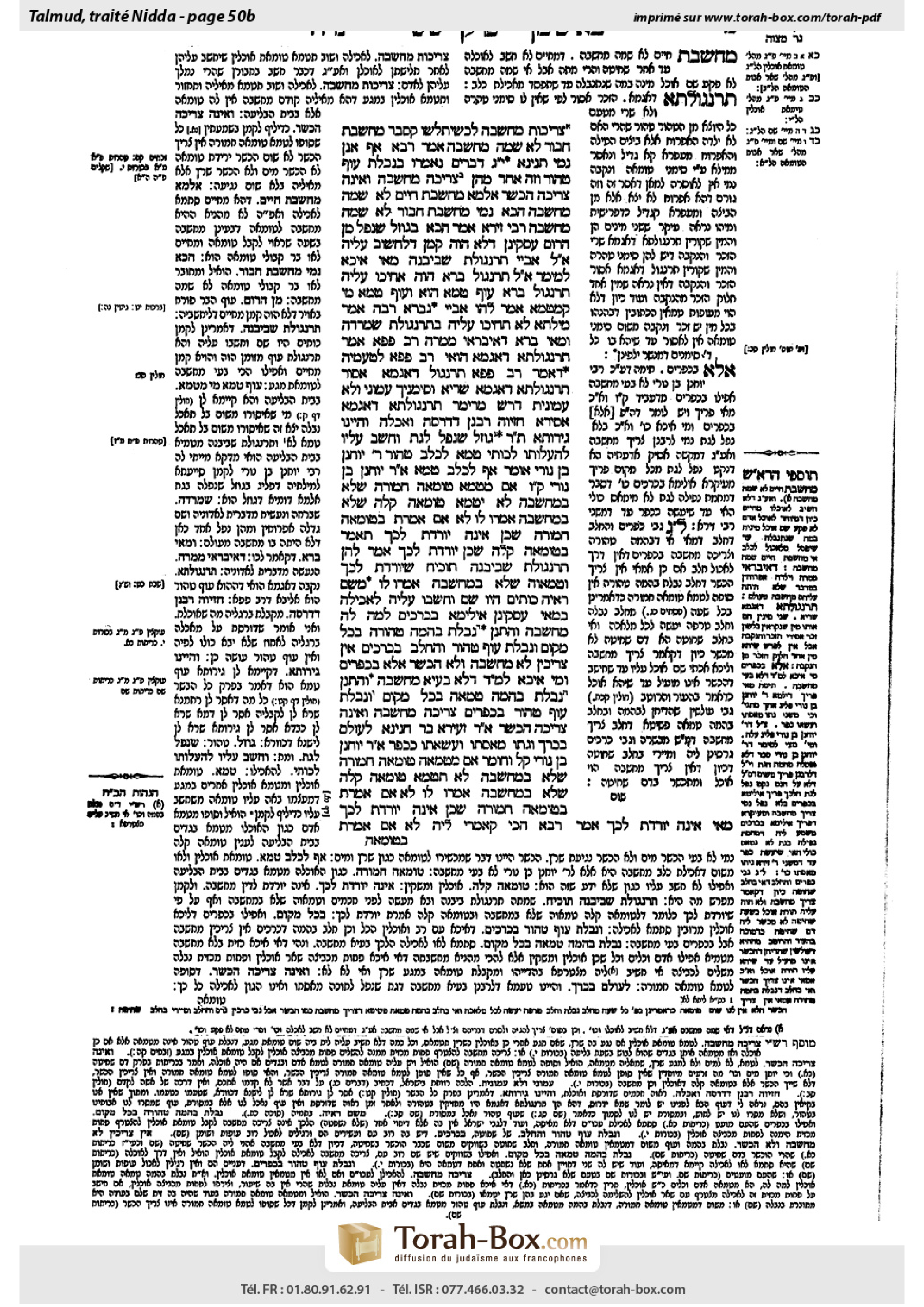
Niddah 50b: Talmud study for Daf Yomi
Daf Yomi is the daily study of one Talmud folio. Explore 37 tractates with scans, Hebrew text, Sefaria English and AI-generated French translations where annotated.
Passage selection and English or AI-generated French translation are available where the scan has annotations. Daf Study is independent of Torah-Box and Sefaria.
Browse Niddah · נידה · All tractatesNiddah 50b text and translations
This page of Niddah includes the Aramaic text, an English translation and an AI-generated French translation, alongside the scan above.
נידה נ׳ ב · Aramaic and Hebrew text
צְרִיכוֹת מַחְשָׁבָה לִכְשֶׁיִּתָּלְשׁוּ, קָסָבַר מַחְשֶׁבֶת חִבּוּר לֹא שְׁמָהּ מַחְשָׁבָה.
אָמַר רָבָא: אַף אֲנַן נָמֵי תְּנֵינָא, שְׁלֹשָׁה עָשָׂר דְּבָרִים נֶאֶמְרוּ בְּנִבְלַת עוֹף טָהוֹר, וְזֶה אֶחָד מֵהֶן: צְרִיכָה מַחְשָׁבָה וְאֵינָהּ צְרִיכָה הֶכְשֵׁר. אַלְמָא מַחְשֶׁבֶת חַיִּים לֹא שְׁמָהּ מַחְשָׁבָה, הָכָא נָמֵי מַחְשֶׁבֶת חִבּוּר לֹא שְׁמָהּ מַחְשָׁבָה.
רַבִּי זֵירָא אָמַר: הָכָא בְּגוֹזָל שֶׁנָּפַל מִן הָרוּם עָסְקִינַן, דְּלָא הֲוָה קַמַּן דְּלַחְשׁוֹב עֲלֵיהּ.
אֲמַר לֵיהּ אַבָּיֵי: תַּרְנְגוֹלֶת שֶׁבְּיַבְנֶה, מַאי אִיכָּא לְמֵימַר? אֲמַר לֵיהּ: תַּרְנְגוֹל בָּרָא הֲוָה.
אַחִיכוּ עֲלֵיהּ: תַּרְנְגוֹל בָּרָא עוֹף טָמֵא הוּא, וְעוֹף טָמֵא מִי קָמְטַמֵּא? אֲמַר לְהוּ אַבָּיֵי: גַּבְרָא רַבָּה אֲמַר מִילְּתָא, לָא תְּחִיכוּ עֲלֵיהּ, בְּתַרְנְגוֹלֶת שֶׁמָּרְדָה, וּמַאי ״בָּרָא״? דְּאִיבְּרַאי מִמָּרַהּ.
רַב פָּפָּא אָמַר: תַּרְנְגוֹלְתָּא דְּאַגְמָא הֲוַאי. רַב פָּפָּא לְטַעְמֵיהּ, דְּאָמַר רַב פָּפָּא: תַּרְנְגוֹלָא דְּאַגְמָא אֲסִיר, תַּרְנְגוֹלְתָּא דְּאַגְמָא שַׁרְיָא.
וְסִימָנָיךְ — ״עַמּוֹנִי וְלֹא עַמּוֹנִית״. דָּרַשׁ מָרִימָר: תַּרְנְגוֹלְתָּא דְּאַגְמָא אֲסִירָא. חַזְיוּהָ רַבָּנַן דְּדָרְסָה וְאָכְלָה, וְהַיְינוּ גֵּירוּתָא.
תָּנוּ רַבָּנַן: גּוֹזָל שֶׁנָּפַל לַגַּת, וְחִשַּׁב עָלָיו לְהַעֲלוֹתוֹ לְכוּתִי — טָמֵא, לְכֶלֶב — טָהוֹר. רַבִּי יוֹחָנָן בֶּן נוּרִי אוֹמֵר: אַף לְכֶלֶב — טָמֵא.
אָמַר רַבִּי יוֹחָנָן בֶּן נוּרִי: קַל וָחוֹמֶר, אִם מְטַמֵּא טוּמְאָה חֲמוּרָה שֶׁלֹּא בְּמַחְשָׁבָה — לֹא יְטַמֵּא טוּמְאָה קַלָּה שֶׁלֹּא בְּמַחְשָׁבָה?!
אָמְרוּ לוֹ: לֹא, אִם אָמַרְתָּ בְּטוּמְאָה חֲמוּרָה, שֶׁכֵּן אֵינָהּ יוֹרֶדֶת לְכָךְ, תֹּאמַר בְּטוּמְאָה קַלָּה, שֶׁכֵּן יוֹרֶדֶת לְכָךְ!
אָמַר לָהֶן: תַּרְנְגוֹלֶת שֶׁבְּיַבְנֶה תּוֹכִיחַ, שֶׁיּוֹרֶדֶת לְכָךְ, וְטִמְּאוּהָ שֶׁלֹּא בְּמַחְשָׁבָה. אָמְרוּ לוֹ: מִשָּׁם רְאָיָה? כּוּתִים הָיוּ שָׁם, וְחִשְּׁבוּ עָלֶיהָ לַאֲכִילָה.
בְּמַאי עָסְקִינַן? אִילֵימָא בִּכְרַכִּים, לְמָה לַהּ מַחְשָׁבָה? וְהָתְנַן: נִבְלַת בְּהֵמָה טְהוֹרָה בְּכׇל מָקוֹם, וְנִבְלַת עוֹף טָהוֹר וְהַחֵלֶב בַּכְּרַכִּים — אֵין צְרִיכִין לֹא מַחְשָׁבָה וְלֹא הֶכְשֵׁר!
אֶלָּא בִּכְפָרִים, וּמִי אִיכָּא לְמַאן דְּאָמַר דְּלָא בָּעֲיָא מַחְשָׁבָה? וְהָתְנַן: נִבְלַת בְּהֵמָה טְמֵאָה בְּכׇל מָקוֹם, וְנִבְלַת עוֹף טָהוֹר בַּכְּפָרִים — צְרִיכָה מַחְשָׁבָה וְאֵינָהּ צְרִיכָה הֶכְשֵׁר!
אָמַר רַבִּי זְעֵירָא בַּר חֲנִינָא: לְעוֹלָם בִּכְרַךְ, וְגִתּוֹ מֵאֲסַתּוּ, וַעֲשָׂאַתּוּ כִּכְפָר.
אָמַר רַבִּי יוֹחָנָן בֶּן נוּרִי: קַל וָחוֹמֶר, אִם מְטַמְּאָה טוּמְאָה חֲמוּרָה שֶׁלֹּא בְּמַחְשָׁבָה, לֹא תְּטַמֵּא טוּמְאָה קַלָּה שֶׁלֹּא בְּמַחְשָׁבָה?
אָמְרוּ לוֹ: לֹא, אִם אָמַרְתָּ בְּטוּמְאָה חֲמוּרָה שֶׁכֵּן אֵינָהּ יוֹרֶדֶת לְכָךְ.
מַאי ״אֵינָהּ יוֹרֶדֶת לְכָךְ״? אָמַר רָבָא: הָכִי קָאָמְרִי לֵיהּ: לֹא, אִם אָמַרְתָּ
Niddah 50b · English translation
they require intent to be used for human consumption once they are detached from the ground, in order for them to be susceptible to ritual impurity. Rabbi Yoḥanan rules in this manner because he holds that intent to designate produce while it is attached to the ground is not considered intent.
Rava said: We learn in a mishna (Teharot 1:1) as well: Thirteen matters were stated with regard to the carcass of a kosher bird, and this is one of them: In order for such a carcass to be susceptible to impurity and to be capable of imparting impurity to food through contact, it requires a person’s intention to eat it, but it does not require exposure to liquid to be rendered susceptible to impurity. Even if one had intent to eat the bird while it was still alive, intent is still required after it became a carcass for it to transmit impurity. Rava concludes: Evidently, intent that the bird be eaten while the bird is alive is not considered intent. Here too, intent to designate produce while it is attached to the ground is not considered intent.
Rabbi Zeira said: Rava’s proof is inconclusive, as here we are dealing with a young bird that fell from a height, where the bird was not before us prior to it becoming a carcass, so that one could have had intent that it is food. Consequently, it requires intent afterward for it to impart impurity, but had there been intent while it was still alive, that would have sufficed.
Abaye said to Rabbi Zeira: What is there to say about the case of the chicken in Yavne? In that instance the Sages deemed the chicken impure due to intent only after it became a carcass, despite the fact that it was present before them while it was alive. This apparently indicates that intent which occurred while the bird was alive is not considered intent. Rabbi Zeira said to Abaye: That was actually a wild chicken, which was not before them while it was alive, and therefore there was no intent that it should be food while it was alive.
Those who heard this comment laughed at Rabbi Zeira’s interpretation: A wild chicken is a non-kosher bird, and does a non-kosher bird impart impurity? Abaye said to them: A great man has stated a matter; do not laugh at him. Rabbi Zeira means that this is referring to a chicken that rebelled against its owner, ran away to the wild, and raised its kosher chicks there. One of those chicks subsequently returned from the wild. Consequently, it had not been present before the Sages while it was alive. And what did Rabbi Zeira mean when he mentioned a wild [bara] chicken? He meant one that was created [de’ivrai] from a chicken that rebelled.
Rav Pappa stated an alternative interpretation: It was a marsh [de’agma] hen. Since no one lives in a marsh, there was no opportunity for intent while it was alive, and therefore intent was necessary afterward. The Gemara adds: Rav Pappa conforms to his standard line of reasoning in this regard, as Rav Pappa said: The animal called the marsh rooster is prohibited, as it is a non-kosher bird, whereas the marsh hen is kosher and permitted.
And your mnemonic to remember which animal is permitted and which is prohibited is the well-known statement of the Sages with regard to the verse: “An Ammonite or a Moabite shall not enter into the assembly of the Lord” (Deuteronomy 23:4). An Ammonite man is unfit to enter the assembly but not an Ammonite woman. Here too, the animal with a female name is permitted, whereas the one with a male name is prohibited. Mareimar taught: The marsh hen is prohibited, contrary to the opinion of Rav Pappa, as the Sages saw that it mauled and ate its prey. And this is the geiruta, a non-kosher bird.
§ Apropos the case of a young kosher bird that fell and died, the Sages taught in a baraita: A young kosher bird that fell into a winepress and died there, where the owner intended to draw it up from the press for a Samaritan to eat, is ritually impure, like any carcass of a kosher bird. If he intended to draw it up from the press for a dog to eat, it is ritually pure. Rabbi Yoḥanan ben Nuri says: Even if he intended to draw it up from the press for a dog to eat, it is impure, as the bird does not require intent for it to be impure.
Rabbi Yoḥanan ben Nuri says in explanation of his opinion: This halakha can be derived by the following a fortiori inference: If the carcass of a kosher bird transmits severe ritual impurity, i.e., it renders one’s garments impure when an olive-bulk of it is in the throat, without thought, i.e., even if no one had intent that a person should eat it, should it not transmit a lenient impurity of food, by touch alone, likewise without thought?
The Rabbis said to Rabbi Yoḥanan ben Nuri: No, this is not a valid a fortiori inference. If you said that there is no requirement of intent with regard to severe ritual impurity, that is because severe ritual impurity does not assume its status with that requirement of thought, i.e., intent is not relevant to that type of impurity. Shall you also say that there is no requirement of thought with regard to lenient impurity, which does assume its status with that requirement of thought? The Gemara will soon explain the precise meaning of this concept of assuming its status with the requirement of thought.
Rabbi Yoḥanan ben Nuri said to the Rabbis: The case of the chicken in Yavne can prove that the question of whether or not intent is required does not depend on that factor. The case in Yavne involved an item that does assume its status with that requirement of thought, and yet the Sages declared it impure without intent. The Rabbis said to Rabbi Yoḥanan ben Nuri: Will you cite proof from there? In that case there were Samaritans there, and the people in Yavne intended that it be eaten by the Samaritans.
The Gemara analyzes the case of a young kosher bird that fell into a winepress: What type of situation are we dealing with? If we say that we are dealing with cities, where there are many people available to consume all sorts of food, including the carcass of a kosher bird, why does it require intent? But didn’t we learn in a mishna (Okatzin 3:3): An unslaughtered carcass of a kosher animal in any location, whether the population is large or small, and the carcass of a kosher bird or the fat of a kosher animal found in cities [bakerakim], require neither intent for human consumption nor contact with liquid for them to be rendered susceptible to impurity?
Rather, it must be referring to villages, where the population is small and there are not many people who would eat the carcass. But this too is difficult: Is there anyone who said that intent is not required in the case of a carcass of a non-kosher bird for the impurity of food? Didn’t we learn in the beginning of that same mishna: A carcass of a non-kosher animal found in any location, and an unslaughtered carcass of a kosher bird in the villages both require intent to consume them, but they do not require contact with a liquid to become susceptible to ritual impurity?
Rabbi Zeira bar Ḥanina says: Actually, the baraita is referring to a case that occurred in a city, and even so intent is required. The reason is that the young bird fell into a winepress, and the winepress rendered it disgusting and thereby rendered it like the carcass of a kosher bird in a village, where there are few people who would eat it.
The Gemara analyzes the exchange cited above. Rabbi Yoḥanan ben Nuri says that this halakha can be derived by an a fortiori inference: If the carcass of a kosher bird transmits severe ritual impurity without thought, should it not transmit lenient impurity without thought?
The Rabbis said to Rabbi Yoḥanan ben Nuri: No, this is not a valid a fortiori inference. If you said so with regard to severe ritual impurity, that is because it does not assume its status with that requirement of thought.
The Gemara asks: What is the meaning of the clause: It does not assume its status with that requirement of thought? In what manner is thought required for the lenient impurity of food it imparts in the case of a bird carcass but not required for the severe impurity it imparts when it is in the throat? Rava said that this is what the Rabbis said to Rabbi Yoḥanan ben Nuri: No, if you said that there is no requirement of thought
Niddah 50b · Traduction française (IA)
Il faut avoir l’intention qu’ils soient consommés par des humains une fois détachés du sol pour qu’ils puissent contracter l’impureté rituelle. Rabbi Yoḥanan statue ainsi parce qu’il considère que l’intention de destiner des produits à la consommation alors qu’ils sont encore attachés au sol n’est pas considérée comme une intention.
Rava dit : Nous l’apprenons également dans une Michna (Teharot 1:1) : treize règles ont été énoncées au sujet de la carcasse d’un oiseau cachère, et voici l’une d’elles : pour qu’une telle carcasse puisse contracter l’impureté et transmettre l’impureté à un aliment par contact, une personne doit avoir l’intention de la manger, mais il n’est pas nécessaire qu’elle soit mise en contact avec un liquide pour devenir susceptible de contracter l’impureté. Même si quelqu’un avait eu l’intention de manger l’oiseau alors qu’il était encore vivant, une intention est encore nécessaire après qu’il est devenu une carcasse pour qu’il transmette l’impureté. Rava conclut : Il ressort de là que l’intention de manger l’oiseau alors qu’il est encore vivant n’est pas considérée comme une intention. De même ici, l’intention de destiner des produits à la consommation alors qu’ils sont encore attachés au sol n’est pas considérée comme une intention.
Rabbi Zeira dit : La preuve de Rava n’est pas concluante, car ici, il s’agit d’un jeune oiseau tombé d’une hauteur, qui ne se trouvait pas devant nous avant de devenir une carcasse ; on n’a donc pas pu avoir l’intention de le considérer comme un aliment. Par conséquent, il faut une intention après coup pour qu’il transmette l’impureté. Mais si l’on avait eu une intention alors qu’il était encore vivant, cela aurait suffi.
Abaye dit à Rabbi Zeira : Que dire du cas de la poule de Yavné ? Dans ce cas, les Sages ont déclaré la poule impure en raison d’une intention formulée seulement après qu’elle est devenue une carcasse, bien qu’elle se soit trouvée devant eux alors qu’elle était encore vivante. Cela indique apparemment qu’une intention formulée lorsque l’oiseau était vivant n’est pas considérée comme une intention. Rabbi Zeira dit à Abaye : Il s’agissait en fait d’une poule sauvage, qui ne se trouvait pas devant eux lorsqu’elle était vivante ; il n’y avait donc pas eu d’intention qu’elle soit un aliment tant qu’elle était vivante.
Ceux qui entendirent cette remarque se moquèrent de l’interprétation de Rabbi Zeira : une poule sauvage est un oiseau non cachère, et un oiseau non cachère transmet-il l’impureté ? Abaye leur dit : Un grand homme a énoncé une idée ; ne vous moquez pas de lui. Rabbi Zeira veut dire qu’il s’agissait d’une poule qui s’était rebellée contre son propriétaire, s’était enfuie dans la nature et y avait élevé ses poussins cachères. L’un de ces poussins était ensuite revenu de la nature. Par conséquent, il ne s’était pas trouvé devant les Sages lorsqu’il était vivant. Et que voulait dire Rabbi Zeira en parlant d’une poule sauvage [bara] ? Il voulait dire qu’elle avait été engendrée [de’ivrai] par une poule qui s’était rebellée.
Rav Pappa proposa une autre interprétation : il s’agissait d’une poule des marais [de’agma]. Comme personne ne vit dans les marais, il n’y avait pas eu d’occasion d’avoir une intention pendant qu’elle était vivante ; une intention après coup était donc nécessaire. La Guemara ajoute : Rav Pappa suit ici son raisonnement habituel, car Rav Pappa a dit : L’animal appelé coq des marais est interdit, puisqu’il s’agit d’un oiseau non cachère, tandis que la poule des marais est cachère et permise.
Et voici un moyen mnémotechnique pour se rappeler quel animal est permis et lequel est interdit : la déclaration bien connue des Sages au sujet du verset : « Un Ammonite ou un Moabite ne pourra entrer dans l’assemblée de l’Éternel » (Deutéronome 23:4). Un homme ammonite ne peut pas entrer dans l’assemblée, mais une femme ammonite le peut. De même ici, l’animal dont le nom est féminin est permis, tandis que celui dont le nom est masculin est interdit. Mareimar enseigna que la poule des marais est interdite, contrairement à l’opinion de Rav Pappa, car les Sages virent qu’elle lacérait sa proie et la mangeait. Il s’agit de la geiruta, un oiseau non cachère.
§ À propos du cas d’un jeune oiseau cachère tombé et mort, les Sages enseignèrent dans une baraïta : un jeune oiseau cachère qui tombe dans un pressoir à vin et y meurt, et dont le propriétaire a l’intention de le retirer du pressoir pour qu’un Samaritain le mange, est rituellement impur, comme toute carcasse d’oiseau cachère. Si le propriétaire a l’intention de le retirer du pressoir pour qu’un chien le mange, il est rituellement pur. Rabbi Yoḥanan ben Nouri dit : même s’il a l’intention de le retirer du pressoir pour qu’un chien le mange, il est impur, car l’oiseau n’a pas besoin d’intention pour être impur.
Rabbi Yoḥanan ben Nouri explique son opinion ainsi : on peut déduire cette halakha par le raisonnement a fortiori suivant : si la carcasse d’un oiseau cachère transmet une impureté rituelle grave — c’est-à-dire qu’elle rend impurs les vêtements d’une personne lorsqu’un volume équivalent à une olive s’en trouve dans sa gorge — sans intention, autrement dit même si personne n’a eu l’intention qu’un humain la mange, ne devrait-elle pas transmettre une impureté légère liée aux aliments, par le seul contact, également sans intention ?
Les rabbins dirent à Rabbi Yoḥanan ben Nouri : Non, ce raisonnement a fortiori n’est pas valable. Si tu dis qu’il n’est pas nécessaire d’avoir une intention pour l’impureté rituelle grave, c’est parce que cette impureté grave ne prend pas son statut en fonction de cette exigence de pensée, c’est-à-dire que l’intention n’est pas pertinente pour ce type d’impureté. Dirais-tu également qu’il n’est pas nécessaire d’avoir une intention pour l’impureté légère, qui, elle, prend son statut en fonction de cette exigence de pensée ? La Guemara expliquera bientôt le sens précis de cette idée selon laquelle une impureté prend son statut en fonction de l’exigence d’une intention.
Rabbi Yoḥanan ben Nouri dit aux rabbins : le cas de la poule de Yavné prouve que la question de savoir si une intention est requise ou non ne dépend pas de ce facteur. Le cas de Yavné concernait un élément qui prend son statut en fonction de cette exigence de pensée, et pourtant les Sages l’ont déclaré impur sans intention. Les rabbins dirent à Rabbi Yoḥanan ben Nouri : Vas-tu citer cela comme preuve ? Dans ce cas, des Samaritains étaient présents, et les habitants de Yavné avaient l’intention que les Samaritains le mangent.
La Guemara examine le cas du jeune oiseau cachère tombé dans un pressoir à vin : de quelle situation s’agit-il ? Si l’on dit qu’il s’agit de villes, où de nombreuses personnes peuvent consommer toutes sortes d’aliments, y compris la carcasse d’un oiseau cachère, pourquoi une intention est-elle nécessaire ? N’avons-nous pas appris dans une Michna (Okatzin 3:3) : une carcasse d’animal cachère non abattu, quel que soit l’endroit où elle se trouve, que la population soit nombreuse ou peu nombreuse, ainsi qu’une carcasse d’oiseau cachère ou la graisse d’un animal cachère trouvée dans les villes [bakerakim], ne nécessitent ni intention de consommation humaine ni contact avec un liquide pour devenir susceptibles de contracter l’impureté ?
Il faut plutôt dire qu’il s’agit de villages, où la population est peu nombreuse et où peu de gens mangeraient la carcasse. Mais cela aussi pose problème : quelqu’un a-t-il jamais dit qu’une carcasse d’oiseau non cachère n’a pas besoin d’intention pour l’impureté alimentaire ? N’avons-nous pas appris au début de cette même Michna : une carcasse d’animal non cachère trouvée en quelque lieu que ce soit, ainsi qu’une carcasse d’oiseau cachère non abattu trouvée dans les villages, nécessitent une intention de les consommer, mais n’ont pas besoin d’être mises en contact avec un liquide pour devenir susceptibles de contracter l’impureté rituelle ?
Rabbi Zeira bar Ḥanina dit : En réalité, la baraïta parle d’un cas survenu dans une ville, et pourtant une intention est requise. La raison en est que le jeune oiseau est tombé dans un pressoir à vin, qui l’a rendu répugnant et l’a ainsi rendu comparable à la carcasse d’un oiseau cachère dans un village, où peu de gens seraient susceptibles de la manger.
La Guemara analyse l’échange cité plus haut. Rabbi Yoḥanan ben Nouri dit que l’on peut déduire cette halakha par un raisonnement a fortiori : si la carcasse d’un oiseau cachère transmet une impureté rituelle grave sans intention, ne devrait-elle pas transmettre une impureté légère sans intention ?
Les rabbins dirent à Rabbi Yoḥanan ben Nouri : Non, ce raisonnement a fortiori n’est pas valable. Si tu dis cela au sujet de l’impureté rituelle grave, c’est parce qu’elle ne prend pas son statut en fonction de cette exigence de pensée.
La Guemara demande : que signifie la formule « elle ne prend pas son statut en fonction de cette exigence de pensée » ? En quel sens une intention est-elle requise pour l’impureté légère liée aux aliments qu’elle transmet dans le cas d’une carcasse d’oiseau, mais n’est-elle pas requise pour l’impureté grave qu’elle transmet lorsqu’elle se trouve dans la gorge ? Rava dit que voici ce que les rabbins dirent à Rabbi Yoḥanan ben Nouri : Non, si tu dis qu’il n’est pas nécessaire d’avoir une intention
Traduction française générée par IA à partir de l’édition anglaise de Sefaria. Vérifie toujours un passage avec le texte source.
Text from Sefaria: William Davidson Edition - Vocalized Aramaic (CC BY NC); William Davidson Edition - English (CC BY NC).