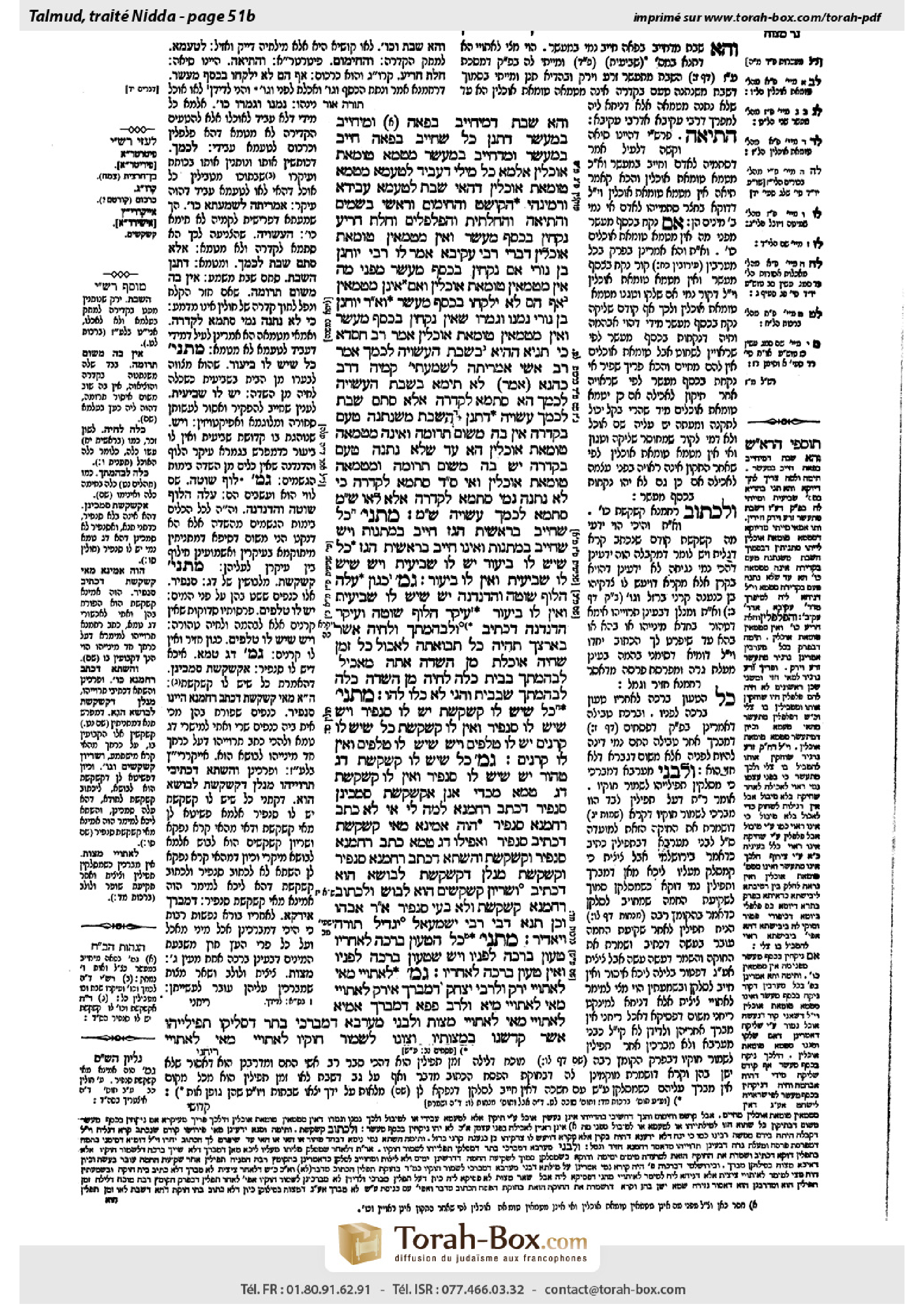
Niddah 51b: Talmud study for Daf Yomi
Daf Yomi is the daily study of one Talmud folio. Explore 37 tractates with scans, Hebrew text, Sefaria English and AI-generated French translations where annotated.
Passage selection and English or AI-generated French translation are available where the scan has annotations. Daf Study is independent of Torah-Box and Sefaria.
Browse Niddah · נידה · All tractatesNiddah 51b text and translations
This page of Niddah includes the Aramaic text, an English translation and an AI-generated French translation, alongside the scan above.
נידה נ״א ב · Aramaic and Hebrew text
וְהָא שֶׁבֶת דְּמִיחַיַּיב בְּפֵאָה וּמִיחַיַּיב בְּמַעֲשֵׂר, דִּתְנַן: כֹּל שֶׁחַיָּיב בַּפֵּאָה חַיָּיב בַּמַּעֲשֵׂר.
וּמִדְּחַיָּיב בַּמַּעֲשֵׂר — מִטַּמֵּא טוּמְאַת אֳוכָלִין, אַלְמָא: כֹּל מִילֵּי דַּעֲבִיד לְטַעְמָא — מִטַּמֵּא טוּמְאַת אֳוכָלִין, דְּהַאי שֶׁבֶת לְטַעְמָא עֲבִידָא.
וּרְמִינְהִי: הַקּוֹשְׁטְ, וְהַחִימּוּם, וְרָאשֵׁי בְשָׂמִים, וְהַתִּיאָה, וְהַחִלְתִּית, וְהַפִּלְפְּלִים, וְחַלַּת חָרִיעַ — נִקָּחִין בְּכֶסֶף מַעֲשֵׂר, וְאֵין מִטַּמְּאִין טוּמְאַת אֳוכָלִין, דִּבְרֵי רַבִּי עֲקִיבָא.
אָמַר לוֹ רַבִּי יוֹחָנָן בֶּן נוּרִי: אִם נִקָּחִין בְּכֶסֶף מַעֲשֵׂר, מִפְּנֵי מָה אֵין מִטַּמְּאִין טוּמְאַת אֳוכָלִין? וְאִם אֵינָן מִטַּמְּאִין, אַף הֵם לֹא יִלָּקְחוּ בְּכֶסֶף מַעֲשֵׂר!
וְאָמַר רַבִּי יוֹחָנָן בֶּן נוּרִי: נִמְנוּ וְגָמְרוּ שֶׁאֵין נִקָּחִין בְּכֶסֶף מַעֲשֵׂר, וְאֵין מִטַּמְּאִין טוּמְאַת אֳוכָלִין.
אָמַר רַב חִסְדָּא: כִּי תַנְיָא הַהִיא — בְּשֶׁבֶת הָעֲשׂוּיָה לְכָמָךְ.
אָמַר רַב אָשֵׁי: אַמְרִיתַהּ לִשְׁמַעְתָּיה קַמֵּיהּ דְּרַב כָּהֲנָא, (אֲמַר): לָא תֵּימָא בְּשֶׁבֶת הָעֲשׂוּיָה לְכָמָךְ, הָא סְתָמָא לִקְדֵרָה, אֶלָּא סְתָם שֶׁבֶת לְכָמָךְ עֲשׂוּיָה, דִּתְנַן: הַשֶּׁבֶת מִשֶּׁנָּתְנָה טַעַם בַּקְּדֵרָה — אֵין בָּהּ מִשּׁוּם תְּרוּמָה, וְאֵינָהּ מִטַּמְּאָה טוּמְאַת אֳוכָלִין.
הָא, עַד שֶׁלֹּא נָתְנָה טַעַם בַּקְּדֵרָה — יֵשׁ בָּהּ מִשּׁוּם תְּרוּמָה, וּמִטַּמְּאָה טוּמְאַת אֳוכָלִין. וְאִי סָלְקָא דַעְתָּךְ סְתָמָא לִקְדֵרָה — כִּי לֹא נָתְנָה נָמֵי סְתָמָא לִקְדֵרָה! אֶלָּא לָאו שְׁמַע מִינַּהּ סְתָמָא לְכָמָךְ עֲשׂוּיָה. שְׁמַע מִינַּהּ.
מַתְנִי' כֹּל שֶׁחַיָּיב בְּרֵאשִׁית הַגֵּז — חַיָּיב בַּמַּתָּנוֹת, וְיֵשׁ שֶׁחַיָּיב בַּמַּתָּנוֹת וְאֵינוֹ חַיָּיב בְּרֵאשִׁית הַגֵּז.
כֹּל שֶׁיֵּשׁ לוֹ בִּיעוּר — יֵשׁ לוֹ שְׁבִיעִית, וְיֵשׁ שֶׁיֵּשׁ לוֹ שְׁבִיעִית — וְאֵין לוֹ בִּיעוּר.
גְּמָ' כְּגוֹן עֲלֵה הַלּוּף שׁוֹטֶה וְהַדַּנְדַּנָּה, יֵשׁ שֶׁיֵּשׁ לוֹ שְׁבִיעִית וְאֵין לוֹ בִּיעוּר, עִיקַּר הַלּוּף שׁוֹטֶה וְעִיקַּר הַדַּנְדַּנָּה.
דִּכְתִיב ״וְלִבְהֶמְתְּךָ וְלַחַיָּה אֲשֶׁר בְּאַרְצֶךָ תִּהְיֶה כׇל תְּבוּאָתָהּ לֶאֱכֹל״, כׇּל זְמַן שֶׁחַיָּה אוֹכֶלֶת מִן הַשָּׂדֶה — אַתָּה מַאֲכִיל לִבְהֶמְתֶּךָ בַּבַּיִת, כָּלָה לַחַיָּה מִן הַשָּׂדֶה — כַּלֵּה לִבְהֶמְתֶּךָ שֶׁבַּבַּיִת, וְהָנֵי לָא כָּלוּ לְהוּ.
מַתְנִי' כֹּל שֶׁיֵּשׁ לוֹ קַשְׂקֶשֶׂת — יֵשׁ לוֹ סְנַפִּיר, וְיֵשׁ שֶׁיֵּשׁ לוֹ סְנַפִּיר וְאֵין לוֹ קַשְׂקֶשֶׂת. כֹּל שֶׁיֵּשׁ לוֹ קַרְנַיִם — יֵשׁ לוֹ טְלָפַיִם, וְיֵשׁ שֶׁיֵּשׁ לוֹ טְלָפַיִם וְאֵין לוֹ קַרְנַיִם.
גְּמָ' כֹּל שֶׁיֵּשׁ לוֹ קַשְׂקֶשֶׂת — דָּג טָהוֹר, יֵשׁ שֶׁיֵּשׁ לוֹ סְנַפִּיר וְאֵין לוֹ קַשְׂקֶשֶׂת — דָּג טָמֵא. מִכְּדֵי אֲנַן אַקַּשְׂקֶשֶׂת סָמְכִינַן, ״סְנַפִּיר״ דִּכְתַב רַחֲמָנָא לְמָה לִי?
אִי לָא כְּתַב רַחֲמָנָא סְנַפִּיר, הֲוָה אָמֵינָא: מַאי ״קַשְׂקֶשֶׂת״ דִּכְתִיב? סְנַפִּיר, וַאֲפִילּוּ דָּג טָמֵא — כְּתַב רַחֲמָנָא ״סְנַפִּיר וְקַשְׂקֶשֶׂת״.
וְהַשְׁתָּא דִּכְתַב רַחֲמָנָא סְנַפִּיר וְקַשְׂקֶשֶׂת, מְנָלַן דְּקַשְׂקֶשֶׂת לְבוּשָׁא הוּא? דִּכְתִיב: ״וְשִׁרְיוֹן קַשְׂקַשִּׂים הוּא לָבוּשׁ״.
וְלִכְתּוֹב רַחֲמָנָא ״קַשְׂקֶשֶׂת״ וְלָא בָּעֵי סְנַפִּיר! אָמַר רַבִּי אֲבָהוּ, וְכֵן תָּנָא דְּבֵי רַבִּי יִשְׁמָעֵאל: ״יַגְדִּיל תּוֹרָה וְיַאְדִּיר״.
מַתְנִי' כֹּל הַטָּעוּן בְּרָכָה לְאַחֲרָיו — טָעוּן בְּרָכָה לְפָנָיו, וְיֵשׁ שֶׁטָּעוּן בְּרָכָה לְפָנָיו וְאֵין טָעוּן בְּרָכָה לְאַחֲרָיו.
גְּמָ' לְאֵתוֹיֵי מַאי? לְאֵתוֹיֵי יָרָק. וּלְרַבִּי יִצְחָק דִּמְבָרֵךְ אַיָּרָק, לְאֵתוֹיֵי מַאי? לְאֵתוֹיֵי מַיָּא.
וּלְרַב פָּפָּא דִּמְבָרֵךְ אַמַּיָּא, לְאֵתוֹיֵי מַאי? לְאֵתוֹיֵי מִצְוֹת. וְלִבְנֵי מַעְרְבָא דִּמְבָרְכִי בָּתַר דְּסַלִּיקוּ תְּפִילַּיְיהוּ ״אֲשֶׁר קִדְּשָׁנוּ בְּמִצְוֹתָיו וְצִוָּנוּ לִשְׁמוֹר חוּקָּיו״, לְאֵתוֹיֵי מַאי? לְאֵתוֹיֵי
Niddah 51b · English translation
The Gemara asks: But with regard to dill, from which one is obligated to designate pe’a, as stated in the mishna, one must also be obligated to separate tithe, since if the obligation of pe’a applies then the obligation of tithes likewise applies. As we learned in the mishna (50a): With regard to any produce from which one is obligated to designate pe’a, one is likewise obligated to separate tithe.
And from the fact that with regard to dill one is obligated to separate tithe, it follows that it becomes impure with the ritual impurity of food. As the mishna on 50a states: Any food that is obligated in tithes becomes impure with the ritual impurity of food. Apparently, any item that is prepared in order to add taste to food, such as dill, becomes impure with the ritual impurity of food, as this dill is prepared in order to add taste to food.
And the Gemara raises a contradiction to this conclusion from a mishna (Okatzin 3:5), which deals with the ritual impurity of food: With regard to spices such as costus, amomum, chief spices, root of crowfoot, asafoetida, peppers, and a cake of safflower, although their function is merely to add taste to food, they are considered food for the purposes of the following halakha: They may be bought with second-tithe money, which must be taken to Jerusalem and used to purchase food. But they are not considered food insofar as they do not become impure with the ritual impurity of food. This is the statement of Rabbi Akiva.
Rabbi Yoḥanan ben Nuri said to Rabbi Akiva: If they are considered food to the extent that they may be bought with second-tithe money, for what reason are they not considered food in terms of becoming impure with the ritual impurity of food? And if they do not become impure with the ritual impurity of food because they are not considered food, then they should also not be bought with second-tithe money.
And Rabbi Yoḥanan ben Nuri said with regard to this halakha: They counted the opinions of the Sages, and they concluded that these spices may not be bought with second-tithe money, and they do not become impure with the ritual impurity of food. This apparently contradicts the previous claim that dill, which is a spice, becomes impure with the ritual impurity of food.
Rav Ḥisda says the following resolution of the difficulty: When that baraita, which indicates that dill is considered food and can contract the impurity of food, is taught, it is referring to dill that is prepared for a spice dish [likhmakh], i.e., to be ground and placed in a Babylonian spice, kutaḥ, which is used as a dip.
Rav Ashi said: I said this halakha of Rav Ḥisda’s before Rav Kahana, and he commented: Do not say that the baraita is referring specifically to a case where the dill was prepared for a spice dish from the outset, which would indicate that if dill is undesignated then it is intended to be an ingredient in a pot of food. Rather, undesignated dill is also prepared for a spice dish. As we learned in a mishna (Okatzin 3:4): With regard to teruma dill, once it imparted flavor in a pot of food and was removed from the pot, it is no longer subject to the prohibition of a non-priest partaking of teruma, and it can no longer become impure with the ritual impurity of food.
Rav Kahana explains the proof: It can be inferred from this mishna that until the dill has imparted flavor in a pot of food it is subject to the prohibition of a non-priest partaking of teruma, and it can become impure with the ritual impurity of food. And if it enters your mind that undesignated dill is intended as an ingredient in a pot of food, then even when one did not place the dill in a pot, the same halakha with respect to teruma and impurity should apply, as when it is undesignated the dill is intended as an ingredient in a pot of food. Rather, must one not conclude from the mishna that undesignated dill is prepared for a spice dish? The Gemara concludes: Learn from the mishna that this is the case.
MISHNA: With regard to any animal, i.e., sheep and rams, from which one is obligated by Torah law (see Deuteronomy 18:4) to give the first shearing of its wool to a priest, he is obligated to have gifts of the priesthood, i.e., the foreleg, the jaw, and the maw, which must be removed from slaughtered animals, taken from it (see Deuteronomy 18:3). And there are animals from which one is obligated to have gifts of the priesthood taken from them, e.g., cattle and goats, but from which he is not obligated to give the first shearing.
The mishna teaches a similar principle: For all Sabbatical-Year produce to which there applies the obligation of eradication from the house when it ceases to be available to the animals in the field, there is the sanctity of Sabbatical-Year produce upon it, i.e., it may not be used for commerce and is ownerless while it is attached to the ground. And there is produce for which there is the sanctity of Sabbatical-Year produce, but for which there is no obligation of eradication from the house, e.g., produce that is preserved in the ground and does not cease to be available in the field.
GEMARA: The mishna teaches that the sanctity of Sabbatical-Year produce applies to any produce upon which there is an obligation of eradication, but the converse is not necessarily the case. The Gemara cites an example of plants whose various parts illustrate these halakhot: Plants such as the wild arum leaf and the ceterach, which cease to be available in the field during the rainy season, are subject to eradication and to the sanctity of the Sabbatical Year. Examples of the second halakha of the mishna, that there is produce for which there is the sanctity of Sabbatical-Year produce but for which there is no obligation of eradication from the house, include the root of the wild arum and the root of the ceterach.
The Gemara explains that it is written in connection to the Sabbatical Year: “And for the cattle and the beasts that are in your land, all its produce may be eaten” (Leviticus 25:7), from which it is derived: As long as the undomesticated animals eat a type of produce from the field, you may feed that type of produce to your domesticated animal in the house, as it still remains in the field. But if that type of produce has ceased for the undomesticated animals in the field, you must cease feeding it to your domesticated animal in the house. This is the obligation of eradication. And these, the root of the wild arum and the ceterach, have not ceased for undomesticated animals in the field, and therefore there is no obligation of eradication.
MISHNA: It is written: “Whatever has fins and scales in the waters, in the seas, and in the rivers, you may eat them” (Leviticus 11:9). There is a principle with regard to the signs indicating that fish are kosher: Any fish that has scales has fins; and there are fish that have fins but do not have scales. Similarly, with regard to kosher animals it is written: “Whatever parts the hoof, and is wholly cloven-footed, and chews the cud, among the beasts, that you may eat” (Leviticus 11:3). Any animal that has horns has hooves; and there are animals that have hooves but do not have horns.
GEMARA: The mishna teaches that any fish that has scales also has fins and therefore is a kosher fish. The mishna also stated that there are fish that have fins but do not have scales. Such a fish is a non-kosher fish. The Gemara asks: Since we rely exclusively upon the sign of the scales, as a fish that has scales necessarily has fins as well, why do I need the sign of fins that the Merciful One writes in the Torah as one of the criteria of kosher fish?
The Gemara answers: If the Merciful One had not also written the sign of fins in the Torah, I would say: What does the word kaskeset, scales, that is written in the Torah mean? It does not mean scales, but fins. And I would therefore say that even a non-kosher fish, which has fins but no scales, is permitted. Therefore, the Merciful One writes both signs, fins and scales.
The Gemara further asks: But now that the Merciful One wrote in the Torah fins and kaskeset, from where do we derive that kaskeset denotes clothing, i.e., scales, rather than fins? The Gemara answers: We derive it from a verse, as it is written about Goliath the Philistine: “And he was clad with a coat of mail [kaskasim]” (I Samuel 17:5).
The Gemara asks: But if there is proof that kaskeset means scales, the question returns: Let the Merciful One write only “scales” and then there would be no need to write “fins.” Rabbi Abbahu says, and likewise a Sage of the school of Rabbi Yishmael taught, that this is in accordance with the verse: “The Lord was pleased, for His righteousness’ sake, to make Torah great and glorious” (Isaiah 42:21).In this context, this means that it is fitting for the Torah to state all the characteristics of a kosher animal rather than merely state that which is absolutely necessary.
MISHNA: This mishna teaches a generalization that is similar to the previous ones: Anything that requires a blessing after one partakes of it requires a blessing beforehand. And there exist items that require a blessing before but do not require a blessing thereafter.
GEMARA: The mishna teaches that there are items that require a blessing before but not after. The Gemara inquires: What case does this halakha in the mishna add? The Gemara answers: It serves to add the case of vegetables, as one recites a blessing before eating them but not afterward. The Gemara asks: And according to the opinion of Rabbi Yitzḥak, who maintains that one recites a blessing on vegetables after eating them, what case does this halakha in the mishna add? The Gemara answers: It serves to add the case of water, as one recites a blessing before drinking it but not afterward.
The Gemara further asks: And according to the opinion of Rav Pappa, who rules that one recites a blessing on water after drinking it, what case does this halakha in the mishna serve to add? The Gemara answers that the mishna, which does not explicitly mention food, serves to add mitzvot. In other words, one recites a blessing before performing a mitzva, e.g., wearing ritual fringes or taking the lulav and the like, but one does not recite a blessing after its fulfillment. The Gemara asks: And according to the residents of the West, Eretz Yisrael, who recite the following blessing after they remove their phylacteries: Who sanctified us with His mitzvot and commanded us to keep His laws, what does this halakha in the mishna come to add? The Gemara answers: It serves to add the case of
Niddah 51b · Traduction française (IA)
La Guemara demande : Mais, pour l’aneth, pour lequel on est tenu de prélever la péa, comme l’enseigne la Michna, ne devrait-on pas également être tenu de prélever la dîme ? En effet, si l’obligation de prélever la péa s’applique, celle de prélever les dîmes s’applique également. Comme nous l’avons appris dans la Michna (50a) : Tout produit pour lequel on est tenu de prélever la péa est également soumis à l’obligation de prélever la dîme.
Et puisque l’on est tenu de prélever la dîme sur l’aneth, il s’ensuit qu’il peut contracter l’impureté rituelle des aliments. Car la Michna de 50a enseigne : Tout aliment soumis à l’obligation de prélever les dîmes peut contracter l’impureté rituelle des aliments. Il semble donc que tout élément préparé pour donner du goût à un aliment, tel que l’aneth, puisse contracter cette impureté, puisque l’aneth est préparé à cette fin.
La Guemara oppose à cette conclusion une Michna (Okatzin 3:5) portant sur l’impureté rituelle des aliments : Quant aux épices telles que le costus, l’amome, les épices principales, la racine de renoncule, l’asa-fœtida, les poivres et une galette de carthame, bien qu’elles servent uniquement à donner du goût aux aliments, elles sont considérées comme des aliments pour l’halakha suivante : on peut les acheter avec l’argent de la seconde dîme, qui doit être apporté à Jérusalem et utilisé pour acheter de la nourriture. Mais elles ne sont pas considérées comme des aliments au regard de leur capacité à contracter l’impureté rituelle des aliments. Telle est la déclaration de Rabbi Akiva.
Rabbi Yoḥanan ben Nuri dit à Rabbi Akiva : Si elles sont considérées comme des aliments au point qu’on puisse les acheter avec l’argent de la seconde dîme, pourquoi ne sont-elles pas considérées comme des aliments au regard de leur capacité à contracter l’impureté rituelle des aliments ? Et si elles ne contractent pas cette impureté parce qu’elles ne sont pas considérées comme des aliments, alors on ne devrait pas non plus pouvoir les acheter avec l’argent de la seconde dîme.
Rabbi Yoḥanan ben Nuri dit au sujet de cette halakha : On a procédé au décompte des avis des Sages et l’on a conclu que ces épices ne peuvent pas être achetées avec l’argent de la seconde dîme et qu’elles ne contractent pas l’impureté rituelle des aliments. Cela semble contredire l’affirmation précédente selon laquelle l’aneth, qui est une épice, contracte cette impureté.
Rav Ḥisda résout la difficulté ainsi : lorsque cette baraïta, qui indique que l’aneth est considéré comme un aliment et peut contracter l’impureté rituelle des aliments, est enseignée, elle parle d’aneth préparé pour un plat d’épices [likhmakh], c’est-à-dire destiné à être broyé et incorporé au condiment babylonien appelé kutaḥ, utilisé comme sauce.
Rav Ashi dit : J’ai exposé cette halakha de Rav Ḥisda devant Rav Kahana, qui a fait remarquer : Ne dis pas que la baraïta parle précisément d’un cas où l’aneth a été préparé dès le départ pour un plat d’épices, ce qui laisserait entendre que l’aneth dont l’usage n’est pas déterminé est destiné à être incorporé dans une marmite. Au contraire, même l’aneth dont l’usage n’est pas déterminé est préparé pour un plat d’épices. En effet, nous avons appris dans une Michna (Okatzin 3:4) : Quant à l’aneth de terouma, dès lors qu’il a donné du goût à un plat dans une marmite et qu’on l’en a retiré, il n’est plus soumis à l’interdiction faite à un non-prêtre de consommer de la terouma et ne peut plus contracter l’impureté rituelle des aliments.
Rav Kahana explique la preuve : On peut déduire de cette Michna que, tant que l’aneth n’a pas donné du goût à un plat dans une marmite, il reste soumis à l’interdiction faite à un non-prêtre de consommer de la terouma et peut contracter l’impureté rituelle des aliments. Or, si l’on pouvait envisager que l’aneth dont l’usage n’est pas déterminé soit destiné à être incorporé dans une marmite, alors, même si on ne l’y a pas mis, les mêmes règles concernant la terouma et l’impureté devraient s’appliquer, puisque l’aneth dont l’usage n’est pas déterminé est destiné à être incorporé dans une marmite. Ne faut-il donc pas conclure de la Michna que cet aneth est préparé pour un plat d’épices ? La Guemara conclut : Apprends de la Michna qu’il en est bien ainsi.
MICHNA : Pour tout animal, c’est-à-dire les brebis et les béliers, dont la Torah écrite impose (voir Deutéronome 18:4) de donner à un prêtre la première tonte de sa laine, il est également obligatoire de prélever sur lui les dons sacerdotaux, à savoir la patte avant, la mâchoire et la caillette, qui doivent être retirés des animaux abattus (voir Deutéronome 18:3). Et il existe des animaux, comme les bovins et les chèvres, sur lesquels il est obligatoire de prélever les dons sacerdotaux, mais pour lesquels il n’est pas obligatoire de donner la première tonte.
La Michna enseigne un principe semblable : pour tout produit de l’année sabbatique soumis à l’obligation de le faire disparaître de la maison lorsqu’il n’est plus disponible pour les animaux dans les champs, s’applique la sainteté des produits de l’année sabbatique ; il ne peut donc pas faire l’objet d’un commerce et, tant qu’il est attaché au sol, il est sans propriétaire. Et il existe des produits auxquels s’applique la sainteté de l’année sabbatique, mais qui ne sont pas soumis à l’obligation de disparaître de la maison, par exemple les produits qui se conservent dans le sol et restent disponibles dans les champs.
GUEMARA : La Michna enseigne que tout produit soumis à l’obligation de disparaître est également frappé de la sainteté de l’année sabbatique, mais que l’inverse n’est pas nécessairement vrai. La Guemara donne l’exemple de plantes dont les différentes parties illustrent ces halakhot : des plantes telles que la feuille d’arum sauvage et le cétérach, qui ne sont plus disponibles dans les champs pendant la saison des pluies, sont soumises à l’obligation de disparaître et à la sainteté de l’année sabbatique. La racine de l’arum sauvage et celle du cétérach illustrent le second cas mentionné dans la Michna : des produits frappés de la sainteté de l’année sabbatique, mais qui ne sont pas soumis à l’obligation de disparaître de la maison.
La Guemara explique qu’il est écrit au sujet de l’année sabbatique : « Et pour le bétail et les bêtes sauvages qui sont dans ton pays, toute sa récolte pourra être mangée » (Lévitique 25:7). On en déduit que tant que les animaux sauvages mangent une espèce de produit dans les champs, tu peux donner cette espèce à manger à ton animal domestique à la maison, puisqu’elle reste disponible dans les champs. Mais si cette espèce n’est plus disponible pour les animaux sauvages dans les champs, tu dois cesser de la donner à manger à ton animal domestique à la maison. Telle est l’obligation de faire disparaître les produits. Or, la racine de l’arum sauvage et celle du cétérach restent disponibles pour les animaux sauvages dans les champs ; elles ne sont donc pas soumises à cette obligation.
MICHNA : Il est écrit : « Tout ce qui a des nageoires et des écailles dans les eaux, dans les mers et dans les rivières, vous pourrez en manger » (Lévitique 11:9). Il existe un principe concernant les signes indiquant qu’un poisson est cachère : tout poisson qui a des écailles a des nageoires, mais certains poissons ont des nageoires sans avoir d’écailles. De même, à propos des animaux cachères, il est écrit : « Tout animal qui a le sabot fendu, le pied entièrement divisé et qui rumine, parmi les bêtes, vous pourrez le manger » (Lévitique 11:3). Tout animal qui a des cornes a des sabots, mais certains animaux ont des sabots sans avoir de cornes.
GUEMARA : La Michna enseigne que tout poisson qui a des écailles a aussi des nageoires et est donc cachère. Elle indique également qu’il existe des poissons qui ont des nageoires sans avoir d’écailles ; un tel poisson n’est pas cachère. La Guemara demande : Puisque nous nous fondons exclusivement sur le signe des écailles, car un poisson qui en a possède nécessairement aussi des nageoires, pourquoi le Miséricordieux a-t-Il inscrit dans la Torah les nageoires comme l’un des critères du poisson cachère ?
La Guemara répond : Si le Miséricordieux n’avait pas également inscrit dans la Torah le signe des nageoires, j’aurais dit : Que signifie le mot kaskeset, « écailles », qui figure dans la Torah ? Il ne signifie pas « écailles », mais « nageoires ». J’aurais donc conclu que même un poisson non cachère, qui a des nageoires mais pas d’écailles, est permis. C’est pourquoi le Miséricordieux a inscrit les deux signes : les nageoires et les écailles.
La Guemara demande encore : Mais puisque le Miséricordieux a inscrit dans la Torah les « nageoires » et les kaskeset, comment déduisons-nous que kaskeset désigne un vêtement, c’est-à-dire des écailles, plutôt que des nageoires ? La Guemara répond : Nous le déduisons d’un verset, comme il est écrit au sujet de Goliath le Philistin : « Il était revêtu d’une cuirasse à écailles [kaskasim] » (I Samuel 17:5).
La Guemara demande : Mais s’il est établi que kaskeset signifie « écailles », la question se pose de nouveau : Que le Miséricordieux n’écrive que « écailles » ; il serait alors inutile d’écrire « nageoires ». Rabbi Abbahu dit — et un Sage de l’école de Rabbi Yishmael a également enseigné — que cela est conforme au verset : « L’Éternel a voulu, à cause de sa justice, rendre la Torah grande et glorieuse » (Isaïe 42:21). Dans ce contexte, cela signifie qu’il convient que la Torah énonce toutes les caractéristiques d’un animal cachère plutôt que de se contenter d’indiquer ce qui est absolument nécessaire.
MICHNA : Cette Michna énonce un principe général semblable aux précédents : tout ce qui requiert une bénédiction après qu’on en a consommé requiert également une bénédiction avant. Et il existe des éléments pour lesquels une bénédiction est requise avant, mais pas après.
GUEMARA : La Michna enseigne qu’il existe des éléments pour lesquels une bénédiction est requise avant, mais pas après. La Guemara demande : Quel cas cette halakha de la Michna ajoute-t-elle ? La Guemara répond : Elle ajoute le cas des légumes, car on récite une bénédiction avant d’en manger, mais pas après. La Guemara demande : Et selon l’avis de Rabbi Yitzḥak, qui soutient qu’on récite une bénédiction après avoir mangé des légumes, quel cas cette halakha de la Michna ajoute-t-elle ? La Guemara répond : Elle ajoute le cas de l’eau, car on récite une bénédiction avant d’en boire, mais pas après.
La Guemara demande encore : Et selon l’avis de Rav Pappa, qui statue qu’on récite une bénédiction après avoir bu de l’eau, quel cas cette halakha de la Michna ajoute-t-elle ? La Guemara répond que la Michna, qui ne mentionne pas explicitement la nourriture, ajoute le cas des mitsvot. Autrement dit, on récite une bénédiction avant d’accomplir une mitsva, par exemple avant de porter les franges rituelles, de prendre le loulav, et ainsi de suite, mais on ne récite pas de bénédiction après son accomplissement. La Guemara demande : Et selon les habitants de l’Ouest, c’est-à-dire de la Terre d’Israël, qui récitent la bénédiction suivante après avoir retiré leurs phylactères : « Qui nous a sanctifiés par Ses mitsvot et nous a ordonné de garder Ses lois », quel cas cette halakha de la Michna vient-elle ajouter ? La Guemara répond : Elle ajoute le cas de
Traduction française générée par IA à partir de l’édition anglaise de Sefaria. Vérifie toujours un passage avec le texte source.
Text from Sefaria: William Davidson Edition - Vocalized Aramaic (CC BY NC); William Davidson Edition - English (CC BY NC).