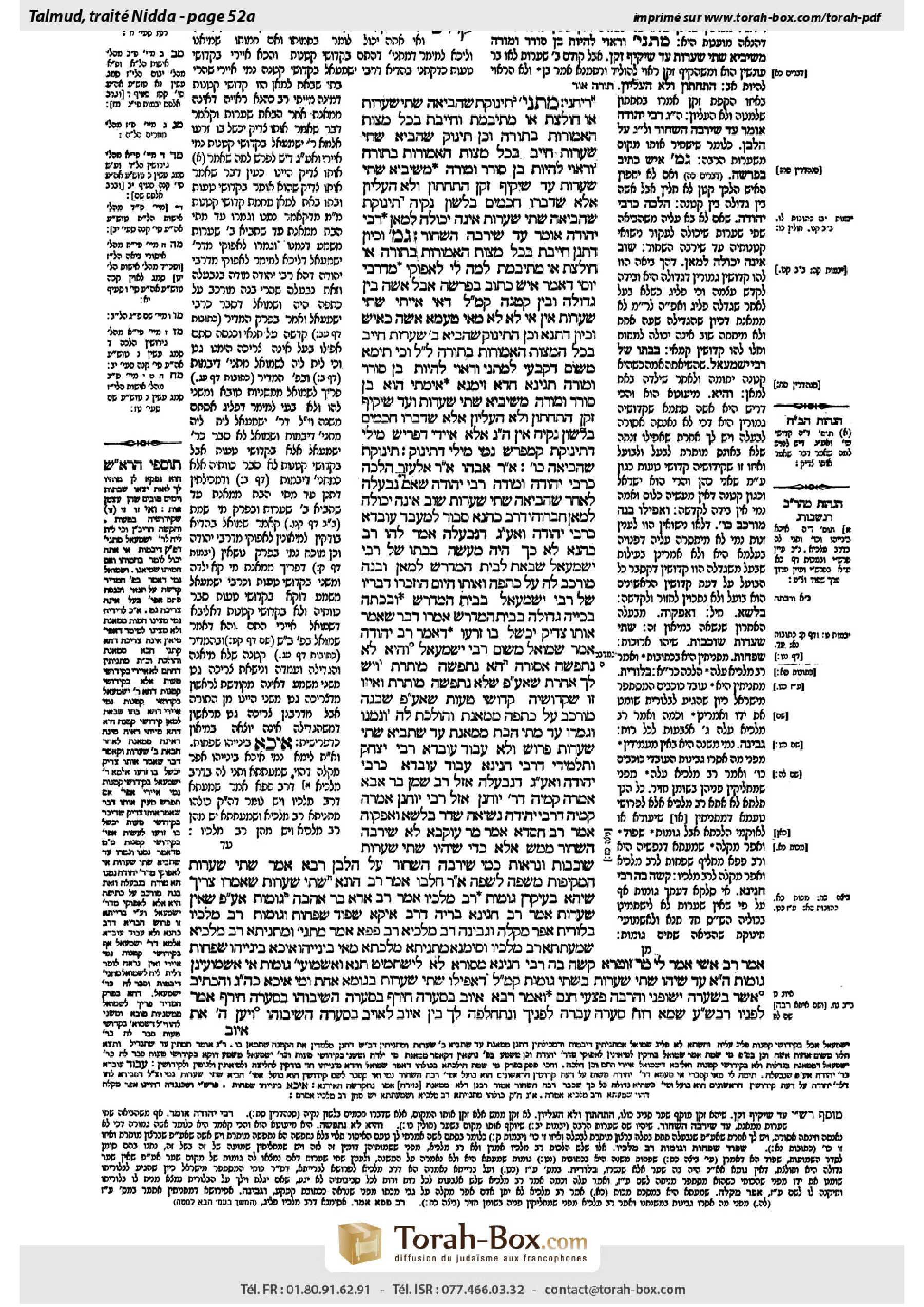
Niddah 52a: Talmud study for Daf Yomi
Daf Yomi is the daily study of one Talmud folio. Explore 37 tractates with scans, Hebrew text, Sefaria English and AI-generated French translations where annotated.
Passage selection and English or AI-generated French translation are available where the scan has annotations. Daf Study is independent of Torah-Box and Sefaria.
Browse Niddah · נידה · All tractatesNiddah 52a text and translations
This page of Niddah includes the Aramaic text, an English translation and an AI-generated French translation, alongside the scan above.
נידה נ״ב א · Aramaic and Hebrew text
רֵיחָנֵי.
מַתְנִי' תִּינוֹקֶת שֶׁהֵבִיאָה שְׁתֵּי שְׂעָרוֹת — אוֹ חוֹלֶצֶת אוֹ מִתְיַבֶּמֶת, וְחַיֶּיבֶת בְּכׇל מִצְוֹת הָאֲמוּרוֹת בַּתּוֹרָה.
וְכֵן תִּינוֹק שֶׁהֵבִיא שְׁתֵּי שְׂעָרוֹת — חַיָּיב בְּכׇל מִצְוֹת הָאֲמוּרוֹת בַּתּוֹרָה, וְרָאוּי לִהְיוֹת בֵּן סוֹרֵר וּמוֹרֶה מִשֶּׁיָּבִיא שְׁתֵּי שְׂעָרוֹת עַד שֶׁיַּקִּיף זָקָן.
הַתַּחְתּוֹן, וְלֹא הָעֶלְיוֹן, אֶלָּא שֶׁדִּבְּרוּ חֲכָמִים בְּלָשׁוֹן נְקִיָּה.
תִּינוֹקֶת שֶׁהֵבִיאָה שְׁתֵּי שְׂעָרוֹת, אֵינָהּ יְכוֹלָה לְמַאן. רַבִּי יְהוּדָה אוֹמֵר: עַד שֶׁיִּרְבֶּה הַשָּׁחוֹר.
גְּמָ' וְכֵיוָן דִּתְנַן ״חַיֶּיבֶת בְּכׇל מִצְוֹת הָאֲמוּרוֹת בַּתּוֹרָה״, ״אוֹ חוֹלֶצֶת אוֹ מִתְיַבֶּמֶת״ לְמָה לִי?
לְאַפּוֹקֵי מִדְּרַבִּי יוֹסֵי, דְּאָמַר: ״אִישׁ״ כָּתוּב בַּפָּרָשָׁה, אֲבָל אִשָּׁה, בֵּין גְּדוֹלָה וּבֵין קְטַנָּה. קָא מַשְׁמַע לַן, דְּאִי אַיְיתִי שְׁתֵּי שְׂעָרוֹת — אִין, אִי לָא — לָא. מַאי טַעְמָא? אִשָּׁה כְּאִישׁ.
וְכֵיוָן דִּתְנָא ״וְכֵן הַתִּינוֹק שֶׁהֵבִיא שְׁתֵּי שְׂעָרוֹת״, ״חַיָּיב בְּכׇל הַמִּצְוֹת הָאֲמוּרוֹת בַּתּוֹרָה״ לְמָה לִי?
וְכִי תֵימָא, מִשּׁוּם דְּקָבָעֵי לְמִתְנֵי ״וְרָאוּי לִהְיוֹת בֵּן סוֹרֵר וּמוֹרֶה״, תְּנֵינָא חֲדָא זִימְנָא: אֵימָתַי הוּא בֵּן סוֹרֵר וּמוֹרֶה — מִשֶּׁיָּבִיא שְׁתֵּי שְׂעָרוֹת וְעַד שֶׁיַּקִּיף זָקָן, הַתַּחְתּוֹן וְלֹא הָעֶלְיוֹן, אֶלָּא שֶׁדִּבְּרוּ חֲכָמִים בְּלָשׁוֹן נְקִיָּה!
אִין הָכִי נָמֵי, אֶלָּא אַיְּידֵי דְּפָרֵישׁ מִילֵּי דְתִינוֹקֶת — קָמְפָרֵשׁ נָמֵי מִילֵּי דְתִינוֹק.
תִּינוֹקֶת שֶׁהֵבִיאָה כּוּ׳. אָמַר רַבִּי אֲבָהוּ אָמַר רַבִּי אֶלְעָזָר: הֲלָכָה כְּרַבִּי יְהוּדָה.
וּמוֹדֶה רַבִּי יְהוּדָה, שֶׁאִם נִבְעֲלָה לְאַחַר שֶׁהֵבִיאָה שְׁתֵּי שְׂעָרוֹת — שׁוּב אֵינָהּ יְכוֹלָה לְמָאֵן.
חַבְרוֹהִי דְּרַב כָּהֲנָא סְבוּר לְמֶעְבַּד עוֹבָדָא כְּרַבִּי יְהוּדָה, וְאַף עַל גַּב דְּנִבְעֲלָה.
אֲמַר לְהוּ רַב כָּהֲנָא: לֹא כָּךְ הָיָה מַעֲשֶׂה בְּבִתּוֹ שֶׁל רַבִּי יִשְׁמָעֵאל, שֶׁבָּאת לְבֵית הַמִּדְרָשׁ לְמָאֵן, וּבְנָהּ מוּרְכָּב לָהּ עַל כְּתֵפָהּ, וְאוֹתוֹ הַיּוֹם הוּזְכְּרוּ דְּבָרָיו שֶׁל רַבִּי יִשְׁמָעֵאל בְּבֵית הַמִּדְרָשׁ, (וּבָכְתָה) [וְרָבְתָה] בְּכִיָּיה גְּדוֹלָה בְּבֵית הַמִּדְרָשׁ.
אָמְרוּ: דָּבָר שֶׁאָמַר אוֹתוֹ צַדִּיק, יִכָּשֵׁל בּוֹ זַרְעוֹ?
דְּאָמַר רַב יְהוּדָה, אָמַר שְׁמוּאֵל מִשּׁוּם רַבִּי יִשְׁמָעֵאל: ״וְהִיא לֹא נִתְפָּשָׂה״ — אֲסוּרָה, הָא נִתְפָּשָׂה — מוּתֶּרֶת, וְיֵשׁ לְךָ אַחֶרֶת שֶׁאַף עַל פִּי שֶׁלֹּא נִתְפָּשָׂה — מוּתֶּרֶת, וְאֵיזוֹ זוֹ — שֶׁקִּדּוּשֶׁיהָ קִדּוּשֵׁי טָעוּת, שֶׁאַף עַל פִּי שֶׁבְּנָהּ מוּרְכָּב עַל כְּתֵפָהּ — מְמָאֶנֶת וְהוֹלֶכֶת לָהּ.
וְנִמְנוּ וְגָמְרוּ: עַד מָתַי הַבַּת מְמָאֶנֶת? עַד שֶׁתָּבִיא שְׁתֵּי שְׂעָרוֹת. פְּרוּשׁ, וְלָא עֲבוּד עוֹבָדָא.
רַבִּי יִצְחָק וְתַלְמִידִי דְּרַבִּי חֲנִינָא עֲבוּד עוֹבָדָא כְּרַבִּי יְהוּדָה, וְאַף עַל גַּב דְּנִבְעֲלָה. אֲזַל רַב שֶׁמֶן בַּר אַבָּא אַמְרַהּ קַמֵּיהּ דְּרַבִּי יוֹחָנָן, אֲזַל רַבִּי יוֹחָנָן אַמְרַהּ קַמֵּיהּ דְּרַבִּי יְהוּדָה נְשִׂיאָה, שַׁדַּר בַּלָּשָׁא וְאַפְּקוּהָ.
אָמַר רַב חִסְדָּא אָמַר מָר עוּקְבָא: לֹא שֶׁיַּרְבֶּה הַשָּׁחוֹר מַמָּשׁ, אֶלָּא כְּדֵי שֶׁיִּהְיוּ שְׁתֵּי שְׂעָרוֹת שׁוֹכְבוֹת, וְנִרְאוֹת כְּמִי שֶׁיִּרְבֶּה הַשָּׁחוֹר עַל הַלָּבָן. רָבָא אָמַר: שְׁתֵּי שְׂעָרוֹת הַמַּקִּיפוֹת מִשָּׂפָה לְשָׂפָה.
אָמַר רַבִּי חֶלְבּוֹ אָמַר רַב הוּנָא: שְׁתֵּי שְׂעָרוֹת שֶׁאָמְרוּ — צָרִיךְ שֶׁיְּהֵא בְּעִיקָּרָן גּוּמּוֹת. רַב מַלְכִּיּוֹ אָמַר רַב אַדָּא בַּר אַהֲבָה: גּוּמּוֹת, אַף עַל פִּי שֶׁאֵין שְׂעָרוֹת.
אָמַר רַב חֲנִינָא בְּרֵיהּ דְּרַב אִיקָא: שַׁפּוּד, שְׁפָחוֹת, וְגוּמּוֹת — רַב מַלְכִּיּוֹ, בְּלוֹרִית, אֵפֶר מִקְלֶה, וּגְבִינָה — רַב מַלְכִּיָּא.
רַב פָּפָּא אָמַר: מַתְנִיתִין וּמַתְנִיתָא — רַב מַלְכִּיָּא, שְׁמַעְתָּתָא — רַב מַלְכִּיּוֹ, וְסִימָנָא: מַתְנִיתָא מַלְכְּתָא.
מַאי בֵּינַיְיהוּ? אִיכָּא בֵּינַיְיהוּ שְׁפָחוֹת.
אָמַר רַב אָשֵׁי, אֲמַר לִי מָר זוּטְרָא, קָשֵׁה בַּהּ רַבִּי חֲנִינָא מִסּוּרָא: לָא לִישְׁתְּמִיט תַּנָּא לְאַשְׁמוֹעִינַן גּוּמּוֹת! אִי אַשְׁמוֹעִינַן גּוּמּוֹת, הֲוָה אָמֵינָא עַד שֶׁיְּהוּ שְׁתֵּי שְׂעָרוֹת בִּשְׁתֵּי גוּמּוֹת, קָא מַשְׁמַע לַן דַּאֲפִילּוּ שְׁתֵּי שְׂעָרוֹת בְּגוּמָּא אַחַת.
וּמִי אִיכָּא כְּהַאי גַּוְונָא? וְהָכְתִיב ״אֲשֶׁר בִּשְׂעָרָה יְשׁוּפֵנִי וְהִרְבָּה פְצָעַי חִנָּם״, וְאָמַר רָבָא: אִיּוֹב בִּסְעָרָה חֵירַף, בִּסְעָרָה הֱשִׁיבוּהוּ. בִּסְעָרָה חֵירַף — אָמַר לְפָנָיו: רִבּוֹנוֹ שֶׁל עוֹלָם, שֶׁמָּא רוּחַ סְעָרָה עָבְרָה לְפָנֶיךָ וְנִתְחַלְּפָה לְךָ בֵּין ״אִיּוֹב״ לְ״אוֹיֵב״. בִּסְעָרָה הֱשִׁיבוּהוּ — ״וַיַּעַן ה׳ אֶת
Niddah 52a · English translation
fragrant spices.
MISHNA: A young girl who reached the age of puberty and grew two pubic hairs is an adult. If her childless husband dies, she either performs ḥalitza and is thereby permitted to marry anyone, or enters into levirate marriage with her husband’s brother. And furthermore, such a girl is obligated to fulfill all the mitzvot stated in the Torah in which women are obligated.
And likewise, a young boy who reached the age of puberty and grew two pubic hairs is an adult and is obligated to fulfill all the mitzvot stated in the Torah. And he is fit to be declared a stubborn and rebellious son if he performs the actions that warrant that designation, from when he grows two pubic hairs until his beard will form a circle. During that period, although he is an adult and punishable for his actions, he is incapable of fathering a child. Consequently, as he is a son and not a father, he can be designated a stubborn and rebellious son.
The mishna explains that the reference is to the lower, pubic, hair, and not to the upper, facial, hair. But the term beard is used, despite its being subject to misinterpretation, due to the fact that the Sages spoke euphemistically.
A young girl who reached the age of puberty and grew two pubic hairs can no longer perform refusal to end a marriage with a husband to whom she was married as a minor by her mother and brothers after her father’s death. Rabbi Yehuda says: She retains the right to perform refusal until the pubic hair will grow to the extent that the black hair will be preponderant in the pubic area.
GEMARA: The Gemara raises an objection: But since we learned in the mishna that a young girl who reached the age of puberty and grew two pubic hairs is considered an adult and is obligated to fulfill all the mitzvot stated in the Torah, why do I need the mishna to also teach: She either performs ḥalitza or enters into levirate marriage. These specific examples are included in the broader statement.
The Gemara explains: This emphasis serves to exclude the opinion of Rabbi Yosei, who said: Man, i.e., an adult man, is written in the passage of ḥalitza: “And if the man does not wish to take his brother’s wife” (Deuteronomy 25:7). But with regard to the woman, whether she is an adult or whether she is a minor, she can be released by ḥalitza, as the Torah does not specify her age. The mishna teaches us that the halakha is not in accordance with the opinion of Rabbi Yosei. Rather, if she grew two pubic hairs, then yes, she can perform ḥalitza, whereas if she did not grow two hairs, she may not perform ḥalitza or enter into levirate marriage. What is the reason for this ruling? It is that the halakha of the woman is like that of the man, as a woman is juxtaposed to man in this passage.
The Gemara asks further: And since we learned in the continuation of the mishna: And likewise, a young boy who reached the age of puberty and grew two pubic hairs is an adult, why do I need the mishna to add explicitly: Is obligated to fulfill all the mitzvot stated in the Torah?
And if you would say that the mishna specified this because it wanted to teach the particular halakha: And he is fit to be declared a stubborn and rebellious son, that cannot be the reason, as we already learned that halakha on another occasion in a mishna (Sanhedrin 68b): When is such a boy liable to receive the death penalty imposed upon a stubborn and rebellious son? From when he grows two pubic hairs until his beard will form a circle. The reference is to the lower, pubic, hair and not to the upper, facial hair, but the term beard is used, due to the fact that the Sages spoke euphemistically.
The Gemara answers: Yes, it is indeed so, i.e., it is not necessary for the mishna to specify with regard to a boy that he is obligated to fulfill all the mitzvot stated in the Torah. But since the mishna specified this matter in the case of a young girl, it also specified this matter in the case of a young boy.
§ The mishna teaches: A young girl who reached the age of puberty and grew two pubic hairs can no longer perform refusal to end a marriage with a husband to whom she was married as a minor by her mother and brothers after her father’s death. Rabbi Yehuda maintains that she retains the right of refusal until the pubic hair grows to the extent that the black hair is preponderant in the pubic area. Rabbi Abbahu says that Rabbi Elazar says: The halakha is in accordance with the opinion of Rabbi Yehuda.
And Rabbi Yehuda concedes to the Rabbis that if she engaged in intercourse with her husband after she grew two pubic hairs, she can no longer perform refusal. This is because the act of intercourse renders her betrothed to him by Torah law, and refusal is a rabbinic enactment that is effective only with regard to a betrothal that applies by rabbinic law.
Rav Kahana’s colleagues thought to perform an action in accordance with the opinion of Rabbi Yehuda in the mishna, and to permit a young girl who had grown two pubic hairs to perform refusal, even though she had engaged in intercourse with her husband after growing two hairs. They held that until the pubic hair grows to the extent that the black hair is preponderant in the pubic area, her betrothal does not apply by Torah law.
Rav Kahana said to his colleagues: Didn’t the incident involving Rabbi Yishmael’s daughter, who was married as a minor by her mother and brothers after her father’s death, transpire in that manner? As she came to the study hall to refuse her marriage, and her son was riding on her shoulders. And on that very day, Rabbi Yishmael’s statement, that a young girl may perform refusal even if she engaged in intercourse with her husband after growing two hairs, was mentioned in the study hall. And she cried with a great weeping in the study hall, as a result of the incident.
The Sages who were in the study hall said: Could it be that with regard to a matter that that righteous Rabbi Yishmael said, i.e., that she can perform refusal, his offspring would stumble upon it? The consequence of her refusal is that she is considered to have borne the child retroactively out of wedlock.
As Rav Yehuda said that Shmuel says in the name of Rabbi Yishmael: The verse states with regard to a sota: “And neither was she taken” (Numbers 5:13), i.e., raped. In this case she is prohibited to her husband. It may be inferred that if she was taken forcefully she is permitted to her husband. And there is a case of another woman where, even though she was not taken forcefully, but was willing, she nevertheless remains permitted. And which case is this? This is referring to one whose betrothal was a mistaken betrothal, as, even if her son from this marriage is riding on her shoulders she may perform refusal and go off as pleases her. Although she engaged in intercourse with her husband after growing two pubic hairs, she was relying on the original betrothal, which was a mistaken betrothal, and did not intend to become betrothed to him by means of this intercourse, which would have rendered her betrothed by Torah law. She may therefore nullify the betrothal by means of refusal.
And the Gemara relates that as a result of the event involving Rabbi Yishmael’s daughter, the Sages assembled, counted the votes, and concluded: Until when may a young girl perform refusal? Until she grows two pubic hairs. Once Rav Kahana’s colleagues heard this, they retracted and did not perform an action in accordance with the opinion of Rabbi Yehuda in the mishna, to permit the girl to perform refusal as they had originally planned.
The Gemara further relates that Rabbi Yitzḥak and the disciples of Rabbi Ḥanina performed an action in accordance with the opinion of Rabbi Yehuda in the mishna, and permitted a young girl who had grown two pubic hairs to perform refusal, even though she had engaged in intercourse with her husband after growing two hairs. Rav Shemen bar Abba subsequently went and stated this story before Rabbi Yoḥanan, and Rabbi Yoḥanan went and stated it before Rabbi Yehuda Nesia. Rabbi Yehuda Nesia sent a constable [ballasha] and removed that girl from her second husband.
With regard to Rabbi Yehuda’s opinion, that the black hair must be preponderant in the pubic area, Rav Ḥisda says that Mar Ukva says: This does not mean that the black hair must literally be preponderant in the pubic area. Rather, there must be two hairs lying down, so that it appears as though the black hairs in the pubic area cover an area greater than the white area uncovered by hair. Rava says: Rabbi Yehuda means that there are two hairs that surround the pubic area from end to end.
§ The mishna teaches that the growth of two hairs is a sign of becoming an adult. The Gemara clarifies the details of this halakha. Rabbi Ḥelbo says that Rav Huna says: These two hairs that the Sages said are a sign of adulthood must have follicles at their roots. Rav Malkiyyu says that Rav Adda bar Ahava says: If there are two follicles next to each other, they constitute a sign of adulthood even if there are no hairs in them. The assumption is that follicles do not exist without hair, and therefore there must have been hairs there that fell out.
This halakha was stated by a Sage by the name of Rav Malkiyyu. To prevent confusion between his rulings and those of the similarly named Rav Malkiyya, Rabbi Ḥanina, son of Rav Ika, says: The halakha involving a skewer, the halakha with regard to maidservants, and the halakha involving hair follicles were all stated by Rav Malkiyyu. By contrast, the halakha with regard to the forelock [belorit], the halakha involving burnt ashes, and the halakha with regard to cheese were all stated by a different Sage named Rav Malkiyya.
Rav Pappa says: The aforementioned halakhot that relate to a mishna or a baraita were stated by Rav Malkiyya, whereas halakhot that do not refer to a mishna or baraita but are independent statements of amora’im were taught by Rav Malkiyyu. And a mnemonic to remember this is: The mishna is a queen [malketa], i.e., the comments that are referring to a mishna were issued by Rav Malkiyya, whose name is similar to the Aramaic term for queen.
The Gemara asks: What is the difference between the opinion of Rabbi Ḥanina, son of Rav Ika, and Rav Pappa? The Gemara answers: The difference between them is with regard to which Sage taught the halakha involving maidservants. Rav Pappa maintains that it was taught by Rav Malkiyya, as it is referring to a dispute in a mishna. By contrast, according to Rabbi Ḥanina, this halakha was stated by Rav Malkiyyu.
With regard to the halakha of Rav Malkiyyu itself, concerning follicles, Rav Ashi says: Mar Zutra told me that Rabbi Ḥanina of Sura posed the following difficulty: If it is correct that follicles suffice as a sign of adulthood, let the tanna of the mishna not evade the issue, but rather let him teach us explicitly that follicles are a sign of adulthood even if they do not contain hair. The Gemara answers: If the mishna had taught us the case of follicles, I would say that they are not considered a sign of adulthood until there are two hairs in two follicles. By omitting any mention of follicles in the mishna, the tanna teaches us that even two hairs in one follicle are a sign of adulthood.
The Gemara asks: And is there actually a case like this, of two hairs in one follicle? But isn’t it written: “He crushes me with a tempest, and multiplies my wounds without cause” (Job 9:17); and Rava said with regard to this verse: Job blasphemed with a tempest, and with a tempest he was answered. He blasphemed with a tempest, as Job said before God: Master of the Universe, perhaps a tempest passed before You and You confused Iyyov, Job, with oyev, enemy. With a tempest he was answered, as the verse states: “Then the Lord answered
Niddah 52a · Traduction française (IA)
des épices parfumées.
Michna : Une jeune fille qui a atteint l'âge de la puberté et a fait pousser deux poils pubiens est considérée comme adulte. Si son époux sans enfants meurt, elle accomplit soit la ḥalitza, ce qui l'autorise à épouser quiconque, soit elle entre dans le mariage de levirat avec le frère de son époux. De plus, une telle fille est tenue d'accomplir toutes les mitsvot énoncées dans la Torah écrite auxquelles les femmes sont obligées.
De même, un jeune garçon qui a atteint l'âge de la puberté et a fait pousser deux poils pubiens est adulte et est tenu d'accomplir toutes les mitsvot énoncées dans la Torah écrite. Il est apte à être déclaré fils rétif et rebelle s'il commet les actes qui justifient cette désignation, depuis le moment où il fait pousser deux poils pubiens jusqu'à ce que sa barbe forme un cercle. Pendant cette période, bien qu'il soit adulte et passible de punition pour ses actes, il n'est pas capable de procréer. Par conséquent, comme il est un fils et non un père, il peut être désigné fils rétif et rebelle.
La Michna explique que la référence est faite aux poils inférieurs, c'est-à-dire pubiens, et non aux poils supérieurs, c'est-à-dire du visage. Cependant, le terme « barbe » est employé, bien qu'il soit sujet à interprétation erronée, en raison du fait que les Sages ont parlé avec euphémisme.
Une jeune fille qui a atteint l'âge de la puberté et a fait pousser deux poils pubiens ne peut plus accomplir le refus pour mettre fin à un mariage contracté alors qu'elle était mineure, par sa mère et ses frères, après la mort de son père. Rabbi Yehouda dit : Elle conserve le droit d'accomplir le refus jusqu'à ce que les poils pubiens poussent au point que les poils noirs soient prépondérants dans la zone pubienne.
Guemara : La Guemara soulève une objection : Mais puisque nous avons appris dans la Michna qu'une jeune fille qui a atteint l'âge de la puberté et a fait pousser deux poils pubiens est considérée comme adulte et est tenue d'accomplir toutes les mitsvot énoncées dans la Torah, pourquoi ai-je besoin que la Michna enseigne également : « Elle accomplit la ḥalitza ou entre dans le mariage de levirat » ? Ces exemples spécifiques sont inclus dans l'énoncé plus large.
La Guemara explique : Cette précision sert à exclure l'opinion de Rabbi Yosei, qui a dit : « L'homme », c'est-à-dire un homme adulte, est mentionné dans le passage de la ḥalitza : « Et si l'homme ne veut pas prendre la femme de son frère » (Deutéronome 25:7). Mais en ce qui concerne la femme, qu'elle soit adulte ou mineure, elle peut être libérée par la ḥalitza, car la Torah ne spécifie pas son âge. La Michna nous enseigne que la halakha ne suit pas l'opinion de Rabbi Yosei. Au contraire, si elle a fait pousser deux poils pubiens, alors oui, elle peut accomplir la ḥalitza ; tandis que si elle n'a pas fait pousser deux poils, elle ne peut ni accomplir la ḥalitza ni entrer dans le mariage de levirat. Quelle est la raison de cette décision ? C'est que la halakha de la femme est comparable à celle de l'homme, car la femme est juxtaposée à l'homme dans ce passage.
La Guemara demande en outre : Et puisque nous avons appris dans la suite de la Michna : « De même, un jeune garçon qui a atteint l'âge de la puberté et a fait pousser deux poils pubiens est considéré comme adulte », pourquoi ai-je besoin que la Michna ajoute explicitement : « Il est tenu d'accomplir toutes les mitsvot énoncées dans la Torah » ?
Et si vous disiez que la Michna a spécifié cela parce qu'elle voulait enseigner la halakha particulière : « Et il est apte à être déclaré fils rétif et rebelle », cela ne peut pas être la raison, car nous avons déjà appris cette halakha à une autre occasion dans une Michna (Sanhédrin 68b) : « Quand un tel garçon est-il passible de la peine de mort imposée à un fils rétif et rebelle ? Depuis le moment où il fait pousser deux poils pubiens jusqu'à ce que sa barbe forme un cercle. » La référence est faite aux poils inférieurs, pubiens, et non aux poils supérieurs, du visage, mais le terme « barbe » est utilisé, en raison du fait que les Sages ont parlé avec euphémisme.
La Guemara répond : Oui, c'est bien ainsi, c'est-à-dire qu'il n'est pas nécessaire pour la Michna de préciser, en ce qui concerne un garçon, qu'il est tenu d'accomplir toutes les mitsvot énoncées dans la Torah. Mais puisque la Michna a précisé ce point dans le cas d'une jeune fille, elle l'a également précisé dans le cas d'un jeune garçon.
§ La Michna enseigne : Une jeune fille qui a atteint l'âge de la puberté et a fait pousser deux poils pubiens ne peut plus exercer le droit de refus pour mettre fin à un mariage contracté alors qu'elle était mineure, par sa mère et ses frères, après la mort de son père. Rabbi Yehuda soutient qu'elle conserve le droit de refus jusqu'à ce que la pilosité pubienne soit telle que les poils noirs y soient prépondérants. Rabbi Abbahu dit que Rabbi Elazar dit : La halakha est conforme à l'opinion de Rabbi Yehuda.
Et Rabbi Yehuda concède aux Rabbins que si elle a eu des rapports sexuels avec son époux après avoir fait pousser deux poils pubiens, elle ne peut plus exercer le droit de refus. En effet, l'acte conjugal la rend fiancée à lui par la loi de la Torah, et le droit de refus est une ordonnance rabbinique qui n'est valable qu'en ce qui concerne une fiançaille établie par la loi rabbinique.
Les collègues de Rav Kahana envisagèrent d'agir conformément à l'opinion de Rabbi Yehuda dans la Michna, et d'autoriser une jeune fille qui avait fait pousser deux poils pubiens à accomplir le refus, même si elle avait eu des rapports sexuels avec son époux après avoir fait pousser deux poils. Ils estimaient que, jusqu'à ce que les poils pubiens poussent au point que les poils noirs soient prépondérants dans la zone pubienne, son engagement matrimonial n'est pas valable selon la Torah écrite.
Rav Kahana dit à ses collègues : L'incident impliquant la fille de Rabbi Yishmaël, qui a été mariée en tant que mineure par sa mère et ses frères après la mort de son père, ne s'est-il pas produit de cette manière ? Elle est venue dans la salle d'étude pour refuser son mariage, et son fils était assis sur ses épaules. Et ce jour-là même, la déclaration de Rabbi Yishmaël, selon laquelle une jeune fille peut accomplir le refus même si elle a eu des rapports sexuels avec son époux après avoir fait pousser deux poils, a été mentionnée dans la salle d'étude. Et elle a pleuré avec un grand sanglot dans la salle d'étude, à la suite de l'incident.
Les Sages qui se trouvaient dans la salle d'étude dirent : Est-il possible qu'en ce qui concerne une affaire que le juste Rabbi Yishmaël a énoncée, à savoir qu'elle peut effectuer le refus, ses descendants en soient scandalisés ? La conséquence de son refus est qu'elle est considérée comme ayant accouché rétroactivement hors mariage.
Comme Rav Yehuda a dit que Shmuel dit au nom de Rabbi Yishmaël : Le verset énonce à propos de la sota : « Et elle n'a pas été prise » (Nombres 5:13), c'est-à-dire violée. Dans ce cas, elle est interdite à son mari. On peut en déduire que si elle a été prise par la force, elle est permise à son mari. Et il existe un cas d'une autre femme où, bien qu'elle n'ait pas été prise par la force, mais qu'elle ait été consentante, elle demeure néanmoins permise. Et quel est ce cas ? Cela fait référence à une femme dont les fiançailles étaient des fiançailles erronées, car, même si son fils issu de ce mariage est assis sur ses épaules, elle peut effectuer le refus et partir comme elle l'entend. Bien qu'elle ait eu des rapports avec son mari après avoir fait pousser deux poils pubiens, elle s'appuyait sur les fiançailles initiales, qui étaient des fiançailles erronées, et n'avait pas l'intention de se fiancer à lui par le moyen de ces rapports, ce qui l'aurait rendue fiancée par la loi de la Torah. Elle peut donc annuler les fiançailles par le moyen du refus.
Et la Guemara rapporte qu'à la suite de l'événement impliquant la fille de Rabbi Yishmaël, les Sages se sont réunis, ont compté les voix et ont conclu : Jusqu'à quand une jeune fille peut-elle effectuer le refus ? Jusqu'à ce qu'elle fasse pousser deux poils pubiens. Une fois que les collègues de Rav Kahana ont entendu cela, ils ont rétracté leur position et n'ont pas agi conformément à l'opinion de Rabbi Yehuda dans la Michna, qui autorise la fille à effectuer le refus comme ils l'avaient initialement prévu.
La Guemara rapporte en outre que Rabbi Yitzḥak et les disciples de Rabbi Ḥanina ont agi conformément à l'opinion de Rabbi Yehuda dans la Michna, et ont permis à une jeune fille qui avait fait pousser deux poils pubiens d'effectuer le refus, même si elle avait eu des rapports avec son mari après avoir fait pousser deux poils. Rav Shemen bar Abba est ensuite allé raconter cette histoire devant Rabbi Yoḥanan, et Rabbi Yoḥanan est allé la raconter devant Rabbi Yehuda Nesia. Rabbi Yehuda Nesia a envoyé un huissier [ballasha] et a retiré cette fille de son second mari.
En ce qui concerne l'opinion de Rabbi Yehuda, selon laquelle le poil noir doit prédominer dans la zone pubienne, Rav Ḥisda dit que Mar Ukva dit : Cela ne signifie pas que le poil noir doit littéralement prédominer dans la zone pubienne. Plutôt, il doit y avoir deux poils couchés, de sorte qu'il semble que les poils noirs de la zone pubienne couvrent une zone plus grande que la zone blanche non couverte de poils. Rava dit : Rabbi Yehuda signifie qu'il y a deux poils qui entourent la zone pubienne d'un bout à l'autre.
§ La Michna enseigne que la croissance de deux poils est un signe de l'âge adulte. La Guemara clarifie les détails de cette halakha. Rabbi Ḥelbo dit que Rav Huna dit : Ces deux poils que les Sages ont dit être un signe de l'âge adulte doivent avoir des follicules à leur base. Rav Malkiyyu dit que Rav Adda bar Ahava dit : S'il y a deux follicules l'un à côté de l'autre, ils constituent un signe de l'âge adulte même s'il n'y a pas de poils dedans. L'hypothèse est que les follicules n'existent pas sans poils, et par conséquent il doit y avoir eu des poils là qui sont tombés.
Cette halakha a été énoncée par un Sage nommé Rav Malkiyyu. Pour éviter la confusion entre ses décisions et celles du Rav Malkiyya, dont le nom est similaire, Rabbi Ḥanina, fils de Rav Ika, dit : La halakha concernant la broche, la halakha concernant les servantes, et la halakha concernant les follicules ont toutes été énoncées par Rav Malkiyyu. En revanche, la halakha concernant la touffe de cheveux [belorit], la halakha concernant les cendres brûlées, et la halakha concernant le fromage ont toutes été énoncées par un autre Sage nommé Rav Malkiyya.
Rav Pappa dit : Les halakhot susmentionnées qui se rapportent à une Michna ou à une baraïta ont été énoncées par Rav Malkiyya, tandis que les halakhot qui ne se rapportent pas à une Michna ou à une baraïta, mais qui sont des déclarations indépendantes des amoraïm, ont été enseignées par Rav Malkiyyu. Et un mnémonique pour s'en souvenir est : La Michna est une reine [malketa], c'est-à-dire que les commentaires qui se rapportent à une Michna ont été émis par Rav Malkiyya, dont le nom est similaire au terme araméen pour reine.
La Guemara demande : Quelle est la différence entre l'opinion de Rabbi Ḥanina, fils de Rav Ika, et celle de Rav Pappa ? La Guemara répond : La différence entre eux concerne le Sage qui a enseigné la halakha concernant les servantes. Rav Pappa soutient qu'elle a été enseignée par Rav Malkiyya, car elle se rapporte à un différend dans une Michna. En revanche, selon Rabbi Ḥanina, cette halakha a été énoncée par Rav Malkiyyu.
En ce qui concerne la halakha de Rav Malkiyyu lui-même, au sujet des follicules, Rav Ashi dit : Mar Zutra m'a dit que Rabbi Ḥanina de Sura a soulevé la difficulté suivante : S'il est exact que les follicules suffisent comme signe de la majorité, que le tanna de la Michna ne se dérobe pas à la question, mais qu'il nous enseigne explicitement que les follicules sont un signe de la majorité même s'ils ne contiennent pas de poils. La Guemara répond : Si la Michna nous avait enseigné le cas des follicules, j'aurais dit qu'ils ne sont pas considérés comme un signe de la majorité tant qu'il n'y a pas deux poils dans deux follicules. En omettant toute mention des follicules dans la Michna, le tanna nous enseigne que même deux poils dans un seul follicule constituent un signe de la majorité.
La Guemara demande : Et existe-t-il réellement un cas de ce type, de deux poils dans un seul follicule ? Mais n'est-il pas écrit : « Il me brise d'une tempête, et multiplie mes plaies sans raison » (Job 9:17) ; et Rava a dit à propos de ce verset : Job a blasphémé par une tempête, et par une tempête il a été répondu. Il a blasphémé par une tempête, car Job a dit devant Dieu : Maître de l'Univers, peut-être qu'une tempête est passée devant Toi et Tu as confondu Iyyov, Job, avec oyev, ennemi. Par une tempête il a été répondu, car le verset énonce : « Alors le Seigneur répondit »
Traduction française générée par IA à partir de l’édition anglaise de Sefaria. Vérifie toujours un passage avec le texte source.
Text from Sefaria: William Davidson Edition - Vocalized Aramaic (CC BY NC); William Davidson Edition - English (CC BY NC).