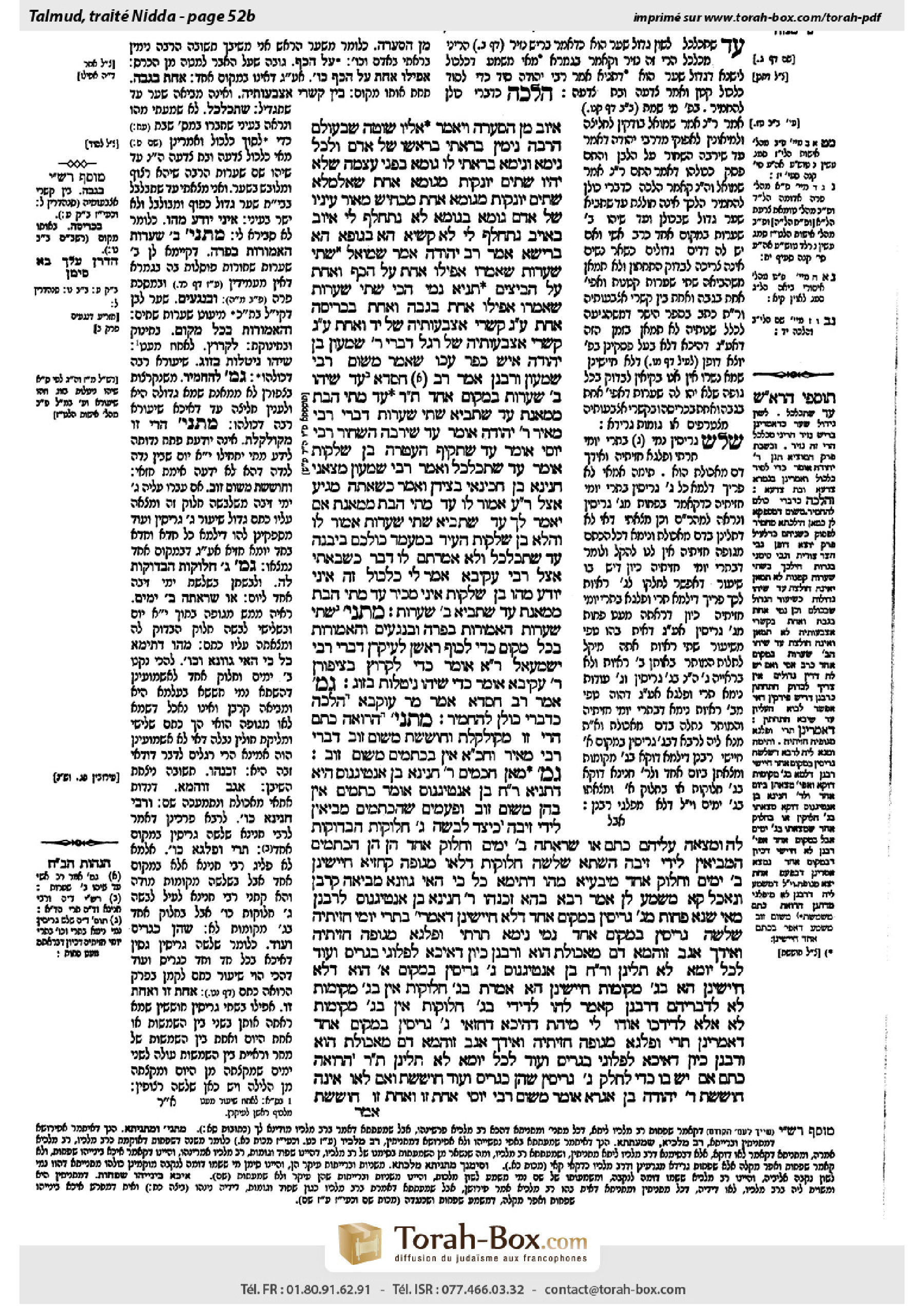
Niddah 52b: Talmud study for Daf Yomi
Daf Yomi is the daily study of one Talmud folio. Explore 37 tractates with scans, Hebrew text, Sefaria English and AI-generated French translations where annotated.
Passage selection and English or AI-generated French translation are available where the scan has annotations. Daf Study is independent of Torah-Box and Sefaria.
Browse Niddah · נידה · All tractatesNiddah 52b text and translations
This page of Niddah includes the Aramaic text, an English translation and an AI-generated French translation, alongside the scan above.
נידה נ״ב ב · Aramaic and Hebrew text
אִיּוֹב מִן הַסְּעָרָה וַיֹּאמַר״ אֵלָיו: שׁוֹטֶה שֶׁבָּעוֹלָם, הַרְבֵּה נִימִין בָּרָאתִי בְּרֹאשׁוֹ שֶׁל אָדָם, וּלְכֹל נִימָא וְנִימָא בָּרָאתִי לוֹ גּוּמָּא בִּפְנֵי עַצְמָהּ שֶׁלֹּא יִהְיוּ שְׁתַּיִם יוֹנְקוֹת מִגּוּמָּא אַחַת, שֶׁאִלְמָלֵא שְׁתַּיִם יוֹנְקוֹת מִגּוּמָּא אַחַת מַכְחִישׁ מְאוֹר עֵינָיו שֶׁל אָדָם. גּוּמָּא בְּגוּמָּא לֹא נִתְחַלֵּף לִי, ״אִיּוֹב״ בְּ״אוֹיֵב״ נִתְחַלֵּף לִי?!
לָא קַשְׁיָא: הָא בְּגוּפָא, הָא בְּרֵישָׁא.
אָמַר רַב יְהוּדָה, אָמַר שְׁמוּאֵל: שְׁתֵּי שְׂעָרוֹת שֶׁאָמְרוּ, אֲפִילּוּ אַחַת עַל הַכַּף וְאַחַת עַל הַבֵּיצִים.
תַּנְיָא נָמֵי הָכִי: שְׁתֵּי שְׂעָרוֹת שֶׁאָמְרוּ, אֲפִילּוּ אַחַת בְּגַבָּהּ וְאַחַת בִּכְרֵיסָהּ, אַחַת עַל גַּבֵּי קִשְׁרֵי אֶצְבְּעוֹתֶיהָ שֶׁל יָד וְאַחַת עַל גַּבֵּי קִשְׁרֵי אֶצְבְּעוֹתֶיהָ שֶׁל רֶגֶל — דִּבְרֵי רַבִּי שִׁמְעוֹן בֶּן יְהוּדָה אִישׁ כְּפַר עַכּוֹ שֶׁאָמַר מִשּׁוּם רַבִּי שִׁמְעוֹן. וְרַבָּנַן? אָמַר רַב חִסְדָּא: עַד שֶׁיְּהוּ שְׁתֵּי שְׂעָרוֹת בְּמָקוֹם אֶחָד.
תָּנוּ רַבָּנַן: עַד מָתַי הַבַּת מְמָאֶנֶת? עַד שֶׁתָּבִיא שְׁתֵּי שְׂעָרוֹת, דִּבְרֵי רַבִּי מֵאִיר. רַבִּי יְהוּדָה אוֹמֵר: עַד שֶׁיִּרְבֶּה הַשָּׁחוֹר. רַבִּי יוֹסֵי אוֹמֵר: עַד שֶׁתַּקִּיף הָעֲטָרָה. בֶּן שְׁלָקוֹת אוֹמֵר: עַד שֶׁתְּכַלְכֵּל.
וְאָמַר רַבִּי שִׁמְעוֹן: מְצָאַנִי חֲנִינָא בֶּן חֲכִינַאי בְּצַיְדָּן, וְאָמַר: כְּשֶׁאַתָּה מַגִּיעַ אֵצֶל רַבִּי עֲקִיבָא, אֱמוֹר לוֹ: עַד מָתַי הַבַּת מְמָאֶנֶת? אִם יֹאמַר לָךְ: עַד שֶׁתָּבִיא שְׁתֵּי שְׂעָרוֹת, אֱמוֹר לוֹ: וַהֲלֹא בֶּן שְׁלָקוֹת הֵעִיד בְּמַעֲמַד כּוּלְּכֶם בְּיַבְנֶה עַד שֶׁתְּכַלְכֵּל, וְלֹא אֲמַרְתֶּם לוֹ דָּבָר!
כְּשֶׁבָּאתִי אֵצֶל רַבִּי עֲקִיבָא, אָמַר לִי: כִּלְכּוּל זֶה — אֵינִי יוֹדֵעַ מַהוּ, בֶּן שְׁלָקוֹת — אֵינִי מַכִּיר, עַד מָתַי הַבַּת מְמָאֶנֶת — עַד שֶׁתָּבִיא שְׁתֵּי שְׂעָרוֹת.
מַתְנִי' שְׁתֵּי שְׂעָרוֹת הָאֲמוּרוֹת בַּפָּרָה, וּבַנְּגָעִים, וְהָאֲמוּרוֹת בְּכׇל מָקוֹם — כְּדֵי לָכוֹף רֹאשָׁן לְעִיקָּרָן, דִּבְרֵי רַבִּי יִשְׁמָעֵאל. רַבִּי אֱלִיעֶזֶר אוֹמֵר: כְּדֵי לִקְרוֹץ בַּצִּיפּוֹרֶן. רַבִּי עֲקִיבָא אוֹמֵר: כְּדֵי שֶׁיְּהוּ נִיטָּלוֹת בְּזוּג.
גְּמָ' אָמַר רַב חִסְדָּא, אָמַר מָר עוּקְבָא: הֲלָכָה כְּדִבְרֵי כּוּלָּן לְהַחֲמִיר.
מַתְנִי' הָרוֹאֶה כֶּתֶם — הֲרֵי זוֹ מְקוּלְקֶלֶת
וְחוֹשֶׁשֶׁת מִשּׁוּם זוֹב, דִּבְרֵי רַבִּי מֵאִיר. וַחֲכָמִים אוֹמְרִים: אֵין בִּכְתָמִים מִשּׁוּם זוֹב.
גְּמָ' מַאן חֲכָמִים? רַבִּי חֲנִינָא בֶּן אַנְטִיגְנוֹס הִיא, דְּתַנְיָא: רַבִּי חֲנִינָא בֶּן אַנְטִיגְנוֹס אוֹמֵר: כְּתָמִים אֵין בָּהֶן מִשּׁוּם זוֹב. וּפְעָמִים שֶׁהַכְּתָמִים מְבִיאִין לִידֵי זִיבָה.
כֵּיצַד? לָבְשָׁה שְׁלֹשָׁה חֲלוּקוֹת הַבְּדוּקוֹת לָהּ, וּמָצְאָה עֲלֵיהֶם כֶּתֶם, אוֹ שֶׁרָאֲתָה שְׁנֵי יָמִים וְחָלוּק אֶחָד — הֵן הֵן הַכְּתָמִים הַמְּבִיאִין לִידֵי זִיבָה.
הַשְׁתָּא שְׁלֹשָׁה חֲלוּקוֹת, דְּלָאו מִגּוּפַהּ קָחָזְיָא — חָיְישִׁינַן, שְׁנֵי יָמִים וְחָלוּק אֶחָד מִיבַּעְיָא?
מַהוּ דְּתֵימָא, כֹּל כִּי הַאי גַוְונָא מְבִיאָה קׇרְבָּן וְנֶאֱכָל? קָא מַשְׁמַע לַן.
אָמַר רָבָא: בְּהָא זַכִּנְהוּ רַבִּי חֲנִינָא בֶּן אַנְטִיגְנוֹס לְרַבָּנַן, מַאי שְׁנָא פָּחוֹת מִשְּׁלֹשָׁה גְּרִיסִין בְּמָקוֹם אֶחָד דְּלָא חָיְישִׁינַן, דְּאָמְרִינַן בִּתְרֵי יוֹמֵי חֲזִיתֵיהּ, שְׁלֹשָׁה גְּרִיסִין בְּמָקוֹם אֶחָד נָמֵי נֵימָא: תַּרְתֵּי וּפַלְגָא מִגּוּפַהּ חֲזֵיתֵיהּ, וְאִידָּךְ אַגַּב זוּהֲמָא דַּם מַאֲכוֹלֶת הוּא.
וְרַבָּנַן, כֵּיוָן דְּאִיכָּא לְפַלּוֹגֵי בִּגְרִיס וָעוֹד לְכֹל יוֹמָא — לָא תָּלֵינַן.
וְרַבִּי חֲנִינָא בֶּן אַנְטִיגְנוֹס, שְׁלֹשָׁה גְּרִיסִין בְּמָקוֹם אֶחָד הוּא דְּלָא חָיְישִׁינַן, הָא בִּשְׁלֹשָׁה מְקוֹמוֹת — חָיְישִׁינַן. הָא אָמְרַתְּ: בִּשְׁלֹשָׁה חֲלוּקוֹת — אִין, בִּשְׁלֹשָׁה מְקוֹמוֹת — לָא!
לְדִבְרֵיהֶם דְּרַבָּנַן קָאָמַר לְהוּ, לְדִידִי — בִּשְׁלֹשָׁה חֲלוּקוֹת — אִין, בִּשְׁלֹשָׁה מְקוֹמוֹת — לָא, אֶלָּא לְדִידְכוּ אוֹדוֹ לִי מִיהַת דְּהֵיכָא דַּחֲזַאי שְׁלֹשָׁה גְּרִיסִין בְּמָקוֹם אֶחָד, דְּאָמְרִינַן: תְּרֵי וּפַלְגָא מִגּוּפַהּ חֲזֵיתֵיהּ, וְאִידָּךְ — אַגַּב זוּהֲמָא דַּם מַאֲכוֹלֶת הוּא!
וְרַבָּנַן, כֵּיוָן דְּאִיכָּא לְפַלּוֹגֵי בִּגְרִיס וָעוֹד לְכֹל יוֹמָא — לָא תָּלֵינַן.
תָּנוּ רַבָּנַן: הָרוֹאֶה כֶּתֶם, אִם יֵשׁ בּוֹ כְּדֵי לְחַלֵּק שְׁלֹשָׁה גְּרִיסִין, שֶׁהֵן כִּגְרִיס וָעוֹד — חוֹשֶׁשֶׁת, וְאִם לָאו — אֵינָהּ חוֹשֶׁשֶׁת.
רַבִּי יְהוּדָה בֶּן אַגְרָא אוֹמֵר מִשּׁוּם רַבִּי יוֹסֵי: אַחַת זוֹ וְאַחַת זוֹ חוֹשֶׁשֶׁת.
Niddah 52b · English translation
Job out of the tempest, and said” (Job 38:1–3) to him: Greatest imbecile in the world! I have created many hairs on a person’s head, and for each and every hair I created its own distinct follicle, so that two hairs should not draw sustenance from one follicle. As, were two hairs to draw sustenance from one follicle, it would weaken a man’s vision. Now if I did not confuse one follicle with another, would I confuse a man named Iyyov with oyev? This indicates that two hairs do not grow from one follicle.
The Gemara answers: It is not difficult; that statement above, that two hairs in one follicle is a valid sign of adulthood, is referring to the hairs in the rest of a person’s body, whereas this statement, that there cannot be two hairs in one follicle, is referring to the hairs on a person’s head.
Rav Yehuda says that Shmuel says: The two hairs that the Sages said are signs of adulthood are valid signs even if they are not adjacent; but rather one hair is on the spoon-shaped area above his organ and one is on the young boy’s testicles.
The Gemara notes that this is also taught in a baraita: The two hairs that the Sages said are signs of adulthood are valid signs even if one hair is on the young girl’s back, below her pubic area, and one on her lower abdomen. The same applies if one hair is on the finger joints of her hand and one hair is on the toe joints of her foot. This is the statement of Rabbi Shimon ben Yehuda, of the village of Akko, who said it in the name of Rabbi Shimon. And what do the Rabbis say about this matter? Rav Ḥisda says: According to the Rabbis, they are not a valid sign of adulthood unless the two hairs are in one place.
§ The mishna teaches that Rabbi Yehuda and the Rabbis disagree with regard to when a young girl can perform refusal. According to the Rabbis, it is until she grows two pubic hairs after she reaches the age of twelve years and one day. According to Rabbi Yehuda she still retains the right to perform refusal at that point, until the majority of the pubic area is filled with hair. In this regard, the Sages taught in a baraita: Until when can a young girl perform refusal? Until she grows two pubic hairs; this is the statement of Rabbi Meir. Rabbi Yehuda says: She can perform refusal until the area covered by the black pubic hairs is greater than the white skin of the genital area. Rabbi Yosei says: Until the nipple is surrounded by hair. Ben Shelakot says: Until the pubic area is filled with hair.
And Rabbi Shimon said: Ḥanina ben Ḥakhinai found me in the city of Tzaidan and said to me: When you reach Rabbi Akiva, say to him: Until when can a young girl perform refusal? If he says to you that she may perform refusal until she grows two pubic hairs, say to him: But didn’t ben Shelakot testify in the presence of all of you in Yavne that she may perform refusal until the pubic area is filled with hair [shetekhalkel], and you did not say anything to him, thereby indicating that you conceded to him?
Rabbi Shimon continued: When I reached Rabbi Akiva, and I said what I had been told to say to him, he said to me: I do not know what this filling with hair [kilkul] is, I don’t know any ben Shelakot, and my opinion with regard to your question, until when can a young girl perform refusal, is that she can perform refusal until she grows two pubic hairs.
MISHNA: The two white or black hairs that are mentioned with regard to disqualification of a red heifer; and the two white hairs mentioned with regard to leprous marks, i.e., that if they grow within a white leprous mark, it is impure; and the two hairs that are mentioned in every place, i.e., with regard to a young boy and girl, are significant only if they are long enough to bend the top of the hairs to reach their roots. This is the statement of Rabbi Yishmael. Rabbi Eliezer says: They must be long enough to grasp them and cut them with a fingernail. Rabbi Akiva says: They must be long enough to be cut with a pair [bezug] of scissors.
GEMARA: Rav Ḥisda says that Mar Ukva says with regard to the various opinions in the mishna on the measure of hairs: The halakha is in accordance with the statements of all of them to be stringent. One should consider it hair only if all of the criteria are met, or consider it to be hair if any one condition is met, depending on which standard yields the more stringent result.
MISHNA: With regard to a woman who sees a red stain on her garment, that woman’s reckoning is distorted. Since she does not know when the blood that caused the stain appeared, she does not know when the seven days of menstrual flow end and when the eleven days of the flow of the zava begin.
And therefore she must be concerned due to the possibility that it might have been caused by the flow of a zava. If she wore the same garment for three days on which she can assume the status of a zava, and subsequently discovered a stain with an area that is the size of at least three split beans, the concern is that on each of those three days a stain with the area of at least one split bean, the minimum area that transmits impurity, was formed. The result is that she is a greater zava and is required to count seven clean days before immersion. This is the statement of Rabbi Meir. And the Rabbis say: No configuration of stains leads to concern due to the flow of a zava.
GEMARA: The Gemara asks: Who are the Rabbis in this mishna? It is Rabbi Ḥanina ben Antigonus, as it is taught in a baraita that Rabbi Ḥanina ben Antigonus says: Stains do not lead to concern due to the flow of a zava, but stains can sometimes lead to ziva.
How so, i.e., how can stains lead to ziva according to Rabbi Ḥanina ben Antigonus? If a woman wore three different robes that had been examined by her for blood stains, and she then found a stain on each of them; or if she saw blood flowing from her body on two consecutive days and on the third day she saw a stain on one of the robes that she wore that day, those are the stains that lead to ziva.
The Gemara raises a difficulty with regard to the above statement: According to the opinion of Rabbi Ḥanina ben Antigonus, now that in a case where she sees stains on three robes we are concerned for ziva, despite the fact that she does not see the blood flowing from her body, is it necessary to state that we are concerned if she experiences bleeding from her body on two days and sees a stain on one of the robes?
The Gemara answers: It is necessary to state that, lest you say that in any case like this, where she experiences bleeding from her body on two days and on the third day she sees a stain on one of the robes, she brings an offering and it is consumed, like one who is definitely a zava. Therefore, Rabbi Ḥanina ben Antigonus teaches us that her status as a zava is uncertain, and consequently she brings a bird for a sin offering that is due to uncertainty, which is not eaten.
Rava said: With this claim Rabbi Ḥanina ben Antigonus bested the other Rabbis, who agree with the opinion of Rabbi Meir in the mishna: What is different about a stain that is less than three split beans in one place, that we are not concerned she might be a zava? The reason is that we say she saw blood on only two days. But in a case where she discovered a stain on her robe with the area of at least three split beans in one place, one can also say: The area of two and a half split beans should be attributed to blood seen from her body, but the other is the blood of a louse that was there due to the dirt associated with her bleeding.
The Gemara asks: And how do the Rabbis respond to this claim? The Gemara answers: They maintain that since it is possible to divide the stain into at least one split bean for each of the three days, we do not attribute the stain to the blood of a louse.
The Gemara raises a difficulty with regard to the statement of Rava: And according to the opinion of Rabbi Ḥanina ben Antigonus, one can infer that it is specifically in the case of a stain with the area of at least three split beans in one place that we are not concerned she might be a zava. It can be inferred from here that if it is in three places, we are concerned. But didn’t you say that if she discovered stains in three robes, yes, we are concerned, which indicates that if it is in three places on a single robe we are not concerned.
The Gemara answers that it was in accordance with the statement of the Rabbis that Rabbi Ḥanina ben Antigonus stated his opinion to them, as follows: According to my opinion, if she discovered stains in three robes, yes we are concerned, whereas if it is in three places we are not concerned. But according to your opinion, at least concede to me that where she saw a stain on her robe with the area of at least three split beans in one place, that we say that the area of two and a half split beans can be attributed to blood seen from her body, and the other is the blood of a louse that was there due to the dirt associated with her bleeding.
The Gemara asks: And how do the Rabbis respond to this claim? The Gemara answers: They maintain that since it is possible to divide the stain into at least one split bean for each of the three days, we do not attribute the stain to the blood of a louse.
§ With regard to a woman who finds a stain on her robe, the Sages taught in a baraita: In the case of a woman who sees a red stain on her garment that she wore for a number of days and she does not know when and where it is from, what is her status? If the area is large enough to be divided into three parts, where the total area is the size of three split beans, each of which is the minimum measure to render her a zava, i.e., an area the size of at least a split bean, she must be concerned that she is a zava, as this stain might be the result of seeing a sufficient measure of blood on each of three occasions. But if the stain is not that size, she does not need to be concerned.
Rabbi Yehuda ben Agra says in the name of Rabbi Yosei: Both in this case, where she saw a stain large enough to be divided into three parts, where the total area is the size of three split beans, and that case, where the stain was not that large, she must be concerned that she might be a zava. This is due to the fact that she possibly saw stains of sufficient size on only two occasions, but one was during twilight, which counts as two days, amounting to a total of three days.
Niddah 52b · Traduction française (IA)
« Le Seigneur répondit à Job du sein de la tempête et dit » (Job 38, 1–3) : « Le plus grand imbécile du monde ! J’ai créé de nombreux cheveux sur la tête de l’homme, et pour chacun d’eux, j’ai créé un follicule distinct, afin que deux cheveux ne tirent pas leur subsistance d’un même follicule. En effet, si deux cheveux tiraient leur subsistance d’un même follicule, cela affaiblirait la vue de l’homme. Or, si je n’ai pas confondu un follicule avec un autre, confondrais-je un homme nommé Iyyov avec oyev ? » Cela indique que deux cheveux ne poussent pas dans un même follicule.
La Guemara répond : Il n’y a pas de difficulté. La déclaration précédente, selon laquelle deux cheveux dans un même follicule constituent un signe valable de la majorité, concerne les poils du reste du corps, tandis que cette déclaration, selon laquelle il ne peut pas y avoir deux cheveux dans un même follicule, concerne les cheveux de la tête.
Rav Yehouda dit au nom de Chmouel : Les deux poils dont les Sages ont dit qu’ils sont des signes de la majorité sont des signes valables même s’ils ne sont pas voisins ; l’un peut se trouver sur la partie en forme de cuiller au-dessus de son organe, et l’autre sur les testicules du jeune garçon.
La Guemara note que cela est également enseigné dans une baraïta : Les deux poils dont les Sages ont dit qu’ils sont des signes de la majorité sont des signes valables même si l’un se trouve dans le dos de la jeune fille, sous sa région pubienne, et l’autre sur le bas de son ventre. Il en va de même si l’un se trouve sur les articulations des doigts de sa main et l’autre sur les articulations des orteils de son pied. Telle est la déclaration de Rabbi Chimon ben Yehouda, du village d’Akko, qui l’a rapportée au nom de Rabbi Chimon. Et que disent les Rabbins à ce sujet ? Rav Ḥisda dit : Selon les Rabbins, ils ne constituent pas un signe valable de la majorité, à moins que les deux poils se trouvent au même endroit.
§ La Michna enseigne que Rabbi Yehouda et les Rabbins sont en désaccord quant au moment jusqu’auquel une jeune fille peut exercer le mi’oun. Selon les Rabbins, elle le peut jusqu’à ce que deux poils pubiens poussent après qu’elle a atteint l’âge de douze ans et un jour. Selon Rabbi Yehouda, elle conserve alors encore le droit d’exercer le mi’oun, jusqu’à ce que la majeure partie de la région pubienne soit couverte de poils. À ce sujet, les Sages ont enseigné dans une baraïta : Jusqu’à quand une jeune fille peut-elle exercer le mi’oun ? Jusqu’à ce que deux poils pubiens poussent ; telle est la déclaration de Rabbi Meïr. Rabbi Yehouda dit : Elle peut exercer le mi’oun jusqu’à ce que la région couverte par les poils pubiens noirs soit plus étendue que la peau blanche de la région génitale. Rabbi Yossi dit : Jusqu’à ce que le mamelon soit entouré de poils. Ben Chelekot dit : Jusqu’à ce que la région pubienne soit couverte de poils.
Et Rabbi Chimon dit : Ḥanina ben Ḥakhinai me trouva dans la ville de Tzaidan et me dit : « Quand tu arriveras auprès de Rabbi Akiva, demande-lui : Jusqu’à quand une jeune fille peut-elle exercer le mi’oun ? S’il te répond qu’elle peut l’exercer jusqu’à ce que deux poils pubiens poussent, dis-lui : Mais ben Chelekot n’a-t-il pas témoigné devant vous tous, à Yavné, qu’elle peut exercer le mi’oun jusqu’à ce que la région pubienne soit couverte de poils [shetekhalkel], et vous ne lui avez rien répondu, indiquant ainsi que vous lui avez donné raison ? »
Rabbi Chimon poursuivit : Lorsque j’arrivai auprès de Rabbi Akiva et lui répétai ce qu’on m’avait dit de lui demander, il me répondit : « Je ne sais pas ce que signifie cette couverture de poils [kilkul], je ne connais aucun ben Chelekot, et mon avis concernant ta question — jusqu’à quand une jeune fille peut-elle exercer le mi’oun ? — est qu’elle peut l’exercer jusqu’à ce que deux poils pubiens poussent. »
MICHNA : Les deux poils blancs ou noirs mentionnés à propos de l’invalidation d’une génisse rousse, les deux poils blancs mentionnés à propos des plaies de lèpre — c’est-à-dire que si des poils poussent à l’intérieur d’une plaie blanche de lèpre, celle-ci est impure — et les deux poils mentionnés en tout lieu, c’est-à-dire à propos d’un jeune garçon et d’une jeune fille, ne sont significatifs que s’ils sont assez longs pour que leur extrémité puisse être courbée jusqu’à leur racine. Telle est la déclaration de Rabbi Yichmaël. Rabbi Eliezer dit : Ils doivent être assez longs pour qu’on puisse les saisir et les couper avec un ongle. Rabbi Akiva dit : Ils doivent être assez longs pour être coupés avec une paire [bezug] de ciseaux.
GUEMARA : Rav Ḥisda dit au nom de Mar Ukva, au sujet des différentes opinions de la Michna concernant la longueur des poils : La halakha suit chacune de ces opinions lorsqu’elle est la plus rigoureuse. Il faut considérer qu’il s’agit de poils uniquement si tous les critères sont remplis, ou considérer qu’il s’agit de poils dès qu’une seule condition est remplie, selon le critère qui entraîne le résultat le plus rigoureux.
MICHNA : À propos d’une femme qui voit une tache rouge sur son vêtement, le décompte de cette femme est faussé. Comme elle ignore quand le sang à l’origine de la tache est apparu, elle ne sait pas quand prennent fin les sept jours de l’écoulement menstruel ni quand commencent les onze jours de l’écoulement de la zava.
Elle doit donc tenir compte de la possibilité que la tache ait été causée par un écoulement de zava. Si elle a porté le même vêtement pendant trois jours au cours desquels elle pouvait acquérir le statut de zava, puis qu’elle a découvert une tache d’une superficie d’au moins trois demi-fèves, on craint qu’une tache d’au moins une demi-fève — la superficie minimale qui transmet l’impureté — se soit formée chacun de ces trois jours. Elle est alors une grande zava et doit compter sept jours purs avant l’immersion. Telle est la déclaration de Rabbi Meïr. Les Rabbins disent : Quelle que soit la configuration des taches, il n’y a pas lieu de craindre un écoulement de zava.
GUEMARA : La Guemara demande : Qui sont les Rabbins de cette Michna ? Il s’agit de Rabbi Ḥanina ben Antigonus, comme l’enseigne une baraïta où Rabbi Ḥanina ben Antigonus dit : Les taches ne font pas craindre un écoulement de zava, mais elles peuvent parfois entraîner le statut de ziva.
Comment cela, c’est-à-dire comment des taches peuvent-elles entraîner le statut de ziva selon Rabbi Ḥanina ben Antigonus ? Si une femme a porté trois robes différentes qu’elle avait vérifiées pour s’assurer qu’elles ne portaient pas de taches de sang, puis qu’elle a trouvé une tache sur chacune d’elles ; ou si elle a vu du sang s’écouler de son corps pendant deux jours consécutifs et que, le troisième jour, elle a vu une tache sur l’une des robes qu’elle portait ce jour-là : voilà les taches qui entraînent le statut de ziva.
La Guemara soulève une difficulté au sujet de la déclaration précédente : Selon l’opinion de Rabbi Ḥanina ben Antigonus, dès lors que, dans le cas où elle voit des taches sur trois robes, on craint qu’elle soit zava, bien qu’elle ne voie pas le sang s’écouler de son corps, est-il nécessaire de préciser que l’on craint qu’elle le soit si elle a un saignement provenant de son corps pendant deux jours et voit une tache sur l’une des robes ?
La Guemara répond : Il était nécessaire de le préciser, de peur que tu dises que, dans un cas comme celui-ci, où elle a un saignement provenant de son corps pendant deux jours et voit une tache sur l’une des robes le troisième jour, elle apporte un sacrifice qui est consommé, comme pour une femme qui est certainement zava. Rabbi Ḥanina ben Antigonus nous enseigne donc que son statut de zava est incertain et que, par conséquent, elle apporte un oiseau comme sacrifice expiatoire en cas de doute, lequel n’est pas consommé.
Rava dit : Par cet argument, Rabbi Ḥanina ben Antigonus a eu raison des autres Rabbins, qui sont d’accord avec l’opinion de Rabbi Meïr dans la Michna : Pourquoi une tache d’une superficie inférieure à trois demi-fèves au même endroit ne fait-elle pas craindre qu’elle soit zava ? Parce que nous disons qu’elle n’a vu du sang que pendant deux jours. Mais, dans le cas où elle a découvert sur sa robe une tache d’une superficie d’au moins trois demi-fèves au même endroit, on peut également dire que l’on attribue une superficie de deux demi-fèves et demie au sang qu’elle a vu s’écouler de son corps, et le reste au sang d’un pou, présent en raison de la saleté associée à son saignement.
La Guemara demande : Et que répondent les Rabbins à cet argument ? La Guemara répond : Ils considèrent que, puisqu’il est possible de diviser la tache en trois parties d’au moins une demi-fève chacune, une pour chacun des trois jours, nous n’attribuons pas la tache au sang d’un pou.
La Guemara soulève une difficulté au sujet de la déclaration de Rava : Selon l’opinion de Rabbi Ḥanina ben Antigonus, on peut déduire que c’est précisément dans le cas d’une tache d’une superficie d’au moins trois demi-fèves au même endroit que l’on ne craint pas qu’elle soit zava. On peut en déduire que si les taches se trouvent en trois endroits, on le craint. Mais n’as-tu pas dit que si elle a découvert des taches sur trois robes, oui, on le craint ? Cela indique que si les taches se trouvent en trois endroits sur une seule robe, on ne le craint pas.
La Guemara répond que Rabbi Ḥanina ben Antigonus a exposé son opinion aux Rabbins conformément à leur déclaration, comme suit : « Selon mon opinion, si elle a découvert des taches sur trois robes, oui, on le craint, tandis que si elles se trouvent en trois endroits, on ne le craint pas. Mais, selon votre opinion, reconnaissez au moins que, lorsqu’elle a vu sur sa robe une tache d’une superficie d’au moins trois demi-fèves au même endroit, nous disons que l’on peut attribuer une superficie de deux demi-fèves et demie au sang qu’elle a vu s’écouler de son corps, et le reste au sang d’un pou, présent en raison de la saleté associée à son saignement. »
La Guemara demande : Et que répondent les Rabbins à cet argument ? La Guemara répond : Ils considèrent que, puisqu’il est possible de diviser la tache en trois parties d’au moins une demi-fève chacune, une pour chacun des trois jours, nous n’attribuons pas la tache au sang d’un pou.
§ À propos d’une femme qui trouve une tache sur sa robe, les Sages ont enseigné dans une baraïta : Dans le cas d’une femme qui voit une tache rouge sur le vêtement qu’elle a porté pendant plusieurs jours et qui ignore quand et d’où elle provient, quel est son statut ? Si la tache est assez grande pour être divisée en trois parties, sa superficie totale étant celle de trois demi-fèves, chacune correspondant à la mesure minimale qui lui confère le statut de zava, c’est-à-dire une superficie d’au moins une demi-fève, elle doit craindre d’être zava, car cette tache pourrait résulter de la découverte d’une quantité suffisante de sang à chacune de trois occasions. Mais si la tache n’atteint pas cette superficie, elle n’a pas à le craindre.
Rabbi Yehouda ben Agra dit au nom de Rabbi Yossi : Dans ce cas, où elle a vu une tache assez grande pour être divisée en trois parties, sa superficie totale étant celle de trois demi-fèves, comme dans le cas où la tache n’était pas aussi grande, elle doit craindre d’être zava. En effet, elle a peut-être vu des taches d’une superficie suffisante à seulement deux occasions, mais l’une d’elles s’est produite au crépuscule, lequel compte comme deux jours, ce qui fait trois jours au total.
Traduction française générée par IA à partir de l’édition anglaise de Sefaria. Vérifie toujours un passage avec le texte source.
Text from Sefaria: William Davidson Edition - Vocalized Aramaic (CC BY NC); William Davidson Edition - English (CC BY NC).